Quick Answer
Spring tick season in Ontario starts as soon as temperatures reach 4°C — typically late March to early April in the GTA — and the ideal window for your first professional tick treatment is late May, timed to nymph emergence.
- Blacklegged ticks become active on any day at or above 4°C, often by late March.
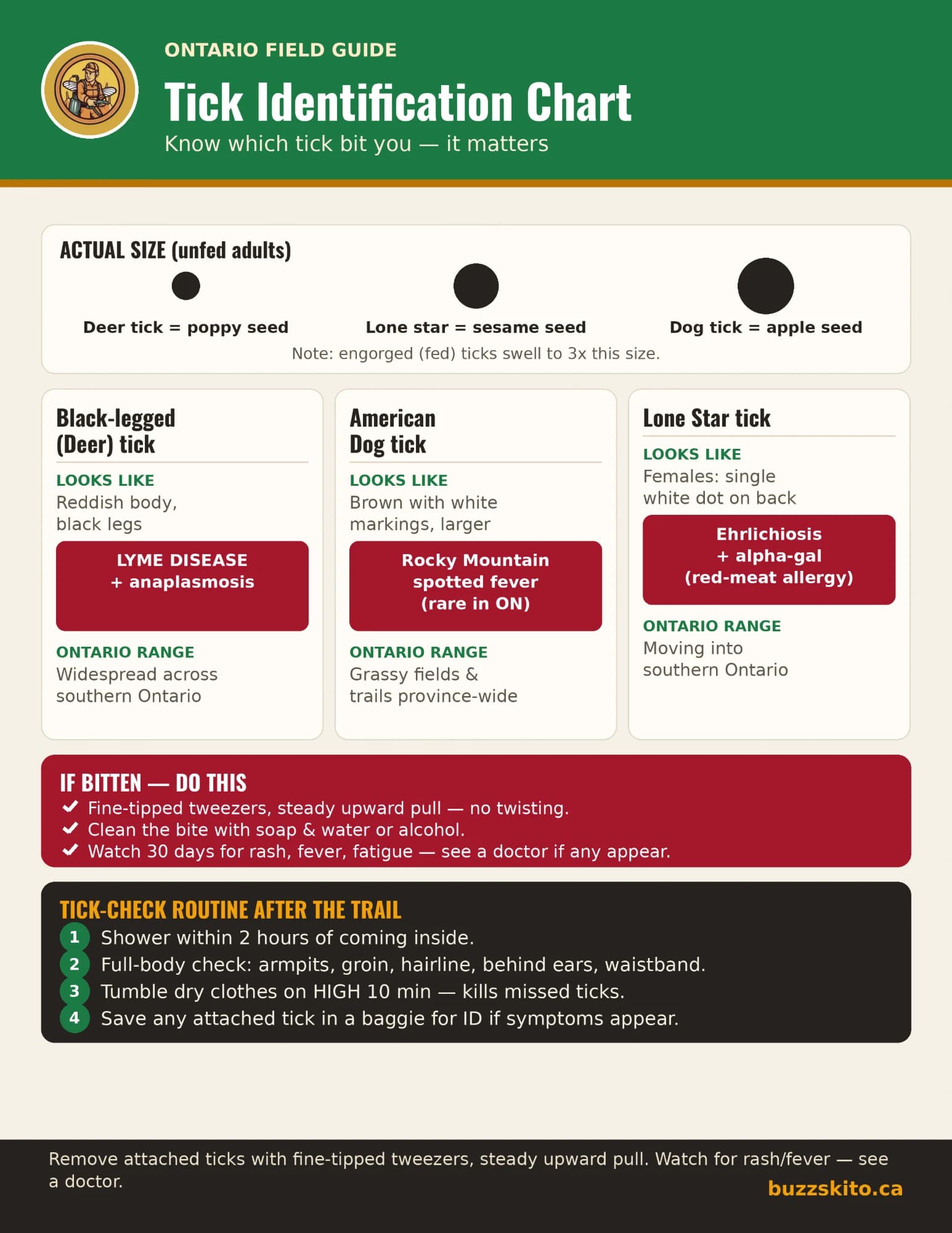
- Nymph-stage ticks are poppy-seed sized (about 1–2 mm) and drive most Ontario Lyme cases.
- May through July is the highest-risk period for tick-borne disease transmission.
- A blacklegged tick generally needs 24–36 hours attached to transmit Lyme disease.
- Schedule the first barrier spray in late May, then renew it roughly monthly — five treatments, May through September.
- Professional tick barrier spray leaves a residual on the treated edges that is renewed roughly monthly.
— BuzzSkito, GTA mosquito & tick control · 150+ five-star Google reviews
Spring tick season in Ontario starts earlier than most homeowners expect — and the timing of your first treatment can make or break your season-long treatment plan. Part of our Ultimate Tick Control Guide for Ontario Homeowners.
Spring Tick Emergence: Earlier Than You Think
Unlike mosquitoes, which require warm temperatures to become active, blacklegged ticks (Ixodes scapularis) have a remarkably low activity threshold. They emerge from dormancy and begin questing (actively seeking a host) on any day that temperatures reach 4°C or above. In the GTA, this means tick activity can begin as early as late March — well before most homeowners are thinking about pest control.
This early emergence is a key reason blacklegged ticks are so effective as disease vectors. While other insects remain dormant, blacklegged ticks are already active and feeding, giving them a head start on the season.
Understanding the Spring Tick Timeline in Ontario
Spring tick activity in Ontario unfolds in two distinct phases, each with different risk implications:
Phase 1: Adult Tick Emergence (Late March — May)
Adult blacklegged ticks that survived the winter under leaf litter and soil emerge as soon as temperatures allow. These are the full-sized ticks (sesame-seed to apple-seed sized) that most people recognize. Adult ticks are actively questing in April and May, seeking deer, dogs, and human hosts along trail edges, garden borders, and woodlot margins.
While adult ticks can transmit Lyme disease, they are relatively large and easier to detect during tick checks. The transmission risk from adult ticks, while real, is somewhat mitigated by their visibility.
Phase 2: Nymph Emergence (Late May — July)
The critical shift happens in late May when nymph-stage blacklegged ticks emerge. Nymphs are the most dangerous life stage for human Lyme disease transmission for several reasons:
- Tiny size: Nymphs are the size of a poppy seed — approximately 1-2 mm — making them extremely difficult to detect on the body
- Same disease risk: Nymphs carry the same pathogens as adult ticks, including Borrelia burgdorferi (Lyme disease), Anaplasmosis, and Babesiosis
- Undetected feeding: Because they are so small and inject a numbing agent, nymphs often feed undetected for the full 24-36 hours needed to transmit Lyme disease
- Peak outdoor season overlap: Nymph activity peaks exactly when people spend the most time outdoors — late May through July
This is why the nymph emergence window (late May through July) is responsible for the majority of human Lyme disease cases in Ontario.
In 2026 that window arrived early enough to make the news across the province. For what pushed it forward and the five steps worth taking in response, see the 2026 Ontario tick surge and 5-step safety plan.
When to Schedule Your First Tick Treatment
The optimal timing for your first professional tick treatment depends on your goals:
Late May: The Sweet Spot
For most GTA homeowners, late May is the ideal time for the first professional tick barrier spray. This timing achieves two critical objectives simultaneously:
- Targets remaining adult ticks from the spring emergence before they can lay eggs
- Targets newly emerged nymphs before they become established in your yard and before peak human exposure begins
A late May treatment opens the critical June-July nymph activity window — the highest-risk period for Lyme disease transmission — with a fresh barrier in place. What it cannot do on its own is hold that window closed until the season ends.
Then Monthly: Five Treatments, May Through September
One spray is not a season. The residual on the treated edges is measured in weeks, not months, so the barrier has to be renewed roughly every four weeks to stay continuous — five applications in total, spread across May through September.
Two things keep happening after that first visit, and both argue for the monthly cadence:
- Nymphs stay active well past the first treatment. Blacklegged nymphs peak from May through July, and they drive most Lyme transmission because they are poppy-seed sized and routinely missed during tick checks. A schedule with a long gap in it leaves that stretch open — precisely the wrong months of the year to be uncovered.
- Wildlife keeps restocking your yard. Deer, mice, and birds move continuously between adjacent woodland and your property line, carrying new ticks in behind the treated barrier. The perimeter has to be re-established, not applied once and forgotten.
The later applications also carry treatment into the fall. Adult blacklegged ticks re-emerge and remain active through November (or later in mild years), so the September treatment goes down while that resurgence is beginning rather than after it.
Properties With High Tick Pressure
Homeowners whose properties border conservation areas, ravines, woodlots, or the Niagara Escarpment have the least margin for a lapse in coverage — the wildlife corridor runs right up to the lawn edge and pushes fresh ticks across it all summer. On those lots we start the season in early May rather than late, and run the full five-treatment schedule through September so no uncovered stretch opens up between applications.
See: BuzzSkito tick control services | Get a free quote
What You Can Do Right Now (Early Spring)
Before your professional treatment appointment, early spring is the perfect time for habitat modification that amplifies the effectiveness of barrier spray:
Remove Leaf Litter
Leaf litter is the single most important overwintering habitat for ticks. Clearing leaves from your yard edges, garden beds, and fence lines removes the protective layer ticks sheltered under all winter. Do this as early in spring as possible — before emerging ticks disperse into your yard.
Spring Yard Cleanup
- Mow your lawn short as soon as growth begins — ticks avoid short, dry, sun-exposed grass
- Trim low branches and shrubs to allow sunlight to reach the ground surface
- Clear brush piles, dead vegetation, and stacked debris from fence lines and garden borders
- Move firewood stacks to dry, sunny locations well away from the house and play areas
- Create or refresh a 1-metre gravel or wood chip barrier between your lawn edge and any wooded border
Address Wildlife Attractants
- Secure garbage bins to discourage raccoons and skunks (which carry ticks into your yard)
- Remove bird feeders from near the house or install squirrel-proof feeders (rodents attracted to spilled seed are Lyme disease reservoirs)
- Block access points under decks and sheds where groundhogs and chipmunks may nest
How Professional Tick Barrier Spray Works
Professional tick barrier spray is applied to the zones where ticks are most concentrated — the transition between lawn and wooded or naturalized areas, garden borders, fence lines, shaded vegetation, stone walls, and wood pile surrounds. The product carries a Canadian PCP registration number, is applied according to label directions, and leaves a residual on the treated surfaces that is renewed roughly monthly.
Key facts about professional tick treatment:
- Places a residual acaricide with a Canadian PCP registration number on the leaf litter and shaded edges where ticks quest
- Stay off treated areas until the spray has dried, as the product label directs
- Aimed at the ticks questing in the treated zones
- Applied under our Ontario Pesticide Operator Licence L-240-2436835197
- Kept off flowering plants, following the label's pollinator directions
Spring Tick Season by GTA Location
Tick emergence timing varies slightly across the GTA based on local conditions:
- Hamilton / Escarpment properties: Among the earliest emergence in the GTA — sheltered escarpment microclimates reach 4°C consistently by mid-March. See: Hamilton tick control
- Mississauga / Oakville: Typical GTA timing — late March to early April adult emergence. See: Mississauga tick control
- Toronto ravine-adjacent: Ravine corridors trap warmth, producing early emergence. See: Toronto tick control
- York Region / Oak Ridges Moraine: Slightly later emergence due to higher elevation and colder microclimates. See: Richmond Hill & Markham tick guide
- Caledon / Halton Hills: Rural properties with extensive wood borders see the highest spring tick volumes. See: Caledon & Halton Hills tick prevention
Burlington is worth calling out on its own. Halton Region surveillance has recorded active adult ticks on the Mountainside and Mt. Nemo trails by the second week of March, because the lake buffer and the south-facing escarpment slope warm ahead of the rest of the region. Our Burlington tick season guide walks through that local calendar month by month.
Mississauga gets the same treatment in our month-by-month Mississauga tick season guide, which maps the spring emergence window against the Credit River and Rattray Marsh corridors where the city’s tick pressure actually sits.
So does Oakville, where the creek valleys rather than the escarpment set the calendar: when ticks are active in Oakville follows the season along Sixteen Mile Creek, Bronte Creek and the Joshua Creek corridor.
The Cost of Waiting Too Long
Homeowners who wait until they find a tick on themselves or a family member before booking treatment are already behind. By the time you encounter a tick in your yard, the local population is established and actively feeding. Every week of delay during the nymph emergence window (late May through July) is a week of the highest-risk period without a treatment in place.
Early scheduling also ensures you secure your preferred treatment date — professional tick control services in the GTA book up quickly in May as demand surges with warmer weather.
See: Pricing | Contact BuzzSkito
Frequently Asked Questions
When does spring tick season start in Ontario?
Spring tick season in Ontario begins as soon as temperatures consistently reach 4°C — which in the GTA typically means late March to early April. Blacklegged ticks (the species that carries Lyme disease) are unlike most insects in that they do not require warm weather to become active. Adult blacklegged ticks that were dormant under leaf litter during the coldest winter months emerge on any day above 4°C, making them one of the earliest arachnids to become active in spring.
When should I schedule my first tick treatment in Ontario?
The optimal timing for your first professional tick treatment in the GTA is late May. This coincides with the emergence of nymph-stage blacklegged ticks — the tiny, poppy-seed-sized life stage responsible for the majority of human Lyme disease cases. Treating in late May targets nymphs before they become established in your yard while also controlling any remaining adult ticks from the spring emergence. Because the residual from one application lasts weeks rather than months, the treatment is then repeated on a roughly monthly cadence — five applications across the May-to-September season — so the barrier stays live through the June-July nymph peak and into the fall adult resurgence instead of lapsing in the middle of the highest-risk window.
Are ticks active in April in Ontario?
Yes. Adult blacklegged ticks are active in April in Ontario — any day that reaches 4°C or above can bring tick activity. April is part of the spring adult tick emergence window. While the majority of Lyme disease transmission occurs in May-July (driven by nymphs), adult ticks active in April can also transmit disease. If you are doing yard work, hiking, or allowing children or pets in grassy or wooded areas in April, tick checks are recommended.
What is the most dangerous time of year for ticks in Ontario?
May through July is the most dangerous period for tick-borne disease in Ontario. This is when nymph-stage blacklegged ticks are active — they are extremely small (the size of a poppy seed), difficult to detect on the body, and carry the same Lyme disease risk as adult ticks. Because nymphs are so hard to see, they often feed undetected for the 24-36 hours needed to transmit Borrelia burgdorferi. The fall adult tick peak (September-November) is also a significant risk period.
Can I do tick prevention in early spring before my professional treatment?
Absolutely. Early spring is an excellent time to do habitat modification work that makes your professional treatment more effective: remove all leaf litter from your yard (this is the most critical tick overwintering habitat), trim low branches and shrubs, mow your lawn short, and create gravel or wood chip barriers at the border between your lawn and any wooded area. These steps reduce the tick habitat on your property so that when your barrier spray is applied in late May, it has maximum impact.