BuzzSkito Mosquito & Tick Control Specialists · Published July 15, 2026
As an Amazon Associate I earn from qualifying purchases. BuzzSkito only points to products we would genuinely use or recommend, at no extra cost to you.
As an Amazon Associate I earn from qualifying purchases. Price shown on Amazon.ca, at no extra cost to you.
🏆 Our Top Pick — For the Tick You Find
A tick that has spent two years in your leaf litter can spend the better part of a week attached to you or your dog, and the sooner it comes off whole the better. Blunt drugstore tweezers squeeze the body and leave mouthparts behind; a fine-tipped remover closes at the skin line and lifts the tick straight out. Own one before the evening you need it.
Pros
- Closes flush at the skin line, whole-tick removal
- Works on poppy-seed nymphs and engorged adults
- Cheap enough to keep one by the door and one in the car
Cons
- Easy to misplace without a keyring loop
- Still needs a slow, steady straight pull
How Long Do Ticks Live?
Ticks live 2 to 3 years. A blacklegged (deer) tick passes through three feeding stages — larva, nymph, and adult — and takes exactly one blood meal at each. The U.S. Centers for Disease Control and Prevention (CDC) describes this as a roughly two-year cycle. A tick that misses a host simply waits months for the next one.
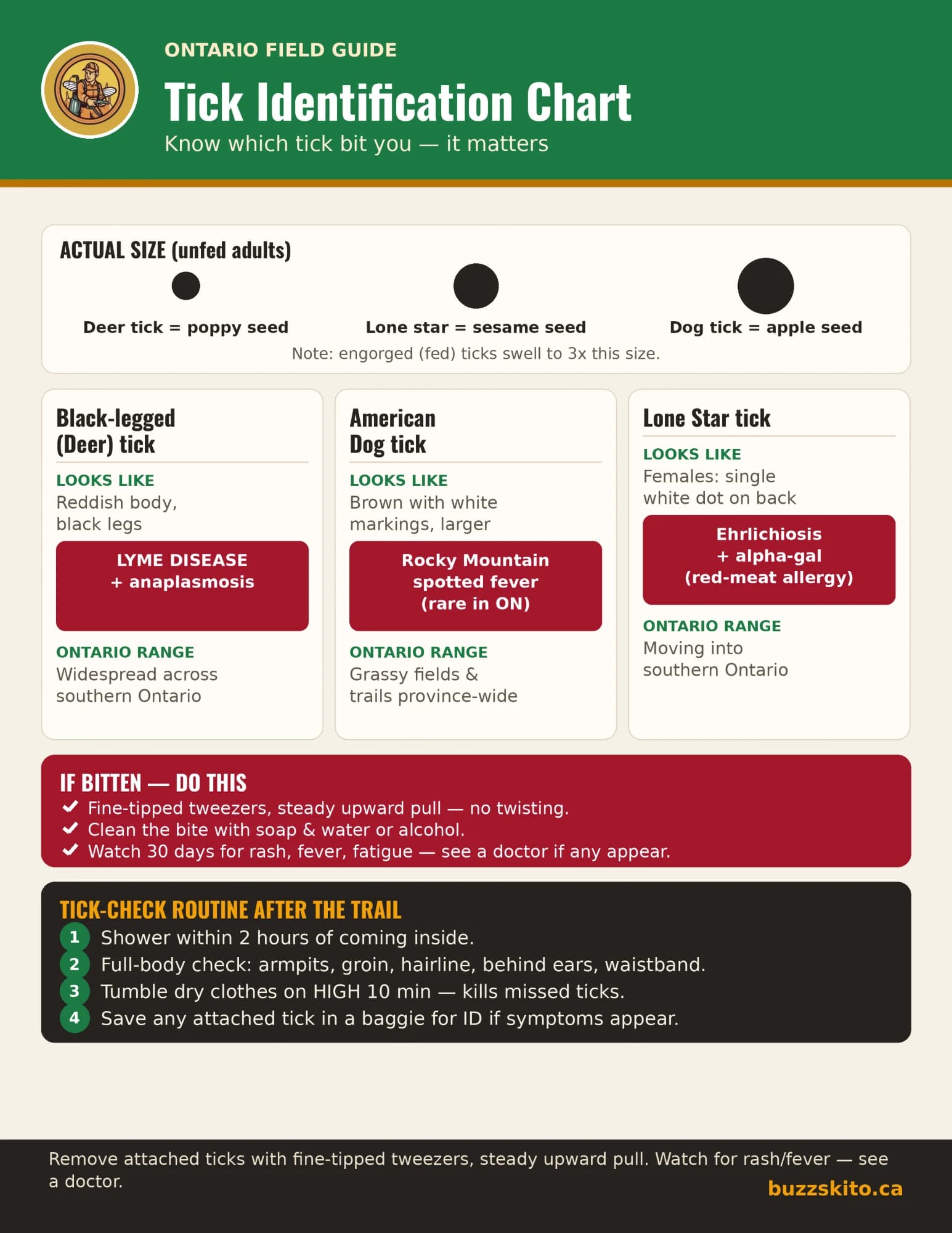
Most ticks live 2 to 3 years. That lifespan is stretched across three feeding stages — larva, nymph, and adult — with a molt in between each one. In Ontario, the species that matters most for human health is the blacklegged (deer) tick (Ixodes scapularis), which can carry the bacterium that causes Lyme disease; the American dog tick is also common in grassy areas but is a lower Lyme risk.
Here is the key to understanding tick lifespan: a tick takes only one blood meal per stage. A larva feeds once and molts into a nymph. The nymph feeds once and molts into an adult. The adult female feeds once, mates, lays a single large batch of eggs, and then dies. Because a tick has to find a host to advance to the next stage, and because it can wait a very long time for that host, the calendar of a tick’s life is measured in years rather than days. A larva that hatches one summer may not become an egg-laying adult until roughly two years later.
This slow, patient life cycle is exactly why ticks persist. They do not need to feed often, they do not need to breed quickly, and a single surviving female can seed the next generation with thousands of eggs.
How Long Do American Dog Ticks Live Compared With Blacklegged Ticks?
Both live for years, but on different clocks. A blacklegged (deer) tick usually completes its cycle in about two years in shaded, humid woodland edges, while an American dog tick more often takes two to three years and prefers open, grassy ground. The CDC describes both as multi-year life cycles built on one blood meal per stage.
The practical difference is disease, not longevity. The blacklegged tick is the species that transmits the bacterium causing Lyme disease; the American dog tick does not, though the CDC associates it with other illnesses such as Rocky Mountain spotted fever and tularemia. Unfed adults of either species can wait many months for a host, which is why both species keep turning up season after season in the same shaded property edges.
How Long Can a Tick Live Without a Host?
An unfed blacklegged tick can live several months to well over a year without a blood meal, as long as the air around it stays cool and humid. Hunger is not what kills a host-less tick — dehydration is. In dry indoor air, that same tick survives only days to about two weeks.
This is where ticks surprise people. An unfed blacklegged tick can survive several months to well over a year without a blood meal, provided it stays cool and humid. Adults that fail to find a host in the fall can go dormant and simply wait for the next season. Ticks are built for patience, not for frequent feeding.
What actually limits a host-less tick is not starvation — it is drying out. Ticks absorb and lose water through their bodies, and they depend on high humidity to stay hydrated. In the moist microclimate of leaf litter or long grass, a tick can outlast an entire season between meals. Move that same tick into dry air and its clock speeds up dramatically. This single fact — that humidity, not food, governs tick survival — is the reason ticks thrive in shaded, damp yard edges and struggle almost everywhere else.
Can Ticks Live in Your House?
No — the common ticks people find here cannot live in a house for long. Blacklegged and American dog ticks need relative humidity of roughly 80% or higher, while heated or air-conditioned indoor air usually sits nearer 30 to 50%. A tick carried inside dies within days to about two weeks and cannot breed indoors.
For Ontario’s common ticks, the answer is essentially no. Blacklegged ticks and American dog ticks need relative humidity of roughly 80% or higher to survive for long. Heated, air-conditioned indoor air typically sits far below that — often 30–50% — which is a desert to a tick. A tick carried inside on a pant leg or a dog will usually dehydrate and die within a few days to a couple of weeks, and it cannot breed or establish a population indoors.
That is genuinely reassuring, and it is the opposite of how fleas and bed bugs behave. Fleas and bed bugs are adapted to complete their life cycles inside your home; blacklegged and dog ticks are not. If you keep finding ticks indoors, they are almost always being carried in fresh from the yard on people or pets — not reproducing in the carpet. The fix is therefore outdoors: reduce tick habitat around the property and check pets before they come in. In the GTA that almost always means one narrow strip — the shaded, humid margin where a lawn meets a ravine, woodlot, or fence line. It is the zone North York tick spray visits target along the Don valley ravines, and the same one tick control in Burlington works through the escarpment woodlots.
There is one worldwide exception worth naming so you can rule it out: the brown dog tick (Rhipicephalus sanguineus) tolerates dry indoor air and can complete its entire life cycle inside homes and kennels, occasionally causing true indoor infestations. It is uncommon in Canada’s outdoor climate, and most Ontario households will never encounter it, but if a home has a genuine repeat tick problem tied to a dog, it is worth mentioning to a veterinarian or licensed pest professional.
As an Amazon Associate I earn from qualifying purchases. BuzzSkito only points to products we would genuinely use or recommend, at no extra cost to you.
What to do right now, if a tick is attached
1. Take it off now, and take it off properly. Free, and it is the step that matters most: grip as close to the skin as you can and pull straight out with steady upward pressure. No twisting, no petroleum jelly, no match, no nail polish — every one of those wastes the minutes that count and can make the tick harder to get out whole. Then wash the bite and your hands.
2. Own a fine-tipped remover before the evening you need one. Drugstore tweezers have a blunt tip that cannot close at the head, so they grab the tick’s body instead and leave the mouthparts behind — and on a dog that is twisting away you get one attempt, not three. A pointed tick tool closes flush at the skin line.
Check price on Amazon.ca →3. Keep the tick and date it. Drop the removed tick into a small screw-top vial and write the date and where you were on the lid in permanent marker. Because attachment time is the number a clinician asks about, a dated specimen is worth far more than a memory three weeks later.
Check price on Amazon.ca →
Watch the bite site and how you feel over the following days and weeks, and see a healthcare provider if a rash, fever, or flu-like symptoms appear — mentioning the bite and its date. General information, not medical advice.
How Long Can a Tick Live in a House?
Ticks can live in a house for only a few days to about two weeks, and that holds for both species you are likely to carry in from an Ontario yard, the blacklegged tick and the American dog tick. Neither species can breed in indoor air that sits near 30 to 50% humidity, so the ticks already inside cannot multiply; the one species that can live its whole life indoors is the brown dog tick, and it is uncommon in Canada. They arrive on pets, clothing and outdoor gear — the Public Health Agency of Canada advises inspecting your pets before you come in because they can bring ticks into your home, checking yourself, your clothing and gear such as backpacks, and putting dry clothes in a dryer on high heat for at least 10 minutes. The question that matters more than the calendar is whether a tick attached to someone and for how long, since the risk of Lyme disease transmission rises the longer a tick stays attached; our guide to whether ticks are dangerous in Ontario covers which species carry which illnesses.
A tick lives only a few days to about two weeks inside a house. Indoor air is too dry for it to rehydrate, so it steadily dehydrates and dies without laying eggs or spreading from room to room. The one exception is the brown dog tick, which tolerates dry indoor air but is uncommon in Canada.
When a tick does end up indoors, it usually survives only a few days to about two weeks. The countdown is driven entirely by moisture loss. On a person’s clothing, in a laundry pile, or crawling across a carpet, the tick cannot rehydrate the way it would in leaf litter, so it steadily dries out and dies. It will not lay eggs indoors and it will not spread from room to room.
To close the loop and avoid a tick hitchhiking back onto someone, the most reliable step is dry heat: tumble-dry clothing on high for at least 10 minutes. Ticks resist water surprisingly well — a normal cold wash cycle will not reliably kill them — but they die quickly in a hot dryer. Vacuuming and emptying the canister handles any tick that dropped onto floors or upholstery. (For more on why ticks survive water but not dry heat, see our companion guide on whether ticks can fly, jump, or swim.)
The order matters as much as the heat does. Dry clothing lets the hot air reach the tick straight away, whereas damp fabric holds the surface temperature down and stretches the cycle out considerably — which is the whole case for why the dryer kills ticks and the wash often does not.
How Long Do Ticks Live Indoors vs Outdoors?
A blacklegged tick lives 2 to 3 years outdoors but only a few days to about two weeks indoors. The difference is humidity, not food. Outdoor leaf litter holds the roughly 80% relative humidity a tick needs to stay hydrated; heated indoor air sits nearer 30 to 50% and dries the tick out.
That single contrast explains almost everything homeowners find confusing about ticks. A pest that can wait more than a year in a ravine slope for a passing deer will not last a fortnight on a living-room rug. It also sets the control point: the humid margin of the property, not the inside of the house.
How Long Can Ticks Live on Clothes or in Carpet?
A tick on clothing or carpet usually survives a few days at most, because indoor air is too dry for it to rehydrate. The CDC recommends tumble-drying dry clothing on high heat for 10 minutes to kill ticks, and notes that damp clothing needs longer. Ticks resist a normal wash cycle far better than dry heat.
Order of operations matters here. Dry clothes first, then wash if the clothes need it — the CDC recommends hot water when a wash is required. Vacuuming carpets and upholstery and emptying the canister afterwards handles any tick that dropped off in the house. No tick will breed in fabric or carpet, so this is cleanup, not an infestation.
Can Ticks Infest a House Like Fleas or Bed Bugs?
No. Fleas and bed bugs complete their entire life cycle indoors, while blacklegged and American dog ticks cannot — indoor air is too dry for them to molt or lay eggs. Repeat indoor tick sightings almost always mean ticks are being carried in fresh from the yard, not breeding in the carpet.
If ticks keep appearing inside, the useful question is which door they come through. Usually it is a dog after a walk, or trouser cuffs after ten minutes of yard work along a shaded fence line. Treating the yard edge and checking pets before they come in solves the indoor problem, because the indoor problem is really an outdoor one.
Do Ticks Die in Winter? Does a Frost Kill Them?
Ticks do not die off in winter, and a frost does not kill them. Blacklegged ticks shelter in leaf litter beneath snow and go dormant instead. Public Health Ontario notes they can become active again whenever daytime temperatures rise above roughly 4°C (about 39°F), which is why ticks turn up during a January thaw.
No — a frost does not kill them all, and this is one of the most damaging tick myths in Ontario. Many people assume the first hard freeze wipes the slate clean, then are caught off guard when ticks reappear the moment the snow melts. Blacklegged ticks are cold-adapted. They do not die at the first frost; they shelter and wait.
In fact, adult blacklegged ticks can be active on any mild day. Public Health Ontario notes that blacklegged ticks can seek a host whenever daytime temperatures rise above roughly 4°C. That means a sunny stretch in November, a January thaw, or an early-March warm-up can all put questing adult ticks back in the grass — long before most people are thinking about tick season at all. This is a major reason the season is longer than most homeowners expect; our Ontario tick-season guide breaks down the month-by-month activity windows.
How Do Ticks Survive the Winter?
Ticks survive winter outdoors, not indoors. Unfed blacklegged nymphs and adults burrow into leaf litter, brush piles, and the loose duff at the base of shrubs, where a blanket of snow insulates the ground close to freezing and holds moisture in. The ticks drop into a dormant, low-metabolism state and wait for spring.
Blacklegged ticks overwinter outdoors, mostly as unfed nymphs or adults, by burrowing into the leaf litter and the loose organic layer at the base of shrubs, brush piles, and woodland edges. Two things keep them alive there:
- Snow is an insulator, not a killer. A blanket of snow traps ground warmth and keeps the leaf-litter layer hovering near freezing, rather than plunging to the frigid air temperature above it. Counter-intuitively, a snowy winter can protect more ticks than a cold, bare one.
- They slow down and hold moisture. Ticks drop into a dormant, low-metabolism state and rely on the humidity of the leaf litter to avoid drying out until spring.
Ticks do die during hard cold snaps — especially deep, sustained cold with little or no snow cover to insulate the ground. But enough survive every year that the population carries over. That carryover is exactly why tick-habitat reduction matters most in fall and early spring: clearing leaf litter and brush removes the sheltered overwintering sites before the next generation gets going. Our guide to keeping ticks out of your yard walks through the specific steps.
That winter hardiness is also why the Canadian tick range keeps creeping north rather than resetting each year — where ticks are found in Canada, province by province shows how far it now reaches.
Will a Hot, Dry Summer Kill Ticks?
A hot, dry stretch kills exposed ticks but does not clear a property. Ticks lose water quickly in sun and open lawn, so activity drops sharply there. Shaded woodland edges, ravine slopes, and damp leaf litter stay humid enough for ticks to wait out a heat wave, so the margins remain the risk zone.
This is the summer mirror of the winter myth. Neither extreme empties a yard, because ticks are not spread evenly across it — they concentrate exactly where the microclimate stays moist. A drought season can make a lawn feel tick-free while the fence line, the woodpile, and the shaded strip under the cedars are unchanged.
How Long Can a Tick Stay on a Dog?
An attached tick stays on a dog for 3 to 10 days. It feeds until it is fully engorged, then detaches on its own to molt or lay eggs. A dog can also carry unattached ticks that are still crawling and have not yet bitten. Check dogs after every walk through grass or woods.
An attached, feeding tick usually stays on a dog for 3 to 10 days, until it is fully engorged with blood, then detaches on its own and drops off to molt or (if it is an adult female) to lay eggs. A dog can also carry ticks that are still crawling and have not yet bitten — those may be brushed off, found on a collar, or picked up during a check.
Because a feeding tick can stay attached for the better part of a week, and because ticks can transmit disease during that window, dogs are worth checking after every walk through grassy or wooded areas. Run your hands over the ears, neck, chest, armpits, groin, and between the toes, where ticks like to attach. Use a vet-recommended tick preventive, and remove any attached tick promptly with fine-tipped tweezers, gripping close to the skin and pulling straight out. If you are unsure whether your dog was exposed or is showing symptoms, ask your veterinarian — that is a medical question for the animal, not one to guess at.
As an Amazon Associate I earn from qualifying purchases. BuzzSkito only points to products we would genuinely use or recommend, at no extra cost to you.
That last step is where household tweezers let people down, and it matters more on a dog than on a person. Drugstore tweezers have a wide, blunt tip that cannot close at the head, so they take hold of the tick’s body instead, squeeze it, and leave the mouthparts behind in the skin — and a dog that is twisting away gives you one attempt, not three. A fine-tipped tick tool or pointed tweezers closes at the skin line and lifts the whole tick straight out. Given that a feeding tick can sit there for the better part of a week, this is a thing to own before the evening you need it. Check tick-removal tools on Amazon.ca →
How Long Do Ticks Stay Attached to a Human?
An undetected blacklegged tick stays attached to a person for 3 to 7 days before dropping off engorged. The Public Health Agency of Canada notes that Lyme disease transmission risk is generally low during the first 24 hours and rises the longer the tick feeds, so same-day removal is what matters most.
Left undetected, a blacklegged tick can feed on a person for 3 to 7 days before dropping off engorged. Prompt removal is the single most useful thing you can do, because the Public Health Agency of Canada notes that the risk of Lyme disease transmission increases the longer a tick stays attached — risk is generally low in the first 24 hours and rises after that. That is the whole logic behind a daily tick check in season: catching and removing a tick early, before it has fed for a full day, meaningfully lowers the odds it passes anything on.
If you find an attached tick, remove it with fine-tipped tweezers by gripping as close to the skin as possible and pulling straight out with steady pressure — do not twist, burn, or smother it. Then clean the area. Watch for an expanding rash, fever, fatigue, or flu-like symptoms in the following days to weeks, and see a healthcare provider if any appear, mentioning that you had a tick bite. Our step-by-step tick check guide covers where to look and how to do it thoroughly.
How Long Must a Tick Be Attached to Transmit Lyme Disease?
Roughly 24 hours or more, and the risk climbs with every additional hour of feeding. The Public Health Agency of Canada notes the risk is generally low during the first 24 hours of attachment. The CDC states that in most cases a blacklegged tick must be attached for 36 to 48 hours or more before the Lyme bacterium is transmitted.
That window is the reason a daily tick check works so well. A tick found and removed the evening you come in from the yard has usually not been attached long enough to matter; one found three days later has. Neither figure is a guarantee — they are odds — which is why any bite followed by symptoms is a question for a healthcare provider rather than a chart.
When Should You See a Doctor After a Tick Bite?
See a healthcare provider if an expanding rash, fever, headache, fatigue, or joint aches appear in the days to weeks after a tick bite. The Public Health Agency of Canada notes that early Lyme disease often begins with an expanding rash at the bite site. Mayo Clinic advises seeking care if you cannot remove the whole tick.
Tell the provider when the bite happened and where you were, since that shapes which illnesses they consider. Keep the removed tick if you still have it. For a pet, the equivalent call goes to a veterinarian. None of this is medical advice — it is the point at which the question stops being a pest-control one.
How Long Does a Tick Live After Feeding?
An engorged tick drops off its host within hours of finishing its meal and does not feed again at that stage. A fed larva or nymph spends the following weeks molting into the next stage. A fed adult female lays a single batch of roughly 1,000 to 3,000 eggs and dies soon after, usually within a few weeks.
So a full blood meal is not the start of a long life — for an adult female it is the end of one. That is also why finding an engorged tick that has already detached is not a sign of an indoor population. It is a tick at the end of a stage, looking for leaf litter it will not find inside a house.
How Do Ticks Die Naturally?
Most ticks die of desiccation — drying out — rather than starvation, cold, or predators. A tick that cannot reach humid leaf litter loses water and dies. The rest are eaten by birds, ants, and spiders, killed by soil fungi and parasitic nematodes, or die of old age after a female lays her single batch of eggs.
Ticks may be tough, but plenty of things end their lives without any help. The main natural causes:
- Desiccation (drying out). By far the biggest killer. A tick that cannot find humid shelter simply loses too much water and dies — which is why sunny, mowed, low-humidity ground is so hostile to them.
- Failing to find a host in time. A tick has finite energy reserves. If it never encounters a host to feed on and advance stages, it eventually runs out.
- Predators. Birds (wild turkeys and guineafowl in particular), ants, spiders, beetles, and certain parasitic wasps all eat or parasitise ticks.
- Fungi and nematodes. Naturally occurring fungi and parasitic roundworms in the soil infect and kill ticks.
- Extreme heat or hard freeze. Prolonged heat with low humidity, or deep cold without insulating snow and leaf litter, will kill ticks that cannot shelter.
- Old age after reproduction. An adult female tick dies naturally after laying her single large batch of eggs — the end of the line for that generation.
The practical takeaway from all of this: you cannot out-wait ticks, because their whole strategy is patience, and you cannot count on winter or a dry spell to clear them. What you can do is remove the humid habitat they depend on — short grass, cleared leaf litter, a dry barrier between lawn and woods — and target the shaded edges where they concentrate. For the edges you still have to walk through, clothing and gear treated with permethrin add a second layer — it is applied to fabric and yard vegetation, never to skin.
Quick Recap
- Lifespan: 2–3 years across larva, nymph, and adult stages, with one blood meal per stage.
- Without a host: months to over a year in humid conditions; only days to weeks in dry indoor air.
- Indoors: Ontario’s common ticks cannot establish inside — too dry. The brown dog tick is the rare exception, and it is uncommon here.
- Winter: a frost does not kill them all; they overwinter in leaf litter under insulating snow and can be active above ~4°C.
- On a dog: an attached tick feeds for 3–10 days, then drops off; check pets after every outing.
That last line is the one that matters in practice: the check after every outing is only as good as the tool you reach for when it finds something. See tick-removal tools on Amazon.ca →
This article is general information, not medical or veterinary advice. For any concern about a tick bite, a rash, or symptoms in a person or a pet, contact a healthcare provider or veterinarian. In an emergency, call 911.
Related Reading
- Tick Season in Ontario: When Are Ticks Active?
- How to Keep Ticks Out of Your Yard (Ontario)
- How to Do a Tick Check (Step by Step)
- Can Ticks Fly, Jump, or Swim? Myths vs Facts
- BuzzSkito Tick Control Service
Frequently Asked Questions
How long do ticks live?+
Most ticks live 2 to 3 years, spread across three feeding stages — larva, nymph, and adult. A blacklegged (deer) tick, the main species of concern in Ontario, takes a single blood meal at each stage, then molts or lays eggs. The full cycle only completes if the tick finds a host at each stage; if it does not, it can wait many months between meals, so its lifespan is measured in years, not days or weeks.
Can ticks live in your house?+
Almost never for Ontario’s common species. Blacklegged (deer) ticks and American dog ticks need very high humidity (roughly 80%+) to survive, and typical heated indoor air is far too dry — so a tick brought inside on clothing or a pet usually dries out and dies within a few days to a couple of weeks and cannot establish an infestation. The one exception worldwide is the brown dog tick, which can complete its whole life cycle indoors, but it is uncommon in Canada. Ticks do not colonise homes the way fleas or bed bugs do.
How long can a tick live without a host?+
Surprisingly long. In cool, humid conditions an unfed blacklegged tick can survive several months to well over a year between blood meals — adults that miss a host in fall can wait until the next season. What kills them is not hunger but drying out (desiccation). In a dry indoor environment that same tick may last only days to a few weeks, because it cannot rehydrate. Humidity, not food, is the main factor in how long a host-less tick survives.
How long can a tick live in a house?+
Usually only a few days to about two weeks. Heated, air-conditioned indoor air sits far below the humidity ticks need, so a blacklegged or dog tick that hitches a ride inside slowly dehydrates and dies. It will not breed indoors or spread through the house. The rare exception is the brown dog tick, which tolerates dry indoor air and can infest homes and kennels — but it is not established in Ontario’s outdoor climate and is an uncommon find here.
Do ticks die in winter?+
No — a frost does not kill them all. This is one of the most common tick myths. Blacklegged ticks survive Ontario winters by sheltering in leaf litter under an insulating layer of snow, where they enter a dormant state. Snow cover actually protects them from the coldest air. Some ticks die during hard cold snaps with little snow, but many survive, which is why ticks reappear every spring — and why adult blacklegged ticks can even be active on mild winter days above about 4°C.
How do ticks survive the winter?+
Blacklegged ticks overwinter outdoors, mostly as unfed nymphs or adults, tucked into leaf litter, brush piles, and the duff at the base of shrubs and trees. That layer, blanketed by snow, stays close to freezing rather than plunging to the air temperature, and it holds moisture. The ticks slow their metabolism and wait out the cold. Public Health Ontario notes blacklegged ticks can become active whenever daytime temperatures rise above roughly 4°C, so warm spells in late fall, winter, and early spring can bring them out.
How long can a tick stay on a dog?+
An attached, feeding tick typically stays on a dog for 3 to 10 days, until it is fully engorged, then drops off on its own to molt or lay eggs. A dog can also carry ticks that are still crawling and have not yet bitten. Because a feeding tick can remain attached for days, and because ticks can transmit disease during that time, check dogs after every walk in grassy or wooded areas, use a vet-recommended tick preventive, and remove any attached tick promptly with fine-tipped tweezers.
How long do ticks stay attached to a human?+
If undetected, a blacklegged tick can stay attached and feed for 3 to 7 days before dropping off engorged. This is why prompt removal matters: the Public Health Agency of Canada notes that the risk of Lyme disease transmission rises the longer a tick is attached, with the risk generally low in the first 24 hours and increasing after that. Do a tick check after time outdoors, remove any attached tick straight out with fine-tipped tweezers, and see a healthcare provider if you develop a rash, fever, or flu-like symptoms.
How do ticks die naturally?+
The biggest natural killer of ticks is drying out (desiccation) — a tick that cannot find humid shelter dehydrates and dies. Others die by failing to find a host before their energy reserves run out, from predators such as birds, ants, spiders, and certain wasps, from fungi and parasitic nematodes, and from extreme heat or a hard freeze without protective snow or leaf litter. Adult female ticks also die naturally after their final act — laying a single large batch of eggs.
Can ticks infest a house like fleas or bed bugs?+
For Ontario’s common ticks, no. Blacklegged and American dog ticks cannot complete their life cycle in dry indoor air, so they do not build up populations inside a home. If you keep finding ticks indoors, they are almost always being carried in fresh on people or pets from the yard — the fix is outdoor: reduce tick habitat around the property and check pets before they come inside. The only tick that truly infests homes is the brown dog tick, which is rare in Canada.
Will a hot, dry summer kill ticks?+
Hot, dry conditions do stress and kill ticks, because they lose water quickly and must retreat to shaded, humid leaf litter to rehydrate. A prolonged heat wave with low humidity can knock down tick activity in exposed, sunny areas. But shaded yard edges, woodland borders, ravines, and damp leaf litter stay humid enough for ticks to ride out the heat, so a dry summer reduces tick pressure without eliminating it — the shady margins of your property remain the risk zone.
How long can ticks live in clothes or carpet?+
A tick on clothing or carpet is living on borrowed time because indoor air is too dry, but it can survive a few days if conditions are damp. To be sure, tumble-dry clothes on high heat for at least 10 minutes — dry heat kills ticks faster than washing, since they resist water and can survive a normal wash cycle. Vacuuming carpets and emptying the canister removes any stragglers. Ticks will not establish or breed in fabric or carpet indoors.
How long do ticks live indoors vs outdoors?+
A blacklegged tick lives 2 to 3 years outdoors but only a few days to about two weeks indoors. The difference is humidity, not food: outdoor leaf litter holds the roughly 80% relative humidity a tick needs to stay hydrated, while heated or air-conditioned indoor air often sits near 30–50% and dries the tick out. That is why ticks are a yard problem rather than a house problem, and why the control point is the shaded, damp edge of a property rather than the carpet.
How long do American dog ticks live compared with blacklegged ticks?+
Both live for years, but on different clocks: a blacklegged (deer) tick usually completes its cycle in about two years in shaded, humid woodland edges, while an American dog tick more often takes two to three years and prefers open, grassy ground. The U.S. Centers for Disease Control and Prevention (CDC) describes both as multi-year life cycles built on one blood meal per stage, and unfed adults of either species can wait many months for a host. The blacklegged tick is the species that transmits Lyme disease; the American dog tick does not.
How long does a tick live after feeding?+
An engorged tick drops off its host within hours of finishing its meal and does not feed again at that stage. A fed larva or nymph then spends the following weeks molting into the next stage. A fed adult female lays a single batch of roughly 1,000 to 3,000 eggs and dies soon after, usually within a few weeks. A full blood meal is not the start of a long life — for an adult female it is the end of one.
How long must a tick be attached to transmit Lyme disease?+
Roughly 24 hours or more, and the risk climbs with every additional hour of feeding. The Public Health Agency of Canada notes that the risk of Lyme disease transmission is generally low during the first 24 hours of attachment and rises the longer the tick stays attached, and the U.S. Centers for Disease Control and Prevention (CDC) states that in most cases a blacklegged tick must be attached for 36 to 48 hours or more before the Lyme bacterium is transmitted. Removing a tick the same day you find it is the single most effective step.
When should you see a doctor after a tick bite?+
See a healthcare provider if an expanding rash, fever, headache, fatigue, or joint aches appear in the days to weeks after a tick bite. The Public Health Agency of Canada notes that early Lyme disease often begins with an expanding rash at the bite site, and Mayo Clinic advises seeking care if you cannot remove the whole tick or if flu-like symptoms follow. Tell the provider when and where the bite happened. This is general information, not medical advice.