Published by BuzzSkito Mosquito & Tick Control
Published October 11, 2026 · Drafted with AI assistance and fact-checked against the sources listed below
How do you know the flies are fungus gnats?
They are fungus gnats if they are slender, dark, mosquito-like flies 1/16 to 1/8 inch long that hover around your houseplants. Texas A&M AgriLife Extension's guide to indoor flies gives that size and describes long slender legs, bead-like antennae and clear or dark wings. Colorado State University Extension adds a Y-shaped pattern on the forewings and says the adults are weak fliers that stay near the infested plant and often collect around window frames. Two other small flies get mistaken for them.
| Fly | Size | What it looks like | Where it breeds | Quick check |
|---|---|---|---|---|
| Fungus gnat | 1/16 to 1/8 inch (1.5 to 3 mm) | Slender, long legs, bead-like antennae | Moist potting soil | Larvae on a potato slice |
| Fruit fly | About 1/8 inch (2 to 4 mm) | Stout, usually reddish eyes | Fermenting fruit and vegetables | Gathers at an apple cider vinegar trap |
| Drain fly (moth fly) | 1/16 to 1/5 inch (2 to 5 mm) | Grayish, densely hairy, moth-like | Microbial film inside drains | Sticks to clear packing tape laid across the drain |
Sizes, appearance and breeding sites: Texas A&M AgriLife Extension, Indoor Flies and Their Control. The potato check comes from Colorado State and Wisconsin.
To confirm that a pot is the source, use a potato. Colorado State says to push 1/4-inch slices or wedges of raw potato into the growing medium; larvae move to the potato and start feeding within a few days. University of Wisconsin-Madison Extension lays the slices on the soil surface and checks them after three to four days. Wisconsin describes the larvae as pale worms with a black head, 1/4 inch long when mature.
If white insects lift off the leaves when you shake the plant, compare them with the table that separates whiteflies from fungus gnats and aphids. Insects clustered on stems and new growth that leave sticky residue are covered in the guide to identifying and controlling aphids.
Why does it take weeks to get rid of fungus gnats?
Because no single tool reaches every life stage, and a new generation is ready every three to four weeks. Colorado State puts the cycle from egg to adult at three to four weeks at room temperatures of 65 to 75°F, and says a female may lay up to 200 eggs during an adult life of 7 to 10 days. The University of California's Pest Notes on fungus gnats give a faster figure for the top of that range: about 17 days per generation at 75°F.
| Stage | How long | What reaches it |
|---|---|---|
| Egg | 3 to 6 days | Drying the surface |
| Larva, in the top 2 to 3 inches | 1 to 2 weeks (Wisconsin); 2 to 3 weeks (Colorado State) | Drying the surface; Bti drench |
| Pupa, in or on the mix | 4 to 5 days (Wisconsin); about 1 week (Colorado State) | Nothing in this plan |
| Adult, flying | About 1 week (Wisconsin); 7 to 10 days (Colorado State) | Yellow sticky traps |
Stage lengths at room temperature, from the Wisconsin and Colorado State extension fact sheets.
That is why a single drench disappoints. Wisconsin's fact sheet says Bti does not affect eggs, pupae or adult fungus gnats, so the eggs and pupae in the pot on drench day become the next round of larvae and adults. Repeating the drench while traps take the adults breaks the cycle. Allow about a month: Wisconsin says it may take three to four weeks of changed watering and a sand or gravel layer to get fungus gnats in check, and a Cornell Cooperative Extension article on fungus gnats says the population is noticeably reduced four to five weeks after Bti treatment starts.
What are the five steps of the fungus gnat kill chain?
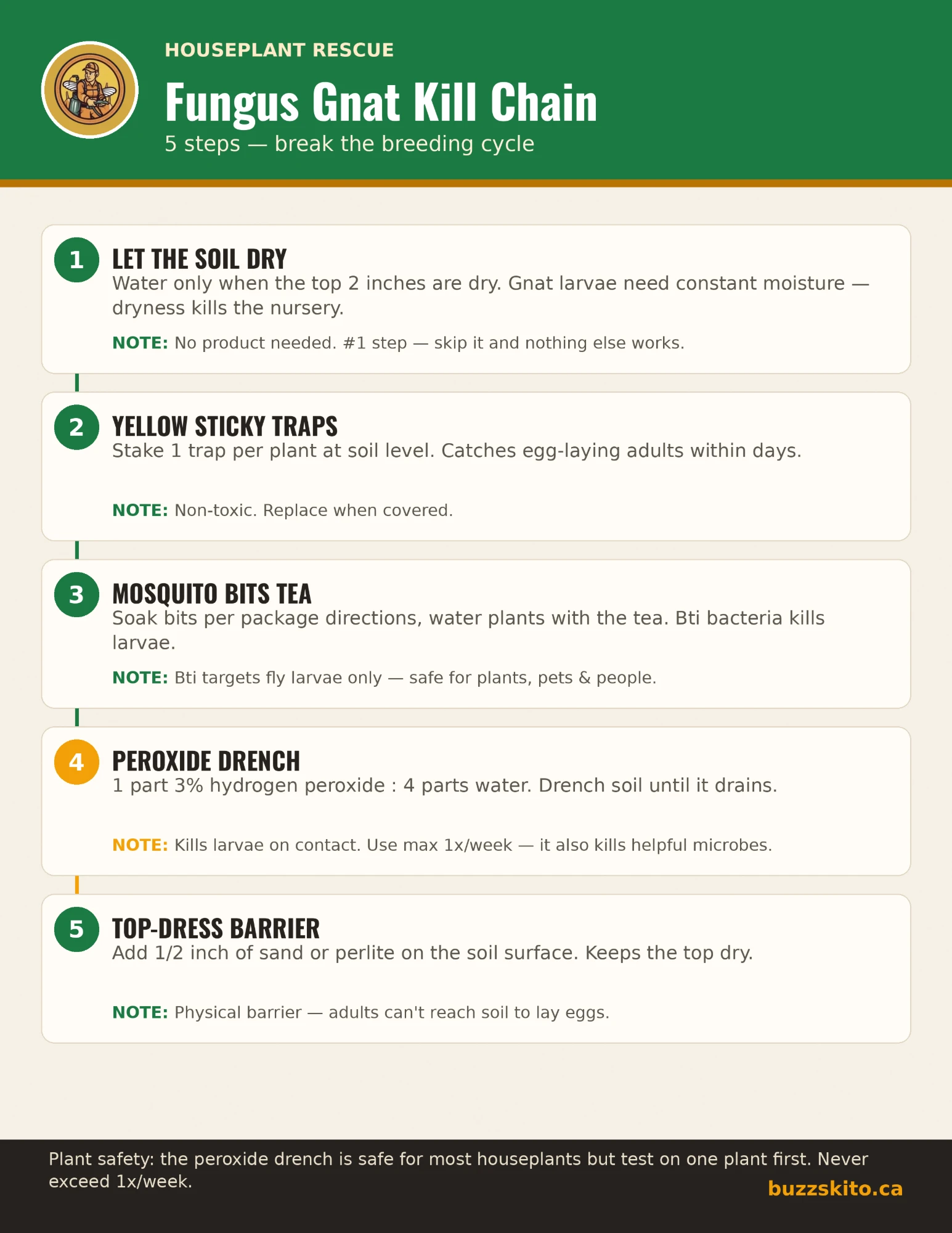
In order: let the soil dry, set yellow sticky traps, water with Mosquito Bits tea, then two optional extras, a peroxide drench and a top-dress barrier. The first three have university or label directions behind them, the fourth has a published ratio but no trial results in the sources used here, and the fifth is disputed. The sequence follows the integrated pest management order in the natural garden pest control guide.
1. Let the Soil Dry: how dry is dry enough?
Dry enough that the top 1 to 2 inches of potting mix are dry before you water again. That is Colorado State's figure, and Cornell Cooperative Extension in Allegany County gives the same. Wisconsin sets the bar at the top inch, and Cornell University's integrated pest management program says the top two, so the guide's 2 inches sits at the deep end of the range.
Drying works on two stages at once. Colorado State says a dry growing medium lowers the survival of eggs and of the larvae that hatch from them, and makes the pot less attractive to egg-laying females. The larvae live in the top 2 to 3 inches, the layer you are drying.
- Check by touch, not by the calendar. Push a finger into the mix to the depth you are aiming for, and water only if it comes out dry.
- Water from the bottom. Wisconsin suggests it because moisture reaches the roots while the soil surface stays dry.
- Remove what holds moisture. Texas A&M's rule for any indoor fly is to eliminate the source, meaning anywhere excess moisture and organic debris have built up. Colorado State says to remove containers holding a lot of decaying plant matter, and the University of California's Pest Notes say to clean up standing water, which includes a full saucer.
Where it stops working. Texas A&M warns that once fungus gnats have become a problem, reducing moisture alone may not give satisfactory control, which is why steps 2 and 3 run alongside it. Plant safety. None of these sources lists plants that cannot take this much drying, so go by the plant: in a small pot, where 2 inches can be most of the root ball, use Wisconsin's top inch, and water any plant that wilts.
2. Yellow Sticky Traps: where do they go, and what do they catch?
They catch flying adults and nothing else, so they work alongside a soil treatment and never instead of one. Colorado State says to place yellow sticky cards underneath the plant canopy or on the edge of the container, and that they may help by mass-trapping adult females, which reduces the number of larvae in the next generation. The University of Connecticut's greenhouse fact sheet on fungus gnats lays the cards horizontally at the soil surface and has them checked and changed weekly.
No source used for this page says how many traps a plant needs or how quickly they fill; the guide's one per plant is a reasonable start, not a published figure. Limits. Traps do nothing to the eggs, larvae and pupae in the mix. Plant safety. Keep the sticky face clear of the leaves.
3. Mosquito Bits Tea: what are the label's measurements?
Four tablespoons of granules per gallon of water, soaked for 30 minutes, with the treated water applied to the soil once a week for three weeks. Those are the fungus gnat directions on the maker's specimen label for Mosquito Bits, a granule containing Bacillus thuringiensis subspecies israelensis (Bti) that the label lists for the soil of house, garden and landscape plants. It is a registered pesticide, so follow the label on your own package if it differs.
Mosquito Bits Tea (Bti soil drench)
1 gallon. The label gives the rate per gallon only; the same ratio is 1 tablespoon per quart.
You need
- 4 tablespoons Mosquito Bits granules
- 1 gallon water
Steps
- Stir the granules into the water, or tie them in a piece of nylon stocking first.
- Soak for 30 minutes, then skim off the floating granules or lift out the stocking.
- Stir or shake the water and pour it directly onto the soil surface, as that week's watering.
- Compost or discard the used granules, and wash your hands with soap and water.
- Repeat weekly for three weeks, and again if fungus gnats reappear.
What it does: The label says this controls the fungus gnat larvae present in the soil at the time of application. Bti works only after larvae eat it.
Where it stops working: Wisconsin's fact sheet says Bti does not affect eggs, pupae or adult gnats, so one drench is not enough and the fliers still need traps.
Pets and children: lower risk
Pets. The National Pesticide Information Center rates Bt as low in toxicity to people and other mammals when eaten, and adds that some Bt products have caused eye and skin irritation. The label's Caution statement covers domestic animals as well as people, so store the granules where a pet cannot get into the container.
Children. The label says to keep the product out of reach of children and carries a Caution signal word: harmful if inhaled or absorbed through the skin, and moderately irritating to the eyes. An adult should do the mixing.
Recipe as published by Summit Chemical, Mosquito Bits specimen label
Universities describe a slightly shorter interval than the label. Wisconsin advises several applications five to seven days apart, with enough water to carry the Bti down to the larvae, and the University of California's Pest Notes say Bti does not persist indoors, so potting media may need repeat treatments about five days apart. Follow the interval on your package, and do not brew a stronger tea.
Labels differ by country, so readers in Canada should go by the package sold there; see how Mosquito Bits compare with Dunks, including their status in Canada and what Bti is and how the dunk form is used.
4. Peroxide Drench: what ratio, and how good is the evidence?
The published ratio is 1 part 3% hydrogen peroxide to 4 parts water, and the evidence behind it is thin. Cornell Cooperative Extension in Allegany County gives that mix, poured over the soil, and says to let the soil dry out afterward. A Colorado Master Gardener answer on the Ask Extension service gives the same ratio and adds two details: saturate the soil, and keep the solution off the leaves.
Peroxide Drench (1 part to 4 parts)
1 1/4 cups from 1/4 cup of peroxide; scale up in the same ratio
You need
- 1 part 3% household hydrogen peroxide (for example, 1/4 cup)
- 4 parts water (for example, 1 cup)
Steps
- Read the bottle and use only the 3% household strength.
- Wait until the top 1 to 2 inches of mix are dry and the plant is due for water.
- Mix 1 part peroxide with 4 parts water.
- Pour it slowly over the soil until the mix is wet through, keeping it off the leaves.
- Empty the saucer, and let the surface dry again before the next watering.
What it does: Cornell Cooperative Extension's educator says the mild solution can help kill fungus gnat larvae without harming the plant, and describes it fizzing as it meets the larvae.
Where it stops working: Of the sources used for this page, only this county extension article and one Ask Extension answer mention peroxide. The Colorado State, Wisconsin, University of California and Texas A&M fact sheets do not list it, and no source used here reports how many larvae it kills. It soaks the pot, which works against step 1.
Pets and children: use with caution
Pets. Poison Control notes that household 3% peroxide is sometimes used to make dogs and cats vomit, and Pet Poison Helpline says peroxide given to a cat can cause serious inflammation and ulcers in the stomach and esophagus, and that dogs exposed to it may have vomiting, diarrhea or difficulty breathing. Neither source covers a diluted soil drench, so keep pets away from the bottle, the mixing jug and the saucer.
Children. Poison Control says a sip of 3% household peroxide is not expected to cause serious symptoms but can bring an upset stomach, vomiting or throat irritation, and that the 35% strength sold as food grade can cause serious internal burns. Use only 3%, and store it out of reach.
Recipe as published by Cornell Cooperative Extension, Allegany County
How to use it. Treat peroxide as a stopgap for a week when you have no Bti, and make it that week's watering. None of the sources says how often it may be repeated: Cornell's educator says only to let the soil dry afterward, and the Colorado answer says you may need to reapply. Plant safety. Cornell describes the mild mix as not harming plants, but no source reviewed names the houseplants that tolerate it, so the guide's advice to try one plant first is a sensible precaution.
5. Top-Dress Barrier: does a layer of sand stop fungus gnats?
It can help keep the surface dry, but the sources disagree on whether it stops egg laying. Wisconsin's fact sheet recommends a 1/2 to 1 inch layer of coarse sand or fine gravel because it helps keep the surface drier and less attractive for egg laying, and Cornell University's integrated pest management program says a 1-inch layer of sand, kept dry, will eventually stop reproduction. The University of Connecticut's greenhouse fact sheet says the opposite about the barrier idea: covering the growing medium with coarse sand or diatomaceous earth does not prevent females from laying eggs.
So use a top layer for dryness and do not count on it as a wall. The guide's 1/2 inch is the thin end of Wisconsin's range (the Colorado Master Gardener answer suggests about 1/4 inch), and no source reviewed recommends perlite as a top layer; the University of California mentions perlite only as an addition to the potting mix, to improve drainage. Limits. A top layer does nothing to larvae already in the pot. Plant safety. The University of Washington's Elisabeth C. Miller Library doubts that sand on top is effective and cautions that it may form a crust and cause a drainage problem, so check moisture under the layer before watering.
When should you repot instead?
Repot when the mix itself is the problem: it has broken down, it stays wet, or the pot still produces gnats after four to five weeks of the steps above. Colorado State recommends repotting every so often, particularly when the growing medium has broken down and is holding too much moisture, and Texas A&M says that where reducing moisture has not been enough, the pot and soil should be treated with an insecticide or replaced. Cornell University's integrated pest management program describes the replacement:
- Take the plant out and discard all of the old potting soil.
- Rinse the soil off the roots without damaging them, and keep the roots in water so they do not dry out.
- Rinse the pot well and let it dry.
- Repot promptly in new, clean potting soil.
Potato-test new and returning plants before they join the others. Colorado State notes that houseplants kept outdoors for the summer are commonly colonized.
Is the fungus gnat kill chain safe around pets and children?
No step is free of risk, and most of it sits with the peroxide bottle and the trap glue. The guide tags the traps as not toxic and Bti as safe for plants, pets and people; the sources use more careful words.
| Step | Risk tier | What the source says |
|---|---|---|
| 1. Let the Soil Dry | No product | Nothing is applied |
| 2. Yellow Sticky Traps | Caution | Texas A&M: most sticky traps contain no pesticides. ASPCA: insect traps are among the sticky substances that need oil, then a soap bath, to come off fur |
| 3. Mosquito Bits Tea (Bti) | Lower risk | NPIC: low in toxicity to people and other mammals, though some Bt products have caused eye and skin irritation. Label: Caution; keep out of reach of children |
| 4. Peroxide Drench | Caution | Poison Control: a sip of 3% can upset the stomach, and a large amount can cause severe irritation and burns. Pet Poison Helpline: given to a cat, it can cause ulcers in the stomach and esophagus |
| 5. Top-Dress Barrier | Not rated | No pet or child guidance on sand or gravel was found in the sources reviewed |
NPIC is the National Pesticide Information Center. Tiers summarize the cited sources and are not a regulatory rating.
Sticky traps. A separate Texas A&M AgriLife Extension page on sticky traps says most contain no pesticides, so the hazard is glue on fur or hair, and that cooking oil may help remove the glue from fingers or hair. For pets, the ASPCA lists insect traps among the sticky substances its decontamination advice covers: coat the area in vegetable or mineral oil, leave it for five to ten minutes, then bathe the animal with a gentle liquid dishwashing soap, and call a veterinarian if that does not clear it. A broader page covers what common pest control methods mean for dogs and cats.
What if the fungus gnats keep coming back?
First rule out two common misses. The wrong fly: stout flies with reddish eyes are fruit flies, and fuzzy gray ones near a sink are drain flies, with sources in the kitchen and the drain. A missed pot: Colorado State says the adults are usually seen near the infested plant, so potato-test the pots they hover over.
If the steps were followed for four to five weeks and potato slices still show larvae, the sources offer more. Colorado State and the University of California both describe the insect-killing nematode Steinernema feltiae, applied as a soil drench. Wisconsin says insecticides containing pyrethrins or synthetic pyrethroids can give temporary control when adult numbers are excessive, applied to the plant and the surface of the potting soil as the product label directs, and never sprayed into the air.
Product choices differ by country. A separate page reviews the fungus gnat products sold in Canada and how they compare. For pests beyond the plant shelf, see which natural pest control methods have evidence behind them.
The printable fungus gnat watering schedule
Print or save
Fungus gnat watering schedule: 4 weeks
Run this on every pot that has gnats, starting on a day the top 1 to 2 inches of mix feel dry.
- Day 1, Bti tea: 4 tablespoons Mosquito Bits per gallon of water (1 tablespoon per quart). Soak 30 minutes, skim off the granules, water the soil with it.
- Day 1, traps: a yellow sticky card under the leaves or on the edge of each pot, and a 1/4-inch slice of raw potato pressed into the soil.
- Day 3 or 4: lift the potato. Pale larvae with black heads confirm the pot. Throw the slice away.
- Day 8 and day 15: Bti tea again, as that week's watering. Replace the sticky card each time and compare the catch.
- Day 22 onward: plain water, only when the top 1 to 2 inches are dry. Leave one card in place as a monitor. If gnats reappear, the label says to repeat the treatment.
- All month: no extra watering between tea days. Water from the bottom where you can, and empty saucers.
- Optional: 1/2 to 1 inch of coarse sand or fine gravel on the surface to help it stay dry.
- No Bti yet? One watering can be 1 part 3% hydrogen peroxide to 4 parts water, kept off the leaves. Then let the soil dry.
- Larvae still on the potato in week 5: discard the old mix, rinse the roots and the pot, repot in fresh mix.
- Keep Bti granules, peroxide and sticky cards out of reach of children and pets. Poison Control (US): 800-222-1222.
Follow the label on your own Bti product if it differs. Ratios come from the product label and the extension sources named in the guide, not from BuzzSkito trials.
buzzskito.ca
This guide is general educational information, not medical advice. If you have symptoms or concerns after a bite or exposure, contact a healthcare provider.
Use any pesticide exactly as its label directs. The label is the law, and what is registered and sold varies by state.
Frequently Asked Questions
Do fungus gnats bite people or pets?+
No. Colorado State University Extension says adult fungus gnats do not bite or feed, and the University of California's Pest Notes say the adults do not bite people or damage plants. They are a nuisance because they gather near plants and, being attracted to light, at windows. The stage that matters is the larva in the potting mix, which feeds on fungi, algae and decaying matter and sometimes on roots. If something in the house is biting, look for a different insect.
Will fungus gnats kill my houseplants?+
Rarely. University of Wisconsin-Madison Extension says larvae may damage roots when their numbers are high, by feeding on root hairs or tunneling into roots, but that this kind of damage is rare in home settings. The University of California says serious damage is more common in greenhouses, nurseries and sod farms, though it notes root damage and even plant death in houseplants when high populations were associated with moist, organically rich soil. Cornell Cooperative Extension names young seedlings and newly propagated cuttings as the plants that suffer most. Texas A&M AgriLife Extension's first advice is to water less often so the potting soil has a chance to dry out.
Can I sprinkle Mosquito Bits on the soil instead of making tea?+
The maker's specimen label reviewed for this page gives one method for fungus gnats: soak 4 tablespoons of granules in a gallon of water for 30 minutes, skim off the granules, and apply the treated water to the soil, weekly for three weeks. It does not describe sprinkling dry granules onto houseplant soil for fungus gnats. Labels are revised from time to time and differ by country, so read the one on your own package and use only a method it lists.
Do apple cider vinegar traps work on fungus gnats?+
Vinegar traps are a fruit fly tool. Texas A&M AgriLife Extension describes apple cider vinegar traps for fruit flies, which breed in fermenting fruit and vegetables. None of the sources reviewed for this page recommends them for fungus gnats, which lay their eggs in moist potting mix and are trapped on yellow sticky cards. If a vinegar trap fills with small flies, check whether they are stout with reddish eyes, because that points to fruit flies and a source in the kitchen.
Does diatomaceous earth on the soil stop fungus gnats?+
The University of Connecticut's greenhouse fact sheet says it does not. Covering the growing medium with a layer of diatomaceous earth or coarse sand does not prevent adult females from laying eggs, and diatomaceous earth absorbs moisture from the growing medium, so cracks form where larvae pupate and females lay eggs. That is greenhouse guidance, but it speaks directly to the idea of a barrier layer. The houseplant fact sheets used for this page put their weight on drying the surface of the mix and on Bti drenches instead.
Where do fungus gnats come from in the first place?+
Often from a plant that spent the summer outdoors, or from potting media. Colorado State University Extension says houseplants kept outdoors in summer are commonly colonized and that numbers may grow once the plants come back into a warmer house, and Wisconsin sees more problems in fall for that reason. The University of California advises against potting media containing incompletely composted organic matter unless it has been pasteurized. Once indoors, females lay eggs in moist mix, and at room temperature a new generation follows in three to four weeks.
Sources
- Fungus Gnats as Houseplant and Indoor Pests — Colorado State University Extension
- Fungus Gnats on Houseplants — University of Wisconsin-Madison Division of Extension
- Indoor Flies and Their Control — Texas A&M AgriLife Extension Service
- A Spooky Houseplant Pest: Fungus Gnats — Cornell Cooperative Extension, Allegany County
- Bacillus thuringiensis (Bt) Fact Sheet — National Pesticide Information Center
- Is hydrogen peroxide safe? — Poison Control (National Capital Poison Center)
- Mosquito Bits specimen label — Summit Chemical Company
How this guide was made: it was researched and drafted with AI assistance from the sources listed above. A second, independent AI pass then checked each factual claim against those sources. Found an error? Email support@buzzskito.ca.