Published by BuzzSkito Mosquito & Tick Control
Published October 11, 2026 · Drafted with AI assistance and fact-checked against the sources listed below
What do whiteflies look like?
Whiteflies are tiny, powdery white insects that look like miniature moths and gather on the undersides of leaves. Clemson Cooperative Extension's houseplant pest fact sheet puts adults at about 1/10 to 1/16 inch long, roughly 1.5 to 2.5 mm, so the one-page guide's figure of about 2 mm fits. Despite the name they are not true flies: Clemson groups them with scales, mealybugs and aphids, and like those relatives they feed by sucking sap.
The young are harder to spot. The University of California's Pest Notes on whiteflies describe a first stage, the crawler, that is barely visible even with a hand lens and moves for several hours before it settles. Later nymphs are oval, flattened and immobile, with greatly reduced legs and antennae, like small scale insects, and range by species from almost transparent yellow or whitish to black with a white fringe. They are the stage that matters: the university says adults by themselves will not cause significant damage unless they are transmitting a plant pathogen, and that plants are generally lost only when nymph numbers are high.
Four signs go with the insects themselves:
- Sticky leaves. Adults and nymphs both suck sap, and Missouri's guide says they take in more than they can digest and excrete the excess as sticky honeydew.
- Black film. Sooty mold grows on the honeydew and darkens the leaf.
- Yellow, dry or dropping leaves. The University of California lists these as the result of large populations.
- Ants. Honeydew attracts ants, which the university says interfere with the natural enemies that would otherwise control whiteflies.
The shake test: does a white cloud rise?
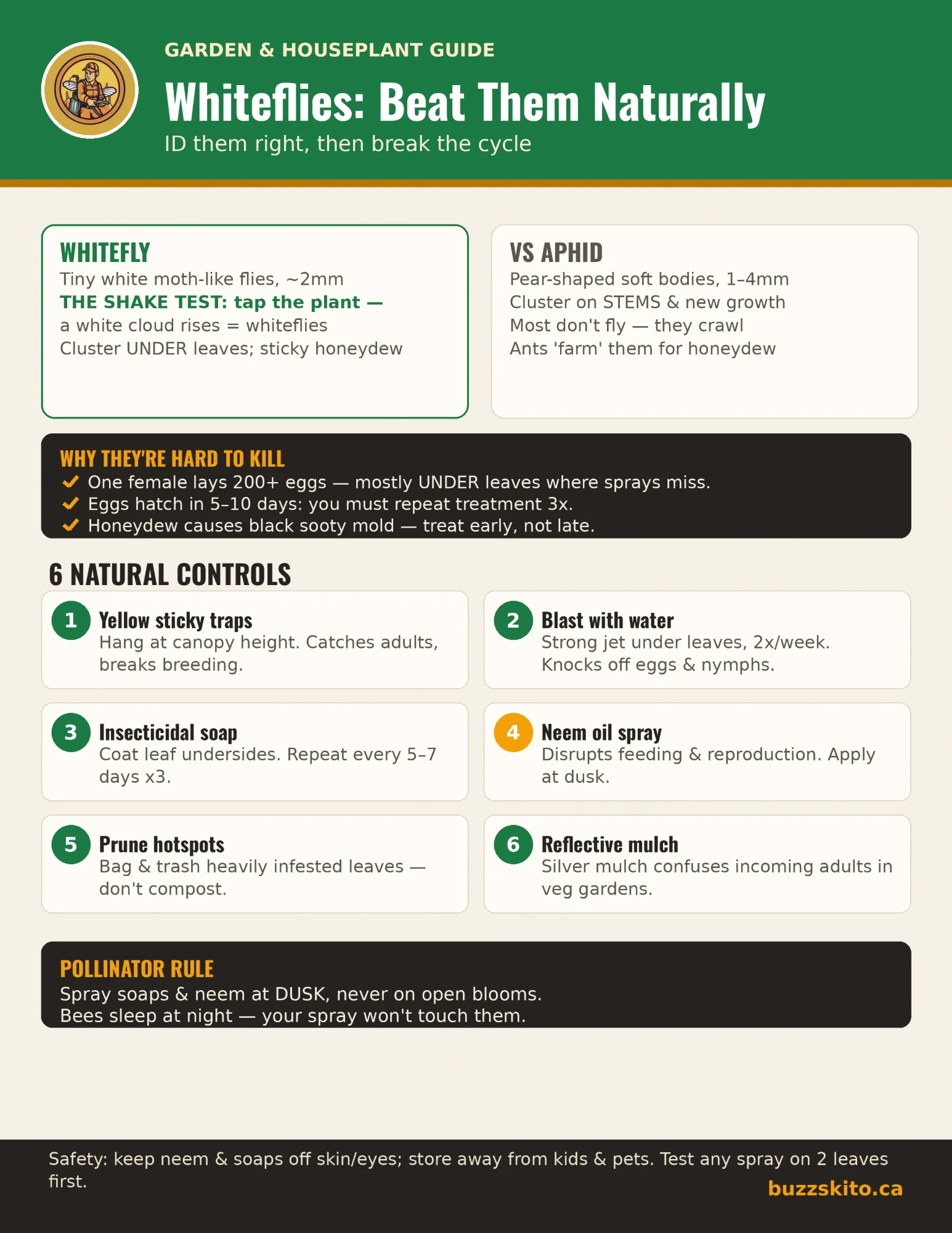
Tap or shake the plant and watch: if small white insects flutter up and settle again, you have whiteflies. Clemson says whiteflies flutter around when an infested plant is disturbed, and University of Missouri Extension describes white clouds of winged adults rising from a heavily infested one. The test has two limits. It shows adults only, so a light infestation may release a handful of insects and no cloud. And it says nothing about the nymphs, which do the damage. After the tap, turn over several leaves, young ones near the top and older ones lower down, and look for flat, pale scales and sticky honeydew.
Whitefly vs aphid: how do you tell them apart?
Go by body shape and by what happens when you tap the plant; where the insects sit is less reliable. Aphids are soft, pear-shaped insects about 1/16 to 1/8 inch long, usually green but sometimes pink, brown, black or yellow, by Clemson's description. That is roughly 1.5 to 3 mm, a slightly narrower band than the 1 to 4 mm on the one-page guide. The University of California's Pest Notes on aphids add that adults are generally wingless, though most species also produce winged forms, and that most aphids do not move quickly when disturbed. A tapped aphid colony stays put; whiteflies take off.
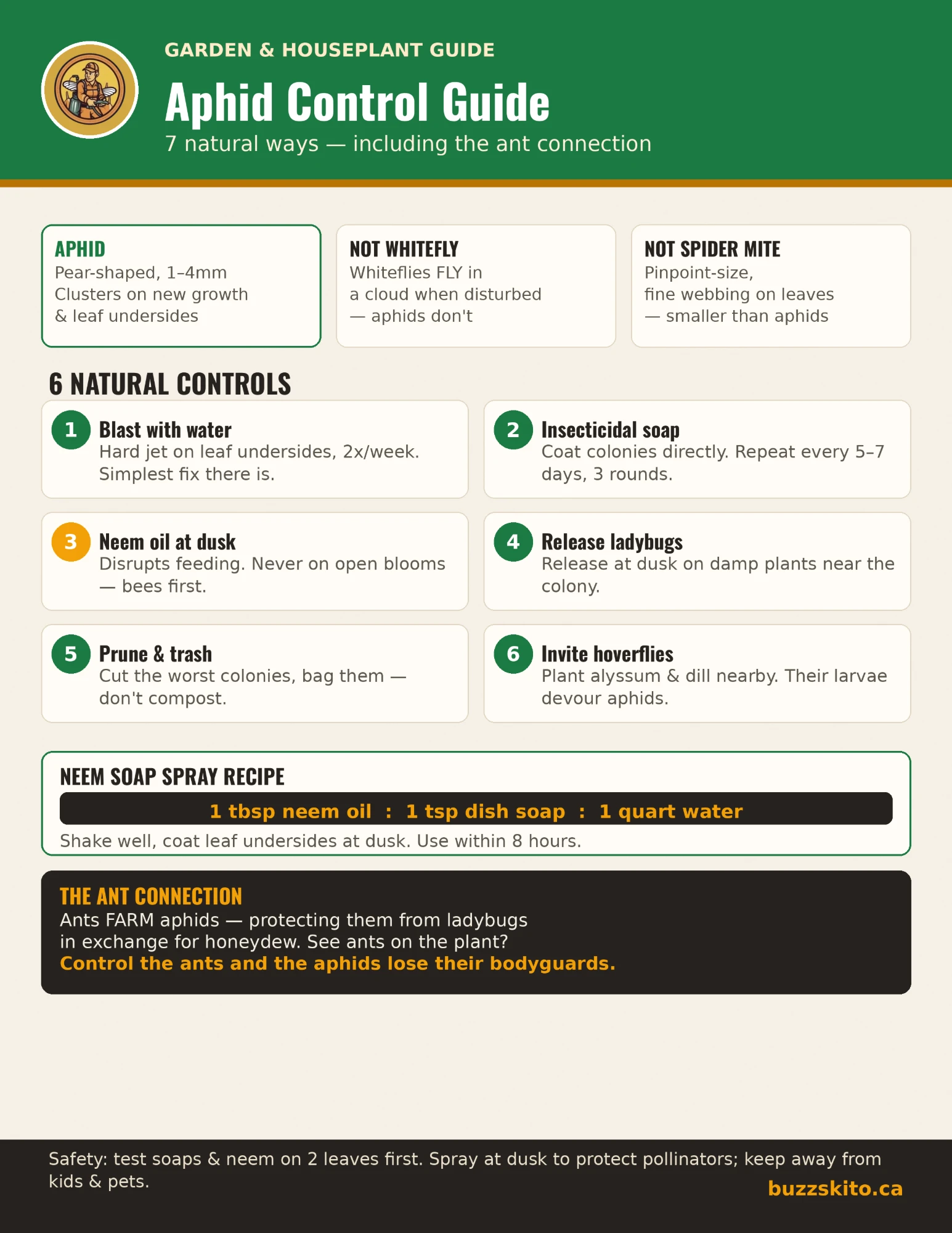
Two of the guide's clues need a caveat. It places whiteflies under leaves and aphids on stems and new growth, but Clemson finds aphids on new growth or on the undersides of leaves, so position alone will not separate the two. And ants do tend aphids for their honeydew and protect them from natural enemies, as the same Pest Notes describe, but whitefly honeydew draws ants as well. The separate guide to getting rid of aphids without harsh sprays covers that ant connection in detail.
Whitefly, aphid, mealybug or fungus gnat?
Two more plant pests get mistaken for whiteflies. Mealybugs are also white, but they are larger, cottony and slow. Fungus gnats also fly up when a pot is moved, but they are dark and they come from the soil.
| Insect | Size | What it looks like | Where you find it | When you tap the plant |
|---|---|---|---|---|
| Whitefly | 1/10 to 1/16 inch | Powdery white, like a tiny moth; nymphs are flat, pale scales | Undersides of leaves | Adults flutter up, then settle |
| Aphid | 1/16 to 1/8 inch | Soft and pear-shaped; usually green, sometimes pink, brown, black or yellow | New growth and undersides of leaves | Most stay where they are |
| Mealybug | 1/8 to 1/4 inch | Pale, covered in white wax that looks like cotton | Lower leaf surfaces and leaf axils | Barely moves; most adults are wingless females |
| Fungus gnat | About 1/8 inch | Delicate, dark fly that resembles a small mosquito | Running across or flying near the soil surface | A weak flier that stays near the pot |
Sizes and locations from Clemson Cooperative Extension (HGIC 2252). Movement notes for aphids and mealybugs, and the fungus gnat's color and flight, from the University of California's Pest Notes on each insect.
If the insects are dark and stay around the pot, follow the step-by-step plan for fungus gnats in houseplants instead; that fix happens in the soil, not on the leaves.
Why are whiteflies hard to kill?
Because the eggs, the settled nymphs and the pupae are all fixed to the undersides of leaves, where sprays miss them, and two of those stages are less susceptible to sprays anyway. Missouri's guide says eggs and nonfeeding pupae are generally not as susceptible to insecticides as nymphs and adults. The University of California adds that soaps and oils control only the whiteflies they directly hit, and that the infested leaves are usually the lowest ones and the hardest to reach.
| Stage | What the sources report | Source |
|---|---|---|
| Eggs per female | Usually 200 to 400; 150 or more, at about 25 a day | University of Missouri; University of New Hampshire |
| Egg hatch | 5 to 7 days; within about a week; within 10 days | Iowa State University; Missouri; New Hampshire |
| Crawler | Moves for several hours, then settles to feed | University of California |
| Settled nymphs | Fixed in place and feeding for about four weeks; 2 to 3 weeks in Iowa State's account | Missouri; Iowa State |
| Egg to adult | 21 to 36 days depending on temperature; 4 to 6 weeks | New Hampshire; Iowa State |
| Adult life | About one month | Missouri |
The New Hampshire figures come from that university's extension fact sheet on the greenhouse whitefly and the Iowa State figures from its extension page on whiteflies as houseplant pests. Ranges differ with species and temperature.
The one-page guide's numbers hold up: 200-plus eggs matches Missouri, and a 5 to 10 day hatch spans the three sources above. The practical consequence is the repeat schedule. A spray that kills today's nymphs and adults leaves eggs that hatch over the following week, so the sources space treatments 5 to 7 days apart. Where they differ is the number of rounds. Clemson's fact sheet on gardenia pests calls for three sprays, Iowa State says weekly repeats are usually required, and Missouri says eradicating a population usually takes four to five applications. Treat three rounds as the minimum and keep going, within the label's limits, while you still find live nymphs.
Treat early, as the guide says. Black sooty mold grows on the honeydew, and Missouri's guide says that the mold and the loss of sap can both interfere with photosynthesis. The University of California states that heavy whitefly infestations are difficult to manage and that the best strategy is to keep problems from developing.
Cold is the one thing on the gardener's side. Missouri says whiteflies die outdoors in colder climates and reproduce all year only in warmer regions and indoors. In cold-winter parts of the US and Canada, that points to houseplants, greenhouses and purchased transplants as the way they come back, so inspect the undersides of the leaves on every new plant before it joins the others. Clemson suggests keeping a new houseplant apart for six weeks.
6 natural controls: what does each one do?
Each of the six does a different job, and none clears whiteflies alone: traps and the hose deal with adults, soap and oil kill the adults and nymphs they wet, pruning removes the stages nothing else reaches, and reflective mulch keeps incoming adults off young plants. The University of California's summary is blunt. Insecticidal soaps and oils such as neem oil may reduce whitefly populations but not eliminate them. Plan on combining methods, which is the approach set out in the guide to natural garden pest control, and expect the repeat sprays to run for weeks, not days.
1. Yellow sticky traps
Yellow sticky traps catch flying adults and show you how many there are; they do not end an infestation. The University of California says traps will not eliminate a damaging population, may reduce it somewhat as one part of a wider program, and are most useful for monitoring and detecting whiteflies. Because whiteflies do not fly far, it takes a lot of traps: as many as one for every two large plants.
- Height. The University of California says to set the sticky yellow surface level with the whitefly infestation. Missouri says to hang the trap vertically or support it on stakes just above the plants, which matches the canopy height the guide shows.
- Position. Face the sticky side toward the plants and keep it out of direct sunlight.
- Homemade version. Missouri describes a 12-by-6-inch strip of cardboard or strong poster board, painted bright yellow on both sides and coated with a sticky substance. The University of California suggests an adhesive of one part petroleum jelly or mineral oil to one part household detergent, which cleans off with soap and water.
- Upkeep. Clean insects and debris off the trap periodically so the surface stays sticky.
- Limits. Traps do nothing to the eggs and nymphs on the leaves, so they cannot be the only control.
2. Blast with water
A strong stream of water aimed at the undersides of the leaves knocks adults off and costs nothing. The University of California says to hose adults off plants with a strong stream, and adds that watering also reduces the hot, dry, dusty conditions that favor whiteflies and hold back their natural enemies. For a houseplant, Clemson's instruction is to wash the plant, and Iowa State University Extension suggests washing the undersides of the leaves with a moist cloth or sponge, a job it calls labor intensive.
How often is less settled. The guide says twice a week, and no source reviewed for this page gives that figure. The closest is the University of California's Pest Notes on the giant whitefly, a larger species: water sprays at least once a week when numbers are high, then once every 2 or 3 weeks as they fall. In comparison studies, those notes report, water alone controlled that species as well as or better than several chemical treatments.
What the jet removes is less certain than the guide suggests. For other whiteflies the university describes water as useful for dislodging adults. The Pacific Northwest Pest Management Handbooks entry on the ash whitefly goes further and says strong streams aimed at the undersides of plants may dislodge or injure the various life stages. Neither names eggs, so treat the hose as a way to thin the population between soap sprays.
3. Insecticidal soap
Insecticidal soap is the first spray to reach for, and it works only on the whiteflies it wets. Clemson's fact sheet on insecticidal soaps explains that these products are potassium salts of fatty acids that kill by suffocation, appear to disrupt the insect's cell membranes, and remove its protective waxes. Coverage of the leaf undersides decides the result, as the guide says. Use a commercial insecticidal soap, not a kitchen mix: Clemson warns that a homemade version carries a substantially increased risk of plant injury, and that dry dish detergent and all laundry detergents are far too harsh.
Insecticidal soap spray from concentrate
1 gallon. Clemson publishes the per-gallon rate only; by arithmetic, a quarter of it for a 1-quart sprayer is just under 2 to just under 4 teaspoons of concentrate
You need
- 1 gallon water (distilled or bottled if your tap water is hard)
- 2 1/2 to 5 tablespoons commercial insecticidal soap concentrate, which makes a 1 to 2 percent solution, or the amount your product's label gives
Steps
- Read the label first. If its rate differs from this range, follow the label. Ready-to-use bottles need no mixing.
- Check for hard water: shake a little soap and water in a jar and wait 15 minutes. If scum forms on the surface, mix with distilled or bottled water.
- Spray a small area of the plant and wait 24 hours for signs of damage. Clemson's houseplant fact sheet says injury can take at least 48 hours to show, so give a houseplant two days.
- Spray in the early morning or late in the day, out of full sun and below 90°F.
- Wet both sides of every leaf, the undersides above all.
- Repeat every 4 to 7 days as the label allows. Rinse the plant with clean water if leaves wilt or brown at the edges within a few hours.
What it does: Kills the adults and nymphs it wets. Plan on three sprays (Clemson's gardenia fact sheet) to four or five (University of Missouri), 5 to 7 days apart.
Where it stops working: It kills only what it wets, and Missouri says eggs and pupae are less susceptible. The University of California says soap may reduce whiteflies but not eliminate them. It can also burn leaves: Clemson's sensitive list includes lantana, gardenias, nasturtiums, sweet pea, Japanese maple and bleeding heart, with azaleas, begonias, fuchsias, geraniums and impatiens somewhat sensitive.
Pets and children: lower risk
Pets. The National Pesticide Information Center rates potassium salts of fatty acids as very low in toxicity to animals when eaten or on the skin, but highly toxic to aquatic invertebrates and slightly toxic to fish. Keep spray and rinse water out of ponds and aquariums, and keep pets off the plant until the spray has dried, or longer if the label says so.
Children. The center says the soap can irritate skin and eyes and that swallowing a high dose may cause stomach upset and vomiting. Store the concentrate in its original container out of reach, and keep children away from the plant until the spray has dried, or longer if the label says so.
Recipe as published by Clemson Cooperative Extension, Insecticidal Soaps for Garden Pest Control (HGIC 2771)
Heat and drought make leaf burn more likely. The University of California says to use soaps and oils only when plants are not drought-stressed and temperatures are under 90°F, and suggests early evening, when there is still enough light to work safely but the sun is off the plants. Whitefly hosts also overlap with Clemson's sensitive lists: the University of California names fuchsia, gardenia and lantana among the plants the greenhouse whitefly may occur on, and Clemson rates all three as sensitive or somewhat sensitive to soap. On those plants, do not skip the 24-hour spot check.
4. Neem oil spray
Neem can help, but what it does depends on which neem product is in the bottle, and no source reviewed for this page publishes a home dilution for it. The National Pesticide Information Center's neem oil fact sheet explains that azadirachtin, the most active component, reduces insect feeding, acts as a repellent, and interferes with insect hormone systems so that it is harder for insects to grow and lay eggs. That is the feeding and reproduction effect on the one-page guide.
Products differ, though. The center notes that azadirachtin can be extracted, and that the portion left over is called clarified hydrophobic neem oil. Clemson's fact sheet on less toxic insecticides says neem oil products act primarily as contact insecticides, repellents and feeding deterrents, while azadirachtin products act as insect growth regulators that interfere with molting and also deter feeding.
Either way, treat neem as a contact spray for whiteflies. The University of California groups neem oil with soaps and petroleum-based oils as products that control only the whiteflies directly sprayed, under the same rules: thorough coverage of the leaf undersides, plants that are not drought-stressed, temperatures under 90°F. Concentrates differ in strength, so mix at the rate on your product's label and no stronger. One spray will not last, either: the center reports that azadirachtin breaks down quickly on plant leaves, with a half-life of 1 to 2.5 days.
Horticultural oil is the third spray in the same family. Clemson's less toxic insecticides fact sheet says most horticultural oils are applied to actively growing plants as a 1 to 2 percent solution, 2 1/2 to 5 tablespoons of oil per gallon of water, and not when the temperature is above 90°F or below 45°F or when rain is forecast within 24 hours. Check the label for its own rate and for plants it should not be used on.
5. Prune hotspots
Removing the worst leaves takes out the stages that traps, water and sprays handle poorly. The University of California says to prune out isolated infested leaves when you first detect them, and that removing leaves or whole plants heavily infested with the nonmobile nymphs and pupae may bring numbers down to a level natural enemies can contain. Missouri gives the same advice for older, heavily infested leaves.
Bag what you cut. The University of California's giant whitefly notes say to place infested material in plastic bags, seal them and remove them from the property, because adults can keep developing from mature nymphs on leaves left in the open. None of the sources mentions compost by name, but an open pile is leaves left in the open, so the guide's instruction to trash them is sound. If most of the leaves are infested, pruning is no longer the answer; see the section below on when to stop.
6. Reflective mulch
Reflective mulch is a way to keep whiteflies off young vegetable plants, not a cure for an infestation that is already there. The University of California says shiny metallic-coated construction paper or reflective plastic mulch can repel whiteflies, especially from small plants, and that clear plastic mulch sprayed with silver paint is an alternative. Its method:
- Remove all weeds, then lay the mulch over the bed and bury the edges with soil to hold it down.
- Cut holes 3 to 4 inches across, and plant several seeds or a single transplant in each one.
- Water plastic mulch by drip irrigation; coated construction paper and other porous mulches may tolerate furrow irrigation or sprinklers if they are sturdy enough.
- Remove the mulch when summer temperatures get high, so the plants do not overheat.
The university adds that the same mulch repels aphids and leafhoppers, helps crop growth and controls weeds, a subject covered in the guide to natural weed control and mulch depth. The repelling effect is described for small plants, and it has no use on a houseplant.
What else works that is not on the one-page guide?
Two more controls have university backing: vacuuming adults in the cool of the morning, and protecting the predators and parasites that eat whiteflies.
Vacuum the adults in the early morning
A small vacuum takes adults off a plant before they lay more eggs. Missouri's guide says to vacuum adult whiteflies in the early morning, when the temperature is cool and they are slow-moving, then put the vacuum bag inside a large plastic bag and freeze it for 24 hours to kill them. Like traps, this deals with adults only, so pair it with pruning and a soap spray.
Keep the natural enemies
Whiteflies have many natural enemies, and the University of California says outbreaks frequently occur when those enemies have been disturbed or destroyed by pesticides, dust buildup or other factors. The general predators it names are lacewings, bigeyed bugs and minute pirate bugs, along with several small lady beetles. Tiny parasites in the genus Encarsia are sold for release in greenhouses, but the university does not generally recommend them outdoors because they are not well adapted to survive in temperate zones. Three habits help the ones already in the yard:
- Keep dust down. The university says dust can kill beneficial insects or disrupt their activity.
- Keep ants off the plants. Ants drawn to honeydew protect whiteflies from their enemies.
- Read the empty nymph cases. A round or oval exit hole means a parasite emerged; a T-shaped opening means a healthy whitefly did.
Why do broad-spectrum insecticides make whiteflies worse?
Because most of them kill the natural enemies, whiteflies quickly build up resistance to them, and most are not very effective in a garden in the first place. Those are the University of California's three reasons for avoiding pesticides other than soaps and oils against whiteflies. It advises against pyrethroids, organophosphates and neonicotinoids, says even the most toxic insecticides are only partially effective, and names carbaryl, pyrethroids and imidacloprid, especially as a foliar spray, as particularly disruptive.
Soil-applied imidacloprid is the usual systemic alternative, and the university does say it can control whitefly nymphs. It also says imidacloprid can harm natural enemies, honey bees and other pollinators, especially on plants that are flowering or soon will be, and can cause outbreaks of spider mites, so it advises reserving it for special situations where those problems can be avoided.
The sources are not unanimous here. Missouri's guide lists pyrethrins, permethrin, imidacloprid and malathion beside soap, oil and neem as over-the-counter insecticides commonly used for whiteflies, and Clemson's houseplant fact sheet says imidacloprid granules put onto the soil will control them. Missouri also says that controlling whiteflies with insecticides has been difficult because they have developed resistance to some chemicals, and that frequent or widespread insecticide use keeps predators from controlling them. That trade-off is why the wider look at natural pest control methods starts with the least disruptive options.
Pollinator rule: when can you spray soap or neem?
Spray in the evening, after bees have stopped working the plants, and never onto open flowers. The National Pesticide Information Center's pollinator protection page gives both halves of the guide's rule: do not spray flowers directly, and do not spray while pollinators are active, because spraying in the evening after bees have returned to their hives lets spray residues dry overnight. Clemson's gardenia and less toxic insecticides fact sheets likewise say to apply sprays late in the evening to reduce the exposure of pollinators.
The two products sit at the lower end of the risk scale for bees. The center's soap fact sheet says flying adult insects with a stronger outer covering, such as lady beetles and bees, may be less affected than soft-bodied pests, though immature, flightless insects are more vulnerable. Its neem fact sheet rates neem oil as practically not toxic to bees and says pollinators are not likely to be harmed, because an insect must eat the treated plant to be killed.
Lower risk is not zero. A soap or oil spray works by contact, so keep it off every insect you do not mean to kill, and read the Environmental Hazards section of the label, as the center advises. If a plant is in full bloom and busy with bees, use the hose and the pruners and hold the spray.
Are whitefly sprays safe around pets and children?
The physical controls involve no pesticide; soap and neem are rated low in toxicity but can irritate skin and eyes, and neem carries a specific warning for cats. The guide's footer has the practice right: keep sprays off skin and out of eyes, and store them away from children and pets.
| Control | Risk tier | What the sources say |
|---|---|---|
| Yellow sticky traps | Lower risk | No pesticide, and no hazard given in the sources reviewed. Hang them where fingers and fur cannot reach the adhesive. |
| Water spray, pruning, vacuuming, reflective mulch | Lower risk | No pesticide involved. |
| Insecticidal soap | Lower risk | NPIC: very low in toxicity to animals by mouth or on skin; can irritate skin and eyes; a high dose swallowed may cause stomach upset and vomiting; highly toxic to aquatic invertebrates |
| Neem oil | Caution | NPIC: slightly irritating to eyes and skin; azadirachtin can be very irritating to the skin and stomach; adverse reactions, some fatal, reported in cats treated with neem oil |
| Horticultural oil | Follow the label | No toxicity figures in the sources reviewed for this page |
NPIC is the National Pesticide Information Center; its soap fact sheet dates from 2001. Tiers summarize the cited fact sheets and are not a regulatory rating.
The cat warning needs its context. The center's fact sheet says neem oil has been used on cats for flea control in other countries, and that some of those cats reacted with sluggishness, excessive salivation, impaired movement, trembling, twitching and convulsions. Some died; most recovered within 1 to 5 days.
That was oil put on the animal, not residue on a sprayed plant, and the fact sheet gives no figure for garden use. The cautious reading is to keep cats away from wet neem spray and from the concentrate, and never to put a garden neem product on a pet. For children, the center found no data showing that they are more sensitive to neem oil than adults.
The basics are the same for both sprays. Mix and spray with children and pets out of the area, wear whatever protection the label calls for, and keep products in their original containers, out of reach. Keep spray and rinse water away from ponds and aquariums, because the center also rates azadirachtin as moderately toxic to fish. For households with dogs and cats, the guide to pest control around pets goes through more products.
Test any spray on a few leaves first
Test first, then wait at least a day. The guide says to try any spray on 2 leaves; Clemson's soap fact sheet says to spray a small area and wait 24 hours to see whether damage appears before the whole plant is treated, and its houseplant fact sheet says symptoms of injury may take at least 48 hours to appear. Give a houseplant two days. For houseplants, Clemson adds that spraying is most safely done outdoors in the shade in mild temperatures. It also lists houseplants that are sensitive to insecticidal soap and should not get it at all, among them ornamental ivy, maidenhair fern, dieffenbachia, schefflera, jade plant, begonia, fuchsia, impatiens and certain palms.
When should you stop and try something else?
Stop when most of a plant's leaves are infested, or when live nymphs are still there after the four or five correctly applied rounds that Missouri describes. At that point the sources favor removing plants over spraying harder.
- A houseplant that is mostly covered. Clemson says that if a plant is severely damaged and not valuable, the simplest solution may be to discard it and its soil, and Iowa State also lists throwing the plant away as an option for heavy infestations.
- An annual or vegetable at the end of its season. The University of California says to destroy infested annuals promptly when flowering or fruiting ends, and to remove and destroy infested vegetable plants after harvest.
- An evergreen that hosts them every winter. Where an evergreen perennial consistently carries high numbers through the winter, the university suggests removing it to lower the overwintering population.
The University of California does not suggest stepping up to a broad-spectrum insecticide at that point, for the reasons given above.
Printable whitefly cheat sheet
The card condenses this page into twelve lines that stand on their own. Print it and keep it with the sprayer.
Print or save
Whitefly cheat sheet
Identify first, then work the undersides of the leaves every 5 to 7 days.
- Identify: tap the plant. White, moth-like insects about 1/16 inch long flutter up and settle. Flip leaves to find flat, pale nymphs and sticky honeydew.
- Not whiteflies: pear-shaped and staying put = aphids; cottony and slow = mealybugs; dark and flying from the soil = fungus gnats.
- Prune first: cut off the worst leaves, seal them in a plastic bag and put the bag in the trash.
- Hose: a strong stream on the leaf undersides at least once a week knocks off adults.
- Vacuum adults in the cool early morning, then freeze the vacuum bag for 24 hours.
- Yellow sticky traps: sticky side facing the plants, level with the infested leaves, out of direct sun. They monitor; they do not cure.
- Insecticidal soap: 1 to 2 percent (2 1/2 to 5 tablespoons of concentrate per gallon of water, or the label rate). Wet the underside of every leaf.
- Repeat sprays every 5 to 7 days, at least three times; four to five is usual. Neem and horticultural oil: label rate only.
- Do not spray in full sun, above 90°F, on a drought-stressed plant or onto open flowers. Evening is best for the plant and for bees.
- Test a small area and wait 24 hours (48 for a houseplant) before spraying a whole plant.
- Skip broad-spectrum insecticides: they kill the predators and parasites that keep whiteflies down.
- Keep sprays off skin and out of eyes, store them away from children and pets, and keep neem away from cats. Poison Control (US): 800-222-1222.
Rates and intervals are reproduced from Clemson, University of Missouri and University of California extension publications; BuzzSkito has not run trials on them. The product label overrides everything on this card.
buzzskito.ca
This guide is general educational information, not medical advice. If you have symptoms or concerns after a bite or exposure, contact a healthcare provider.
Use any pesticide exactly as its label directs. The label is the law, and what is registered and sold varies by state.
Frequently Asked Questions
Does dish soap and water kill whiteflies?+
University sources steer gardeners away from it. Clemson Cooperative Extension describes insecticidal soap as a highly refined version of liquid dish soap, but warns that a homemade mix carries a substantially increased risk of plant injury, and that dry dish detergent and all laundry detergents are far too harsh. Its fact sheet on less toxic insecticides also advises against homemade soap recipes because they are more likely to injure plants. A commercial insecticidal soap, mixed at the label rate and spot-checked on a small area for 24 hours, is the product the dilution and repeat schedules on this page were written for.
Where do whiteflies come from?+
Usually from another plant. The University of Missouri says whiteflies die outdoors in colder climates and reproduce all year only in warmer regions and indoors, and the University of New Hampshire says the greenhouse whitefly survives a New Hampshire winter only in greenhouses. That points to houseplants and greenhouse-grown transplants as the usual carriers. Iowa State University Extension says to check every plant you buy and every plant you bring indoors from the garden or patio in the fall, the University of California says to inspect new plants for adults and nymphs before adding them to a garden, and Clemson suggests keeping a new houseplant apart from the others for six weeks.
How long does it take to get rid of whiteflies?+
Plan on weeks. The sources space sprays 5 to 7 days apart, so the three sprays in Clemson's schedule span about two weeks and the four to five applications the University of Missouri describes span roughly two to four weeks. The reason is the life cycle. Eggs hatch in about a week, and the University of New Hampshire puts egg to adult at 21 to 36 days depending on temperature, so adults can keep emerging for weeks from stages a spray did not kill. Keep checking the undersides of the leaves, and stay within the number of applications the product label allows.
Do yellow sticky traps get rid of whiteflies?+
No. The University of California says yellow sticky traps will not eliminate a damaging whitefly population, though they may reduce it somewhat as one part of a wider program, and that they are most useful for monitoring and detection. Iowa State University Extension makes the same point for houseplants: traps catch only the flying adults. The eggs and nymphs on the undersides of the leaves are untouched. Use traps, set level with the infested leaves, to find out whether whiteflies are present and whether numbers are rising or falling, and rely on pruning, water and soap or oil sprays for the stages on the leaf.
Is neem oil or insecticidal soap better for whiteflies?+
The sources used here do not rank one above the other. The University of California groups insecticidal soap, neem oil and petroleum-based oils together as products that control only the whiteflies directly sprayed and that may reduce a population without eliminating it. Soap has the simpler instructions: Clemson publishes a 1 to 2 percent dilution, while neem concentrates vary and have to be mixed at the label rate. Neem also carries a caution for cat owners, because the National Pesticide Information Center reports adverse reactions in cats that were treated with neem oil. Whichever you choose, coverage of the leaf undersides and the repeat schedule matter more than the product.
Do whiteflies spread to other plants?+
Yes, though they are not strong travelers. The University of California notes that whiteflies do not fly very far, which is why so many sticky traps are needed, but it also lists very broad host ranges: the greenhouse whitefly feeds on most vegetables and herbaceous ornamentals, and the sweetpotato whitefly on many herbaceous and some woody plants, including tomatoes, peppers, cucurbits, roses and hibiscus. Indoors, move an infested plant away from the others while you treat it, and check the undersides of its neighbors' leaves at each spray. Outdoors, remove and destroy infested vegetable plants after harvest, as the university advises.
Sources
- Whiteflies (Pest Notes, UC ANR Publication 7401) — University of California Statewide Integrated Pest Management Program
- Managing Whiteflies on Indoor and Outdoor Plants (G7275) — University of Missouri Extension
- Common Houseplant Insects & Related Pests (HGIC 2252) — Clemson Cooperative Extension Home & Garden Information Center
- Insecticidal Soaps for Garden Pest Control (HGIC 2771) — Clemson Cooperative Extension Home & Garden Information Center
- Neem Oil General Fact Sheet — National Pesticide Information Center
- Potassium Salts of Fatty Acids (General Fact Sheet) — National Pesticide Information Center
- Pollinator Protection — National Pesticide Information Center
How this guide was made: it was researched and drafted with AI assistance from the sources listed above. A second, independent AI pass then checked each factual claim against those sources. Found an error? Email support@buzzskito.ca.