
BuzzSkito Mosquito & Tick Control Specialists · Published July 21, 2026
Know Your Enemy: The Life Cycle That Explains Everything
Every failed fungus gnat treatment fails for the same reason: it attacks the flies you can see and ignores the population you cannot. So before the protocol, thirty seconds of biology — because once you see the life cycle, the whole strategy becomes obvious.
Adult fungus gnats are the tiny (3–4 mm) grey-black flies drifting weakly around your pots and, maddeningly, toward your face and screens — they are drawn to light and to the CO2 you exhale. Each female lives only about a week, but in that week she lays up to two hundred eggs in the top layer of moist potting soil. The eggs hatch in about three days into translucent, black-headed larvae that spend roughly two weeks in the top 3–5 centimetres of soil eating what the species is named for: fungi and decaying organic matter. In a heavily infested pot, they also graze root hairs and tender young roots — harmless to a robust monstera, genuinely damaging to seedlings, cuttings, and anything already stressed. After a brief pupal stage, a new generation of adults emerges, and the wheel turns again. The full cycle runs three to four weeks at room temperature, with all generations present at once. If a fly of the same size is fuzzy rather than mosquito-like, and keeps turning up at a floor drain or shower instead of a pot, it is a drain fly — the overnight tape test identifies exactly which drain is producing them.
Two strategic facts fall out of this. First, the adults are a symptom — they live a week and die on their own; killing them without killing larvae just makes room for the next wave. Second, everything depends on surface moisture. Eggs and larvae need the top layer of soil consistently damp. Let it truly dry and the habitat collapses. That is why the cure starts not at the store but at your watering can.
Step 1 — Fix the Water: The Dry-Out and Bottom-Watering Protocol
Fungus gnats are, bluntly, an overwatering symptom with wings. Nurseries keep soil damp because it is their job to grow plants fast; homes keep soil damp out of love. Either way, a permanently moist soil surface is a fungus gnat nursery, and no product ends an infestation while the habitat persists. The fix costs nothing:
- Let the top 3–5 cm dry completely between waterings. Push a finger in to the second knuckle; if you feel any moisture, wait. Most common houseplants — pothos, monstera, snake plants, ZZs, ficus — prefer this anyway. The larvae, which cannot survive in dry soil, do not.
- Switch to bottom-watering during treatment. Set the nursery pot in a few centimetres of water for 15–30 minutes and let the root zone drink from below, keeping the surface layer — the egg-laying zone — dry. You get hydrated roots and hostile real estate at the same time.
- Empty saucers and cache pots. Standing water under the pot keeps the drainage layer wet and gives females a second egg-laying site through the drainage holes.
- Halve your watering frequency in winter. Lower light means plants drink at a fraction of their summer rate. Watering on a summer schedule from November to March is the single biggest reason fungus gnats are a winter pest in Canadian and northern-US homes.
For a light infestation — a few gnats a week — this step plus sticky cards is often the entire cure. For anything more established, add the larvicide.
Step 2 — Trap the Adults: Yellow Sticky Cards
Fungus gnat adults orient strongly to the colour yellow, and the humble yellow sticky card exploits it perfectly. Stake or clip cards horizontally or at a low angle just above the soil surface — that is where adults cruise, land, and lay — with one card per affected pot and a couple of extras near the worst cluster. Catches start within hours, which is satisfying, but the card’s real value is strategic: every female stuck to a card is up to two hundred eggs that never enter your soil, and the card itself is your scoreboard. Count roughly what a fresh card catches in its first two days at the start of treatment, then compare a fresh card two weeks in. Falling numbers mean the protocol is working; a card that stays nearly clean for a week means you are done.
What cards cannot do is finish the job alone. The soil is producing new adults every few days, and cards only intercept a fraction before they lay. Cards without a larval kill is a treadmill — which brings us to the tool that actually ends infestations.
Step 3 — Kill the Larvae: BTI, the Actual Fix
BTI — Bacillus thuringiensis israelensis — is a naturally occurring soil bacterium and one of the most precisely targeted pest controls ever brought to market. When the larvae of fungus gnats, mosquitoes, and blackflies ingest it, a protein specific to their gut chemistry destroys the gut lining and the larva dies within hours to a day. That protein does nothing to humans, cats, dogs, birds, fish, earthworms, bees, or plants — the mode of action simply does not exist outside those larval guts. This specificity is why BTI is approved for residential use by Health Canada’s Pest Management Regulatory Agency and the US EPA alike, and why the same bacterium is trusted in some jurisdictions’ drinking-water reservoirs. Whatever product you buy, the label is your contract: in Canada, look for the PCP registration number on the package and follow its houseplant directions rather than a stranger’s recipe — including ours — where they differ.
The most widely available consumer BTI product on both sides of the border is Summit Mosquito Bits — BTI-coated corn-cob granules sold in the familiar orange-and-green container at Canadian Tire, Home Depot, Rona, garden centres, and Amazon in Canada, and the equivalent big-box stores in the US. (Periodic stock gaps on specific listings cause a recurring “is this banned?” rumour in Canada; it is not — it is a supply hiccup. Our Mosquito Bits vs Dunks guide covers Canadian retail availability in detail.)
For houseplants, use the steep method: add about four tablespoons of Bits per gallon (roughly four litres) of water, let them soak for thirty minutes so the BTI releases into the water, strain out the granules if you like, and water your plants normally with it. Every watering now delivers the larvicide directly into the larval feeding zone. The alternative is top-dressing granules onto the soil and watering through them — it works, but the corn-cob carrier sometimes sprouts a harmless white fuzz as it breaks down, which tends to cause more panic than the gnats did. The slower-release sibling product, Mosquito Dunks, can also be broken into quarters and steeped the same way; our Mosquito Dunks guide covers when the 30-day format makes more sense.
The critical detail: repeat for two to three weeks. BTI kills larvae — not eggs, not pupae, not adults. On day one, every larva feeding in treated soil dies, but eggs keep hatching for days and pupae keep emerging as adults for a week or more. Treat with every watering for two to three weeks and each new hatch meets lethal soil the moment it starts feeding. Seeing some adults in week two is not failure; it is the tail of the pipeline emptying. The sticky-card scoreboard will show the curve bending.
The Sand Top-Dress: An Honest Verdict
The most-shared fungus gnat tip on plant social media is a centimetre of sand or decorative gravel on the soil surface: adults supposedly cannot lay through the dry barrier, larvae supposedly cannot emerge. The logic is genuinely sound — and in practice it usually fails, for reasons that are obvious in hindsight. A thin sand layer cracks as soil shrinks and swells, pulls away from the pot rim leaving a perfect egg-laying moat, and wicks moisture upward so its underside stays damp. And fungus gnats do not need the front door anyway: females will happily lay through the drainage holes at the bottom of the pot, where the soil is dampest of all. Add that a top-dress makes the finger-test of soil moisture impossible — encouraging exactly the blind-schedule watering that causes gnats — and the verdict writes itself. A deep layer (2–3 cm) of coarse, sharp, fast-draining grit can contribute as one layer of a real protocol; as a standalone cure, it earns its reputation among frustrated plant owners, not its reputation on social media.
The Hydrogen Peroxide Drench: Partially True, Honestly Framed
The other famous home remedy actually does something — it just does far less than advertised. Ordinary 3% hydrogen peroxide, diluted about one part peroxide to four parts water and used to drench the pot, kills larvae on contact as it fizzes through the top layer of soil, then breaks down into water and oxygen within minutes. At that dilution it will not harm established plants (some sensitive seedlings disagree), and the brief oxygen release is, if anything, mildly pleasant for compacted soil.
Here is what the viral posts leave out: peroxide has zero residual effect. It kills the larvae it physically touches in the seconds before it decomposes — larvae deeper in the pot, in the drainage layer, or sheltered in dense root mass survive, every unhatched egg survives, and every adult survives. Tomorrow’s hatch lands in untreated soil. Used once, it is a decent population knockdown while you wait for sticky cards and Bits to arrive; used as the whole plan, it is a subscription to spraying your plants forever. It also indiscriminately kills soil microbes — a real cost if you keep living soil for aroids or use beneficial-microbe amendments. Fine tool, wrong job title.
Heavy Infestation? Add Air Support
When an infestation has been building for months — typically a big plant collection, a propagation shelf, or that one enormous planter that never dries — adults stop hovering politely around pots and start drifting across the room, toward lamps, screens, and wine glasses. The soil protocol above still does the curing, but a plug-in UV trap meaningfully shortens the misery window. The Katchy — a UV lure, a quiet fan, and a glue board in a tidy cylinder — runs overnight near the worst shelf and pulls flying adults out of the air passively while the BTI shuts down the source. We tested it across a full season against fruit flies and fungus gnats in our full Katchy review; the short version is that it is a genuinely effective supplement with one hard rule attached: never buy it as the only fix, because no air-side device touches the larvae in the soil.
For the same plan as a one-page routine, with a watering card you can print, see how to get rid of fungus gnats, step by step.
When Treatment Isn’t Enough: The Repotting Trigger
Sometimes the soil itself has failed, and no protocol fixes broken potting mix. Repot — do not just keep treating — when you see any of these: the mix stays soggy for a week or more after a normal watering; it smells sour or mushroomy (active decay, i.e., unlimited larval food); it has visibly collapsed into dense black muck that no longer drains; larvae are visible in numbers when you scratch the surface; or a properly run three-week combo has not bent the sticky-card curve. Old peat-based mixes break down into exactly the fungus-rich sludge this insect evolved for — at that point you are farming gnats, not growing plants.
Do the repot properly: slide the plant out, shake and gently rinse the old mix off the roots, trim anything brown and mushy (healthy roots are firm and pale), scrub the pot with hot soapy water, and repot into fresh mix straight from a sealed bag, ideally cut with extra perlite for drainage. Then get the old soil out of the house immediately — a bag of infested mix in the corner will happily re-seed every plant you just cleaned. Which is also the prevention lesson: store potting soil sealed in a lidded tote, quarantine every new plant two weeks away from the collection with a sticky card staked in its pot, and bottom-water by default. Do those three things and you will likely never read a fungus gnat guide again.
Fungus Gnats vs Fruit Flies: Make Sure You’re Fighting the Right Bug
One last check, because the fixes do not transfer. If your tiny flies are stocky, tan-brown with red eyes, and clustered around the fruit bowl, the sink drain, or the recycling — those are fruit flies, and drying out your plants will accomplish nothing. Fruit flies breed in fermenting food residue and need a different playbook entirely: our fruit fly elimination guide and fruit fly trap comparison cover it. Fungus gnats are slimmer, darker, longer-legged, fly like they are slightly drunk, and always lead you back to a pot. Ten seconds of identification saves two weeks of treating the wrong insect.
Frequently Asked Questions
What kills fungus gnats the fastest?+
The fastest complete kill is the combo: yellow sticky cards to knock down the flying adults immediately, plus a BTI larvicide (such as Summit Mosquito Bits steeped into your watering can) to kill the larvae in the soil — the part every quick fix misses. Adults live only about a week and die off on their own; the infestation persists because larvae in the potting mix keep producing new adults every few days. Kill the larvae with BTI, intercept the adults on sticky cards, let the top of the soil dry out, and a typical infestation collapses within two to four weeks — roughly one full life cycle.
Where do fungus gnats come from in the first place?+
Almost always one of three doors: a newly purchased plant whose nursery soil already contained eggs or larvae, a bag of potting mix that was stored open or damp, or adults slipping in through screens toward light on humid days. Greenhouse-grown plants are the most common source — commercial growing conditions (warm, damp, peat-rich media) are ideal fungus gnat habitat. That is why quarantining new plants away from your collection for two weeks, and storing potting soil sealed in a tote, prevents most infestations before they start.
How do I tell fungus gnats from fruit flies?+
Location and look. Fungus gnats are mosquito-like — slender dark grey-black bodies, long legs, weak clumsy flight — and hover around potted plants, running when you disturb the soil surface. Fruit flies are stockier, tan-to-brown with red eyes, fly more strongly, and cluster around fruit, drains, and recycling bins rather than plants. The fix is completely different: fruit flies need the food source removed and a vinegar-style trap, while fungus gnats need the soil dried out and larvae killed. If your swarm is in the kitchen and ignores your plants, see our fruit fly guide instead.
Do fungus gnats actually damage houseplants?+
Adults are harmless — annoying, but they do not bite people or pets and do not chew leaves. The larvae are the real issue: they feed primarily on fungi and decaying organic matter in the soil, but in heavy infestations they also graze on root hairs and tender young roots. Mature, established plants usually shrug this off. Seedlings, cuttings, and stressed plants can be visibly set back — yellowing, wilting, and slow growth — and larval feeding wounds can open the door to root-rot pathogens. A light infestation is a nuisance; a heavy one in a propagation tray is a genuine plant-health problem.
Does hydrogen peroxide kill fungus gnats?+
Partially — and only the larvae it touches. A drench of 3% hydrogen peroxide diluted about 1 part peroxide to 4 parts water kills larvae on contact as it fizzes through the top layer of soil, and at that dilution it will not harm most established plants. But it has zero residual effect: eggs that hatch the next day are unaffected, larvae deeper in the pot or in the drainage layer survive, and adults are untouched entirely. Treat it as a one-time knockdown that reduces the population, not a cure. BTI does the same job better because it keeps killing larvae for days and reaches the whole root zone through normal watering.
Do sticky traps alone get rid of fungus gnats?+
No — and this is the most common reason people conclude nothing works. Yellow sticky cards are excellent at two jobs: telling you how bad the infestation is (monitoring) and removing egg-laying adults before they reproduce (knockdown). But every adult on a card came from a larva in your soil, and the soil keeps producing replacements. Cards plus nothing is a treadmill. Cards plus a larval kill (BTI drench, dry-out protocol, bottom watering) is a pincer that ends the infestation. Use the cards as your scoreboard: when a fresh card stays nearly empty for a week, you have won.
Is BTI safe for houseplants, pets, and kids?+
BTI (Bacillus thuringiensis israelensis) is a naturally occurring soil bacterium and one of the most species-specific insect controls ever developed — it affects the larvae of fungus gnats, mosquitoes, and blackflies, and essentially nothing else. It does not harm humans, cats, dogs, birds, fish, earthworms, bees, or the plants themselves, which is why it is approved for residential use by both Health Canada’s PMRA and the US EPA, and why the same bacterium is used in drinking-water reservoirs in some jurisdictions. As with any pest control product, check the label of the specific product you buy — in Canada, look for the PCP registration number on the package — and follow its directions for houseplant use.
How do I use Mosquito Bits on houseplants for fungus gnats?+
Two ways. The steep method (our preference): add roughly 4 tablespoons of Bits per gallon (about 4 litres) of water, let them soak 30 minutes to release the BTI, strain if you like, and use that water for your normal watering. Repeat with each watering for 2 to 3 weeks so every hatch of larvae meets treated soil. The top-dress method: sprinkle Bits on the soil surface and water through them — simpler, but the corn-cob granules can briefly grow a harmless white fuzz as they break down, which alarms people. Either way, verify the directions on your package’s label, since label rates are the ones actually tested and approved.
Does a sand or gravel top dressing stop fungus gnats?+
Mostly no, despite being the most-shared tip on plant social media. The theory is sound — adults lay eggs in the top layer of moist soil, so a dry barrier should stop them — but in practice a thin sand layer cracks, pulls away from the pot rim, and stays moist underneath, and gnats exploit every gap. Worse, they will happily lay eggs through drainage holes at the bottom of the pot, bypassing the barrier entirely. A deep (2–3 cm) layer of coarse, fast-drying grit helps somewhat as one layer of a bigger strategy, but as a standalone fix it fails often enough that we can’t recommend it. Fix the moisture and kill the larvae instead.
How long does it take to get rid of fungus gnats completely?+
Plan on two to four weeks — roughly one full life cycle plus a margin. The egg-to-adult cycle runs about 3 to 4 weeks at typical room temperature (eggs hatch in ~3 days, larvae feed for ~2 weeks, pupae emerge as adults ~4 days later), and no treatment kills every stage at once. BTI kills larvae but not eggs, pupae, or adults; sticky cards catch adults but nothing in the soil. That is why the combo needs to run continuously for 2–3 weeks: each stage gets intercepted as it arrives at the stage you can kill. Seeing a few adults in week two is normal, not failure.
Can fungus gnats survive winter? Why do I get them in December?+
Outdoors in a northern winter, no. Indoors, your home is a year-round greenhouse: warm rooms, moist potting soil, and reduced light that slows plant water use (so soil stays wet longer) make winter the peak season for fungus gnats in Canada and the northern US. The winter spike almost always traces to the same root cause — watering on a summer schedule while plants are drinking at a winter rate. Halving your watering frequency from November to March prevents most winter infestations by itself, and it is better for the plants too.
When should I just repot instead of treating?+
Repot when the soil itself is the problem: the mix stays soggy for a week or more after watering, smells sour or mushroomy, has visibly broken down into dense muck, or the infestation persists after a full 3-week combo treatment. Slide the plant out, shake and gently rinse the old soil off the roots, trim any brown mushy roots, wash the pot with hot soapy water, and repot into fresh mix straight from a sealed bag — ideally cut with extra perlite for drainage. Bag the old soil and get it out of the house; a bin of infested soil indoors will re-seed every plant you just cleaned.
Do fungus gnat sprays work?+
Aerosol sprays kill the adults you hit and nothing else — the larvae in the soil are untouched, so the swarm is back within days. They are the least useful tool for this pest, and spraying insecticides repeatedly around indoor living spaces is exactly the kind of overkill this problem does not need. Regulations also differ by country: products marketed for gnats in US stores are not necessarily registered for sale in Canada, so Canadian readers should check for a PCP registration number on any insecticide label before buying. The good news is you almost certainly do not need a spray at all — moisture control, sticky cards, and BTI beat sprays on every axis.
Related Guides
- Mosquito Bits vs Dunks — Which BTI Format to Buy in Canada
- Mosquito Dunks — The Complete Canadian Guide
- Katchy Indoor Insect Trap Review — A Full Season of Testing
- How to Get Rid of Fruit Flies — Full Playbook
- Best Fruit Fly Trap — Tested and Compared
- How to Get Rid of Silverfish — The Other Damp-Loving Indoor Pest
- Pest Control Cost Canada — What Professionals Charge
Keep reading
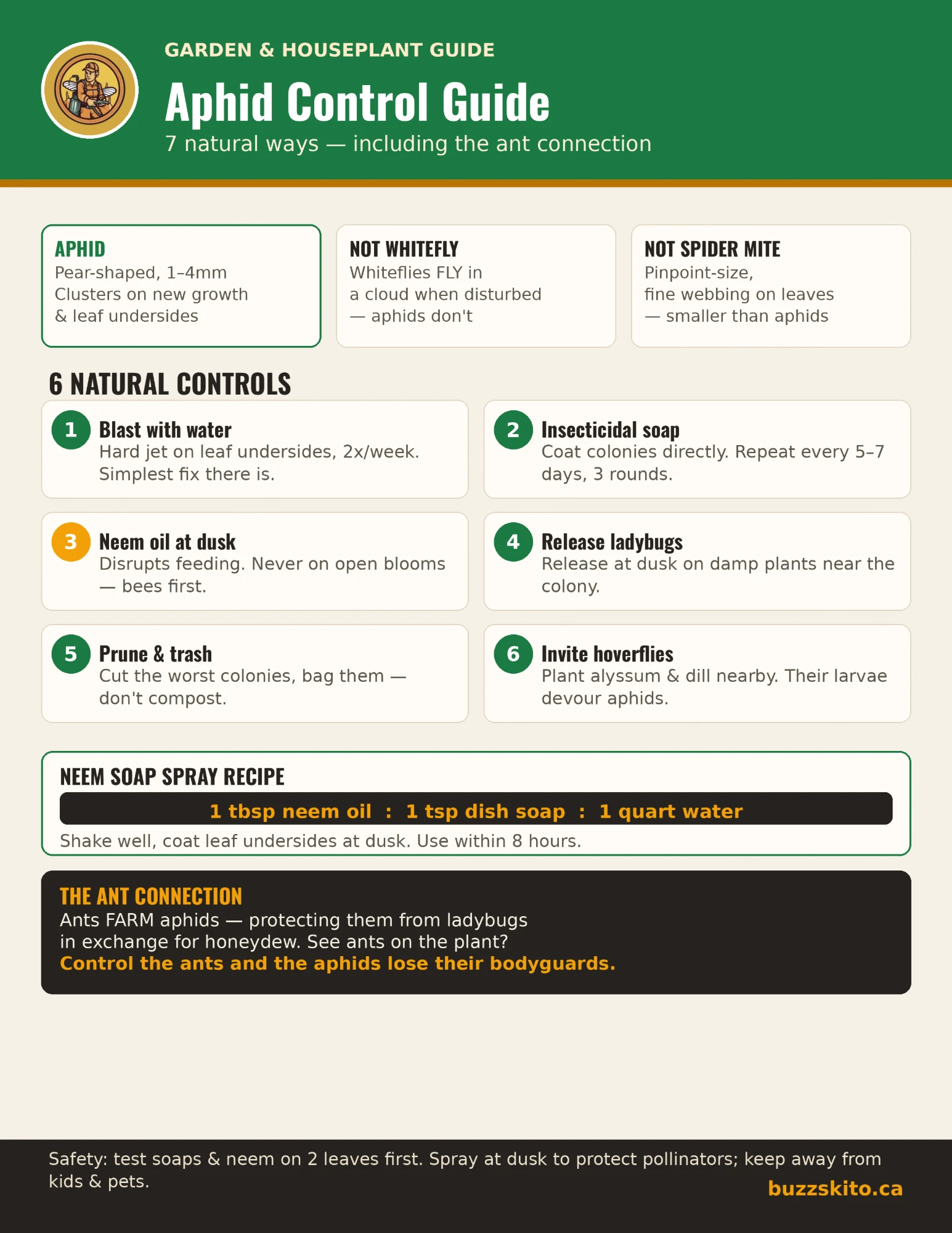 How to Get Rid of Aphids Naturally: 6 Controls and the Ant ConnectionHow to get rid of aphids naturally: hose them off, prune, protect their predators, then use soap or neem at the…
 Natural Weed Killer: What Works, With Exact Ratios and Honest LimitsNatural weed killer checked against extension sources: the 1 gallon, 1 cup, 1 tablespoon vinegar recipe, boiling water,…
- Best Deer Fence for Gardens in Canada 2026 — 7 ft Netting, Posts, and the Install That…Deer fencing for Canadian gardens: why 7 ft is the threshold a 6 ft fence misses, UV-stabilised poly netting vs metal,…