BuzzSkito Mosquito & Tick Control Specialists · Published July 21, 2026
What Is the Best Sprayer for a Tick Yard in Canada?
The best sprayer for a tick yard is not simply the biggest tank on the biggest ATV — it is the one that lets you put product exactly where ticks live, at enough pressure to reach them. For most Canadian acreage that means a 25-gallon tow-behind sprayer like the Chapin 97600 that combines a folding boom for the open lawn with a handheld spot-wand hose for the perimeter. The tank size covers a half-acre to a couple of acres per fill, the 12-volt pump keeps pressure steady so your application rate does not sag, and — most importantly — the spot wand lets you drive product into the wooded edge and leaf litter that a boom sails right over.
Understanding why the wand matters more than the boom is the key to buying the right rig, and it starts with knowing where ticks actually are in a yard. Get that wrong and you will spend money broadcasting the one part of the property ticks avoid.
Check current Canadian availability of the four picks:
Where Ticks Actually Live — and Why the Spot Wand Wins
Ticks are not lawn insects. The open, sunny, regularly-mowed part of a lawn is hostile to them — it is hot and dry, and a questing tick left there quickly desiccates and dies. What ticks need is shade and humidity, and they find it in the transition zone where lawn meets woods or tall grass — ecologists call it the ecotone. Add leaf-litter banks, stone walls, wood piles, dense ground-cover beds, shrub borders, and fence lines, and you have a map of nearly every tick in the yard. Study after study of residential properties finds the overwhelming majority of ticks within a few metres of that wooded edge.
That single fact reshapes what equipment you need. A wide broadcast boom is efficient for covering open lawn, but the open lawn is precisely where the ticks are not. The tool that hits the tick zone is a handheld spot wand you can aim into the base of shrubs, along the stone wall, into the leaf litter, and a metre or two into the woodland margin. This is why our top pick pairs a boom with a spot wand, and why the pure spot sprayer earns its own award: for the tick-specific job, precise edge application beats broadcast every time. If you only remember one thing from this guide, remember that you are buying a wand, and the tank and boom are supporting cast.
Boom vs Boomless vs Spot Wand
Tow-behind sprayers deliver product three ways, and a good tick rig uses more than one:
- Folding boom. A horizontal bar of nozzles that lays down an even band across open lawn quickly. Efficient for large mowed areas, and useful if you also want general lawn treatment — but it cannot reach into an edge.
- Boomless nozzle. A single tip that throws a wide fan, handy on rough or obstacle-strewn ground where a boom would snag. A reasonable compromise on uneven rural land.
- Spot wand. A handheld hose-and-nozzle that gives you full aim and control. This is the tick tool — the only way to drive product into shrub bases, stone walls, and leaf litter where ticks harbour.
The best tow-behind sprayers ship with a boom (or boomless bar) and a spot-wand hose, letting you broadcast the open lawn and then walk or ride the perimeter with precision. For pure tick work, prioritise the wand; treat the boom as a bonus for whole-lawn coverage.
How to Choose: Sizing and What You Are Actually Paying For
These rigs span a wide price range, and on acreage the money is real, so it is worth being clear about which specs earn their cost for this job. Prioritise in this order:
- Tank size matched to your acreage (get this right first). Undersizing is the common regret — refilling and re-mixing mid-job on a big lot wastes an afternoon. 15 gallons suits a small lot, 25 gallons a half-to-one acre, 40 gallons wooded rural land. But do not oversize either: a full 40-gallon tank is heavy and needs a real ATV to tow safely.
- A 12-volt pump with real pressure (pay for this). Look for roughly 40–60 PSI and a solid GPM figure. A weak pump only wets the surface; you need enough push to drive product into leaf litter and the base of dense shrubs where ticks sit. A 12-volt pump also spares you the fatigue of a hand-pump unit over an acre.
- A UV-stabilised poly tank (pay for this). The sprayer lives outdoors. A cheap tank goes brittle and cracks within a couple of Canadian seasons; a UV-stabilised polyethylene tank lasts.
- Agitation, if your product needs it (check the label). Wettable-powder and suspension-concentrate products settle without agitation, so your last gallon is far stronger than your first — uneven and non-compliant. Jet or mechanical agitation, or a bypass stir line, fixes this.
- An in-line strainer and quality nozzles (make sure they are included). Cheap to include, essential to avoid clogging with powder formulations.
- The right hitch and power source (confirm compatibility). A universal pin hitch fits most ATVs and hitch-equipped mowers; confirm you have a 12-volt outlet or battery terminal to power the pump.
Read that as a spending map: put your dollars into a right-sized tank, a real pump, and a durable tank, and confirm the wand, strainer, and hitch are in the box. Everything else is secondary. If you are cross-shopping smaller tools, our backpack sprayer guide and pump pressure sprayer guide cover the walk-behind end of the range, and the Field King backpack review digs into one popular option in detail.
The Legal Part: What You Can Put in the Tank
This is where DIY tick control most often goes wrong, and it has nothing to do with the sprayer. The tow-behind unit itself is just a device and needs no registration. But whatever you spray is regulated by Health Canada’s Pest Management Regulatory Agency (PMRA), and only products carrying a Canadian PCP (Pest Control Products) registration number are legal to apply outdoors on a residential property.
The trap is that many of the most-talked-about US tick concentrates — bifenthrin products such as Talstar, and various permethrin yard concentrates — are heavily marketed south of the border and appear on some marketplaces, but are not registered for domestic outdoor use in Canada. Importing and spraying them is illegal, can carry real penalties, and is exactly the kind of grey-market shortcut this guide will not recommend. Before anything goes in the tank, read the label, find the PCP number, and confirm the product is registered for your intended use. If you cannot confirm it, do not spray it. This is also a genuine advantage of hiring a licensed applicator: they can legally use commercial-class registered tick products that a homeowner simply cannot buy.
Technique: Treat the Edge, Reapply Through the Season
Because ticks concentrate in the transition zone, a barrier treatment targets a band roughly three metres wide along the lawn-woods boundary, the first stretch of adjacent woods, stone walls, wood piles, ground-cover beds, and tall-grass margins — not the open lawn. Peer-reviewed work on residential tick barriers has found a single well-placed perimeter application can sharply reduce the ticks in a yard for weeks. Treating the whole lawn wastes product, costs more, and needlessly exposes pollinators; a focused perimeter band is both more effective per litre and more responsible.
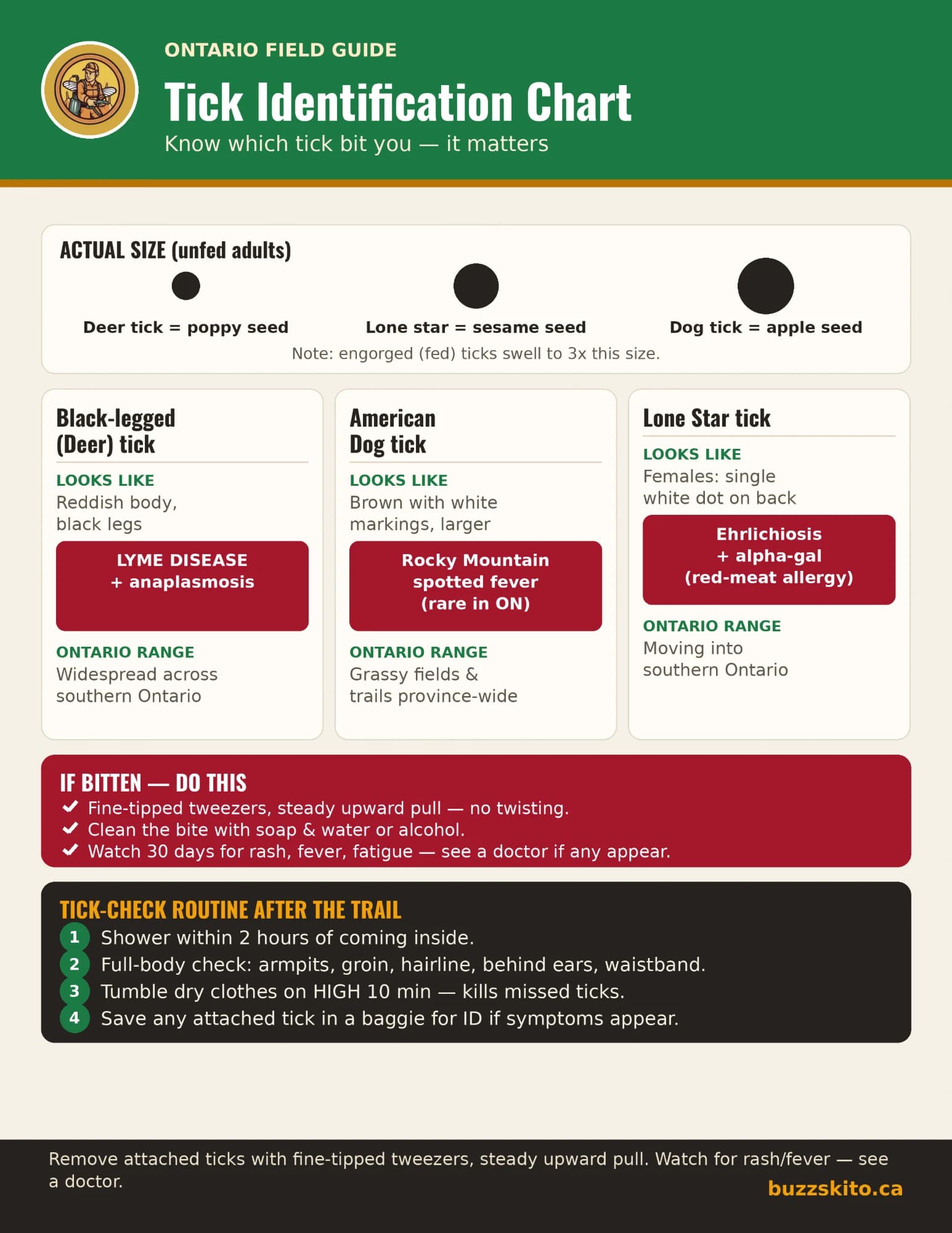
Timing matters as much as placement. In most of Canada, tick pressure runs spring through fall with two adult peaks (roughly April–June and September–November) and a midsummer nymph peak — and nymphs are the stage most likely to transmit Lyme. Residual products break down under sun and rain, and deer, rodents, and birds carry fresh ticks in all season, so a full-season plan means reapplying every few weeks, not a single spray in May. If you want a same-day physical deterrent to pair with a barrier spray, a motion-activated sprinkler can help keep deer — the tick taxi — off the lawn edge in the first place.
Tow-Behind Sprayer vs Backpack vs Professional Service
A tow-behind ATV sprayer is not always the right answer — it earns its cost on acreage and is overkill on a small lot. Here is how the honest options compare for a tick yard:
| Option | Best property | Edge coverage | Effort |
|---|---|---|---|
| Backpack sprayer | Small lot, short edge | Good — you walk it | Higher on big lots |
| Compact 15-gal tow-behind | Suburban lot | Good with a wand | Low |
| 25-gal tow-behind (Chapin) | Half-to-one acre | Best — boom + wand | Low |
| 40-gal ATV sprayer | Multi-acre rural | Best — big tank + wand | Low, needs real ATV |
| Professional tick control | Any — esp. wooded / Lyme-risk | Best — expert placement | None — done for you |
For a small suburban lot, a good backpack sprayer walked around the perimeter is enough and far cheaper to buy and store. The tow-behind rig pays off once the perimeter is long enough that carrying and refilling a backpack becomes the bottleneck. And for anyone with young children, pets, a Lyme-risk history, or simply a large wooded lot they would rather not manage, professional barrier treatment is usually faster, safer, and more reliable — the applicator legally uses commercial-class product and knows exactly where the harbourage is.
Frequently Asked Questions
What is the best ATV or tow-behind sprayer for treating a tick yard in Canada?+
For most Canadian acreage the best pick is a 25-gallon tow-behind sprayer like the Chapin 97600 with both a folding boom for broadcasting the open lawn and a handheld spot wand for hitting the perimeter. Ticks concentrate at the woodland edge, in tall grass, and in leaf litter along fence lines and stone walls — not in the middle of a mowed lawn — so the tool that matters most is a spot wand you can aim into that transition zone at volume. A 25-gallon poly tank on an ATV or ride-on mower covers a half-acre to two acres per fill, and the 12-volt pump keeps steady pressure without hand-pumping. Smaller lots do fine with a 15-gallon spot sprayer; large or heavily-wooded properties benefit from a 40-gallon boom unit. Whatever you tow, the product in the tank must be PMRA-registered for residential outdoor use in Canada.
Where do ticks actually live in a yard, and where do I spray?+
Ticks do not live in the open, sunny, mowed part of a lawn — it is too hot and dry for them and they desiccate quickly there. They concentrate in the shaded, humid transition zone: the edge where lawn meets woods or tall grass, leaf-litter banks, stone walls, wood piles, ground-cover beds, and along fence lines and shrub borders. The single highest-value target is that lawn-to-forest boundary, often called the ecotone. A perimeter or barrier treatment focuses the product on a band roughly three metres wide along that edge and the first stretch of adjacent woods, plus any leaf litter and tall-grass margins. That is why a spot wand you can aim into the edge matters more than a wide boom for tick work — the boom is for the open lawn, the wand is for where the ticks really are.
Do I need a boom, a boomless nozzle, or a spot wand for ticks?+
For a tick yard you want all three capabilities if you can, but the spot wand is the non-negotiable one. A folding boom broadcasts an even band across open lawn quickly and is efficient for large mowed areas. A boomless nozzle throws a wide fan from a single tip and is handy for rough ground where a boom would catch on obstacles. But ticks live in the edge and the leaf litter, and only a handheld spot wand lets you aim into the base of shrubs, along the stone wall, and into the woodland margin where a boom cannot reach. The ideal tow-behind sprayer therefore includes a boom or boomless bar for the lawn and a spot-wand hose for the perimeter — most quality Chapin and Fimco units ship with both.
What size tank do I need for my property?+
Match the tank to your treated area, remembering that for ticks you are mostly treating the perimeter band, not every square foot. As a rough guide: a small suburban lot with a modest wooded edge is well served by a 15-gallon spot sprayer; a half-acre to one-acre property with a real tree line suits a 25-gallon tow-behind; and multi-acre or heavily wooded rural land justifies a 40-gallon or larger unit so you are not constantly refilling. Bigger is not automatically better — a 40-gallon tank full of liquid is heavy, needs a capable ATV or tractor to tow, and is overkill for a quarter-acre. Undersizing is the more common regret, though, because refilling and re-mixing mid-job on a large lot wastes an afternoon.
Can I pull a tow-behind sprayer with a ride-on mower instead of an ATV?+
Yes, for the smaller and mid-size tanks. A 15- or 25-gallon tow-behind with a standard hitch pin tows fine behind most lawn tractors and zero-turn mowers with a hitch, which is how a lot of Canadian homeowners run them — you do not need a quad. The things to check are the hitch type (a universal pin hitch fits most machines), whether your mower has a 12-volt outlet or battery terminal to power the pump, and the total towed weight on slopes. For a 40-gallon unit you generally want a genuine ATV, UTV, or compact tractor because a full tank can exceed 150 kg and a lawn tractor may struggle to stop it on a grade.
What product goes in the tank — and is it legal in Canada?+
This is the part that trips people up. The sprayer is just a device and needs no registration, but whatever you put in it is regulated by Health Canada's Pest Management Regulatory Agency (PMRA). Only products bearing a Canadian PCP (Pest Control Products) registration number are legal to apply outdoors on a residential property. Many popular US tick concentrates — bifenthrin products such as Talstar, and various permethrin yard concentrates — are widely sold across the border and on some marketplaces but are NOT registered for domestic outdoor use in Canada, so importing and spraying them is illegal and can carry real penalties. Read the label, look for the PCP number, and if you are not certain a product is registered for your use, do not spray it. When in doubt, a licensed applicator uses commercial-class registered products a homeowner cannot legally buy.
How does the pump and pressure affect tick coverage?+
Coverage quality comes down to consistent pressure and the right droplet size, and that is the job of the pump. Most quality tow-behind sprayers use a 12-volt diaphragm pump rated for a given PSI and GPM (gallons per minute). For tick perimeter work you want enough pressure to push product into leaf litter and the base of dense shrubs — a weak pump just wets the surface and the tick-bearing layer underneath stays dry. Look for a pump in the 40–60 PSI range with a solid GPM figure, and a good in-line strainer so wettable-powder formulations do not clog the nozzle. Battery-powered 12-volt pumps are far less tiring than a hand-pump unit over a full acre, and they hold pressure steady so your application rate stays even from the first metre to the last.
Does a poly tank matter, and what about agitation?+
Yes on both. A UV-stabilised polyethylene tank resists cracking and sun degradation, which matters because a sprayer lives outdoors and a cheap tank goes brittle in a couple of Canadian seasons. Agitation matters if you use wettable-powder or suspension-concentrate products, which many tick and mosquito control products are: without agitation the active ingredient settles to the bottom of the tank and your last gallon is far stronger than your first, giving you uneven, non-compliant coverage. Better units include jet or mechanical agitation, or a bypass line that stirs the tank as the pump runs. If your chosen product is a wettable powder, agitation is not optional.
How much of the yard should I actually treat for ticks?+
Less than most people expect, which is good news. Because ticks concentrate in the edge and leaf-litter zone, a barrier treatment targets a band roughly three metres wide along the lawn-woods boundary, the first stretch of adjacent woods, stone walls, wood piles, ground-cover beds, and any tall-grass margins — not the open, sunny, mowed lawn where ticks do not survive. Peer-reviewed work on residential tick barriers found a single well-placed perimeter application can cut the number of ticks in the yard dramatically for weeks. Treating the whole lawn wastes product and money; a focused perimeter band is both more effective per litre and more responsible. That focus is exactly why a spot wand beats a broadcast boom for the tick-specific part of the job.
How often do I need to spray, and when in the season?+
In most of Canada, tick pressure runs from early spring through late fall, with two peaks: adult ticks are active in spring (roughly April–June) and again in fall (September–November), while nymphs — the stage most likely to transmit Lyme — peak in early-to-mid summer. A residential barrier program typically applies a perimeter treatment every few weeks through the active season, which for a full-season plan means several rounds rather than a single spray. Reapplication matters because residual products break down in sun and rain, and because new ticks are carried in by deer, rodents, and birds all season. A one-and-done spray in May will not hold through the summer nymph peak.
Is a tow-behind ATV sprayer better than a backpack sprayer for ticks?+
It depends entirely on the size of your property. For a small suburban lot with a short wooded edge, a good backpack sprayer is more than enough, cheaper, and easier to store — you can walk the perimeter in twenty minutes. The tow-behind ATV or tractor sprayer earns its cost on acreage: once you are treating a long tree line, multiple hundred metres of edge, or several acres of rough ground, carrying and refilling a backpack becomes the bottleneck and a towed tank with a spot-wand hose lets you cover the whole perimeter in one pass. Many rural properties use both — the tow unit for the long lawn edges and a backpack for the tight spots the ATV cannot reach.
Should I just hire a professional for tick control instead?+
For many homeowners, yes — and the honest calculus is about product access as much as equipment. A licensed applicator can legally use commercial-class registered tick products that a homeowner cannot buy, knows exactly where the tick harbourage is, and calibrates the application rate so it is both effective and compliant. If you have small children, pets, a Lyme-risk history, or simply a large wooded lot you do not want to manage yourself, professional barrier treatment is usually faster, safer, and more reliable than buying and running your own rig. If you enjoy the DIY route and have a compliant Canadian-registered product, a tow-behind sprayer is a perfectly legitimate tool — just respect the label, the PMRA rules, and the perimeter-focused technique.