
Published by BuzzSkito Mosquito & Tick Control
Published October 23, 2026 · Fact-checked against the sources listed below
What does a Joro spider look like?
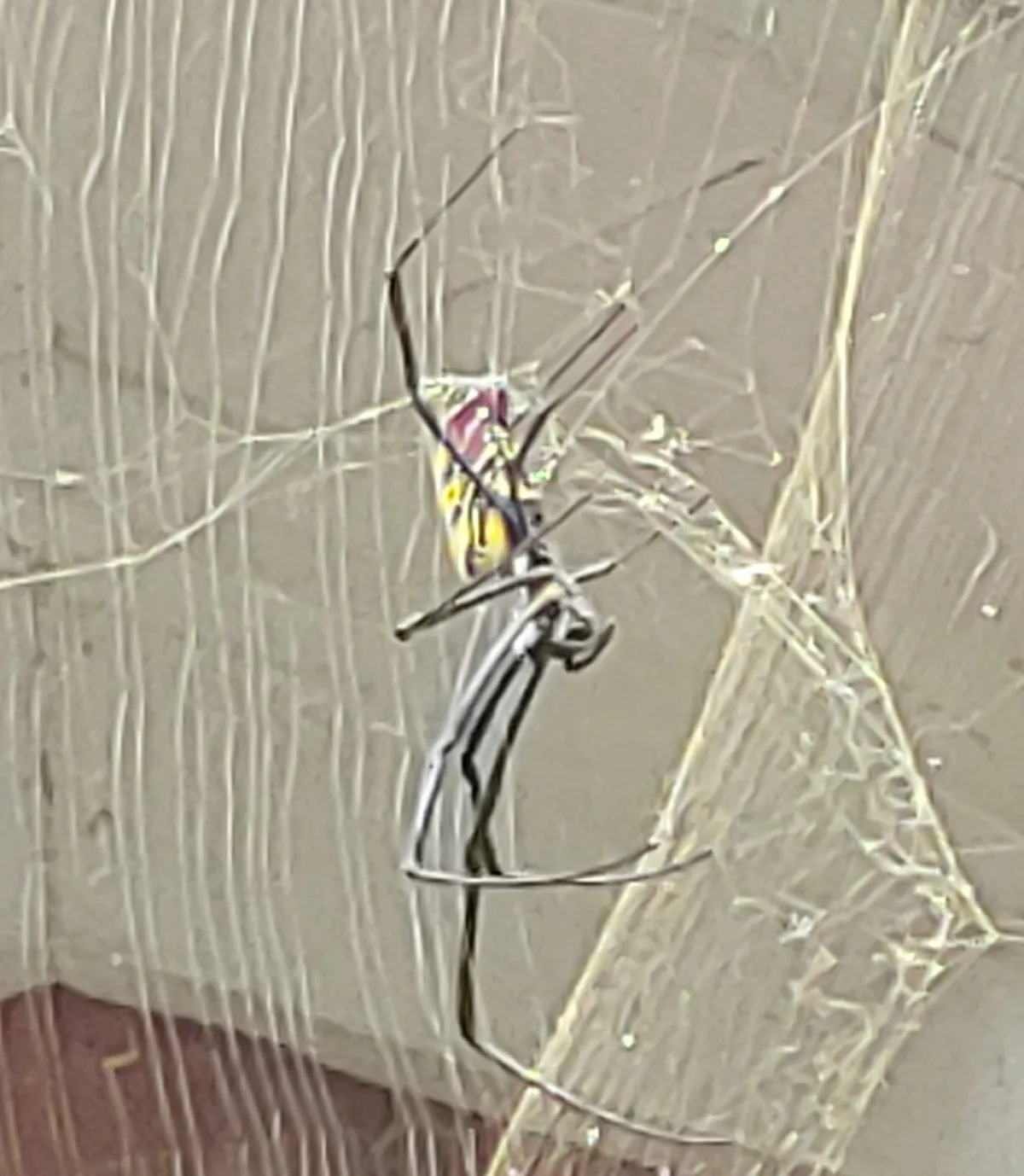
An adult female Joro spider is hard to miss: UGA Extension's Joro spider circular, revised in June 2026, describes a bright yellow abdomen with broad, horizontal bluish-green bands on top, large red markings underneath, and long black legs with yellow-orange bands, or rarely all black legs. Her body is 0.67 to 1.2 inches (17 to 30 mm) long.
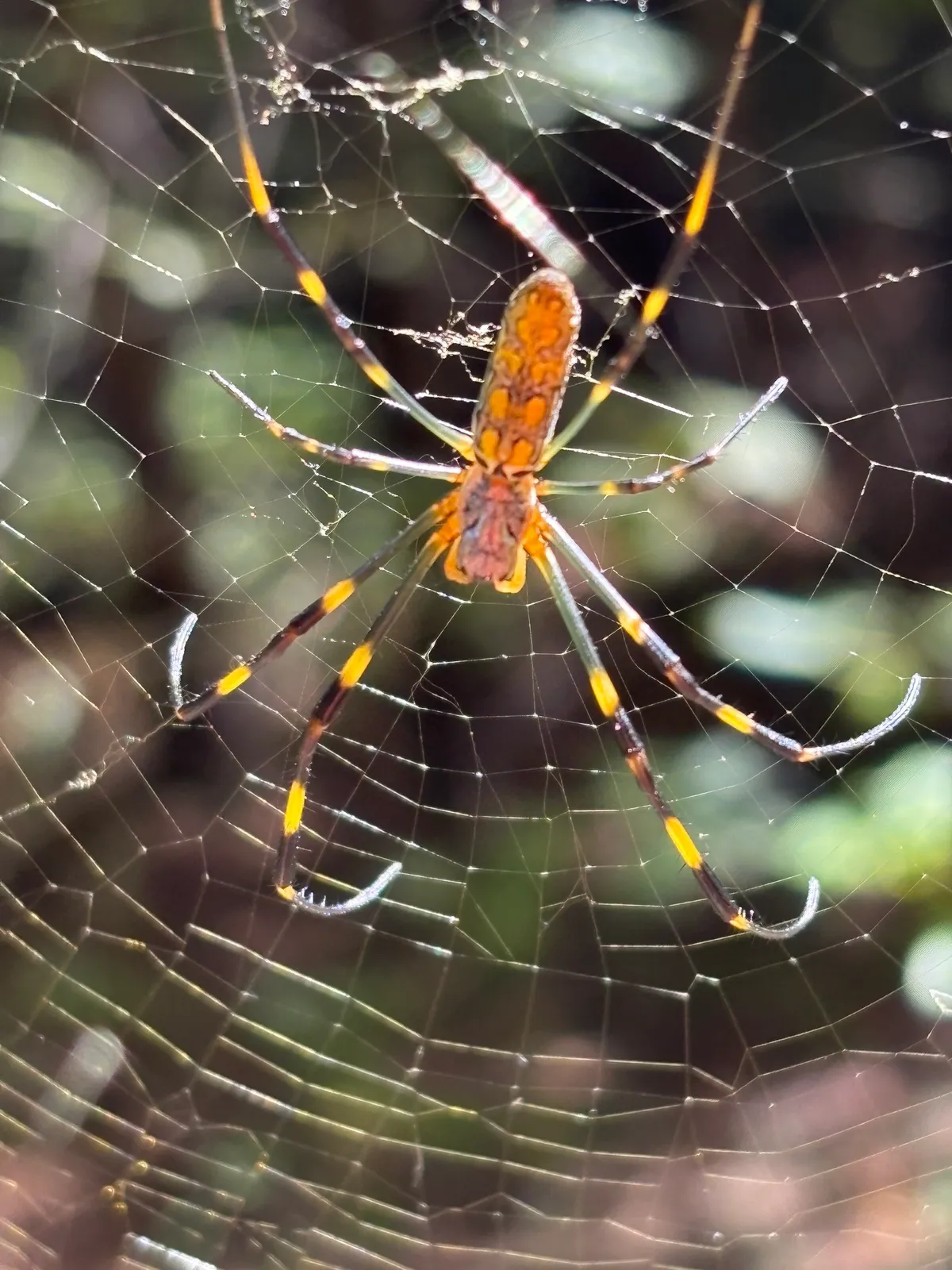
With her legs spread she spans 3 or more inches, Clemson says, or up to 4 inches by Penn State Extension's Jorō spider page, which adds golden or silvery hairs on the front body section. UGA's landscape circular describes the underside as black and white checked, with red splotches near the tail end.
Males look like a different spider: UGA gives them a body of only 0.16 to 0.31 inch (4 to 8 mm), light brown in front with dark stripes and greenish-brown behind with yellow stripes. Females can be as much as 500 times heavier, UGA says, and its researchers have found up to 10 males in one female's web; Penn State says males spin no webs of their own.
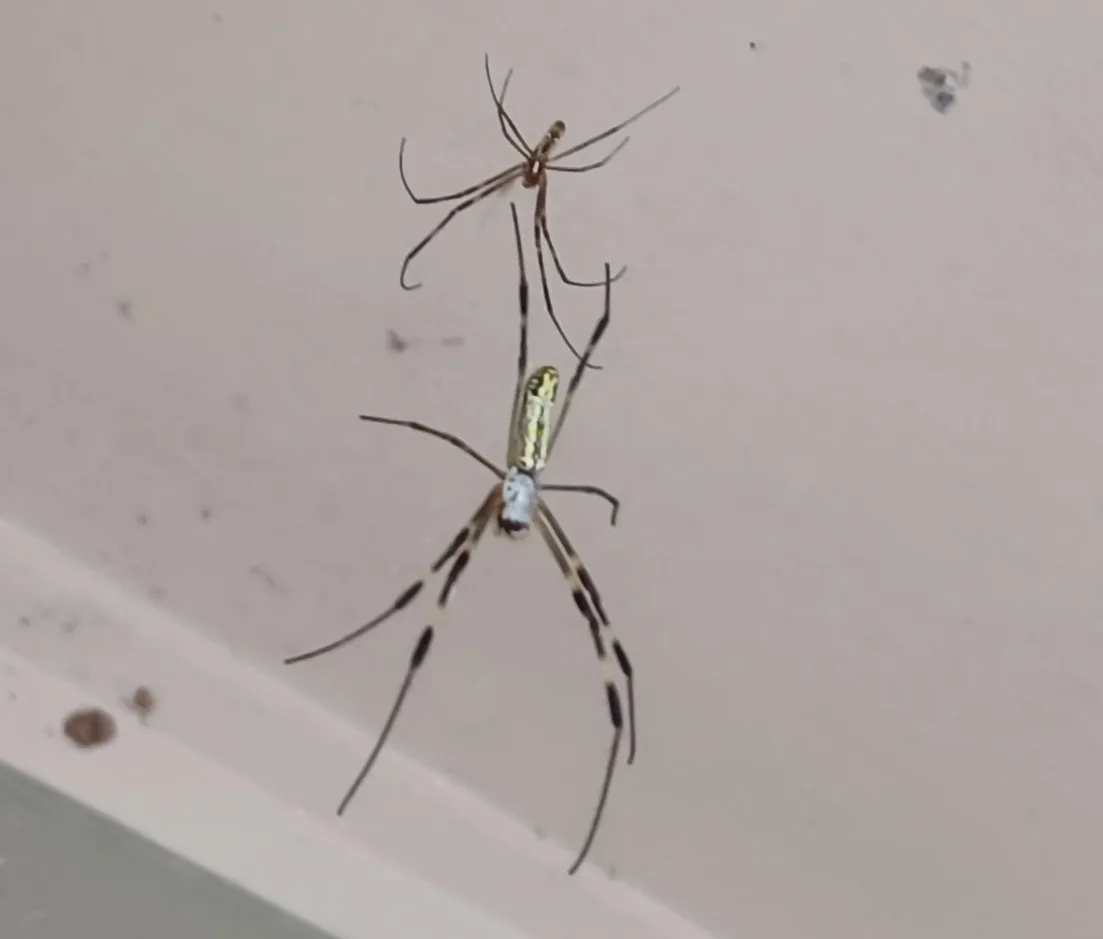
Young spiders are harder to place: Clemson says juveniles often look like native orb weavers, and UGA's landscape circular says females are easy to recognize by mid-August.
Joro spider vs banana spider: how do you tell them apart?
Check the abdomen and the legs. The banana spider, or golden silk orb weaver (Trichonephila clavipes), is the Joro's closest look-alike in the Southeast, UGA says: the female has rows of silvery white spots on her abdomen instead of blue bands, and yellow-orange legs with brown bands, with black tufts of hair at the joints of three of the four pairs. A Joro's legs have no tufts. Penn State compares the tufts to fuzzy leg warmers.
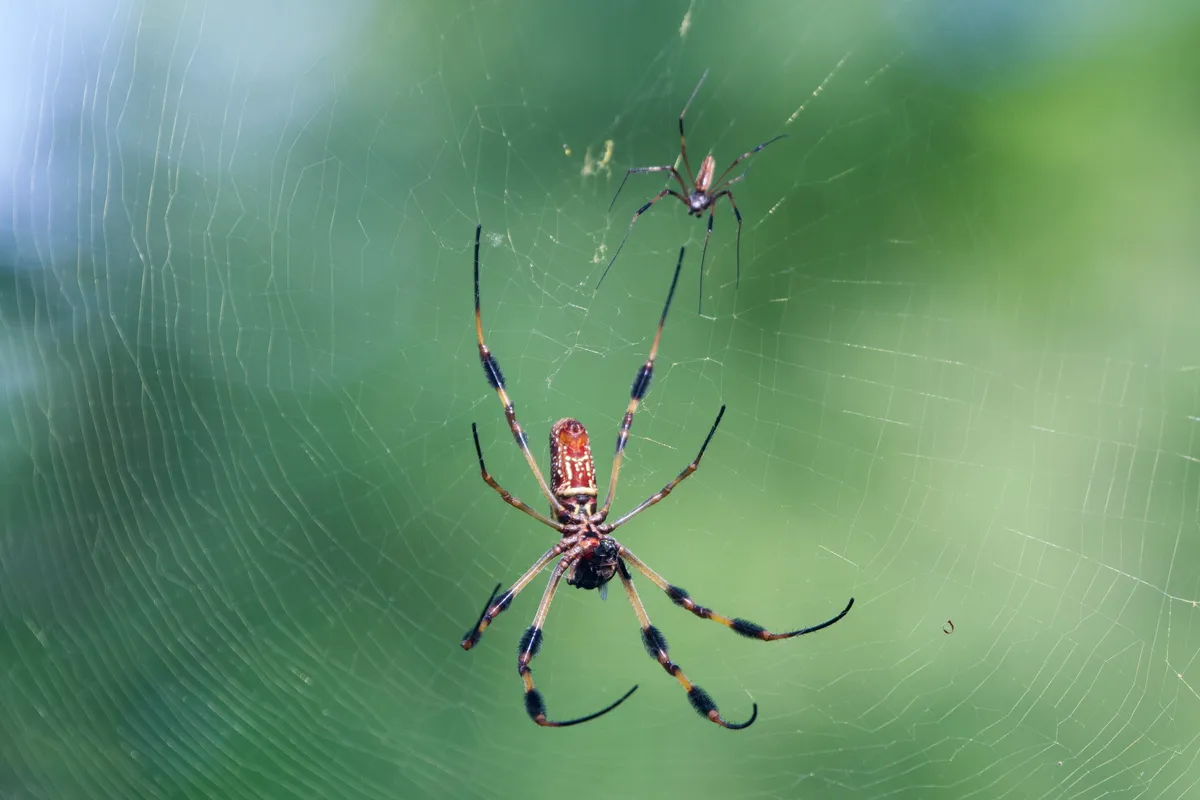
NC State Extension's Plant Disease and Insect Clinic calls the golden silk spider, sometimes called a banana spider, a close relative of the Joro that is most often found near the coast. UF/IFAS's golden silk spider profile gives females a length of nearly 1 to over 1 1/2 inches (24 to 40 mm) and golden webs often 3 to 6 1/2 feet (1 to 2 meters) across.
Where you live is a clue, not proof. UF says the golden silk orb weaver occurs throughout Florida, north to North Carolina and across the Gulf states, and Penn State says it lives mainly on the Coastal Plain and has apparently moved north into southern Virginia, while the Joro has spread from northern Georgia into neighboring states. The guide to spiders in Florida covers the native species.
Could it be a garden spider instead?
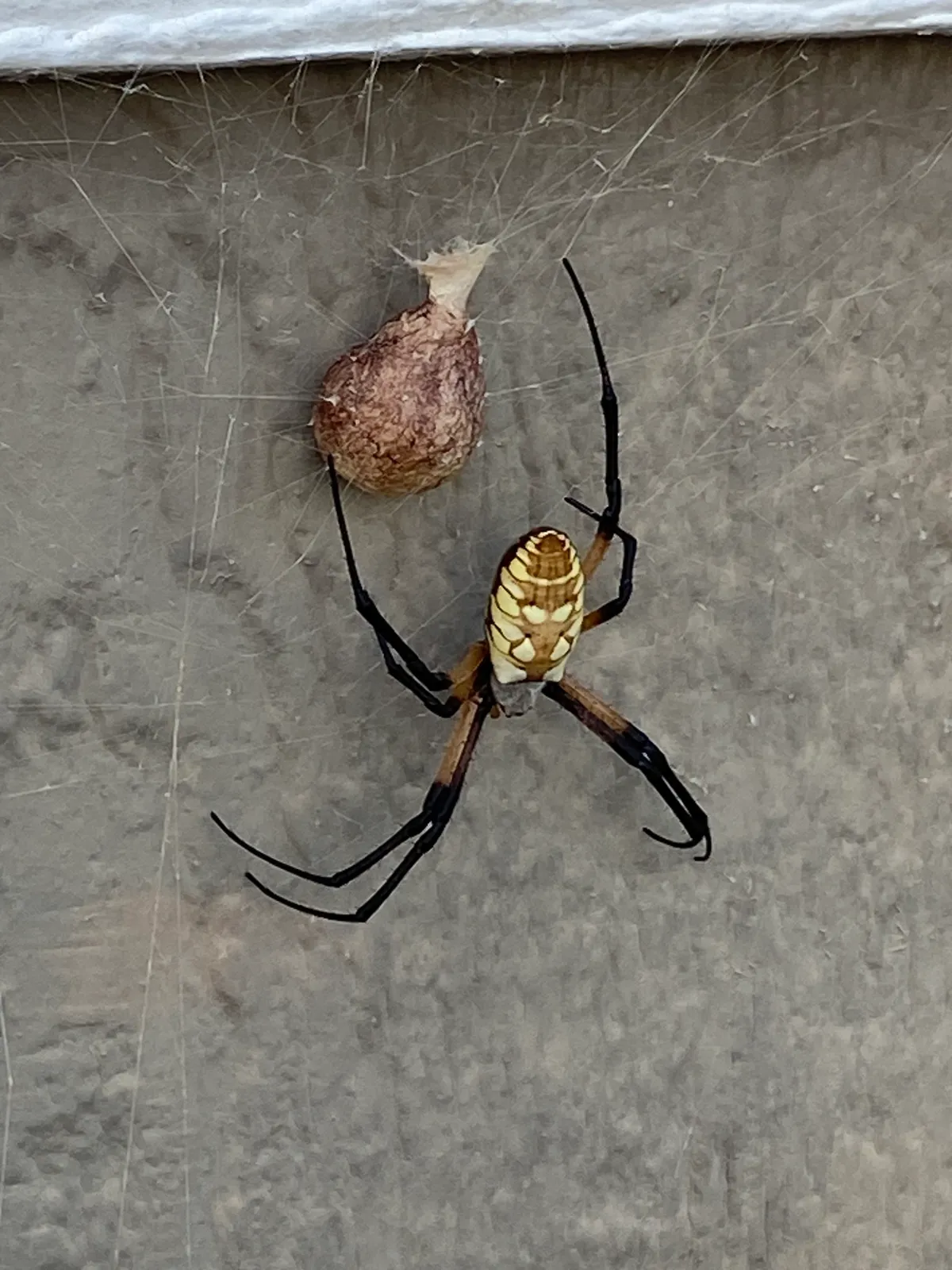
Two native garden spiders also have black, yellow and silver bodies, and both are smaller. UGA describes the yellow garden spider (Argiope aurantia) by its yellow and black abdomen and gives the banded garden spider (Argiope trifasciata) a body of 0.6 to 1 inch, with many thin black, yellow and silvery white bands. Penn State says both occur across the United States, and NC State notes the yellow one is sometimes called a writing spider.
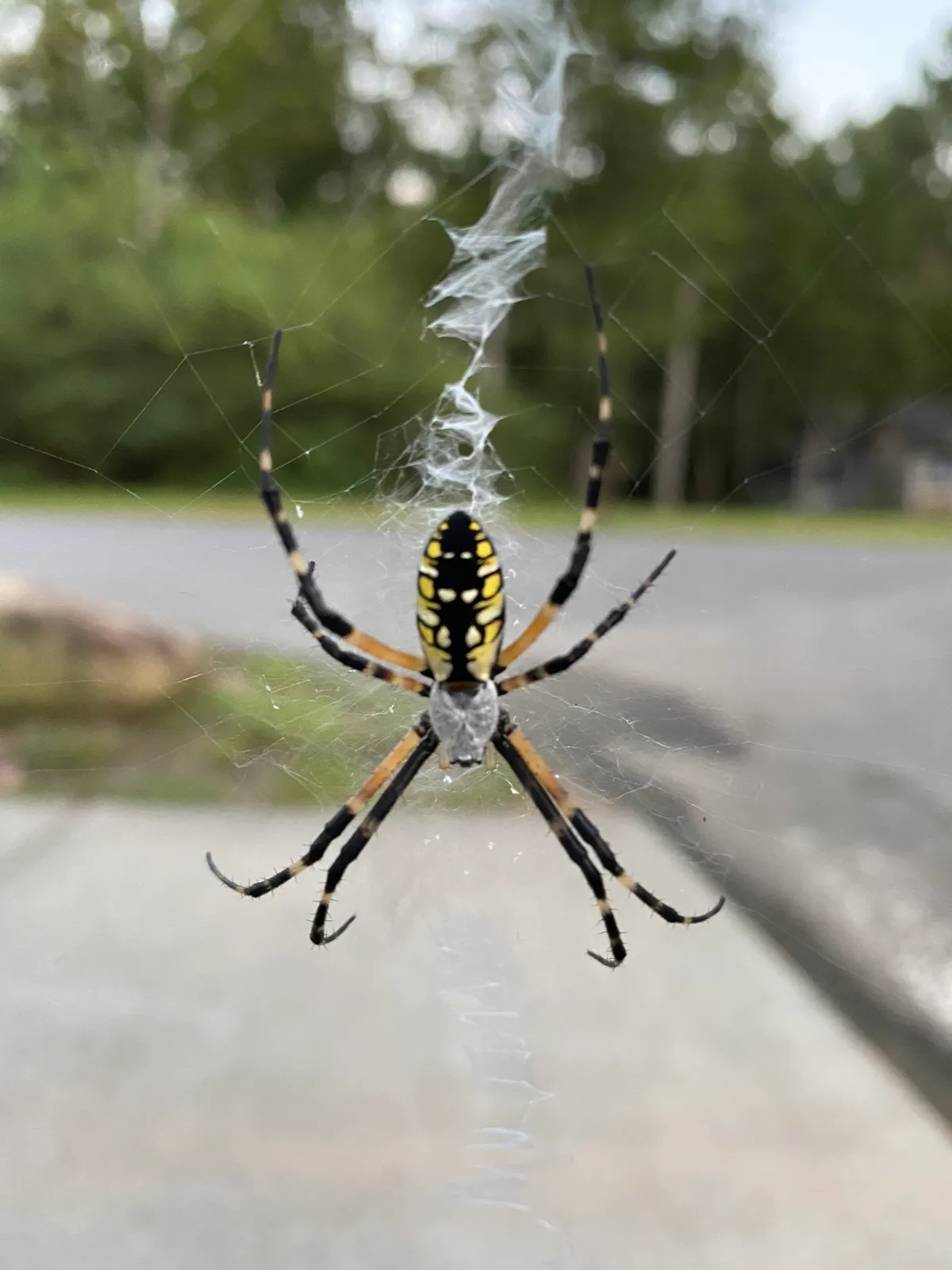
The web is the quickest check. Penn State says garden spiders usually weave a stabilimentum, an obvious band of silk that is often a zigzag, into the web, while Joro spiderlings rarely make one and adults never do. The Missouri Department of Conservation (MDC) gives the yellow garden spider a body of 3/4 to 1 inch and says its web is about 2 feet across, with the zigzag running up and down the center, and that the spider is common near houses and in gardens. NC State adds that it lacks leg tufts and, like the Joro, is usually noticed only when the females mature in mid- or late summer.
NC State's clinic is also sent two other natives as suspected Joros: silver and green orchard spiders, seen in spring and early summer while Joros are still tiny, and the basilica orbweaver, whose web is shaped like an upside-down bowl. The orb weaver guide covers the native web builders, and the spider identifier helps with a spider that fits none of these.
Commonly confused with
- Golden silk orb weaverSpots, not bands, on the abdomen and black hair tufts on three pairs of legs
- Yellow garden spiderSmaller and black and yellow, with a zigzag band of silk through the middle of its web
Photos: Golden silk orb weaver: no rights reserved, via iNaturalist, CC0 1.0. Yellow garden spider: NCBioTeacher, CC0, via Wikimedia Commons, CC0 1.0.
Where are Joro spiders now?
As of June 2026, UGA's circular lists Joro spiders as established in Georgia, North Carolina, South Carolina, Tennessee and Alabama and spreading to adjacent regions, with isolated populations in Maryland, Virginia and Pennsylvania. Penn State's 2026 range map shows an established population around Elkridge, Maryland, that has been there for at least a few years and appears to be expanding.
Where Joro spiders are established, as of UGA Extension's June 2026 revision
- Established
- Isolated populations
- No record
Show the list
Established (5): Alabama, Georgia, North Carolina, Tennessee, South Carolina
Isolated populations (3): Pennsylvania, Maryland, Virginia
No record (43): Alaska, Arizona, Colorado, Florida, Indiana, Kansas, Maine, Massachusetts, Minnesota, New Jersey, North Dakota, Oklahoma, South Dakota, Texas, Wyoming, Connecticut, Missouri, West Virginia, Illinois, New Mexico, Arkansas, California, Delaware, District of Columbia, Hawaii, Iowa, Kentucky, Michigan, Mississippi, Montana, New Hampshire, New York, Ohio, Oregon, Utah, Washington, Wisconsin, Nebraska, Idaho, Nevada, Vermont, Louisiana, Rhode Island
The Joro is native to East Asia, UGA says, and its spread in the US began in northeast Georgia. The first published North American record describes spiders collected around homes in Barrow, Jackson and Madison counties in late October and early November 2014, and UGA's landscape circular says the first population appeared to center on Braselton and Hoschton, along I-85. By 2022 they had spread about 75 miles in all directions, UGA says; Penn State puts the spread from 2014 to 2026 at 50 to 80 miles, about 10 miles a year.
How far north could they spread?
North looks likely. A 2023 study in Ecology and Evolution found that models built from the spider's native range place the most suitable North American habitat north of where it lives now, and that it appears to be spreading faster north than south. Compared with the golden silk orb weaver, the Joro has about double the metabolism and a 77% higher heart rate and can survive a brief freeze that kills many of its relatives, UGA researchers reported in 2022; one of them said it could probably live along most of the Eastern Seaboard. Penn State expects it to reach at least Pennsylvania, and possibly farther north in warmer, coastal areas.
Can Joro spiders fly?
No. The flying spider headlines describe ballooning, and only the babies do it. Clemson says spiderlings climb to a high spot and let out long silk strands that air currents lift, carrying them over potentially long distances, and that this is the only life stage when Joro spiders travel through the air. Joro Watch says ballooning is unlikely for adults, because mature females weigh far more than spiderlings.
How far they go depends on the ride. Penn State says ballooning spiderlings can travel tens to hundreds of miles, especially in strong winds and storms, while Joro Watch says that on their own the spiders may move only a few miles and that fast spread over large areas is likely due to people unknowingly carrying spiders or eggs. NC State Extension in Clay County names vehicles, plants and outdoor equipment as the rides, and UGA Today reported that the chances of a Joro reaching a new place on a car or in luggage are high.
Are Joro spiders dangerous?
Not to people or pets, by every source cited here. Penn State says Joro spiders do not have medically important bites: their fangs are small and have difficulty piercing skin, they are reluctant to bite even when handled, and their weak venom makes a bite less painful than a bee sting, with local pain and redness that fade quickly. Penn State found no published reports of allergic reactions to a bite, though some people may be allergic to the venom.
What its authors believe was the first controlled study of spider bites agrees. In Nelsen and colleagues' 2025 study in the Journal of Medical Entomology, Joro spiders met with escalating contact in the field mostly moved away, and bites were very rare, mainly when a spider was forcibly restrained. Volunteers bitten under medical supervision reported low pain and only local redness and swelling that faded quickly, and the authors concluded the bite should not be a cause for fear.
Clemson's researchers have handled hundreds of Joro spiders and were never bitten from touching webs or spiders or holding them loosely. A bite is most likely when a spider is held tightly, and it may leave a small, red, itchy welt like a mosquito bite or bee sting that usually fades within a day or two; Clemson calls the venom not medically relevant and not known to harm people or pets. See what a spider bite looks like and mosquito bites vs spider bites; the venomous spiders guide covers the widows and recluses, whose bites can be serious.
For any spider bite, Poison Control says to wash it with soap and water, put cold water or a cloth filled with ice on it for 10 to 20 minutes, and watch for signs of infection such as pus or worsening swelling.
When do Joro spiders show up, and what happens in winter?
They hatch in spring but are rarely noticed before late summer. Clemson says the eggs hatch from late April to early May, and UGA says the small juveniles show up as early as May but are hard to spot. Reports pick up in late July and August and peak in September and October: UGA's month-by-month count of all EDDMapS reports up to April 6, 2026 runs from fewer than 50 for May to about 1,660 for August, about 4,800 for September and about 9,800 for October.
Cold ends the season. UGA says egg sacs are laid from mid-October through November, and Clemson says females lay into December, typically before the first major freeze, and that the adults die in winter after the first freeze. The species spends the winter as eggs, UGA's landscape circular says, in sacs UGA describes as dense and white, holding 400 to 500 eggs and attached to leaves, tree bark and human-made structures. There is one generation a year. The spider egg sac guide compares other spiders' sacs.
Are Joro spiders bad for native wildlife?
Nobody knows yet, and the early studies point different ways. UGA's circular says its scientists honestly do not know whether Joros are disrupting ecosystems or displacing native species, and that a new team is working on the question.
Some surveys find fewer native orb weavers where Joros are thick. The 2023 Ecology and Evolution study found the Joro the most common and abundant species in its survey, and its models suggest lower native orb weaver diversity close to where it was first found, though human population density complicates that finding. In forests around Atlanta, a 2025 census published in Insects found Joro numbers doubling each year from 2022 to 2024 while the count of native orb weavers, seven species in all, fell by about 40% a year.
Food may not be the reason. A 2026 diet study in PLOS One, which read prey DNA from spiders collected at 52 sites, found that Joro and native orb weaver diets overlapped but were mostly different, with at least 26 kinds of prey found only in Joros, and that native spiders ate much the same whether or not Joros were present, which does not suggest strong competition.
Joro Watch says there are no confirmed published reports of birds or bats caught in Joro webs, though it suggests removing webs around bird feeders, birdbaths and flowers that hummingbirds visit. The spiders have predators too: University of Florida researchers reported that black and yellow mud daubers collect Joro spiders to feed their young.
What should you do about Joro spiders in your yard?
Mostly, leave them. UGA's landscape circular says spiders at the edges of the yard or in shrub beds where people do not walk can be left alone, and that ones more than about 10 feet up are best ignored. Clemson says Joro spiders are highly unlikely to come inside, although they may build webs on the house. UGA researchers said in 2022 that people should try to learn to live with them.
Where a web blocks a path, porch, deck or doorway, UGA suggests using a broom, rake, long stick or pole to wrap the spider in its web and take it away. A spider that is moved must go a good distance or it will return, UGA says; Clemson gives the example of moving one from a porch to the edge of the woods. Taking down only the web does not work, because the spider rebuilds it quickly. UGA adds that webs should not stay near pollinator or flower gardens or beehives.
Skip the sprays. UGA advises against insecticides over large areas because they also kill pollinators and the predators that keep pests such as aphids, scales and mites in check. Penn State says pesticide controls are not recommended at this point, and NC State says chemical control is not advised because the spiders are not aggressive. Keeping spiders out of the house covers the spiders that do come indoors, and how to get rid of spiders covers bigger spider problems.
Report what you see. UGA asks people to report sightings, with photos if they can, to Joro Watch or through the EDDMapS app, and Joro Watch says that looking and not finding one is worth reporting too. In North Carolina, NC State Extension asks residents to post photos to iNaturalist, from the top and underside if possible, with the date, place and habitat.
This guide is general educational information, not medical advice. If you have symptoms or concerns after a bite or exposure, contact a healthcare provider.
Frequently Asked Questions
How venomous is the Joro spider?+
Not enough to matter to people. All spiders are venomous, Joro Watch notes, and Joros use their venom on prey. Penn State Extension calls the venom weak and says Joro bites are not medically important, and Clemson researchers call it not medically relevant and not known to harm people or pets. In a 2025 controlled study in the Journal of Medical Entomology, volunteers bitten under medical supervision reported low pain and only local redness and swelling that faded quickly.
What happens if you are bitten by a Joro spider?+
Usually a small, red, itchy welt. Clemson researchers say a bite may leave a welt like a mosquito bite or bee sting that usually fades within a day or two, and Penn State says it causes only local pain and redness that go away without treatment. Poison Control advises washing any spider bite with soap and water and cooling it for 10 to 20 minutes. Mayo Clinic says to get care right away for severe pain, a growing wound, trouble breathing or swallowing, or spreading redness or red streaks.
Should Joro spiders be killed?+
Extension advice says to deal only with the ones in the way. UGA's landscape circular says the most direct way to eliminate a problem spider is to kill it, and, for homeowners who can tolerate some spiders, recommends removing and killing those whose webs are on or beside porches, walkways, decks and doorways and leaving those at the yard's edge alone. UGA researchers urged people in 2022 to learn to live with them, and UGA Today reported that there is really nothing anyone can do to stop their spread.
Do Joro spiders go in houses?+
Rarely. Clemson Extension says Joro spiders are highly unlikely to come inside your home, though they may build webs on the house or other structures. UGA says the webs are common at the edges of habitats, such as the perimeter of a park or yard, and between power lines, and Clemson lists forest edges, parks, roadside plants, yards with trees, buildings and streetlights. A web across a door or porch can be moved with a broom or long stick, as UGA describes.
What animal kills Joro spiders?+
Mud dauber wasps are one documented predator. University of Florida researchers reported that black and yellow mud daubers, which paralyze spiders and pack them into mud nests to feed their young, collect Joro spiders. UGA researchers suggested in 2022 that Joros may also be extra food for native predators such as birds. The adults themselves do not outlive winter: Clemson says they die after the first freeze, and the next generation hatches from eggs in spring.
Can Joro spiders fly?+
No. What headlines call flying is ballooning, and only the tiny spiderlings do it. Clemson Extension says young spiders climb to a high spot and release silk strands that air currents lift, sometimes carrying them long distances, and that this is the only life stage when Joro spiders travel through the air. Joro Watch says it is unlikely for adults, which weigh far more. Penn State says ballooning spiderlings can travel tens to hundreds of miles in strong winds and storms.
How big is a Joro spider?+
An adult female's body is 0.67 to 1.2 inches (17 to 30 mm) long, UGA Extension says, and with her legs spread she spans 3 or more inches by Clemson's measure, or up to 4 inches by Penn State's. Males are far smaller: UGA gives them a body of 0.16 to 0.31 inch (4 to 8 mm) and says females can be as much as 500 times heavier. Females reach full size in late summer, and UGA says they are easy to recognize by mid-August.
Is a banana spider the same as a Joro spider?+
No, but they are close relatives. Banana spider is a common name for the golden silk orb weaver, a native of the Southeast that NC State Extension calls a close relative of the Joro. UGA Extension says the female golden silk orb weaver has rows of silvery white spots instead of the Joro's blue bands, and black tufts of hair at the joints of three pairs of legs, which the Joro lacks. UF/IFAS says the golden silk orb weaver bites only if held or pinched, and less severely than a bee sting.
What states have Joro spiders?+
As of UGA Extension's June 2026 revision, Joro spiders are established in Georgia, North Carolina, South Carolina, Tennessee and Alabama and spreading to adjacent regions, with isolated populations in Maryland, Virginia and Pennsylvania. Penn State Extension's 2026 range map shows the Maryland population, around Elkridge, appearing to expand. Single spiders found in Oklahoma in 2021 and California in 2025 do not by themselves mean an established population, Penn State says. The range is still growing, so check the date on any map.
What happens to Joro spiders in the winter?+
The adults die. Clemson Extension says females lay their eggs into December, typically before the first major freeze, and that the adult spiders die in winter after the first freeze. The species spends the winter as eggs, in dense white silk sacs of 400 to 500 eggs that UGA says are attached to leaves, tree bark and human-made structures. Clemson says the spiderlings hatch from late April to early May, and UGA says there is one generation a year.
Sources
- Joro Spider: Trichonephila clavata (Circular 1273; R. D. Wallace, R. Hoebeke and J. Schmidt; published with minor revisions June 16, 2026) — University of Georgia Cooperative Extension
- Managing Joro Spiders in the Landscape (Circular 1289; S. V. Joseph and J. Schmidt; published with full review August 27, 2026) — University of Georgia Cooperative Extension
- The Jorō Spider (HGIC 2517; B. Biggs, A. Chuang and D. Coyle, published November 21, 2024) — Clemson Cooperative Extension Home & Garden Information Center
- Jorō Spiders (updated September 8, 2025; range map dated 2026) — Penn State Extension
- Joro Spider Questions: Identification, Bites & Spread (FAQ, last updated September 2026) — Joro Watch, Center for Invasive Species and Ecosystem Health, University of Georgia
- Joro spiders likely to spread beyond Georgia (Leigh Hataway, March 3, 2022) — UGA Today, University of Georgia
- Joro Spider (Tyler Osborn, October 6, 2025) — NC State Extension, Clay County Center
- Similar but Different: These Are NOT Joro Spiders (Matt Bertone, July 17, 2024) — NC State Extension, Plant Disease and Insect Clinic
- Golden Silk Spider, Trichonephila clavipes (EENY229; H. V. Weems Jr. and G. B. Edwards Jr.) — University of Florida, UF/IFAS Featured Creatures
- Black-and-Yellow Garden Spider (field guide, reviewed December 30, 2024) — Missouri Department of Conservation
- Nephila clavata L Koch, the Joro Spider of East Asia, newly recorded from North America (E. R. Hoebeke, W. Huffmaster and B. J. Freeman; PeerJ, 2015; abstract) — PeerJ, via PubMed (National Library of Medicine)
- Veni, vidi, vici? Future spread and ecological impacts of a rapidly expanding invasive predator population (D. R. Nelsen and others; Ecology and Evolution, November 2023; abstract) — Ecology and Evolution, via PubMed (National Library of Medicine)
- Explosive Growth of the Jorō Spider and Concurrent Decline of Native Orbweaving Spiders in Atlanta, Georgia Forests (R. W. Pemberton; Insects, April 2025; abstract) — Insects, via PubMed (National Library of Medicine)
- DNA metabarcoding to estimate diet overlap between the introduced Joro spider and three native orb-weaving spiders (E. E. Grabarczyk and J. M. Schmidt; PLOS One, June 2026; abstract) — PLOS One, via PubMed (National Library of Medicine)
- Keep calm and carry on: bites from Trichonephila clavata are unlikely and cause minimal discomfort (D. R. Nelsen and others; Journal of Medical Entomology, November 2025; abstract) — Journal of Medical Entomology, via PubMed (National Library of Medicine)
- UF/IFAS uses wasps to monitor exotic Joro spider (Erin C. Powell, September 23, 2016) — UF/IFAS News, University of Florida
- Spider bites: Symptoms and causes (July 30, 2021) — Mayo Clinic
- Insect and spider bites: When to worry (Wendy Klein-Schwartz) — Poison Control (National Capital Poison Center)
How this guide was made: it was researched and drafted with AI assistance from the sources listed above. A second, independent AI pass then checked each factual claim against those sources. Found an error? Email support@buzzskito.ca.