Published by BuzzSkito Mosquito & Tick Control
Published October 28, 2026 · Fact-checked against the sources listed below
What do baby rats look like?
A newborn rat is a tiny, hairless pup with its eyes shut, and within about two weeks it has a coat of fur and open eyes. ICWDM's Norway rat biology page says newborn rats are hairless with their eyes closed but grow rapidly, and the Merck Veterinary Manual's guide to rat breeding says baby rats are born deaf and blind. Animal Diversity Web, a species database at the University of Michigan Museum of Zoology, gives the Norway rat an average birth weight of 5 grams, under 1/5 ounce.
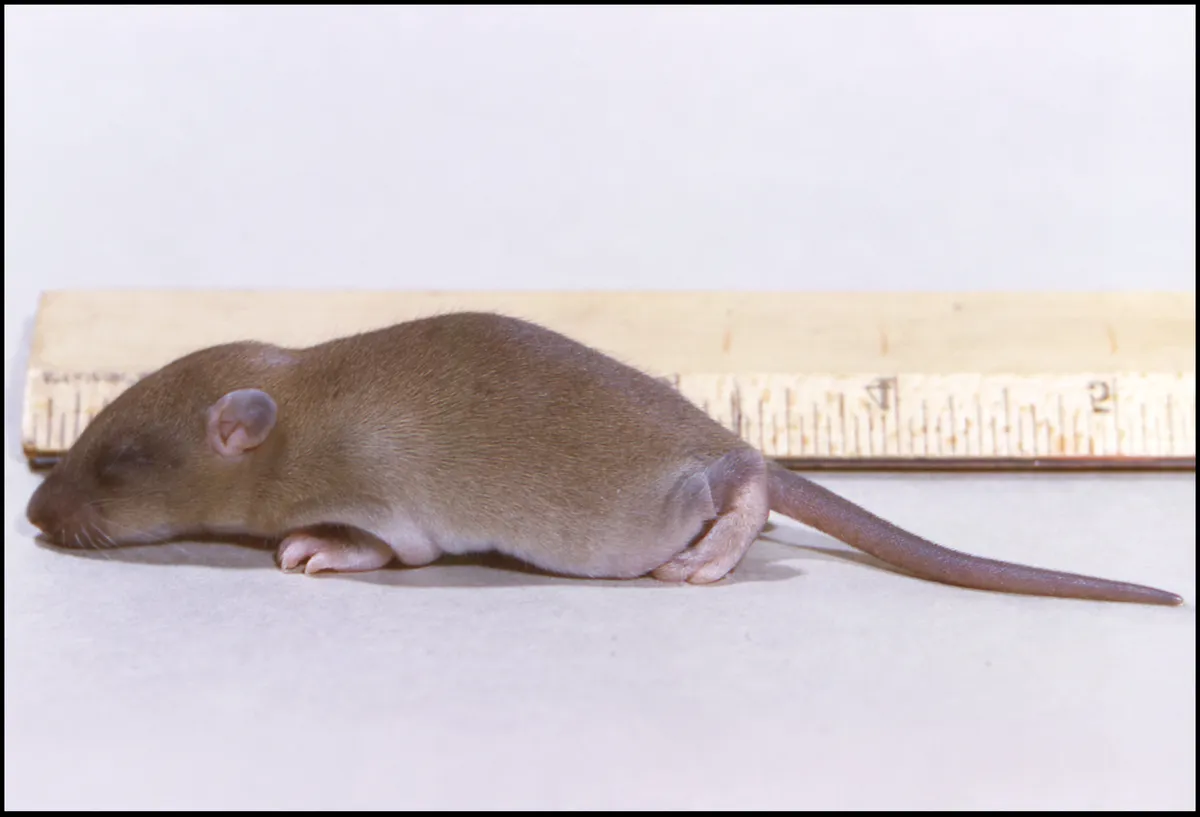
Fur comes first, then the eyes open. ICWDM's roof rat biology page says roof rat pups grow hair within a week and open their eyes between 9 and 14 days, when they begin to explore and move about near the nest. Norway rats take a little longer: the Smithsonian's National Zoo says brown rat young take about two weeks to open their eyes, and Animal Diversity Web gives 14 to 17 days.
Look at the proportions, not just the size. UC IPM's rat Pest Notes say very young rats have large heads and feet in proportion to their bodies, and Arkansas Extension's guide to controlling mice and rats singles out the hind feet: a young rat has larger hind feet and a larger head for its body than a house mouse. That is the quickest check when a small rodent could be either, and the side-by-side guide to rats and mice covers the rest, from tails to droppings.
How fast do baby rats grow up?
Fast: a Norway rat goes from hairless newborn to independent in about 3 to 4 weeks and can breed at about 3 months. ICWDM says Norway rat young eat solid food at 2 1/2 to 3 weeks and become independent at about 3 to 4 weeks, and the National Zoo says the young nurse for three to four weeks and then leave the nest.
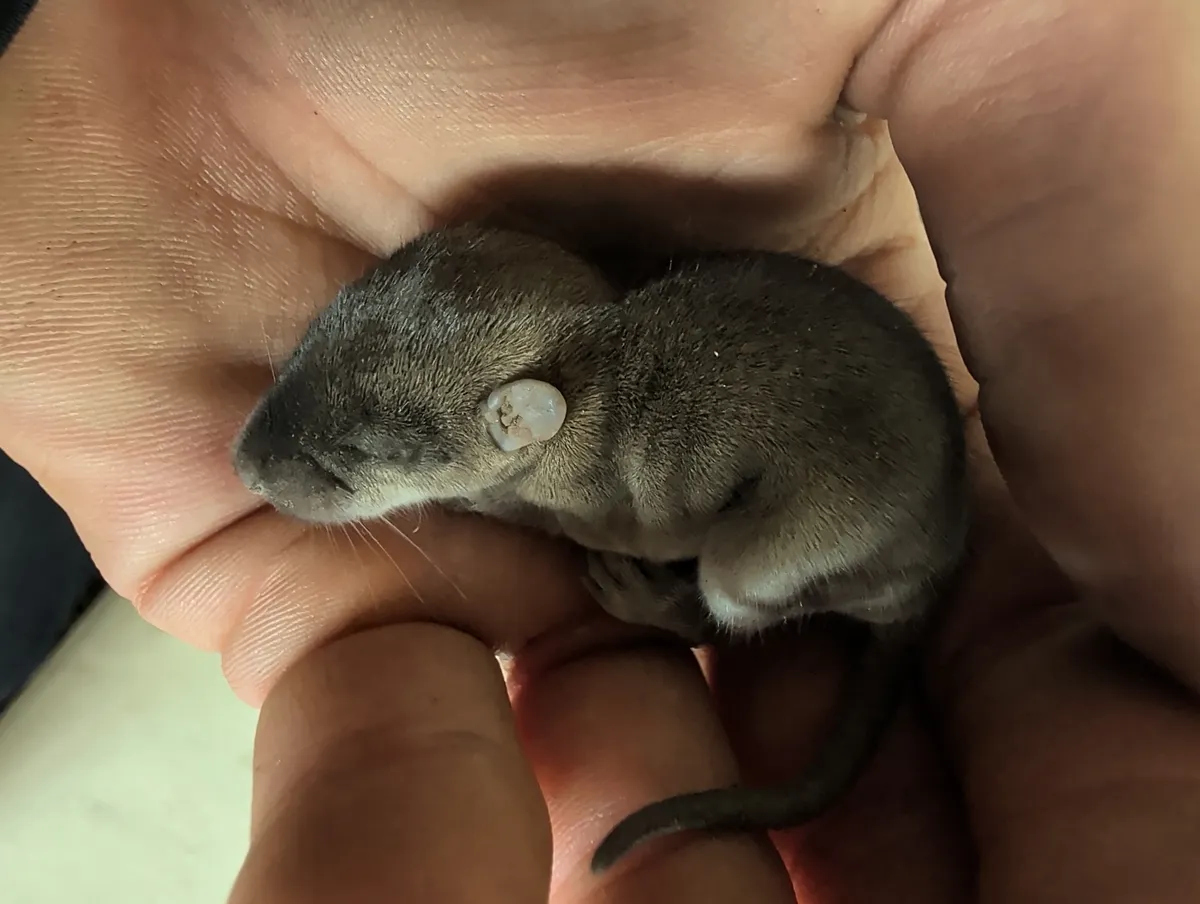
Roof rats stay with their mother a little longer. ICWDM says roof rat pups begin taking solid food in their third week, may keep nursing until 4 or 5 weeks old, and are completely independent and able to breed at about 3 months. Wild Norway rats are sexually mature at 3 months too, and a female can mate again within a day or two of giving birth. How long rats live and how fast they breed follows the whole life cycle.
Norway rat or roof rat pups?
Roof rat pups come in smaller litters and open their eyes sooner: ICWDM gives 5 to 8 young per roof rat litter, with eyes opening at 9 to 14 days, against 6 to 12 per Norway rat litter, whose eyes open at about 2 weeks according to the National Zoo. The grown rats differ more plainly: Arkansas Extension describes the roof rat as sleeker, with larger ears and a tail longer than its body, and the Norway rat as a stocky burrower whose tail is shorter than its body. The side-by-side guide to roof rats and Norway rats compares them in detail.
What else gets mistaken for baby rats?
Baby mice, adult house mice, voles and shrews can all be mistaken for baby rats, and each has a tell:
- Baby mice. Mouse litters average 4 to 7 young, Arkansas Extension says, and a young rat has larger hind feet and a larger head for its body than a mouse; the guide to baby mice shows mouse pups day by day.
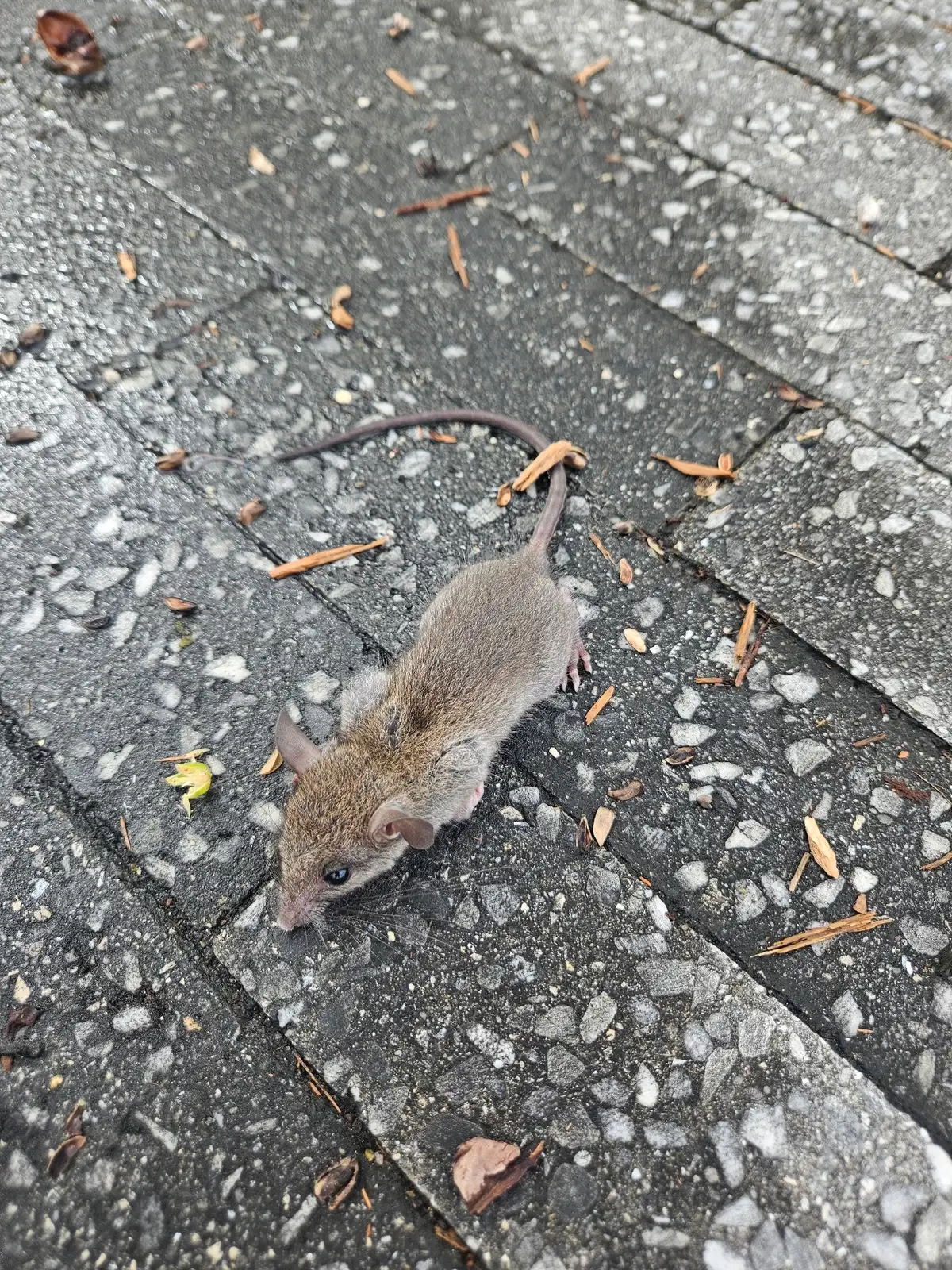
- Adult house mice. At 5 to 8 inches with the tail (Arkansas Extension), an adult mouse is about as long as CDC's 2-week-old rat, so judge proportions, not length.
- Voles. UC IPM's vole Pest Notes describe a compact, heavy body, short legs, a short furred tail, small eyes and partly hidden ears; voles live in dense vegetation and usually do not enter homes. See the vole guide.
- Shrews. Not rodents at all: the Missouri Department of Conservation describes a pointed snout that reaches past the mouth, tiny black eyes and ears hidden in the fur. See the shrew guide.
If the animals turn out to be mice, the complete guide to mice covers them from identification to control.
Commonly confused with
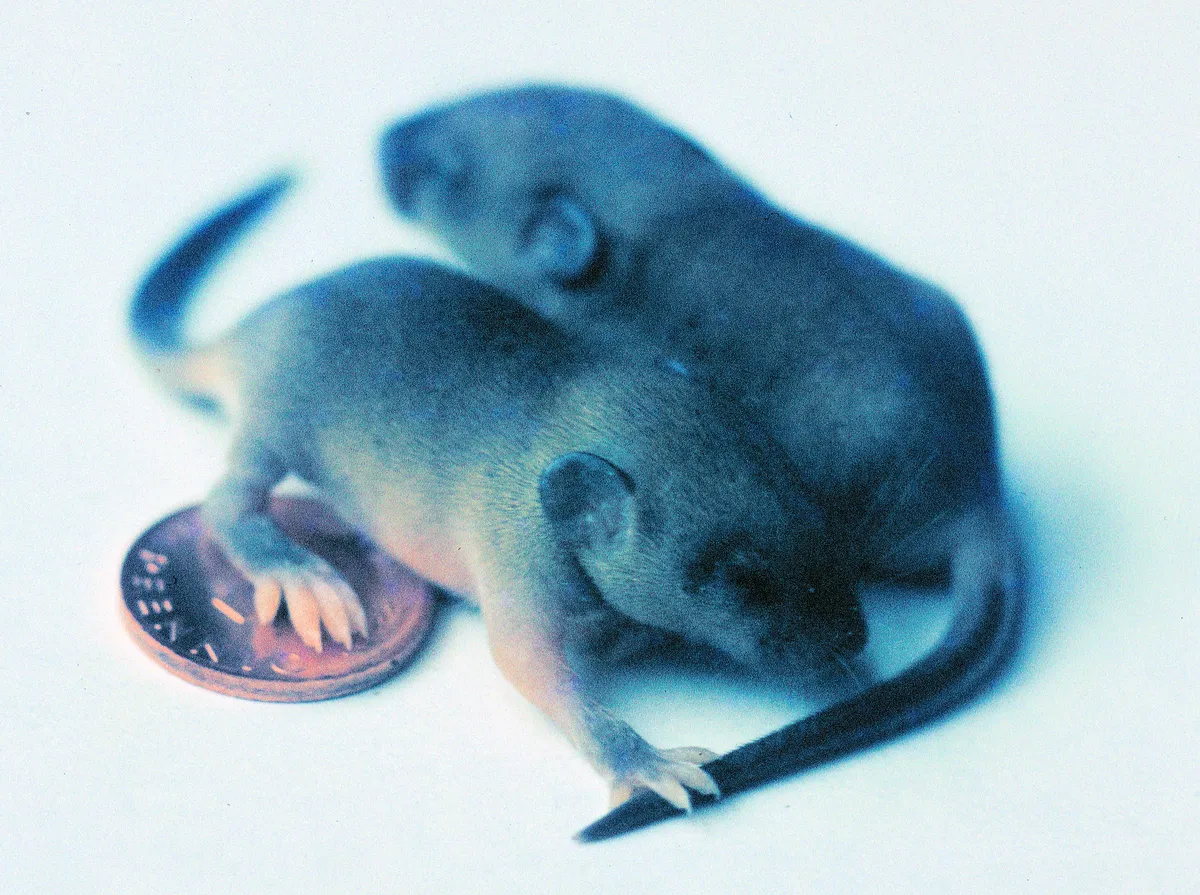 Baby mouseSmaller hind feet and head for its body than a young rat; litters average 4 to 7
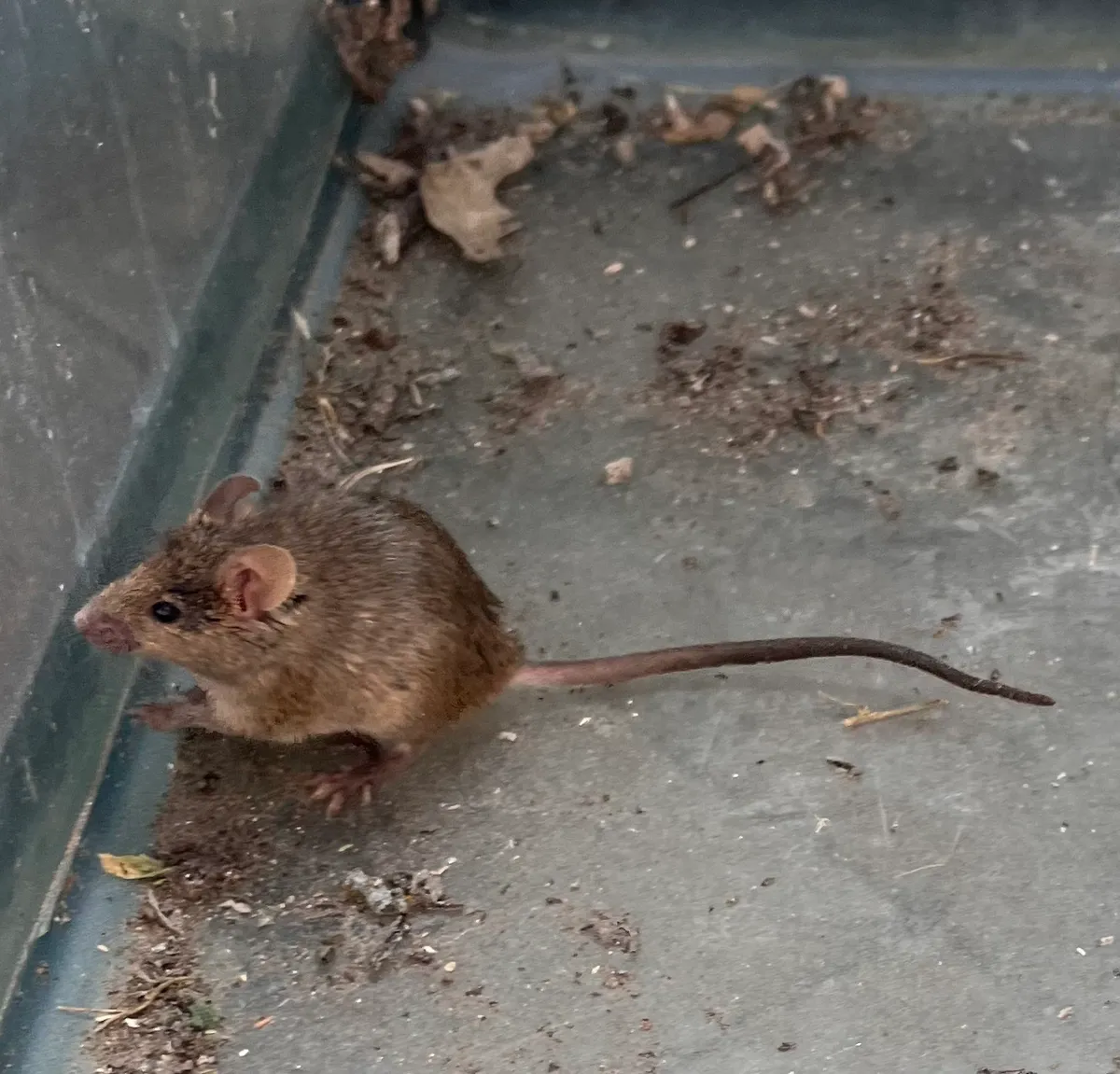 House mouseAbout 5 to 8 inches long with its tail as an adult, with a small head and feet for its body
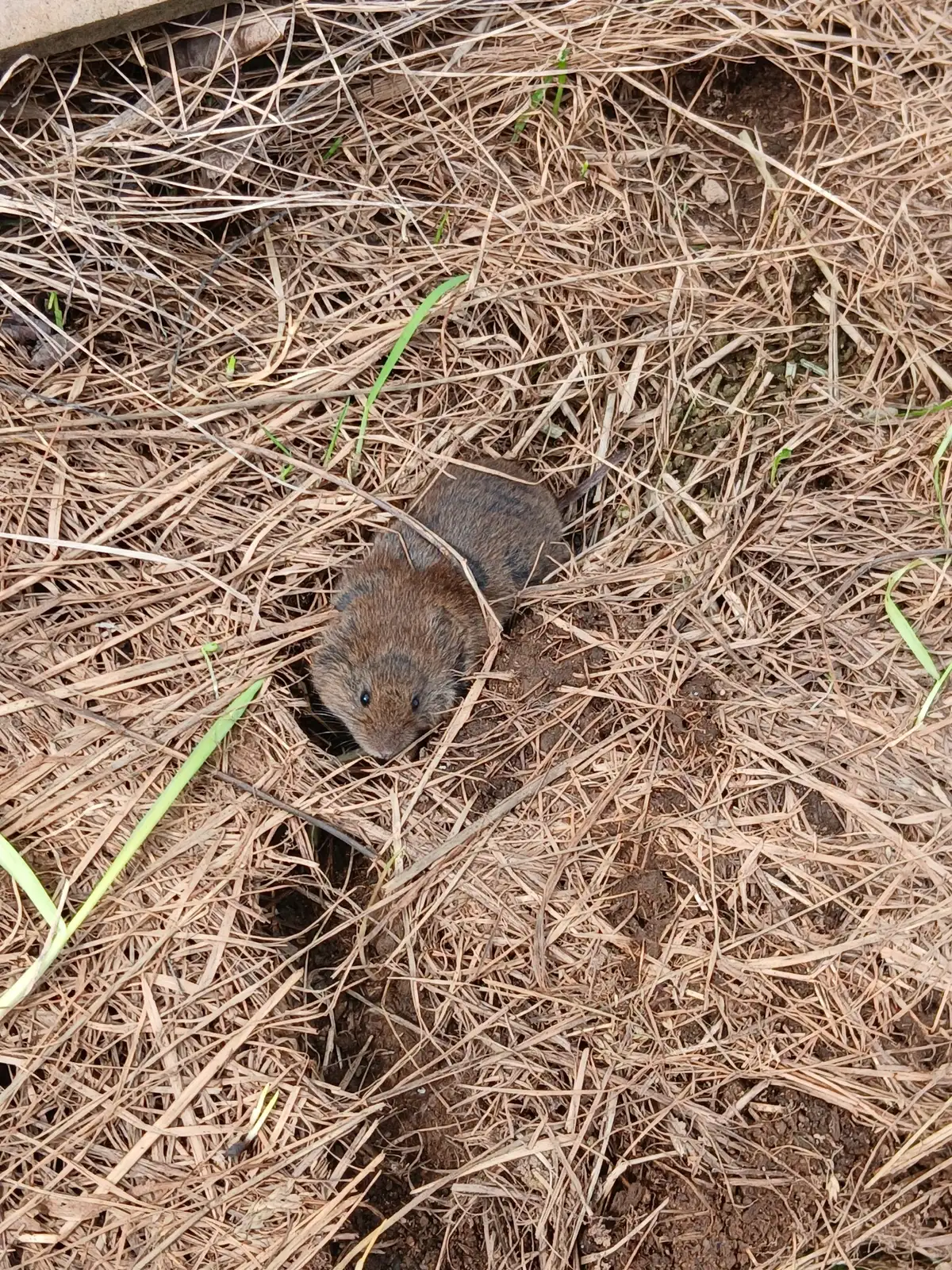 VoleStocky, with a short furred tail, small eyes and partly hidden ears; rarely indoors
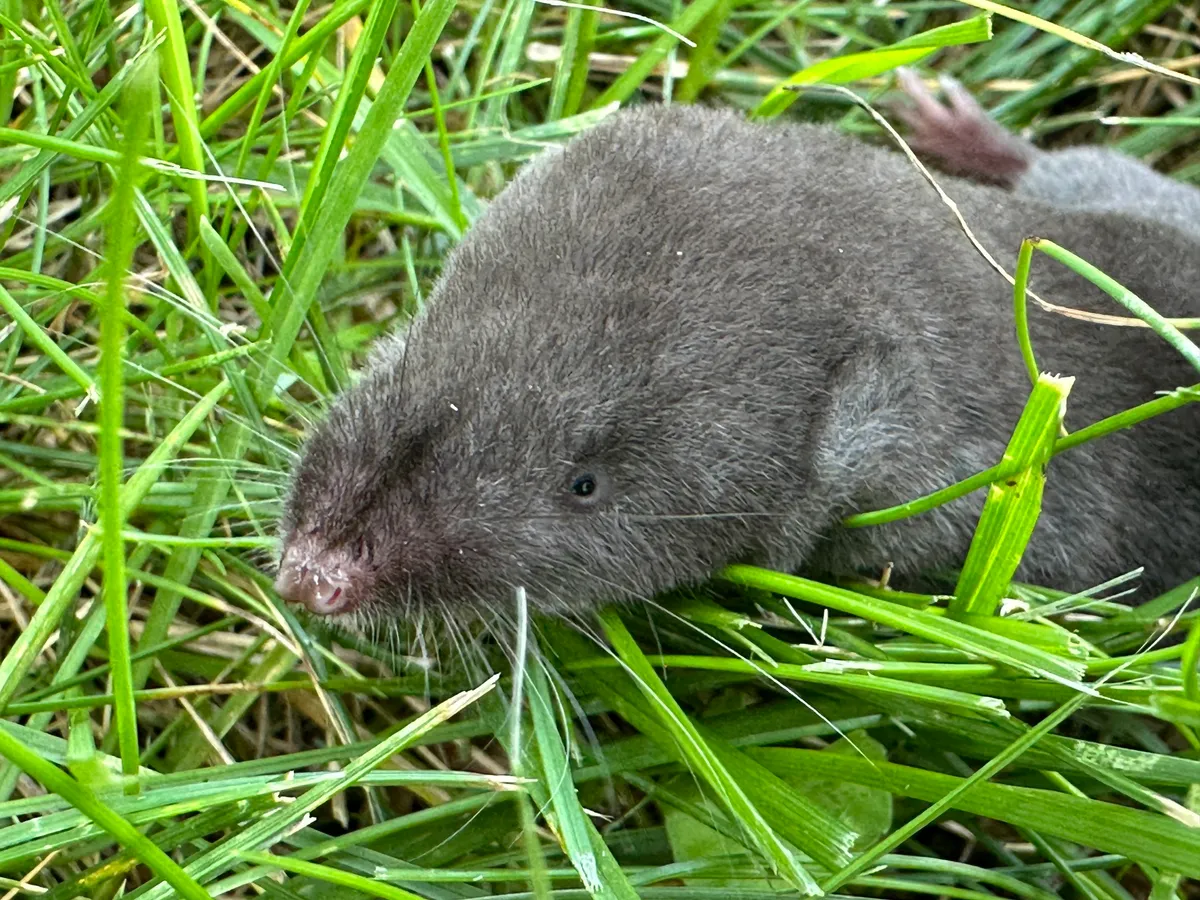 ShrewNot a rodent: a pointed snout that reaches past the mouth, and tiny eyes
Photos: Baby mouse: Gerbil, CC BY-SA 4.0, via Wikimedia Commons, CC BY-SA 4.0. House mouse: no rights reserved, via iNaturalist, CC0 1.0. Vole: (c) Ian Murdoch, some rights reserved (CC BY), via iNaturalist, CC BY 4.0. Shrew: (c) Meghan Cassidy, some rights reserved (CC BY-SA), via iNaturalist, CC BY-SA 4.0.
Where do rats have their babies?
Norway rats usually raise their young low down, in burrows, and roof rats up high. ICWDM says Norway rats usually nest in burrows below ground or at ground level, and the nests may be lined with shredded paper, cloth or other fibrous material; females may share a burrow and raise their young together, and in northern climates rats prefer nest sites near a source of heat.
Those burrows turn up under buildings and concrete slabs, along stream banks and in dumps, ICWDM says, and UC IPM adds foundations, rubbish and woodpiles, and gardens; indoors, Norway rats usually stay in basements and on ground floors. Roof rats usually nest off the ground, UC IPM says: in shrubs, trees and ivy outdoors, and in attics, wall voids, ceiling voids and cabinets indoors.
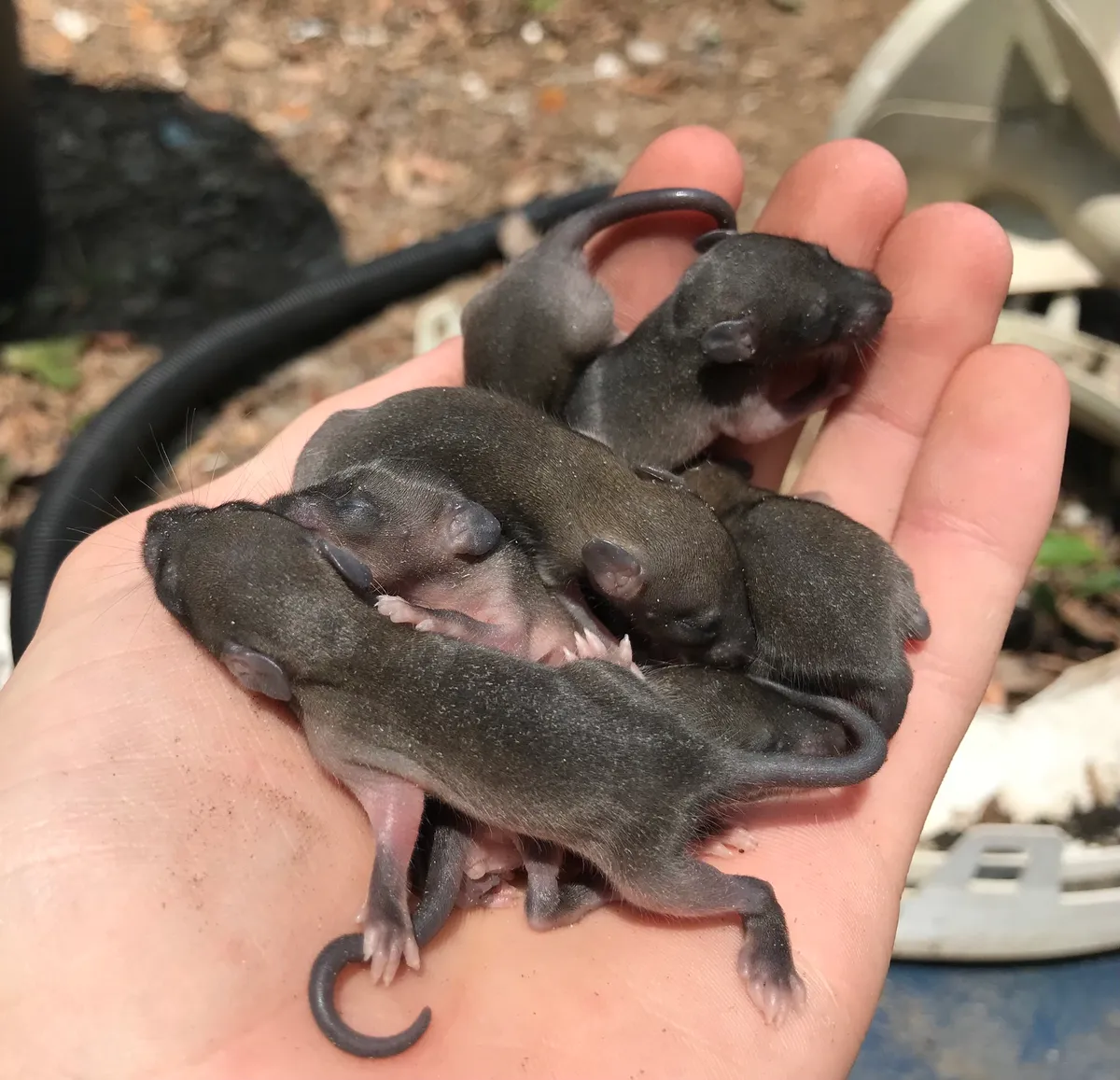
Very young pups do not wander far: ICWDM says roof rat pups begin to move about near the nest only once their eyes open, so a pup whose eyes are still closed has not started roaming, and its nest is likely close by. What a rat nest looks like has its own guide, and noises overhead are sorted by time of day in the guide to animals in the attic.
What does finding baby rats mean?
It means rats are breeding on the spot, and probably that there are more of them than you have seen. A litter is a mother and 6 to 12 young for a Norway rat, or 5 to 8 for a roof rat, and ICWDM says a Norway rat female has 3 to 6 litters a year. UC IPM says the average female Norway rat can wean 20 or more young a year.
ICWDM's guide to identifying Norway rat damage says rats are normally active at night and wary of people, so many more are usually present than are seen. Signs give only a rough count, it cautions, but fresh droppings, tracks and gnawing with three or more rats seen at night point to large numbers, and so do rats seen by day. The guide to rat droppings shows how to tell fresh droppings from old.
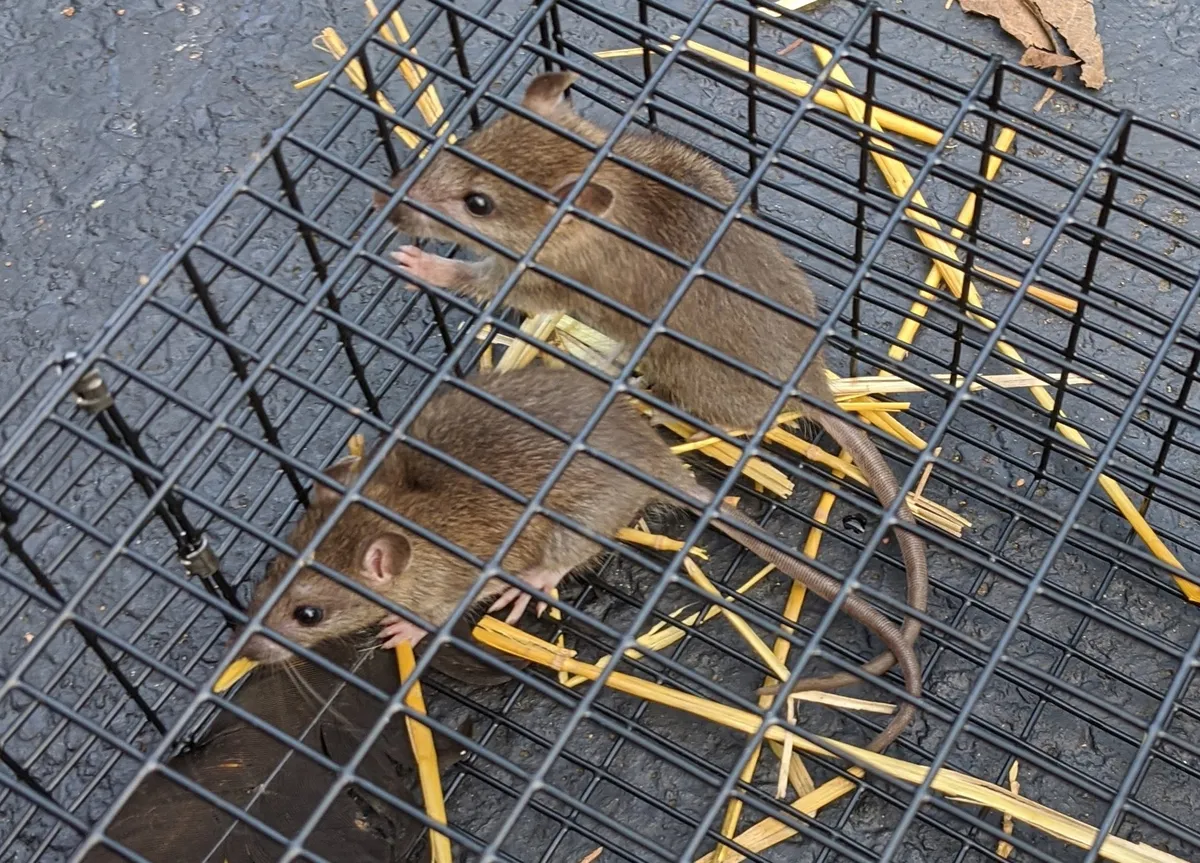
ICWDM says Norway rat breeding often peaks in spring and fall and often stops in winter, depending on habitat, while roof rats in tropical or semitropical regions may breed nearly year-round. And roof rats come back to old nests: UC IPM says that if nest sites are not removed, the rats will return to them.
Can baby rats make you sick?
Treat them as you would any wild rat. CDC's rodent pages, which do not single out young rats, describe diseases that spread through bites and scratches and through urine, droppings, saliva and nesting material:
- Rat-bite fever. CDC's rat-bite fever page says it spreads through scratches, bites and contact with a rodent's saliva or urine; symptoms, usually fever, vomiting, headache and muscle pain, start 3 to 10 days after contact, sometimes as late as 21.
- Leptospirosis. It spreads through the urine of infected animals, rats and mice among them, says CDC's leptospirosis page, and illness can start 2 to 30 days after contact.
- Seoul virus. This hantavirus is carried mainly by Norway rats and has been found in wild and pet rats in the United States, according to CDC's guidance for veterinarians; infected rats show no signs of illness and can shed it in urine, droppings and saliva for months.
- Fleas and mites. CDC notes that fleas are common on rodents (the guide to fleas on people explains whether they can live on you), and the Merck Veterinary Manual describes an itchy, red, bumpy rash in people caused by the tropical rat mite; see the guide to rat mites.
- Not rabies. UC IPM says commensal rats and mice, the kinds that live around people, do not carry or transmit rabies.
What if your pet rat had babies?
Pet rats are the same species as the wild Norway rat, bred as pets in white, black or brown, the National Zoo says, but Merck's figures for pet rats differ from the wild ones. The Merck Veterinary Manual gives a usual litter of 8 to 18 pups, born deaf and blind after a pregnancy of 21 to 23 days and weaned about 21 days after birth.
Merck advises keeping the cage in a quiet place and not disturbing the litter for at least 7 days after birth, especially a female's first, and warns that a mother may abandon or eat her babies because of inadequate food, lack of water, overcrowding, poor nesting material or excessive noise. Males mature at about 6 to 10 weeks and females at 8 to 12, so Merck says to house them separately by then.
Pet rats carry health risks too: CDC says Seoul virus has been found in pet rats in the United States and that keeping pet rodents may increase the risk of rat-bite fever, and Merck says rats are not recommended as pets for children.
How do you deal with a litter of rats safely?
Leave the pups untouched and go after the adults and their way in:
- Don't handle them. CDC says avoiding contact with rodents lowers the risk of rat-bite fever, and UC IPM says never to touch rodents with bare hands and to wash thoroughly after handling traps.
- Don't move them somewhere else. ICWDM's guidance on handling Norway rats does not recommend relocating them, because Norway rats are invasive in the US.
- Trap the adults. CDC's trapping guide recommends snap traps made for rats, set with the baited end against the wall where you have seen droppings or nesting material, and says not to use glue or live traps, which can scare rodents into urinating. Rats tend to avoid new objects, so UC IPM suggests leaving traps baited but unset until the bait has been taken several times.
- Expect the young to slip past the traps. UC IPM says small juvenile rats often won't trigger a rat snap trap, and ICWDM's roof rat page says young rats generally cannot be trapped until about 1 month old. CDC says the rats are gone once a week passes with no catches and no new signs.
- Seal the way in. UC IPM says to seal openings larger than 1/4 inch with steel wool, wire screen or sheet metal, because rats chew through plastic, foam, wood and caulk, and that young rats can squeeze beneath a door with only a 1/2-inch gap. CDC's sealing guide lists where to look, and a checklist of the gaps rodents squeeze through walks through them.
- Remove the nest, wet. Use CDC's cleanup steps below; UC IPM says roof rats return to nest sites that are not removed.
- Skip the gadgets and keep poison for last. UC IPM says rats quickly get used to repeated sounds, which makes ultrasonic devices ineffective against rats in homes and gardens (more on whether ultrasonic pest repellers work). CDC reserves poison bait stations for infestations that persist, used as the label directs, and UC IPM says all rodenticides are toxic to pets, people and other animals.
CDC's cleanup steps
CDC's guidance on cleaning up after rodents says never to sweep or vacuum urine, droppings or nesting material, which can put droplets carrying viruses into the air. Its steps:
- Open all doors and windows for 30 minutes before you start, and leave the area while it airs out.
- Put on rubber or plastic gloves. When picking up dead rodents, CDC also suggests insect repellent on clothing, shoes and hands, because fleas are common on rodents.
- Spray the nest, any dead rodent, urine and droppings with a disinfectant, or a freshly made mix of 1.5 cups of household bleach in 1 gallon of water, until very wet, and let it soak for 5 minutes or as the label directs.
- Put the nesting material, any dead rodents and used traps in a plastic bag, knot it, seal it inside a second bag, and put it in a covered garbage can that is emptied regularly.
- Wipe up the soaked urine and droppings with paper towels, throw them in a covered garbage can, then mop or sponge floors, countertops, cabinets and drawers with disinfectant.
- Wash your gloved hands with soap and water or disinfectant, take the gloves off, then wash your hands with soap and warm water.
What about pups that are still alive?
The CDC, university and veterinary sources used here give no homeowner procedure for live wild pups, so none is offered here. What they do establish is the timeline: Norway rat pups do not eat solid food until 2 1/2 to 3 weeks, so younger pups depend on their mother's milk, and ICWDM does not recommend moving Norway rats elsewhere. If trapping does not solve the problem, CDC suggests professional help.
This guide is general educational information, not medical advice. If you have symptoms or concerns after a bite or exposure, contact a healthcare provider.
Frequently Asked Questions
What should I do if I find baby rats?+
Don't touch them, and don't move them elsewhere. CDC says avoiding contact with rodents lowers the risk of rat-bite fever, UC IPM says never to touch rodents with bare hands, and the Internet Center for Wildlife Damage Management does not recommend relocating Norway rats because they are invasive in the US. Then deal with the adults: set snap traps made for rats along the walls, seal openings larger than 1/4 inch with steel wool, wire screen or sheet metal, and clean up droppings and nesting material wet, as CDC describes, never by sweeping or vacuuming.
Will a baby rat survive without its mother?+
The sources used here give no survival time, but they show how long pups depend on her. Norway rat pups do not eat solid food until 2 1/2 to 3 weeks and become independent at about 3 to 4 weeks, according to the Internet Center for Wildlife Damage Management, which also says roof rat pups may nurse until 4 or 5 weeks old. A pup younger than about 3 weeks still relies on its mother's milk.
How big are baby rats?+
Small at first, but they grow fast. Animal Diversity Web gives the Norway rat an average birth weight of 5 grams, under 1/5 ounce, and a CDC photograph shows a 2-week-old Norway rat about 5 1/4 inches long. That is close to the 5 to 8 inches, tail included, that Arkansas Extension gives for an adult house mouse, so proportions matter more than size: a young rat has larger hind feet and a larger head for its body. Adult Norway rats weigh 7 to 18 ounces, UC IPM says.
When do baby rats leave the nest?+
At about 3 to 4 weeks old, for Norway rats. The Smithsonian's National Zoo says Norway rat young nurse for three to four weeks and then leave the nest, and the Internet Center for Wildlife Damage Management says they become independent at about 3 to 4 weeks. Roof rat pups begin moving about near the nest once their eyes open, at 9 to 14 days, may nurse until 4 or 5 weeks, and are completely independent of their mother at about 3 months.
How many rats do I have if I see one?+
Probably more than one. The Internet Center for Wildlife Damage Management says rats are normally active at night and wary of people, so many more are usually present than are seen, and that rats seen during the day indicate large numbers. It treats fresh droppings, tracks and gnawing with three or more rats seen at night as a sign of large numbers too. A baby rat also means a litter: 6 to 12 young for a Norway rat or 5 to 8 for a roof rat, plus the mother.
Are baby rats dangerous to touch?+
They can be: CDC's rodent guidance does not single out young rats. CDC says rat-bite fever spreads through bites, scratches and contact with a rodent's saliva or urine, and that you can lower your risk by avoiding contact with rodents. CDC also says Seoul virus, carried mainly by Norway rats, has been found in wild rats in the United States, and that infected rats show no signs of illness. UC IPM says never to touch rodents with bare hands. If fever, vomiting, headache or muscle pain follow contact with rodents, CDC says to see a healthcare provider immediately.
Can I release baby rats outside?+
The Internet Center for Wildlife Damage Management does not recommend relocating Norway rats, because they are invasive in the United States, and none of the CDC, university or veterinary sources used here gives a procedure for raising wild rat pups. CDC advises avoiding contact with rodents to lower the risk of rat-bite fever and says Seoul virus has been found in wild rats in the US. Rats released near a house can breed there too: the same wildlife center says Norway rats are sexually mature at 3 months.
Do baby rats carry rabies?+
UC IPM says commensal rats and mice, the kinds that live around people, do not carry or transmit rabies. That does not make them safe to handle: CDC lists rats among the rodents that carry rat-bite fever, which spreads through bites, scratches and contact with saliva or urine, and says leptospirosis spreads through the urine of infected animals, rats among them. MedlinePlus advises washing any bite with soap and water, contacting a provider right away after a bite from a wild animal, and seeing one within 24 hours for any bite that breaks the skin.
What time of year do rats have babies?+
Often in spring and fall. The Internet Center for Wildlife Damage Management says Norway rat breeding often peaks in spring and fall, declines in the heat of summer and often stops in winter, depending on habitat, and that seasonal trends are most pronounced where the climate is extreme. It says roof rats usually peak in spring and fall as well, and that in tropical or semitropical regions their breeding season may run nearly year-round.
Why won't my rat traps catch the young rats?+
Young rats often don't set them off. UC IPM says small juvenile rats often won't trigger a rat snap trap, and the Internet Center for Wildlife Damage Management says young roof rats generally cannot be trapped until about 1 month old. Rats of any age are also wary of new objects, so UC IPM suggests leaving traps baited but unset until the bait has been taken several times. CDC says to keep trapping until a week passes with no catches and no new signs of rats.
Sources
- Norway Rat Biology — Internet Center for Wildlife Damage Management (ICWDM)
- Roof Rat Biology — Internet Center for Wildlife Damage Management (ICWDM)
- Norway Rat Damage Identification — Internet Center for Wildlife Damage Management (ICWDM)
- Norway Rat Handling — Internet Center for Wildlife Damage Management (ICWDM)
- Pest Notes: Rats (UC ANR Publication 74106; N. M. Quinn, updated June 2025) — University of California Statewide IPM Program
- Pest Notes: Voles (Meadow Mice) (UC ANR Publication 7439; R. A. Baldwin, updated April 2023) — University of California Statewide IPM Program
- Controlling Mice and Rats (MP546; R. McPeake, 2018) — University of Arkansas System Division of Agriculture Cooperative Extension Service
- Rattus norvegicus (brown rat) — Animal Diversity Web, University of Michigan Museum of Zoology
- Norway rat — Smithsonian's National Zoo and Conservation Biology Institute
- Shrews (Field Guide) — Missouri Department of Conservation
- Breeding and Reproduction of Rats (K. E. Quesenberry and K. R. Boschert; updated September 2024) — Merck Veterinary Manual
- Mice and Rats as Pets (J. Frohlich; reviewed May 2026) — Merck Veterinary Manual
- Public Health Image Library, ID 26272: 2-week-old Norway rat beside a ruler (Bayard F. Bjornson, 1961) — Centers for Disease Control and Prevention
- How to Clean Up After Rodents (April 8, 2024) — Centers for Disease Control and Prevention
- How to Trap Up to Remove Rodents (April 8, 2024) — Centers for Disease Control and Prevention
- How to Seal Up to Prevent Rodents (April 8, 2024) — Centers for Disease Control and Prevention
- About Rat Bite Fever (RBF) (July 9, 2024) — Centers for Disease Control and Prevention
- About Leptospirosis (February 10, 2026) — Centers for Disease Control and Prevention
- Veterinary Guidance for Testing for Seoul Virus in Pet Rats (May 14, 2024) — Centers for Disease Control and Prevention
- Animal bites - self-care (reviewed April 13, 2026) — MedlinePlus, US National Library of Medicine
How this guide was made: it was researched and drafted with AI assistance from the sources listed above. A second, independent AI pass then checked each factual claim against those sources. Found an error? Email support@buzzskito.ca.