Published by BuzzSkito Mosquito & Tick Control
Published October 29, 2026 · Fact-checked against the sources listed below
What does a tomato hornworm look like?
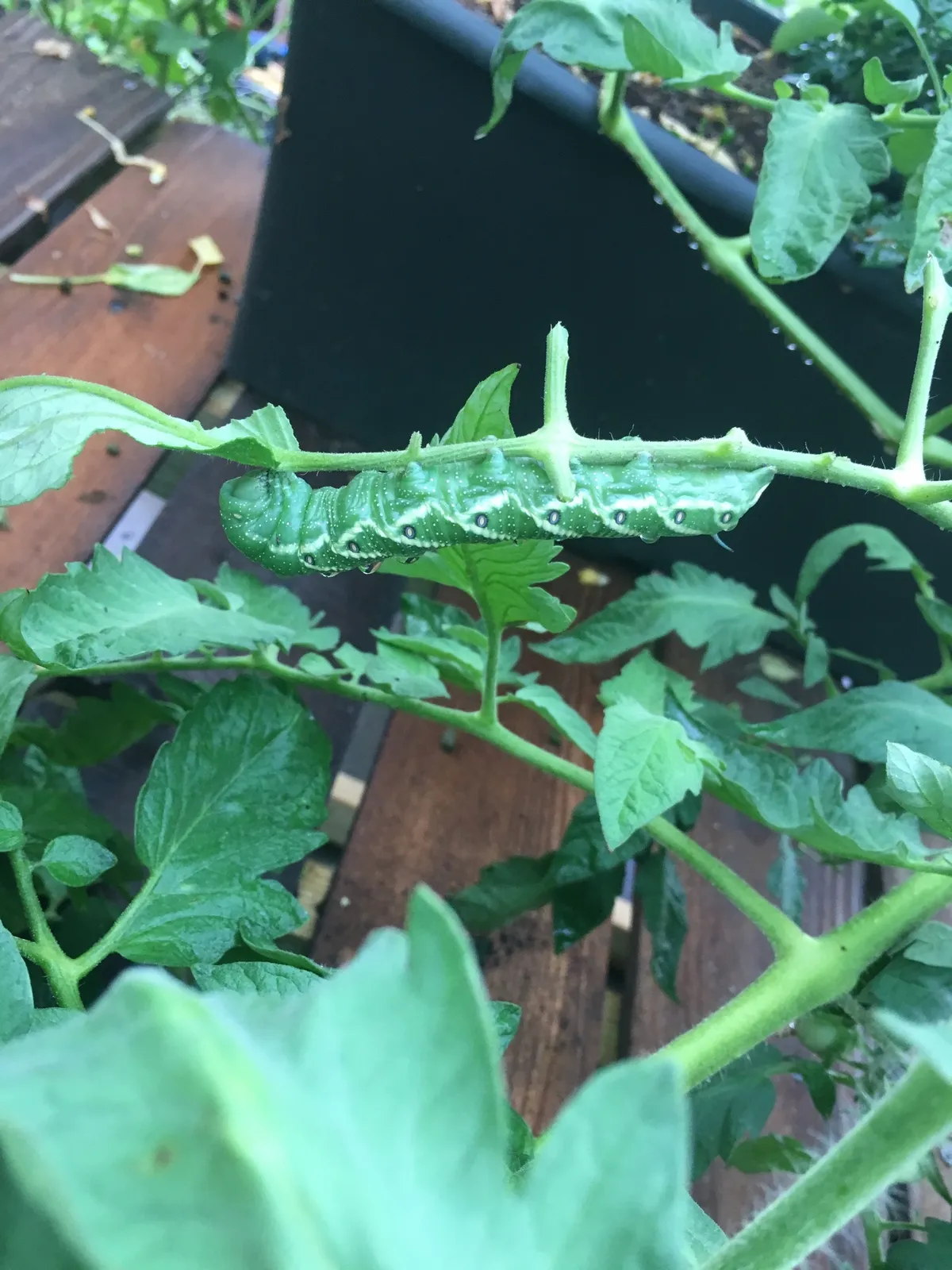
A big green caterpillar with white V marks along its sides and a horn on its tail. UC IPM says tomato hornworms are likely the largest caterpillars in a vegetable garden, and University of Minnesota Extension (UMN) says they reach 4 inches, with eight white, V-shaped marks on each side and a black horn on the last body segment. Iowa State University says a big one is almost as thick as your thumb.
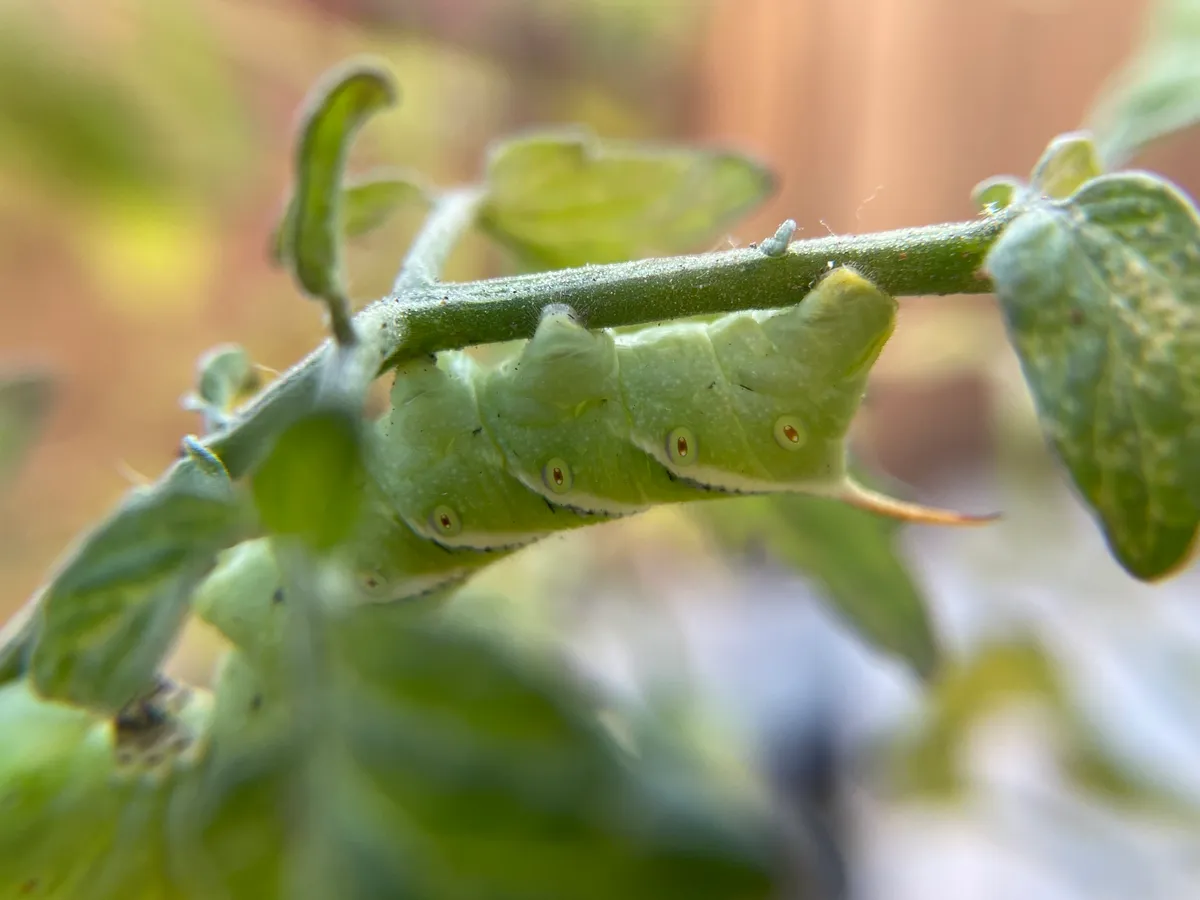
Young ones look different. UMN says small tomato hornworms are yellow to white with no markings, and NC State Extension describes hatchlings as bluish to pale green with a black horn, about 1/4 inch long by Virginia Cooperative Extension's measure; Kansas State University (K-State) says ones that small are nearly impossible to find. Grown ones can be dark brown, the University of Missouri says, and UMaine Extension says tobacco hornworms are sometimes brown.
The horn looks like a stinger, but K-State says it cannot sting or puncture, and Iowa State says hornworms won't hurt you; a handled one thrashes and may regurgitate, K-State adds. If yours is hairy or spiny, compare it with the guide to stinging caterpillars.
Tomato hornworm vs tobacco hornworm: how do you tell them apart?
Count the white marks and check the horn. NC State gives the tobacco hornworm seven diagonal stripes on each side and a red horn, and the tomato hornworm eight chevrons and a bluish black horn; Penn State Extension adds that the tobacco hornworm's white stripes have black margins and the tomato hornworm's green ones.
| Feature | Tomato hornworm | Tobacco hornworm |
|---|---|---|
| White marks | Eight V-shaped marks (chevrons) on each side | Seven diagonal lines on each side |
| Edges of the marks | Green | Black |
| Horn | Dark blue to black, straight | Red, usually curved |
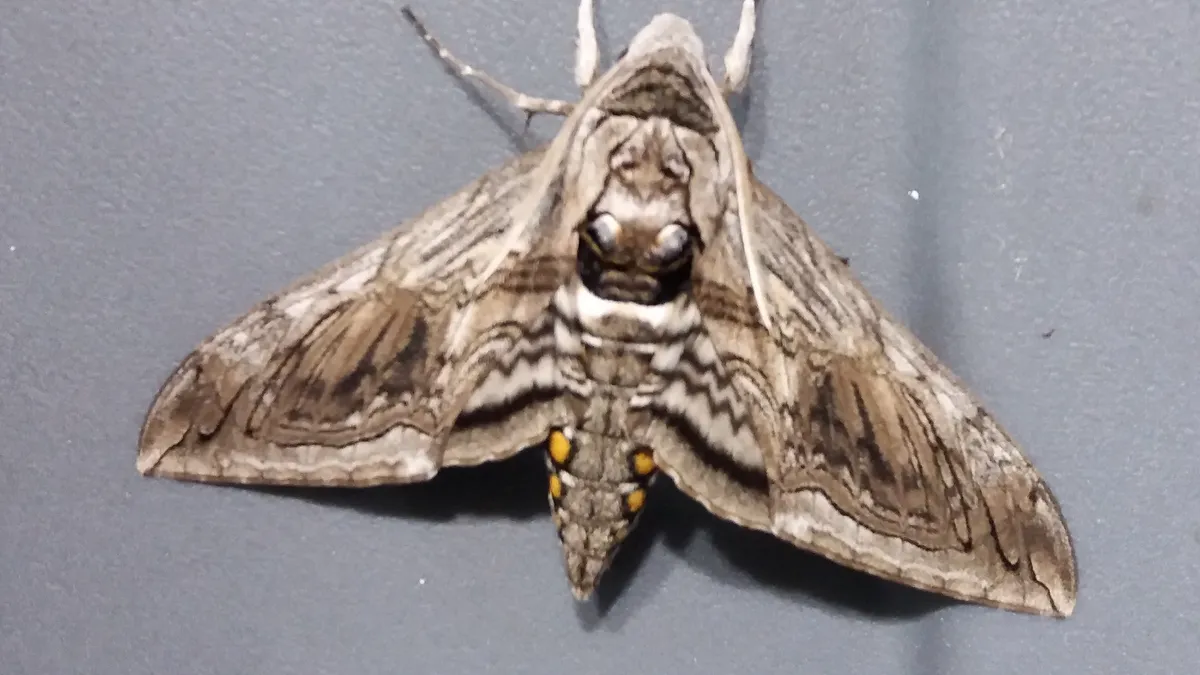
| Adult moth | Five-spotted hawk moth: five pairs of yellow-orange spots on the abdomen | Carolina sphinx: six pairs, the last pair small |
| Where it is more common | The northern US, in a field guide UF/IFAS cites | The South; also the one most often found in Illinois and Maine |
NC State, Penn State and Clemson (larvae); UF/IFAS (moths and range); Illinois Extension and UMaine Extension (which one gardeners meet).
For your tomatoes it hardly matters: Penn State says management is the same for both, and Utah State University says they cause similar damage to the same plants. The one you have may well be the tobacco hornworm. UF/IFAS says the tomato hornworm is uncommon in the Southeast and that hornworm damage on tomato in Florida is typically the tobacco hornworm's.
Farther north the sources differ. UF/IFAS's tobacco hornworm profile, citing a field guide, says the tomato hornworm predominates in the northern US, but Illinois Extension calls the tobacco hornworm the more commonly seen of the two, and UMaine says Maine homeowners meet the tomato hornworm far less often.
What else looks like a tomato hornworm?
Other sphinx moth caterpillars, which also carry a horn. Utah State names the white-lined sphinx caterpillar as the look-alike and says it feeds mainly on fruit and ornamental plants, rarely on vegetables. The University of Minnesota's insect identifier describes one about 3 inches long, green with black stripes and yellow and orange markings or mostly black, on evening primrose, grapes, apples and many other plants.
A caterpillar inside the fruit is more likely a tomato fruitworm, which Clemson Cooperative Extension calls the most damaging tomato insect pest in South Carolina. Clemson says it grows to about 1 1/2 inches, varies from greenish yellow to brown or black with paler lengthwise stripes, and bores into green fruit, usually at the stem end. Hornworms feed on the surface of the fruit instead, leaving large, open scars.
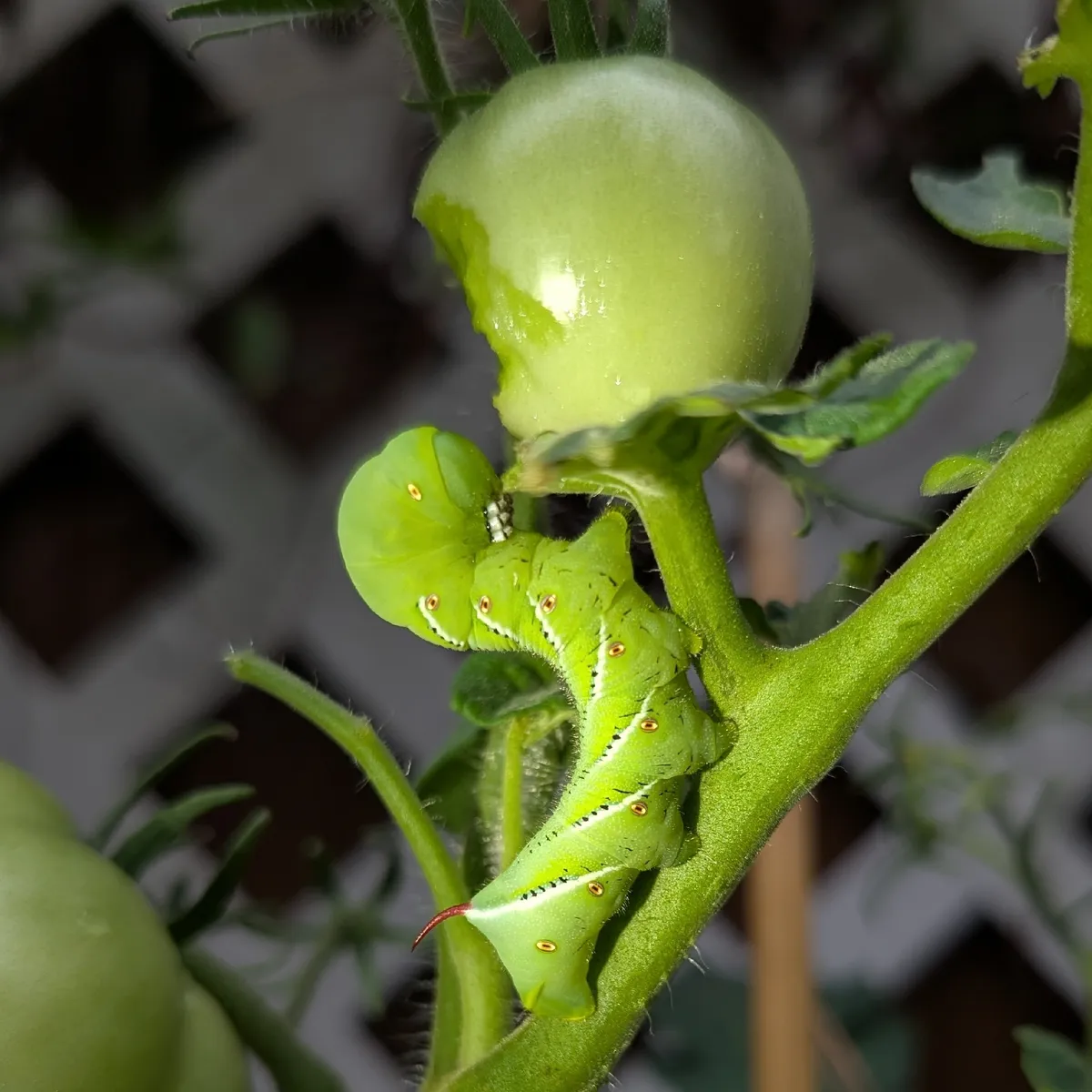
What does tomato hornworm damage look like?
Leaves and small stems eaten from the top of the plant down. UMN says tomato hornworms start on the upper leaves, UC IPM that whole leaves and small stems may be eaten, and Oklahoma State University that plants are often left with stems and leaf veins but no leaf surfaces.
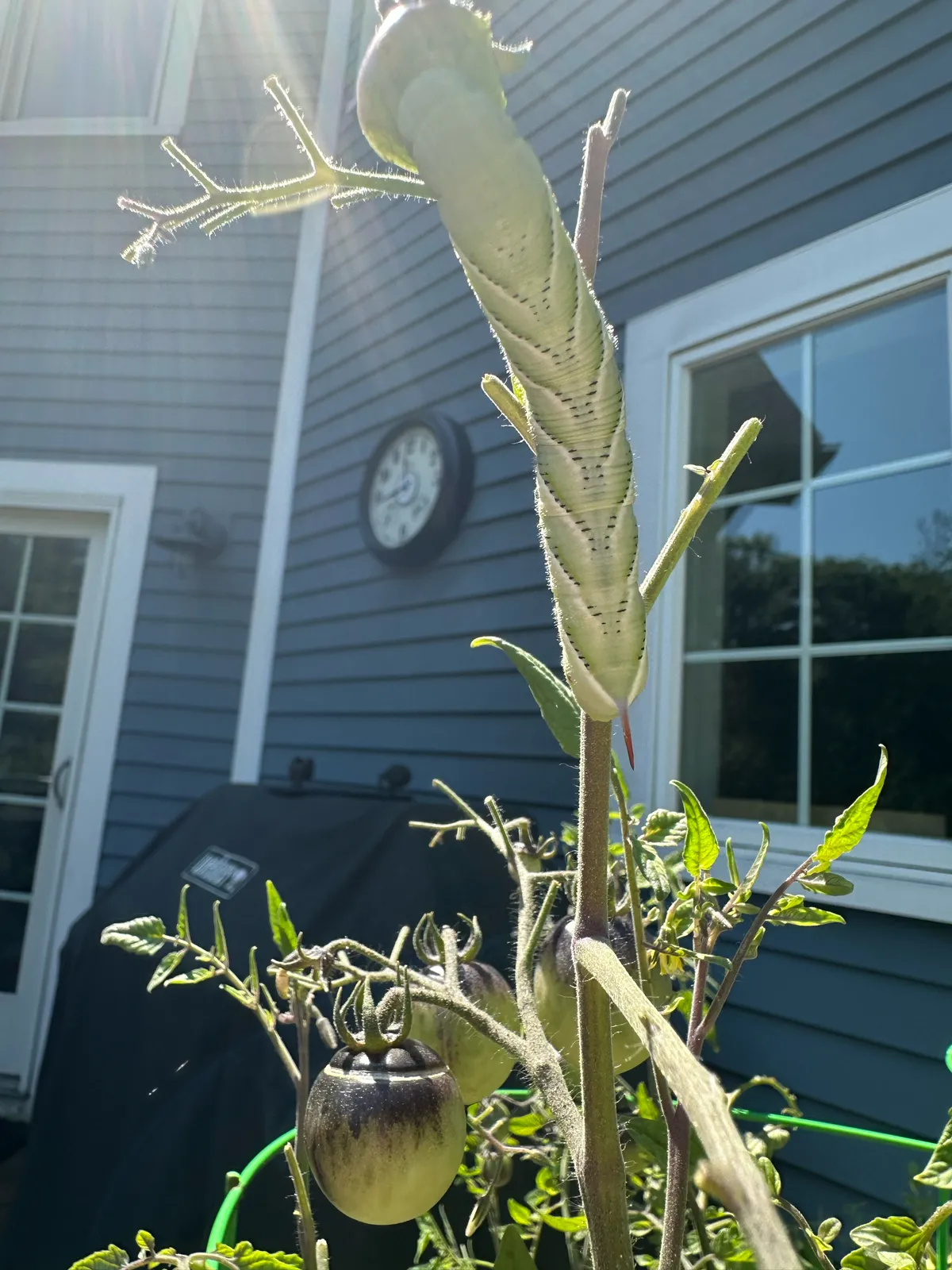
It happens fast. UMN says the last caterpillar stage eats nearly as much as all the earlier stages combined, Wisconsin Horticulture that a hornworm can eat up to four times its weight a day, and Oklahoma State that two or three large ones can virtually defoliate even a large plant. Virginia Cooperative Extension says the damage is most often noticed in late summer, when plants are stripped seemingly overnight.
Fruit is hit less often. Clemson says heavy infestations scar the surface of developing fruit, and the University of Nevada, Reno says the damage looks like a bird's. UF/IFAS says fruit that hornworms feed on will not mature properly, and Utah State adds that lost leaves can mean less fruit and more sunscald.
What does hornworm poop look like?
Large dark pellets. UMN says the dark green or black droppings are clearly visible, NC State that they are distinctively barrel-shaped, and Penn State that they show flower- or star-shaped segments up close. Penn State reads their age by color: green pellets are fresh, while blackened ones are older and the hornworm may have moved on.
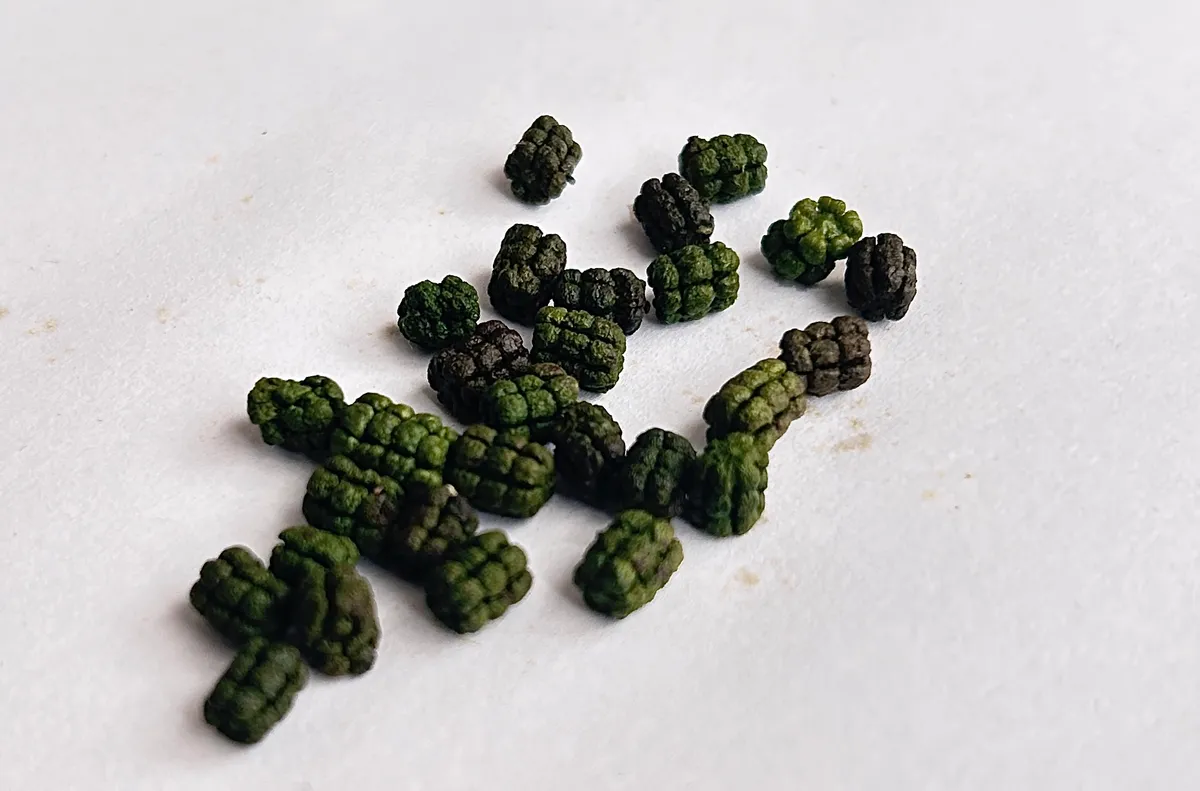
Use them to find the caterpillar. K-State says frass collects on lower leaves and beneath plants, and Utah State that it is plentiful even when only a few larvae are present, so search the stems and leaves just above a fresh pile.
Why is a hornworm covered in white eggs?
They are not eggs but the silk cocoons of a tiny parasitic wasp, Cotesia congregata. NC State Extension's factsheet on the wasp says amateur gardeners sometimes take them for eggs the hornworm laid and destroy this beneficial insect, and Illinois Extension also says they are commonly misidentified as eggs.
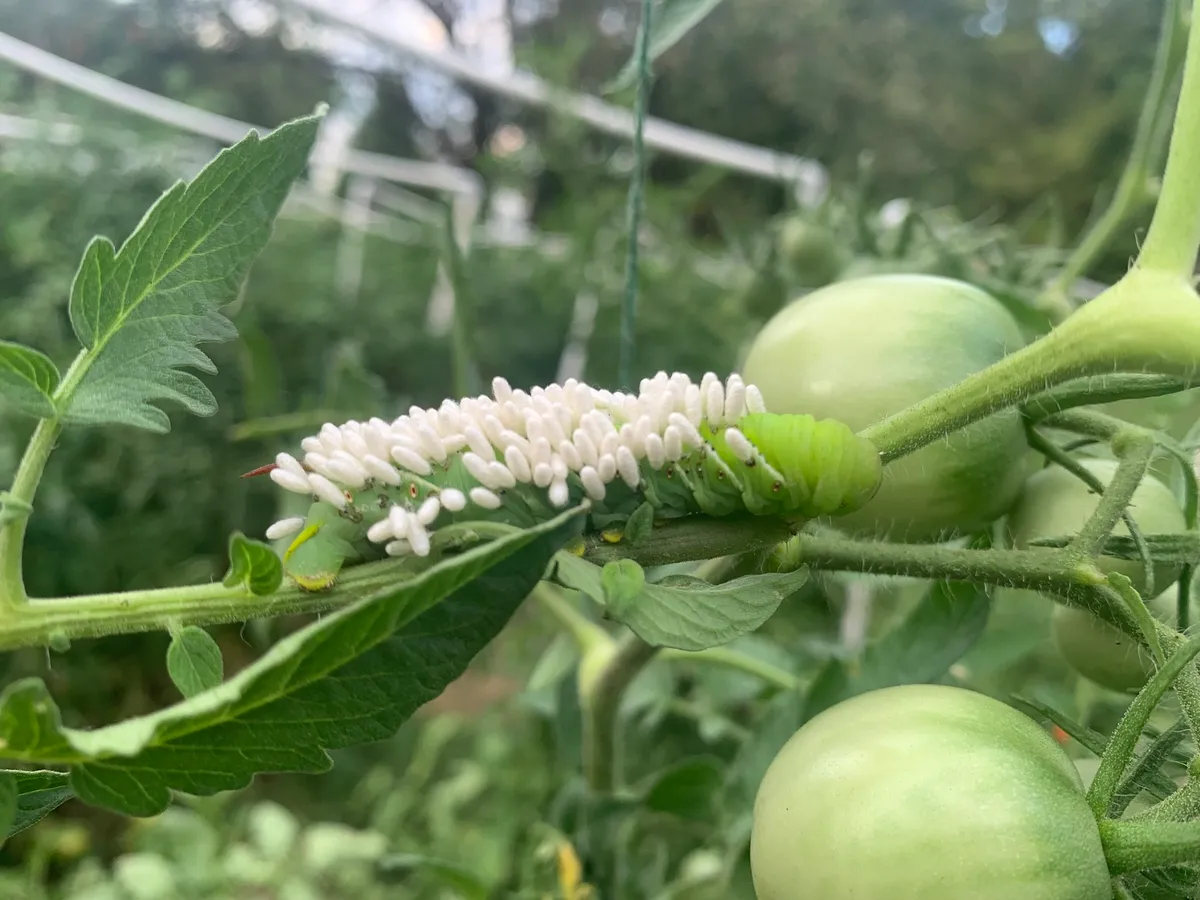
A female wasp lays a few to more than 300 eggs inside a caterpillar, NC State says; the larvae feed inside it, chew out and spin their cocoons together, and adults emerge 3 to 8 days later to find new hosts. A parasitized hornworm eats about a fifth as much as a healthy one and dies before completing its development, NC State's tobacco hornworm guide adds.
Leave it on the plant, as NC State, Virginia Cooperative Extension, UMN and Wisconsin all advise, so the wasps can emerge and attack other hornworms. Not sure? K-State suggests keeping a picked hornworm in a container with tomato leaves to see whether cocoons appear. The wasps are up to 1/8 inch long, and NC State calls them harmless to humans.
UC IPM says natural enemies normally keep hornworm numbers under control; UMN names lady beetles, green lacewings and paper wasps, and NC State stilt bugs and tachinid flies. The natural garden pest control guide covers parasitic wasps and the other beneficial insects.
What else is eating my tomato plants?
If there is no hornworm and no barrel-shaped frass, look for a different pest. Hornworms chew; these other tomato pests from Clemson's tomato insect pest guide leave different signs:
- Stink bugs are shield-shaped and suck sap from ripening fruit; young fruit they puncture grows deformed. See the stink bug guide, or its Canadian edition for readers in Canada.
- Leaf-footed bugs are about 13/16 inch and dark brown, with a narrow cream stripe across the back and flattened, leaf-like hind legs (leaf-footed bugs).
- Twospotted spider mites are the size of a period; leaves they feed on get fine flecking or stippling and turn pale or grayish (spider mites).
- Potato aphids are soft, pear-shaped and about 1/8 inch, pink or green, and new growth they feed on turns stunted and curled (aphid control).
Not a hornworm? Other tomato pests
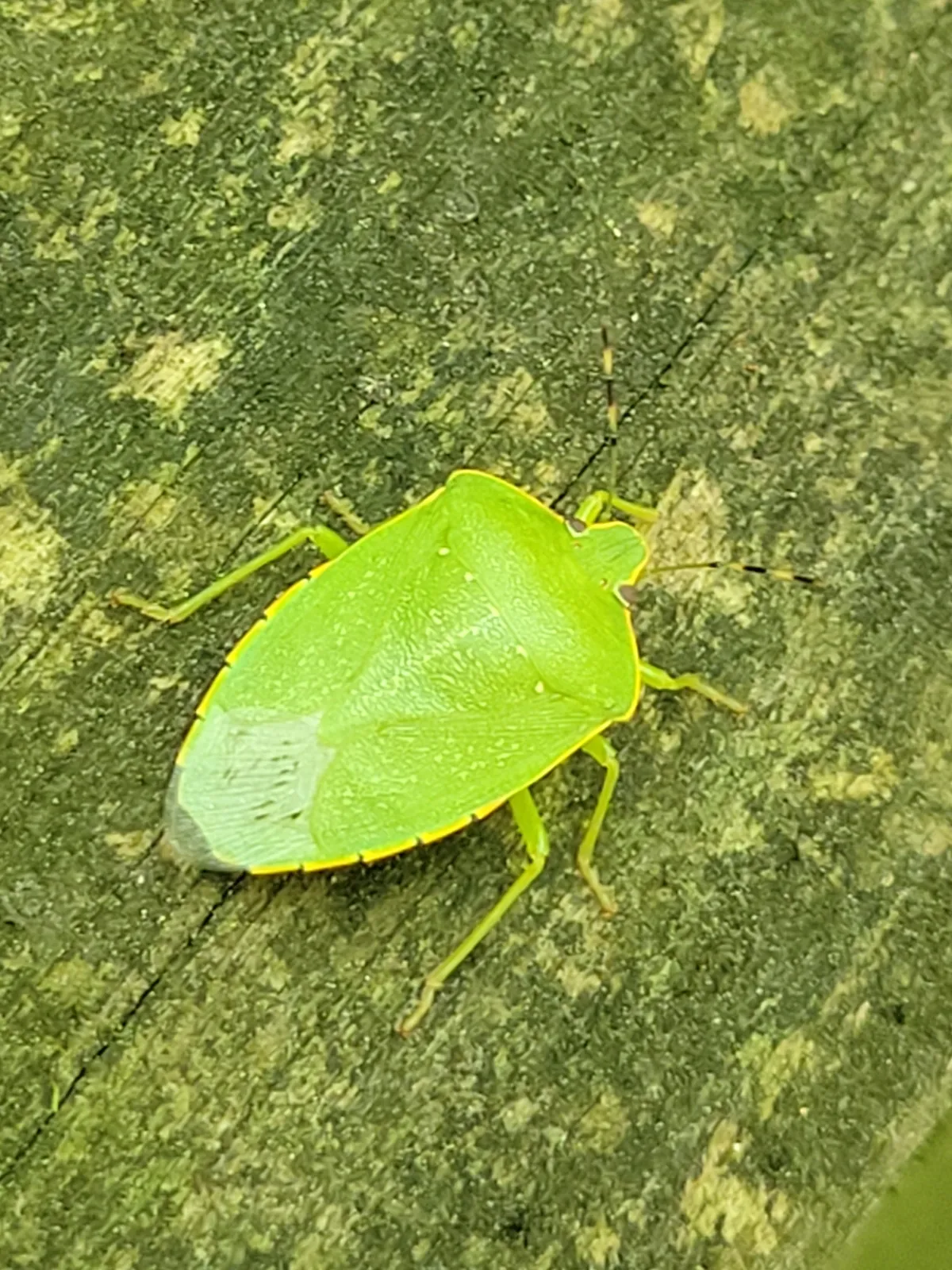 Stink bugShield-shaped; sucks sap from ripening fruit instead of chewing leaves, and young fruit it punctures grows deformed
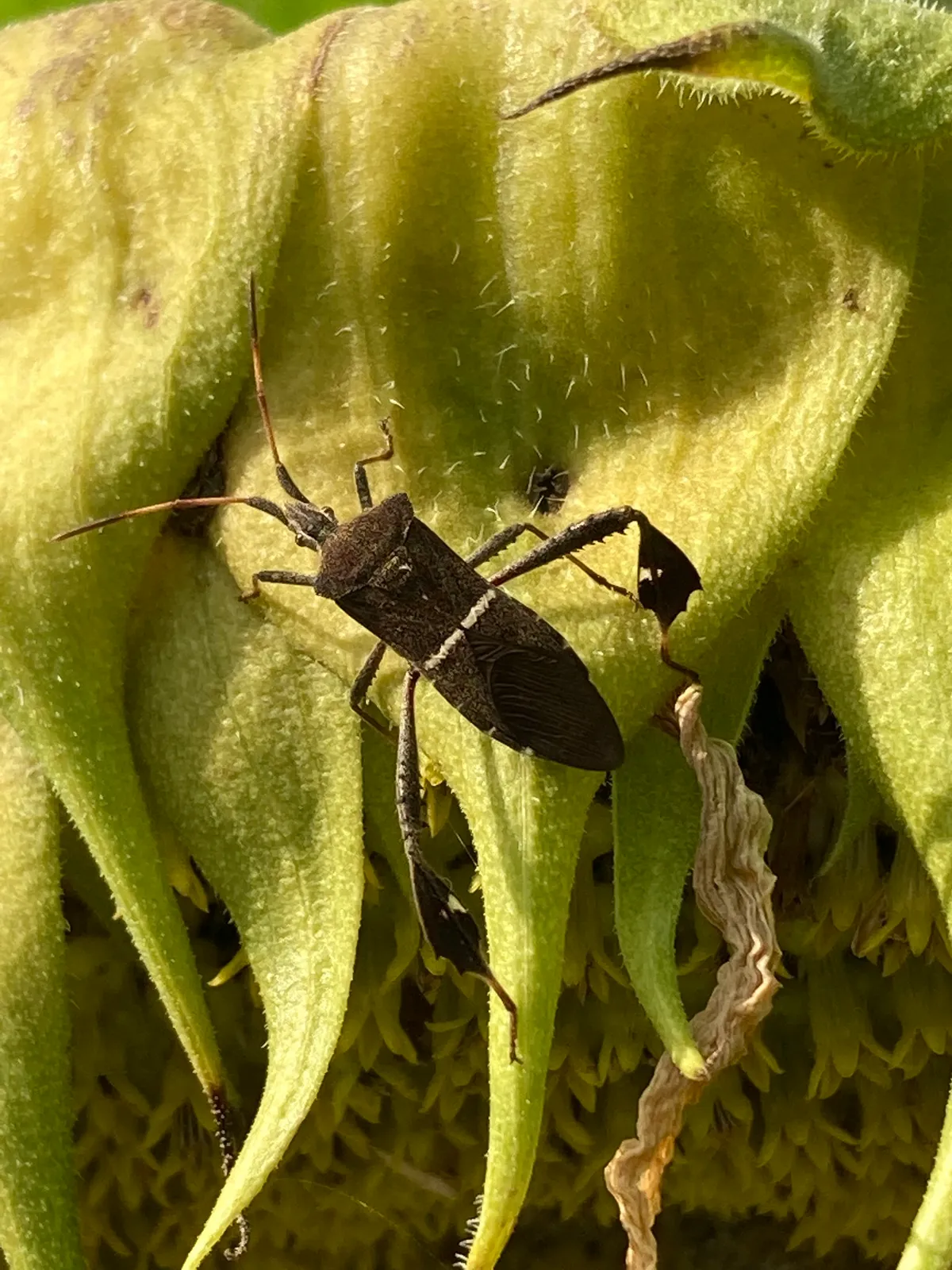 Leaf-footed bugAbout 13/16 inch, dark brown, with a pale stripe across the back and flat, leaf-like hind legs
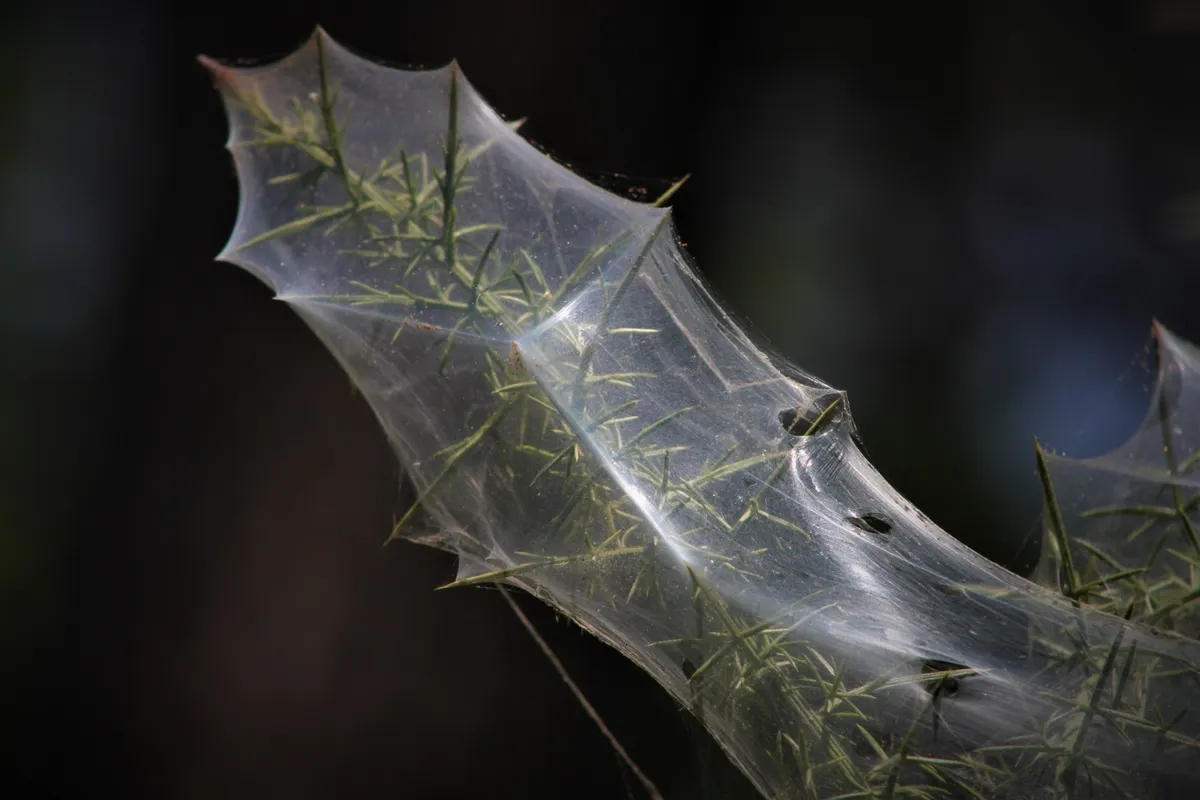 Spider mitesSpecks the size of a period; leaves get fine flecking or stippling and turn pale or grayish
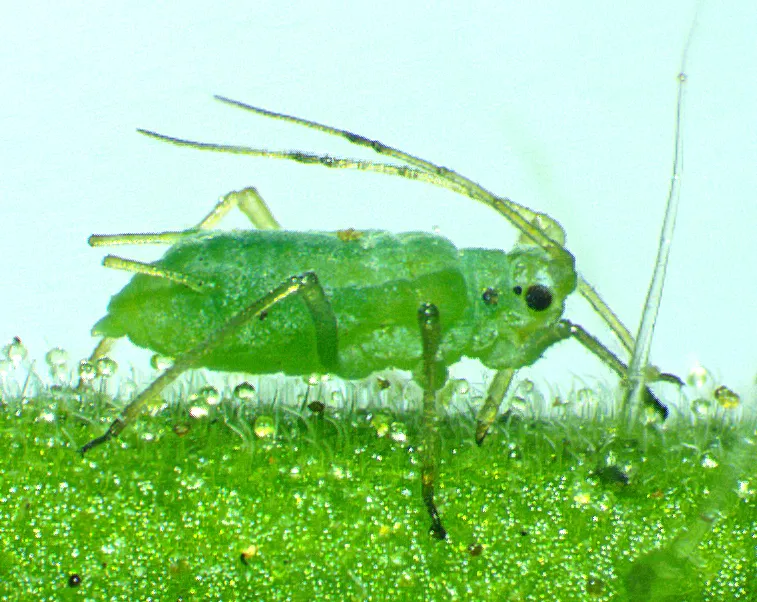 Potato aphidSoft and pear-shaped, about 1/8 inch, green or pink; new growth it feeds on turns stunted and curled
Photos: Stink bug: no rights reserved, via iNaturalist, CC0 1.0. Leaf-footed bug: no rights reserved, via iNaturalist, CC0 1.0. Spider mites: no rights reserved, via iNaturalist, CC0 1.0. Potato aphid: no rights reserved, via iNaturalist, CC0 1.0.
What is the tomato hornworm life cycle?
Egg, caterpillar, pupa in the soil, moth. UMN says the pupae spend the winter in the soil and the moths emerge in spring; the caterpillars grow for 3 to 4 weeks, burrow into the soil to pupate, and a second generation of moths appears in midsummer.
| Stage | What it looks like | How long |
|---|---|---|
| Egg | Smooth, round, about 1/16 inch; light green, then white before hatching; laid singly on leaves | About 4 days in South Carolina |
| Caterpillar | Grows from about 1/4 inch to 3 to 4 inches through five or six stages | 3 to 4 weeks |
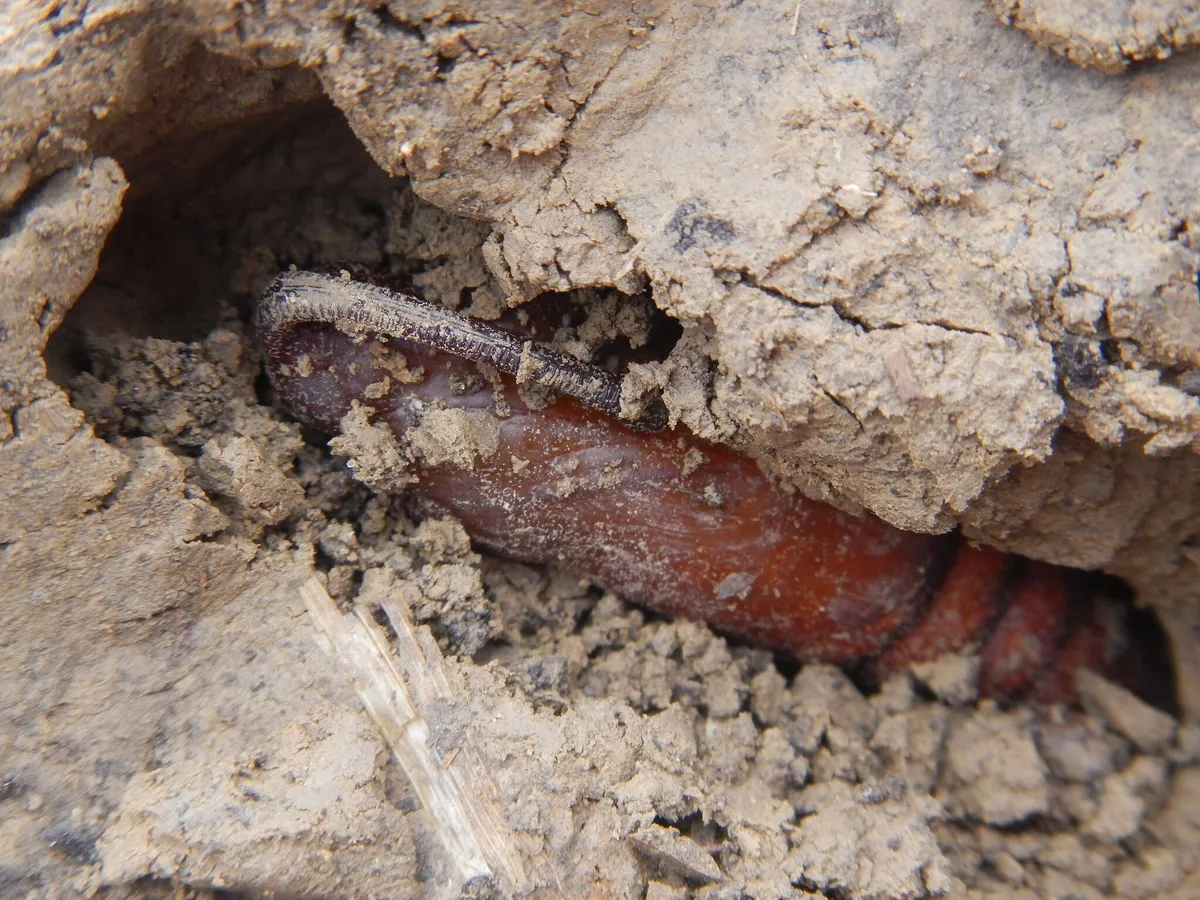
| Pupa | Dark reddish brown, 2 to 3 inches, with a looped handle at the front; in the soil | About 2 to 3 weeks in summer; all winter for the last generation |
| Moth | Gray-brown, with a wingspan up to about 5 inches and yellow-orange spots along the abdomen | Usually 2 to 3 weeks |
Clemson, UMN, NC State, UF/IFAS, Utah State and Virginia Cooperative Extension; timings vary with temperature.
The pupa is the stage you dig up. The University of Missouri says overwintering pupae lie about 5 to 6 inches below the surface, and Virginia Cooperative Extension says they are often turned up when a garden is tilled in spring. The loop at the front holds the moth's developing mouthparts, UF/IFAS says.
The adult is a hawk moth, also called a sphinx or hummingbird moth: UF/IFAS says the tomato hornworm becomes the five-spotted hawk moth and the tobacco hornworm the Carolina sphinx. Clemson says the moths hover over plants at dusk; Wisconsin says people mistake them for hummingbirds and that they do not harm plants, and Illinois Extension says they act as pollinators.
When do tomato hornworms come out?
From late spring into fall. Moths first fly from mid-May in Oklahoma to late June in Wisconsin, and Clemson and Illinois Extension say damage usually begins in midsummer and continues for the rest of the season.
| State | Moths first fly | Caterpillars to look for | Generations |
|---|---|---|---|
| Oklahoma | Mid-May | Late May or early June, then early August to early October | Two |
| South Carolina | Early June, some as late as August | From midsummer to the end of the season | At least two |
| North Carolina | Early June | Most damage in July and later | Two to three |
| Missouri | Mid- to late spring | Second generation full grown in mid- to late summer | Usually two |
| Minnesota | Spring | Second brood feeds until late summer or early fall | Two |
| Wisconsin | Late June | Early July through August | Up to two |
| Pennsylvania | Not given | July through September | Not given |
| Utah | Mid-spring | Peak in midsummer; start checking in early July | One or two |
| California | Not given | Mostly midsummer, with a smaller peak in late summer | Not given |
Oklahoma State, Clemson, NC State, Missouri, UMN, UW-Madison, Penn State, Utah State and UC IPM, each for its state.
Start looking before the damage shows. UMN advises checking plants at least twice a week during the summer, and Utah State says to start in early July. In California, UC IPM says infestations tend to be worse in warm inland areas.
How do you get rid of tomato hornworms?
By hand, in most gardens. UMN calls picking them off the most effective control and says pesticides are generally not necessary, and Wisconsin says hornworms rarely do enough damage to justify insecticides in home gardens. In the order the extension services give:
- Find them. Follow bare stems and fresh droppings in early morning or evening, since Utah State says larvae tend to hide by day. Illinois Extension says that under a UV (black) light at night the caterpillars look bright green against deep red-orange leaves, and the University of Missouri says spraying plants with water in quick-drying conditions makes them move.
- Leave any hornworm with white cocoons for the wasps.
- Pick off the rest and drop them into soapy water, as UMN advises, or snip them with shears, as UC IPM suggests.
- Spray only small caterpillars, and only if picking is not practical (see below).
- Till after harvest. Wisconsin says tillage can kill up to 90% of the larvae in the soil, and the University of Missouri suggests 6 inches deep in fall.
- Pull nightshade weeds and rotate crops. UMN says to remove weeds, naming horsenettle, jimsonweed and nightshade as alternate hosts, and UF/IFAS lists crop rotation among the cultural controls.
Which sprays work on hornworms?
Bacillus thuringiensis subspecies kurstaki (Bt) comes first. UMN says caterpillars must eat it, that it is specific to caterpillars and does not affect other insects, bees included, and that it works best on very young ones. Utah State lists it as effective only on caterpillars under 1/2 inch, Penn State says to treat hornworms under 3/4 inch, and UF/IFAS says rain or irrigation can wash it off, so repeat applications may be needed. How Bt works is covered separately.
Spinosad kills caterpillars that eat it and is effective for about one to two weeks, UMN says, but is toxic to bees while wet. Insecticidal soap is most effective on small caterpillars, must hit them directly and has no residual activity, UMN says. K-State lists Bt, spinosad and non-residual neem products as choices that avoid harming beneficial insects.
Broad-spectrum insecticides, such as the pyrethroids UMN names (bifenthrin, cyfluthrin, lambda-cyhalothrin, permethrin) or the carbaryl the University of Missouri lists, can kill the beneficial insects that keep hornworms in check; the University of Nevada, Reno warns that spraying for hornworms could set off aphid outbreaks that way. Clemson says not to use permethrin on tomato varieties whose fruit is less than 1 inch across.
No extension source cited here recommends basil, dill or marigolds against hornworms, and the garden pest control guide's planting chart weighs the claim that basil repels them. For the rest of the garden, see the guides to Japanese beetles, the spotted lanternfly, mole crickets and bugs on houseplants, or browse more pest identification guides.
Use any pesticide exactly as its label directs. The label is the law, and what is registered and sold varies by state.
Frequently Asked Questions
Should you kill tomato hornworms?+
Most extension services say to remove them when they are eating your plants. The University of Minnesota calls hand-picking the most effective control and suggests dropping them into soapy water. Check each one for small white cocoons first: a hornworm carrying them has been parasitized by a beneficial wasp and should be left in the garden. If you would rather keep the moths, which Illinois Extension says act as pollinators, it suggests growing a sacrificial tomato plant or two and moving the caterpillars onto them.
Is it safe to touch a tomato hornworm?+
Yes. Kansas State University says the horn cannot sting or puncture, and Iowa State University says hornworms won't hurt you, so they can be picked off by hand. Expect some reaction: K-State says a handled hornworm thrashes and may regurgitate its stomach contents. The tiny wasps that come out of the white cocoons on parasitized hornworms are harmless to humans too, according to NC State Extension and the University of Missouri.
What does a tomato hornworm turn into?+
A large moth. UF/IFAS says the tomato hornworm becomes the five-spotted hawk moth, a sphinx moth with five pairs of yellow-orange spots on its abdomen, while the tobacco hornworm becomes the Carolina sphinx, which usually has six pairs. Utah State gives the five-spotted hawk moth a wingspan of up to 5 inches. After 3 to 4 weeks of feeding, the caterpillar burrows into the soil to pupate, and in summer the moth emerges about two weeks later, the University of Minnesota says.
What do I do if I find a tomato hornworm?+
Look it over, then look for more. If its back is covered in small white cocoons, leave it, because wasps will emerge from them and attack other hornworms. If not, pick it off and drop it into soapy water, as the University of Minnesota suggests. Then search the rest of the plant and its neighbors, using fresh dark droppings and bare stems as clues, and keep checking at least twice a week through the summer. Tilling after harvest destroys the pupae in the soil.
What kills tomato hornworms instantly?+
None of the extension sources cited here describes a spray that works instantly. The quickest method is hand-picking: the University of Minnesota says to drop them into soapy water, and UC IPM says they can be snipped with shears. Bacillus thuringiensis (Bt) has to be eaten to work and acts mainly on young caterpillars, and Utah State lists it as effective only on caterpillars under 1/2 inch. Spinosad also kills caterpillars that eat it. Broad-spectrum insecticides can kill the beneficial wasps too, and the University of Minnesota says pesticides are generally not necessary.
Can a tomato plant survive hornworm damage?+
It depends on how much is eaten and how early you catch them. The University of Minnesota says the last caterpillar stage eats nearly as much as all the earlier stages combined, so hornworms removed young do far less harm. Utah State says lost leaves can reduce fruit production and expose fruit to sunscald, and UF/IFAS says fruit that hornworms feed on will not mature properly. Wisconsin Extension says hornworms do not typically cause significant damage in commercial fields, though large numbers occasionally do in home gardens.
What do tomato hornworm eggs look like?+
Tiny, round and pale. Clemson Cooperative Extension describes hornworm eggs as smooth spheres about 1/16 inch across, light green at first and white before they hatch, and UF/IFAS describes them as green to yellow-green with a pearly look. Clemson says the moths lay them at night on the undersides of leaves, one to five per plant visit, and that they hatch in about four days, depending on temperature. Kansas State University says the eggs are small and translucent, which makes them hard to see.
Do the wasps from the white cocoons sting people?+
No. NC State Extension describes Cotesia congregata as small black wasps, up to 1/8 inch long, that are harmless to humans, and the University of Missouri also calls them harmless to humans. The females lay their eggs inside hornworms, where the wasp larvae feed before spinning the white cocoons. Leaving a cocoon-covered hornworm on the plant lets a new generation of these wasps go after the rest of your hornworms, which is why extension services say not to destroy it.
What eats tomato hornworms?+
Many animals and insects. The University of Minnesota says lady beetles and green lacewings eat hornworm eggs and young caterpillars and that paper wasps feed on garden caterpillars, and NC State Extension adds stilt bugs, which eat the eggs, and tachinid flies, which kill hornworms in the pupal stage. UF/IFAS lists birds and small mammals. Tiny wasps attack them too: Trichogramma wasps parasitize the eggs and Cotesia congregata the caterpillars. UC IPM says natural enemies normally keep hornworm numbers under control.
Why can't I find the hornworm eating my tomatoes?+
Because it matches the plant. The University of Minnesota says hornworms blend in with the leaves and may not be noticed until most of the damage is done, and Utah State says the larvae tend to hide during the day. Follow the clues instead: bare stems near the top of the plant and dark droppings on the leaves or the ground below. Search early in the morning or in the evening, or at night with a UV light, under which Illinois Extension says the caterpillars look bright green against deep red-orange leaves.
Sources
- Tomato hornworms in home gardens (Jeffrey Hahn and Suzanne Wold-Burkness; reviewed 2020) — University of Minnesota Extension
- Tomato Hornworm, Manduca quinquemaculata (EENY-700; Morgan A. Byron and Jennifer L. Gillett-Kaufman) — University of Florida, UF/IFAS Featured Creatures
- Tobacco Hornworm, Manduca sexta (EENY-692; Morgan A. Byron and Jennifer L. Gillett-Kaufman) — University of Florida, UF/IFAS Featured Creatures
- Cotesia Congregata, Parasitoid (PDIC Factsheet; James Baker, October 1, 2026) — NC State Extension
- Tobacco Hornworms (Lorena Lopez, August 5, 2025) — NC State Extension
- Tomato Insect Pests (HGIC 2218; updated May 23, 2025) — Clemson Cooperative Extension, Home and Garden Information Center
- Tomato and Tobacco Hornworms (Utah Pests fact sheet; Nick Volesky and Marion Murray, March 2019) — Utah State University Extension
- Hornworms (XHT1107; Russell Groves, revised May 1, 2020) — University of Wisconsin-Madison Division of Extension, Wisconsin Horticulture
- Hornworms (Home and Landscape) — UC Statewide IPM Program, University of California Agriculture and Natural Resources
- Hornworms in Home Gardens (3104-1551; Eric Day and Theresa A. Dellinger, May 31, 2023) — Virginia Cooperative Extension, Virginia Tech
- Tomato and Tobacco Hornworms (MF3075; Robert J. Bauernfeind, April 2013) — Kansas State University Research and Extension
- Caterpillars 'Horn In' on Tomato Plants (Michele Warmund, August 6, 2021) — University of Missouri Integrated Pest Management
- Hornworm caterpillars on tomatoes (Good Growing; Ken Johnson, August 7, 2020) — University of Illinois Extension
- Evidence of Tobacco and Tomato Hornworm on Tomatoes — Penn State Extension
- Tomato Hornworm, Tobacco Hornworm (Digital Diagnostics) — Oklahoma State University Extension
- A Northern Nevada Homeowner's Guide to Identifying and Managing: Tobacco and Tomato Hornworms (FS-23-33; M. Andrews, W. Hanson Mazet and H. Kratsch, 2023) — University of Nevada, Reno Extension
- Hornworms (Home and Garden IPM) — University of Maine Cooperative Extension
- Whitelined sphinx caterpillar (What insect is this?) — University of Minnesota Extension
- Tomato Hornworm (Yard and Garden, September 13, 2016) — Iowa State University Extension and Outreach
How this guide was made: it was researched and drafted with AI assistance from the sources listed above. A second, independent AI pass then checked each factual claim against those sources. Found an error? Email support@buzzskito.ca.