
Published by BuzzSkito Mosquito & Tick Control
Published October 28, 2026 · Fact-checked against the sources listed below
What is a stick bug?
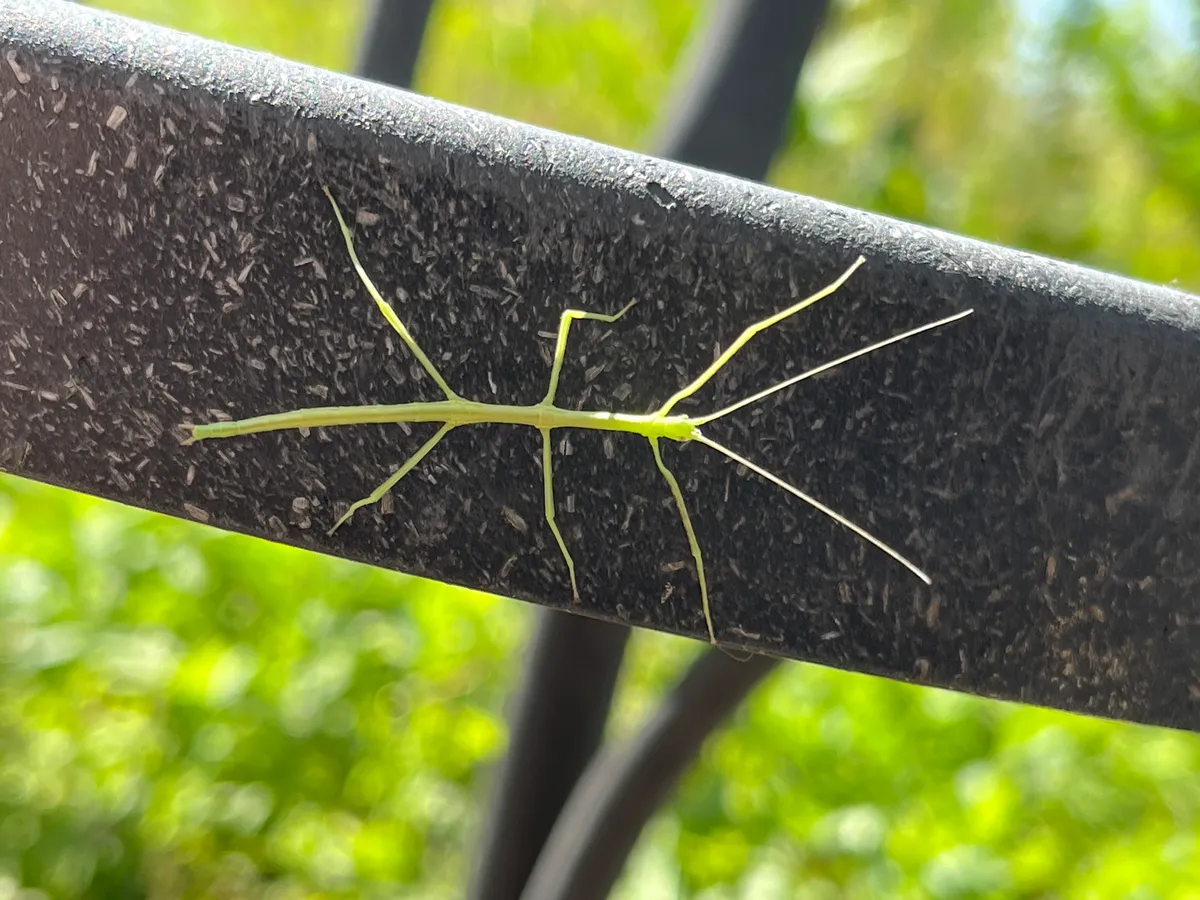
A stick bug is a walkingstick, a slow, leaf-eating insect that survives by looking like a twig. The Missouri Department of Conservation (MDC) places walkingsticks in the order Phasmida, sometimes called Phasmatodea, and says they are camouflaged to look like brown, tan, gray or green twigs, with long, slender legs, bodies and antennae.
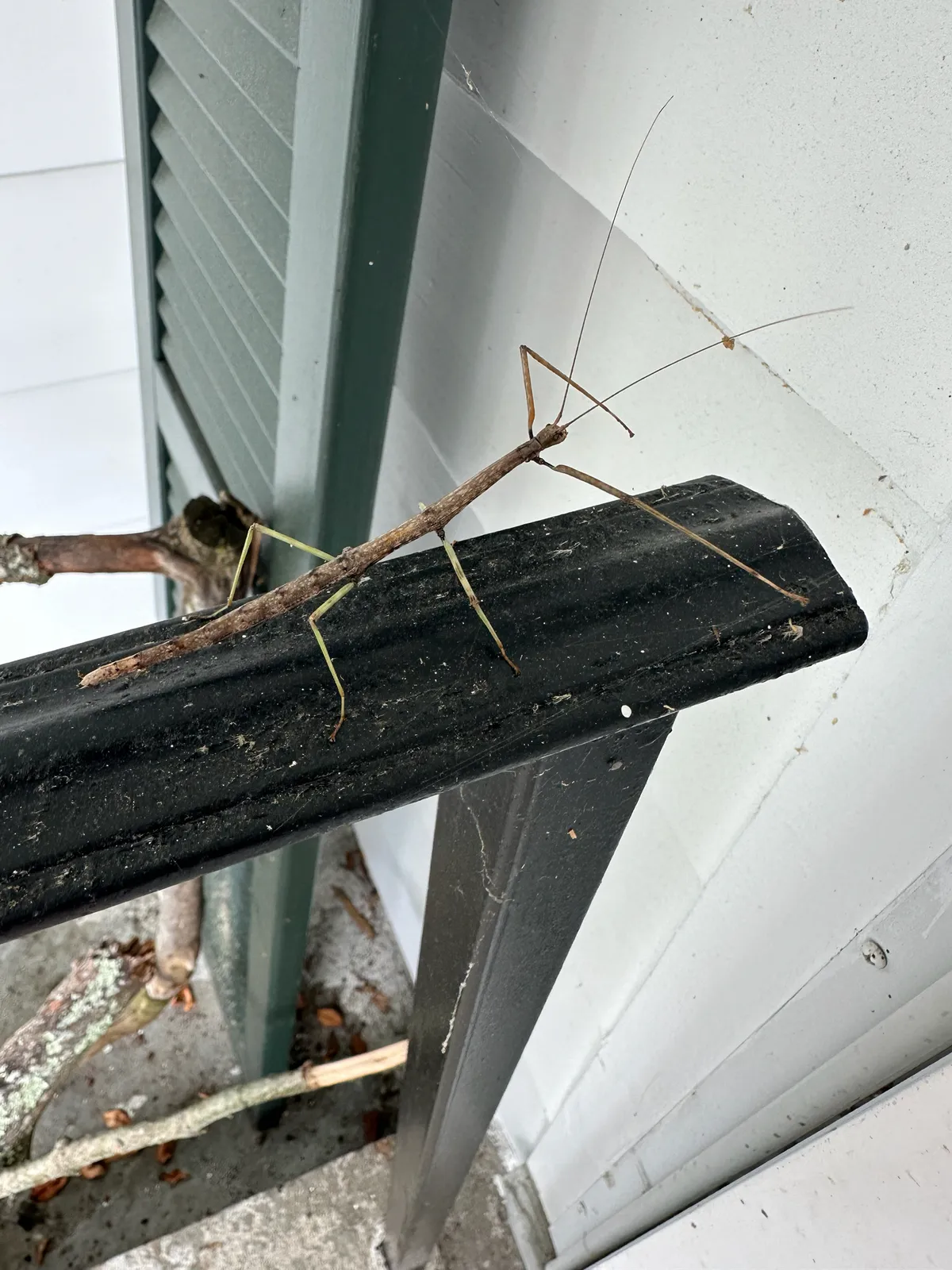
Most of the world's thousands of species live in the tropics. MDC counts only about 30 in North America, most of them found only in the southernmost states, and says all of Missouri's walkingsticks are wingless; Iowa State University Extension says the same of adults across the upper US, and adds that walkingsticks chew the leaves of the plants they hide on.
How do you identify a stick bug?
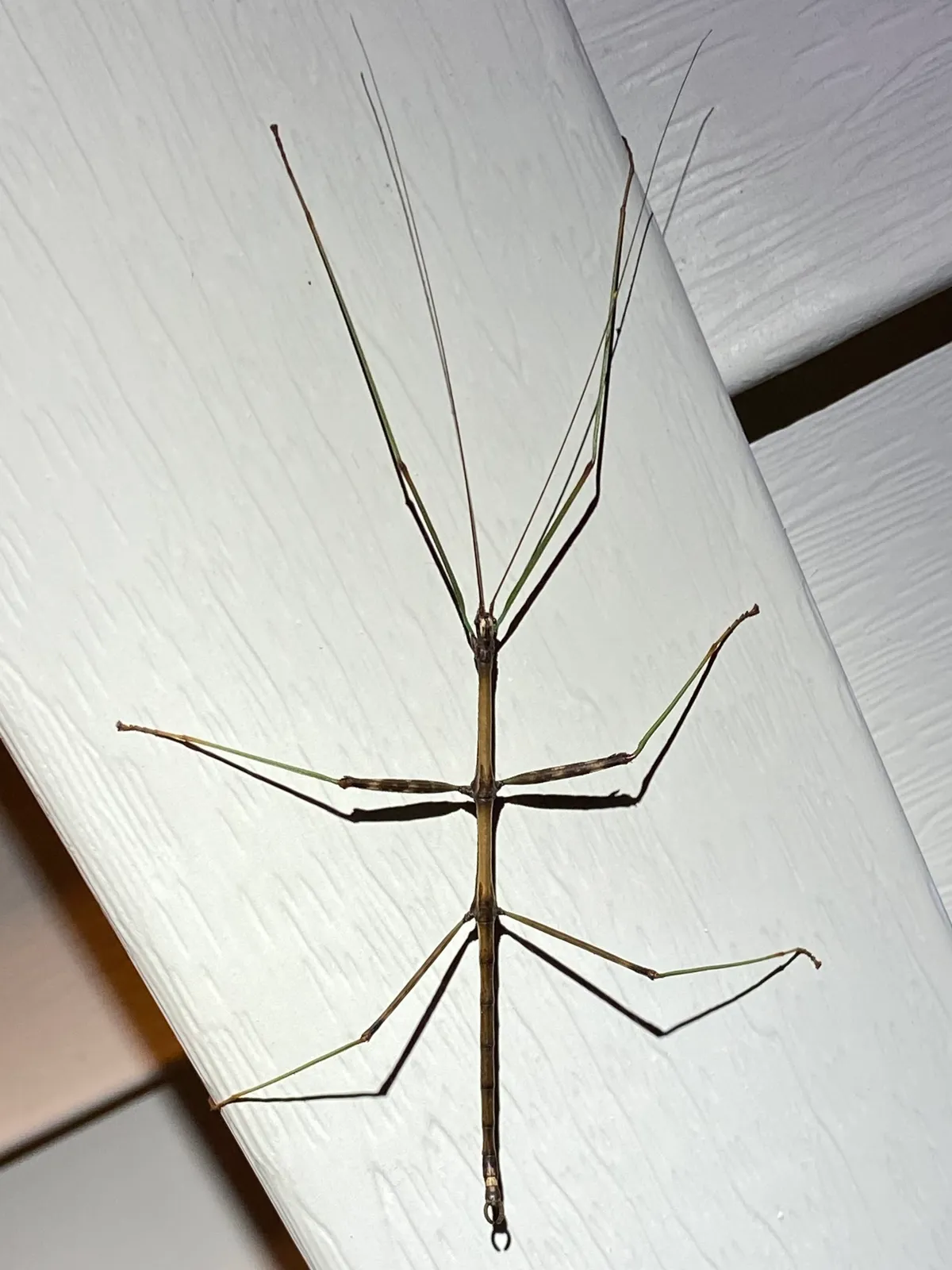
Look at the legs: a walkingstick stands on six long, thin legs of about the same length and has no wings. MDC's walkingstick guide says the legs are all roughly the same length. A twig-shaped insect holding up a pair of grasping front legs is a hunter, a mantis or a thread-legged assassin bug, and a long-legged insect with wings may be a crane fly; all three are covered below.
The young are green nymphs that look like miniature adults, about 1/4 inch long at hatching, Iowa State says, and they reach full size in late July or August.
Which stick bugs live in the US?
Four are covered here: the northern walkingstick of much of the East and Midwest, the giant walkingstick of the south-central states, and two striped walkingsticks of the South that spray.
Northern walkingstick
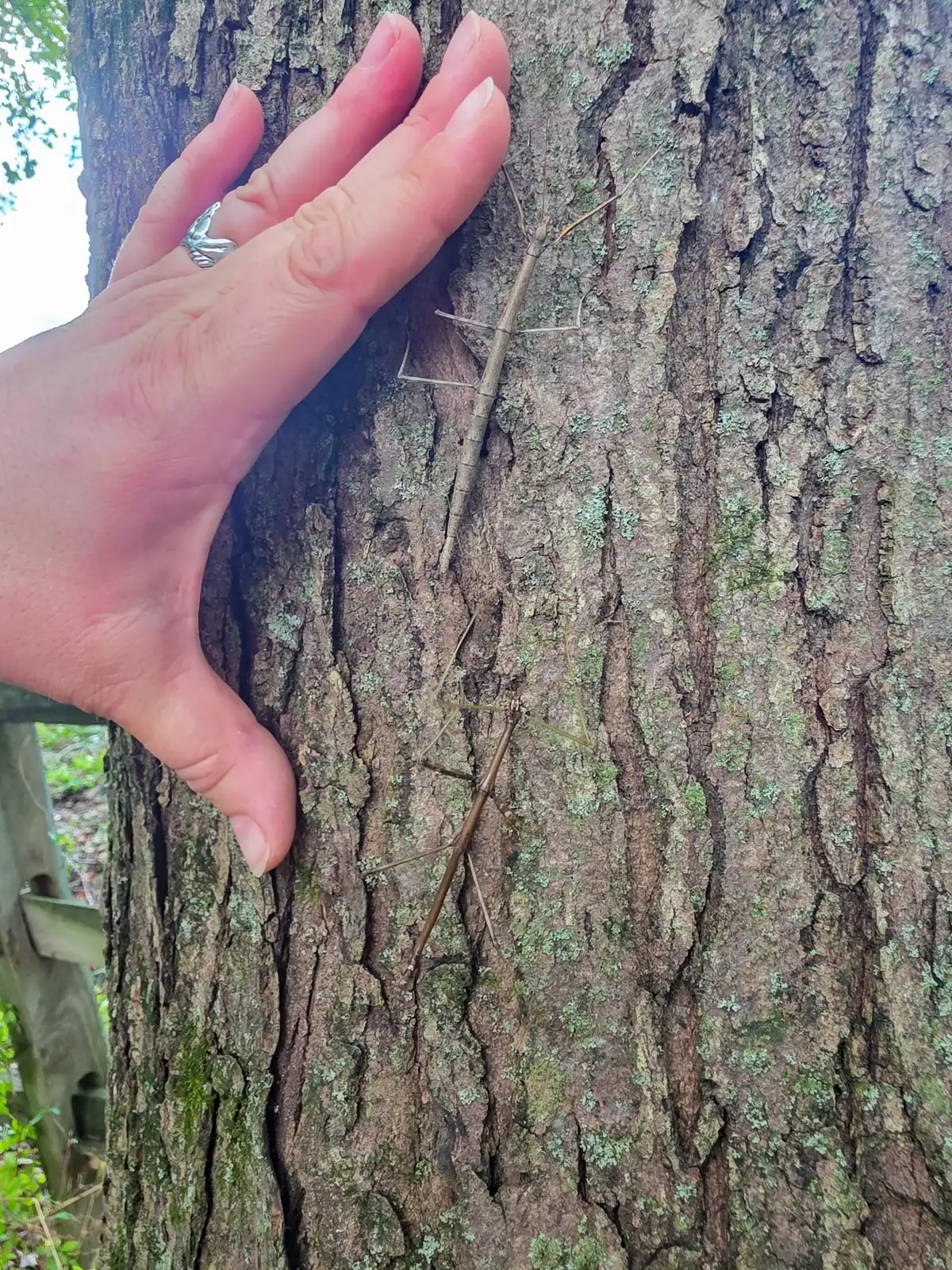
The northern walkingstick, Diapheromera femorata, is Missouri's most common walkingstick, MDC says, and Iowa State says only one of the four species known from the upper Midwest is common. Animal Diversity Web (ADW) gives its range as eastern North America from the Atlantic coast into northern Florida, west to New Mexico and north into Canada, where it is the only stick insect.
MDC's northern walkingstick guide measures adults at 3 inches for males and 3 3/4 inches for females, not counting legs and antennae, with antennae about two-thirds the length of the body. Males are brown, females greenish brown and larger, and the young are green. ADW adds that males tend to have banded femurs, the long upper section of each leg.
Giant walkingstick
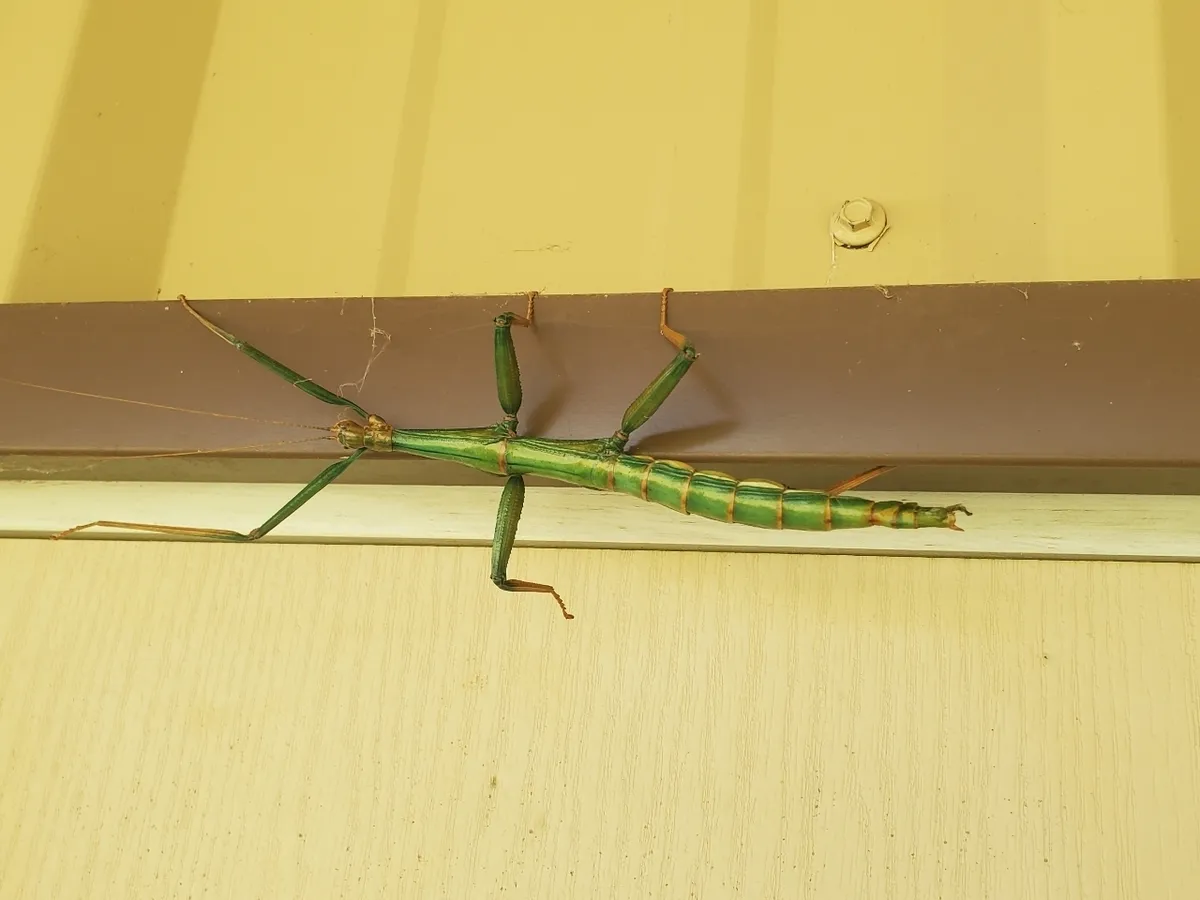
The giant walkingstick, Megaphasma denticrus, is the longest insect in the United States, says Texas A&M Forest Service: it reaches 7 inches and is common throughout Texas, though not usually in dense numbers. MDC counts it among Missouri's two most common walkingsticks.
MDC's giant walkingstick guide says females reach 7 inches, that the color runs from greenish to tan, brown or rusty brown, and that the middle and hind legs carry spines, with one large spine on each hind leg of the male.
Two-striped walkingsticks
The southern two-striped walkingstick, Anisomorpha buprestoides, is the most common stick insect in Florida, according to UF/IFAS Featured Creatures, and lives throughout Florida and around the Gulf Coastal Plain west to Texas. UF/IFAS describes a large, stout insect for a walkingstick, brown with three bold black stripes; females average about 2 2/3 inches and males about 1 2/3 inches. A black-and-white form lives only in Ocala National Forest scrub.
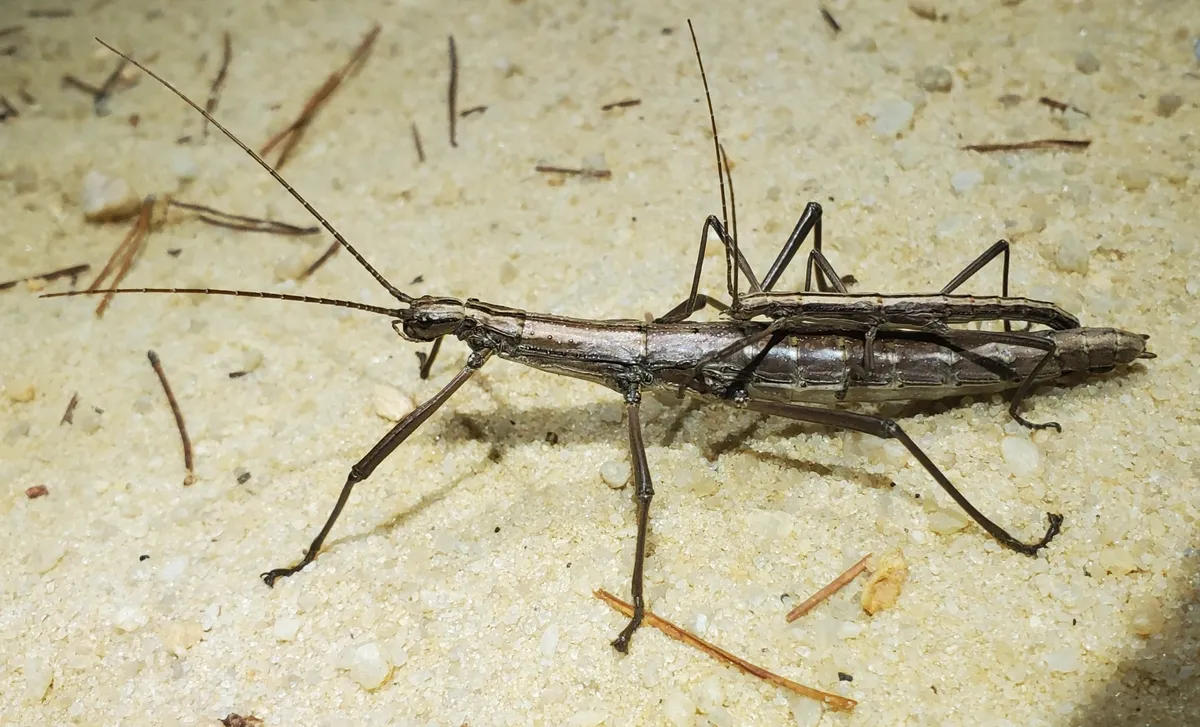
Farther north and inland lives the northern two-striped walkingstick, or musk mare, Anisomorpha ferruginea, which UF/IFAS describes as smaller and paler, without the bold stripes. MDC's musk mare guide describes a chunky tan, brown or brownish-yellow insect, 2 to 2 1/4 inches long for females and 1 to 1 1/2 inches for males (not counting legs and antennae), whose side stripes are often faint, ranging from Texas and Kansas through Georgia and Virginia but not Florida.
What looks like a stick bug?
A praying mantis, a thread-legged assassin bug or a crane fly, and the front legs or wings give each one away.
Praying mantis
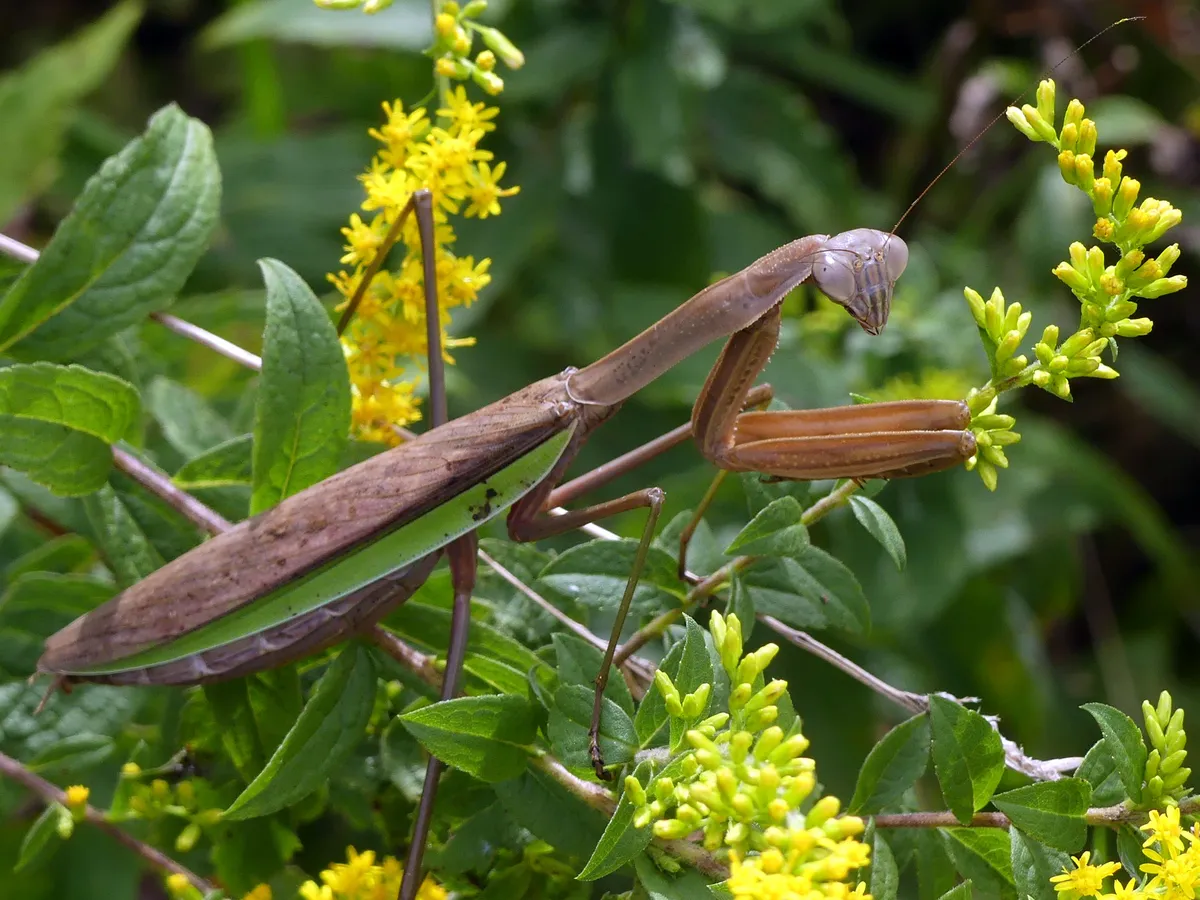
MDC's northern walkingstick guide lists mantids among the walkingstick's look-alikes. MDC's Chinese mantis guide describes a triangular head that swivels to track prey and folded front legs that fly out to grab it. The Chinese mantis, not native and first introduced in 1896, grows to 5 inches, is usually tan with a green line along the edges of its forewings, and is usually seen in or near the plants around houses; MDC calls it harmless to humans.
Thread-legged assassin bug
Mississippi State University Extension describes very slender predators about 1 1/4 to 1 1/2 inches long, with thread-like legs, long thin antennae, mantis-like front legs for grabbing prey and a long, slender beak. They come to lights at night; the author usually finds them on buildings near outdoor lights or in spider webs. They can bite, though few people have experienced it; assassin bugs and wheel bugs covers the family.
Crane fly
A crane fly has wings, which no common US walkingstick has. MDC's crane fly guide describes insects up to about 1 1/2 inches long with slender bodies, very long legs and one pair of wings, nearly all looking like giant mosquitoes, and says they do not bite. What a crane fly is, and why people call it a mosquito hawk covers them.
Commonly confused with
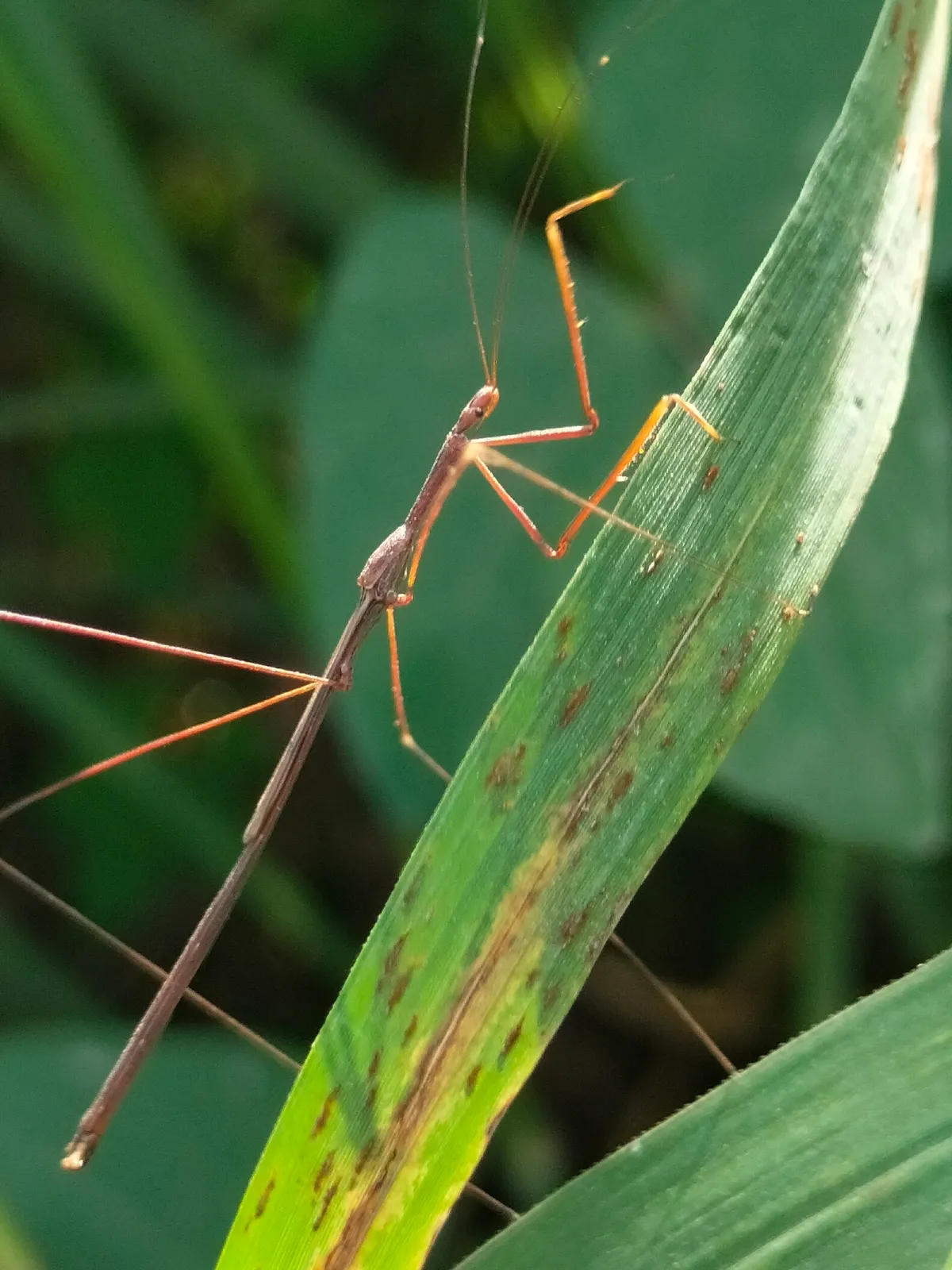 Thread-legged assassin bugMantis-like grasping front legs and a beak; only about 1 1/4 to 1 1/2 inches long
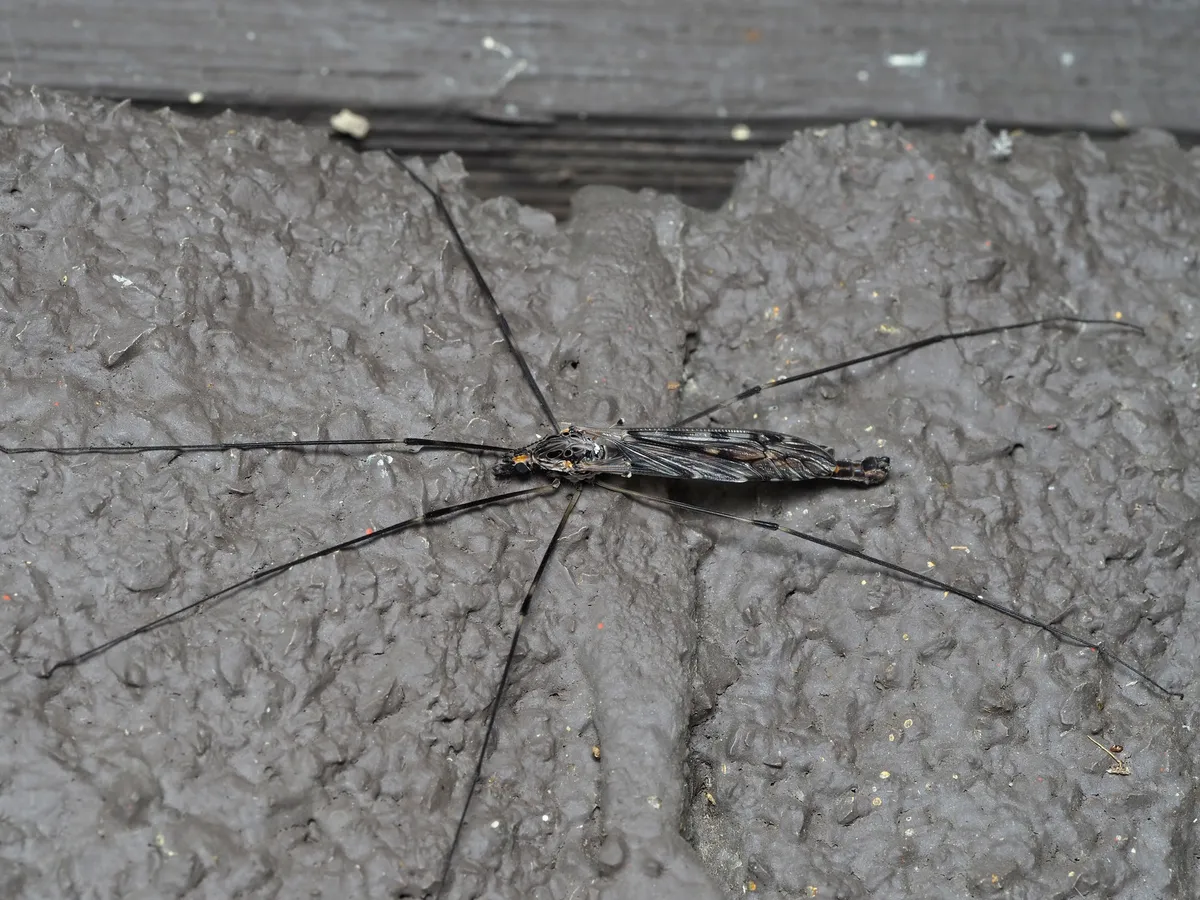 Crane flyOne pair of wings and very long legs; looks like a giant mosquito and does not bite
Photos: Thread-legged assassin bug: no rights reserved, via iNaturalist, CC0 1.0. Crane fly: Kaldari, CC0, via Wikimedia Commons, CC0 1.0.
Are stick bugs harmful? Do they bite?
Most are not, and none stings. A 2011 veterinary case report says most walkingstick species are considered harmless. Texas A&M Forest Service calls the belief that walkingsticks sting false and describes giant walkingsticks as docile and harmless, though their feet can cling tightly to skin and clothing. None of the extension or agency sources cited here describes a walkingstick biting a person.
Their defense is to keep still and look like a stick: ADW says northern walkingsticks freeze with their legs held close to the body when a predator is near, and can regrow a lost leg. MDC says many predators, most likely birds, eat walkingsticks when they find them. The exception to harmless is chemical: the two-striped walkingsticks spray.
If you are trying to explain a bite, the bug bite chart and the bug bite identifier cover the insects that do bite.
Which stick bug sprays, and what does it do to your eyes?
The two-striped walkingsticks are the US species that spray. A 2016 case report in Wilderness & Environmental Medicine calls Anisomorpha buprestoides one of two US stick insect types with this defense, and the 2011 veterinary report names the northern and southern two-striped walkingsticks of the Southeast. Mississippi State University Extension says other stick insects, which are usually longer, do not have this ability.
UF/IFAS says the fluid comes from two glands that open just behind the head, works from the day a nymph hatches, and contains anisomorphal, a chemical related to catnip. The insects aim accurately up to about 12 to 16 inches (30 to 40 cm), UF/IFAS says; NC State Extension says the northern species squirts its fluid up to a foot, and MDC says they aim for the eyes.
In an eye it causes intense pain, MDC says. UF/IFAS retells a 1937 Texas case: a man watching a pair from within 2 feet was hit in the left eye, and cool water eased the burning to a dull ache. The next morning the eye was bright red and, for 48 hours, too sensitive to light and pressure for him to work; his vision stayed impaired for about five days, with no lasting effects.
Cases since have ranged from conjunctivitis to corneal ulcers, the 2016 report says. Its patient, an older woman sprayed in her own home, went to an Orlando emergency department with a red, tearing eye that improved with rinsing.
Pets are at risk too. The 2011 veterinary report describes a Chihuahua in southeastern Louisiana whose left eye began watering, squinting and swelling within seconds of approaching a walkingstick; an emergency veterinary hospital found a corneal ulcer, which healed 10 days after the injury. The authors note that children and animals may be at higher risk because they are curious and close to the insect's size. If a pet squints or paws at an eye after a run-in, call your veterinarian.
Why is there a stick bug on my house?
Mostly because a wall is where you can see one. MDC says people rarely notice walkingsticks unless they venture onto buildings or sidewalks, where their camouflage stops working, and that the adults feed at night and rest during the day.
Late summer and fall is the season: Iowa State says walkingsticks reach full size in late July or August, MDC says walkingsticks mate in late summer and autumn, and MDC and UF/IFAS say the striped kinds are most often seen in fall, musk mares often in pairs on the ground or on low plants.
What do stick bugs eat, and do they hurt trees?
They eat the leaves of trees and shrubs. MDC says Missouri's walkingsticks feed mostly on oaks, locusts, walnut and cherry, the northern walkingstick preferring oaks and hazelnut, and Iowa State lists oaks, basswood and wild cherry as the adults' favorites and says maples and conifers are avoided. UF/IFAS cites reports of southern two-striped walkingsticks eating crepe myrtle, roses and oak.
Only big outbreaks do visible harm. Iowa State says walkingsticks are generally not considered pests and seldom do enough damage to warrant management, though large populations can strip plants noticeably. Arkansas's Forest Health Highlights for 2017, published on the USDA Forest Service's forest health site, reported heavy walkingstick defoliation that September around White Rock Mountain in the Ozark National Forest, after numbers rose following a warm, wet winter.
Trees usually recover. MDC says they do unless the defoliation repeats or something else is stressing them, and Texas A&M Forest Service says outbreaks matter only when they happen several years in a row, which can weaken trees enough to kill them. UF/IFAS knows of no reports of the southern two-striped walkingstick causing serious defoliation, though Mississippi State University Extension says rare local population explosions have caused significant defoliation of ornamental shrubs such as aucuba and azalea.
Where do stick bugs go in winter?
Nowhere: where winters freeze, the adults die and the eggs wait in the leaf litter. MDC says the adults die when it freezes, after each female drops her eggs one by one into the leaf litter below. Iowa State describes the eggs as hard, flat, round and about 1/8 inch long, like seeds, and says a female keeps laying until frost, often up to 150 eggs.
In spring the eggs hatch and the young climb into the trees above, MDC says; Iowa State puts hatching in May or early June. Some eggs take longer: Texas A&M Forest Service says some walkingstick eggs do not hatch until the second spring, and ADW says northern walkingsticks in the northern US and southern Canada usually take two years per generation, against one in the southern US.
Two-striped walkingsticks often bury theirs: UF/IFAS describes Florida females laying 8 to 10 eggs in small pits dug in sandy soil, and MDC says musk mares apparently lay in the soil rather than dropping eggs from trees. Where winters freeze, walkingsticks get through them as eggs outdoors, not as adults hiding indoors like the insects in bugs in the house in winter.
Can you keep a stick bug as a pet?
A native walkingstick, yes: University of Georgia Extension in Fayette County suggests a stick insect as an option for anyone who wants a unique pet and calls them harmless to humans, and Iowa State says walkingstick adults prefer oak, basswood and wild cherry leaves. Leave the striped kinds alone: MDC urges great caution around musk mares, and NC State says not to examine them closely.
Non-native stick insects raise a federal question. The USDA's Animal and Plant Health Inspection Service (APHIS) issues permits for the import and interstate movement of live insects that are plant pests, and lets the native and naturalized species on its exception list move between the lower 48 states without one. As of October 2026 that list includes grasshoppers and a katydid but no walkingstick, so check with APHIS before buying, selling or shipping a stick insect across state lines.
What should you do about a stick bug?
Usually nothing. Texas A&M Forest Service says no control is needed for walkingsticks, and Iowa State says they seldom do enough damage to warrant management. A northern or giant walkingstick on a door or walkway can be coaxed onto a stick and set back on a tree or shrub.
Give a striped one room, and keep children and pets back. For other insects found on and around the house, browse more pest identification guides.
This guide is general educational information, not medical advice. If you have symptoms or concerns after a bite or exposure, contact a healthcare provider.
Frequently Asked Questions
Is a stick bug harmful to humans?+
Most are not. A 2011 veterinary case report says most walkingstick species are considered harmless, and Texas A&M Forest Service calls the giant walkingstick docile and harmless. The exception is the two-striped walkingsticks, which spray a fluid from glands just behind the head. UF/IFAS says it is painfully irritating to the eyes and mucous membranes, and case reports describe eye injuries ranging from conjunctivitis to corneal ulcers. If it hits an eye, rinse the eye right away with plenty of water and call Poison Control at 1-800-222-1222.
Do stick bugs bite?+
None of the extension or agency sources cited on this page describes a walkingstick biting a person. They chew leaves, Iowa State University Extension says, and Texas A&M Forest Service says the common belief that walkingsticks sting is false, though a giant walkingstick's feet can cling tightly to skin and clothing. The look-alike that can bite is the thread-legged assassin bug, a small predator with mantis-like front legs; Mississippi State University Extension says few people have experienced its bite.
Are stick bugs poisonous?+
None of the extension or agency sources here describes walkingsticks as poisonous to handle, and they have no sting. What some have is a spray: the two-striped walkingsticks squirt a fluid whose active ingredient, anisomorphal, is related to catnip, from glands just behind the head. UF/IFAS says it is painfully irritating to the eyes and mucous membranes, and the Missouri Department of Conservation says the insects aim for the eyes. A 2016 case report counts the southern two-striped walkingstick as one of only two US stick insects that use this defense.
Why are stick bugs illegal?+
Finding or watching a native walkingstick is not illegal. The restrictions people run into are federal permit rules: USDA APHIS issues permits for the import and the interstate movement of live insects that are plant pests, to protect US agricultural and natural resources, and lets the species on its exception list move between the lower 48 states without one. As of October 2026, no walkingstick is on that list. Check with APHIS before you buy, sell or ship a stick insect across state lines, especially a non-native species.
How rare is it to see a stick bug?+
Walkingsticks are common but hard to spot. The Missouri Department of Conservation calls the northern walkingstick the state's most common walkingstick, and Iowa State says only one of the four species known in the upper Midwest is common. MDC says people rarely notice walkingsticks unless they venture onto buildings or sidewalks, where their camouflage stops working, and that adults feed at night and rest by day. Look in late summer and fall, when the adults are full grown and mating.
What kills a stick bug?+
Predators and freezing weather. The Missouri Department of Conservation says many predators, most likely birds, eat walkingsticks when they find them, and Animal Diversity Web names crows and American robins among the northern walkingstick's. MDC says the adults die when it freezes in fall, leaving their eggs in the leaf litter to hatch in spring. In tests reported by UF/IFAS, the two-striped walkingstick's spray drove off ants, beetles, mice and birds, though opossums withstood it. Insecticide is not needed: Texas A&M Forest Service says no control is needed for walkingsticks.
Is it okay to pick up a stick bug?+
Gently, if it is a northern or giant walkingstick. Texas A&M Forest Service calls giant walkingsticks harmless and docile, noting only that their feet can cling tightly to skin and clothing when one is picked up, and Animal Diversity Web says walkingsticks can regrow a lost leg. Do not pick up a striped one. The Missouri Department of Conservation says two-striped walkingsticks spray when they are handled or feel threatened and aim for the eyes, and NC State Extension advises against even examining them closely.
What is the lifespan of a stick bug?+
For the northern walkingstick, one growing season plus a winter as an egg. Iowa State says the eggs hatch in May or early June, the nymphs reach full size in late July or August, and females lay eggs until frost; the Missouri Department of Conservation says the adults die when it freezes. Some eggs wait longer: Texas A&M Forest Service says some walkingstick eggs do not hatch until the second spring, and Animal Diversity Web says northern walkingsticks in the northern US and southern Canada usually take two years per generation.
Can I keep a stick bug as a pet?+
A native walkingstick, yes, by one extension account: University of Georgia Extension in Fayette County suggests a stick insect as an option for anyone who wants a unique pet and calls them harmless to humans. Offer the leaves it eats in the wild; Iowa State says walkingstick adults prefer oak, basswood and wild cherry. Leave two-striped walkingsticks alone, since they spray. For a non-native species from a breeder or another state, ask USDA APHIS first, because it regulates the import and interstate movement of plant-pest insects by permit.
What do stick bugs eat?+
Leaves of trees and shrubs. The Missouri Department of Conservation says Missouri's walkingsticks feed mostly on deciduous trees such as oaks, locusts, walnut and cherry, and that the northern walkingstick prefers oaks and hazelnut. Iowa State lists oaks, basswood and wild cherry as the adults' favorites and says maples and conifers such as pine and spruce are avoided. UF/IFAS cites reports of southern two-striped walkingsticks eating crepe myrtle, roses and oak. They feed at night, MDC says, and trees usually recover even from an outbreak.
Sources
- Twostriped Walkingstick, Anisomorpha buprestoides (EENY-314/IN590; Michael C. Thomas) — University of Florida, UF/IFAS Featured Creatures
- Walkingsticks (Stick Insects) (Field Guide) — Missouri Department of Conservation
- Northern Walkingstick (Field Guide) — Missouri Department of Conservation
- Giant Walkingstick (Field Guide) — Missouri Department of Conservation
- Northern Two-Striped Walkingstick (Musk Mare) (Field Guide) — Missouri Department of Conservation
- Northern Twostriped Walkingstick (James Baker; published August 29, 2017, revised October 7, 2019) — NC State Extension
- Walking Stick (Yard and Garden, September 13, 2016) — Iowa State University Extension and Outreach
- Giant Walking Sticks — Texas A&M Forest Service
- Diapheromera femorata, common walkingstick (Lindsay Harrington and Dave Sannino, 2011) — Animal Diversity Web, University of Michigan Museum of Zoology
- Arkansas Forest Health Highlights for 2017 — Arkansas Forestry Commission, on the USDA Forest Service forest health site
- Corneal ulceration in a dog following exposure to the defensive spray of a walkingstick insect (Anisomorpha spp.) (Brutlag, Hovda and Della Ripa, Journal of Veterinary Emergency and Critical Care, 2011) — US National Library of Medicine, PubMed
- Twostriped Walkingstick Targets Human Eye With Chemical Defense Spray (Ferrara, Luck and Chappell, Wilderness & Environmental Medicine, 2016) — US National Library of Medicine, PubMed
- First Aid: Act Fast! — Poison Control, National Capital Poison Center
- Chinese Mantis (Field Guide) — Missouri Department of Conservation
- Thread-legged Assassin Bug (Bug's Eye View, Vol. 8, No. 10; Blake Layton) — Mississippi State University Extension Service
- Twostriped Walkingstick (Bug's Eye View, Vol. 6, No. 26; Blake Layton) — Mississippi State University Extension Service
- Large Crane Flies (Field Guide) — Missouri Department of Conservation
- Have you ever seen a stick insect? (October 18, 2022) — University of Georgia Cooperative Extension, Fayette County
- Exceptions to Permitting Requirements for the Interstate Movement of Certain Plant Pests (last modified July 1, 2026) — USDA Animal and Plant Health Inspection Service
How this guide was made: it was researched and drafted with AI assistance from the sources listed above. A second, independent AI pass then checked each factual claim against those sources. Found an error? Email support@buzzskito.ca.