Where are ticks found in Canada?
Ticks live in every province and territory of Canada — roughly 40 species have been recorded nationally — but they are not spread evenly, and only a handful of species matter for human disease. The single most important species is the blacklegged tick (Ixodes scapularis), also called the deer tick, because it is the one that transmits the bacterium that causes Lyme disease in central and eastern Canada. On the West Coast, that role is played by its cousin, the western blacklegged tick (Ixodes pacificus).
Ticks favour humid, sheltered habitat: the tall-grass and leaf-litter edges where lawns meet woods, brushy trails, ravine slopes, and the transition zones around wetlands and forests. That is why a national map of “where are ticks in Canada” tracks forests, river valleys, and shorelines rather than city centres or open prairie. The Public Health Agency of Canada (PHAC), together with the crowd-sourced surveillance platform eTick.ca, tracks where established populations exist and where the range is expanding.
As an Amazon Associate I earn from qualifying purchases. BuzzSkito only points to products we would genuinely use or recommend, at no extra cost to you.
As an Amazon Associate I earn from qualifying purchases. Price shown on Amazon.ca, at no extra cost to you.
🏆 The One Thing to Own Anywhere in Canada
Wherever in Canada you are, the advice from every provincial health unit is the same: remove an attached tick promptly, grip it at the skin line, and pull straight up. A fine-tipped remover does that far better than bathroom tweezers, and keeps the tick intact for an eTick.ca photo.
Check price on Amazon.caWhat kinds of ticks live in Canada?
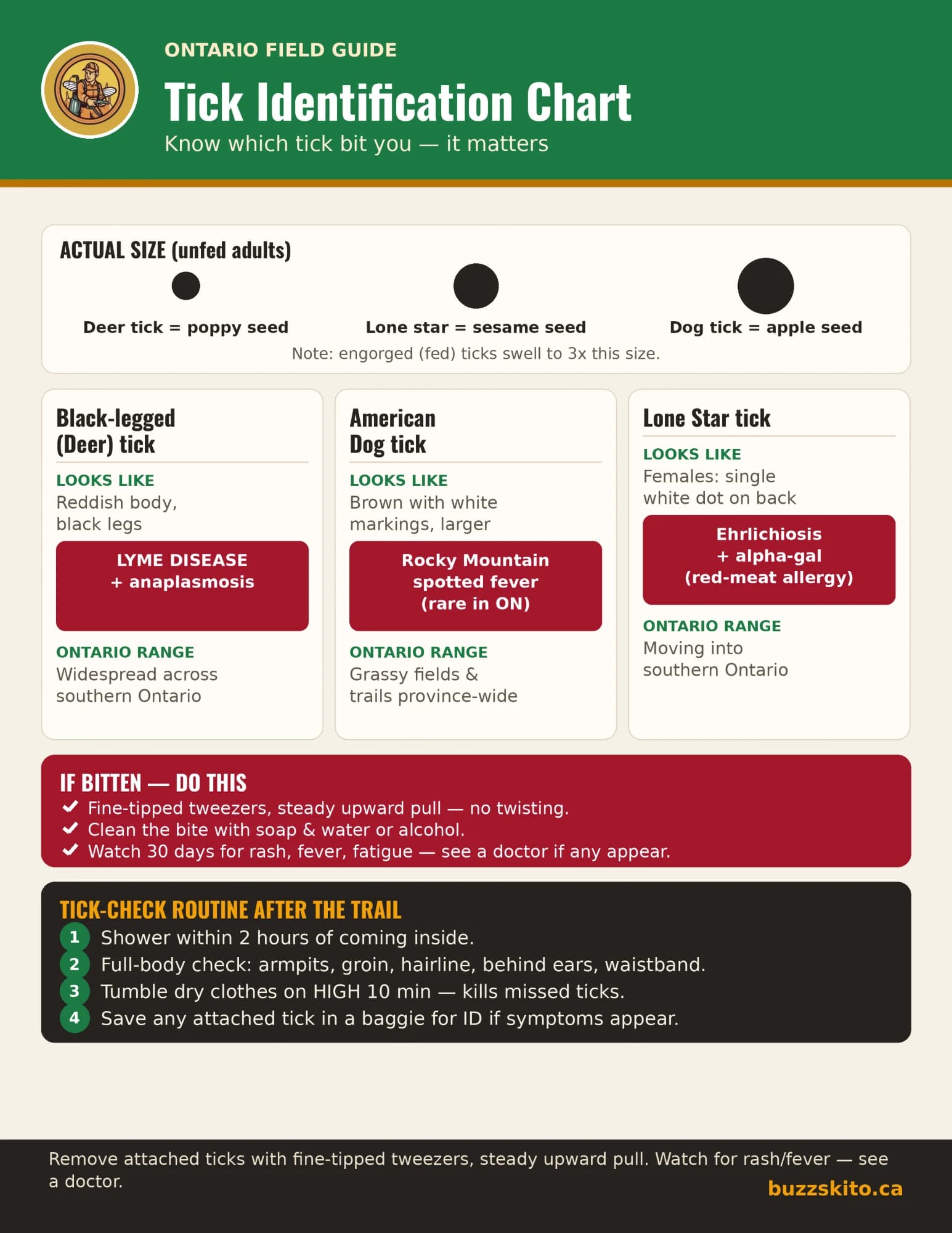
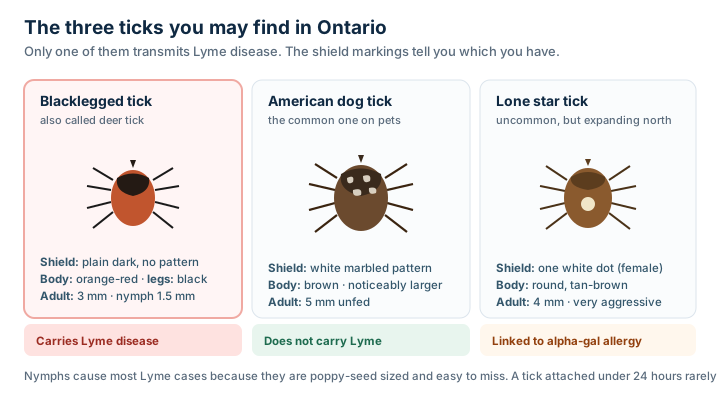
Only a few of Canada’s roughly 40 tick species are commonly encountered by people and pets. Knowing which one you are looking at matters, because only the blacklegged group carries Lyme disease. These four account for the vast majority of tick encounters nationally:
- Blacklegged tick (Ixodes scapularis) — the “deer tick.” The main Lyme vector in central and eastern Canada. Established across southern Ontario, Quebec, and the Maritimes.
- Western blacklegged tick (Ixodes pacificus) — the coastal-BC Lyme vector, with a much lower infection rate than its eastern cousin.
- American dog tick (Dermacentor variabilis) — large, widespread from the Prairies through Ontario to the Maritimes. Does not carry Lyme; can rarely transmit other conditions.
- Rocky Mountain wood tick (Dermacentor andersoni) — the dominant spring tick of the BC interior, Alberta, and Saskatchewan. Also not a Lyme carrier.
That split — blacklegged ticks in the east and on the BC coast, dog and wood ticks across the west — is the single most useful fact for interpreting any “are there ticks in [place]” question.
Which provinces have ticks?
All of them have ticks of some kind. The meaningful distinction is between provinces where the blacklegged (Lyme) tick is established — reproducing locally in large numbers — and provinces where it is mostly adventitious, meaning individual ticks are dropped off by migratory birds each spring but have not yet formed a self-sustaining population. Below is the region-by-region picture that the province-specific questions all roll up into.
Are there ticks in British Columbia, Vancouver, and Vancouver Island?
Yes. BC has ticks throughout the province. On the coast — Vancouver Island, the Gulf Islands, the Lower Mainland, and the Fraser Valley — the Lyme-carrying species is the western blacklegged tick. The reassuring detail, which BC public health has reported for years, is that the infection rate is low: typically around 1 percent of western blacklegged ticks carry the Lyme bacterium, compared with much higher rates in parts of Ontario and the Maritimes. The BC Interior also has the Rocky Mountain wood tick and American dog tick, which do not carry Lyme but can transmit other, rarer conditions.
Are there ticks in Alberta and Calgary?
Yes, but the risk profile is different. Alberta’s established ticks are the American dog tick and the Rocky Mountain wood tick, common in grassy and shrubby areas in spring around Calgary, Edmonton, and the foothills. The blacklegged tick that spreads Lyme is not considered established in Alberta — the ones found each year are almost all bird-carried. Alberta Health runs a submit-a-tick program, and locally acquired Lyme remains uncommon, but the province still recommends tick checks after time in places like Fish Creek Provincial Park or Kananaskis.
Are there ticks in Saskatchewan and Manitoba?
Saskatchewan mirrors Alberta: American dog ticks and wood ticks are widespread, while the blacklegged tick is not established, so Lyme risk is low. Manitoba is where the eastern pattern begins — the province has defined blacklegged-tick risk areas, mostly in the southeast toward the Ontario border and around the southern Manitoba forests, and it reports locally acquired Lyme cases each year.
Are there ticks in Ontario, including High Park and Mississauga?
Yes — extensively. Ontario has some of the largest established blacklegged-tick zones in the country, concentrated in eastern Ontario (Kingston, the Thousand Islands, the Ottawa Valley), along the Lake Erie and Lake Ontario shorelines, and increasingly through the ravine and river-valley systems of the Greater Toronto Area. Blacklegged ticks have been detected in Toronto parks and ravines, and Toronto Public Health treats natural areas such as High Park, the Rouge, and the Don Valley as places ticks can be present. In the western GTA, Mississauga’s Credit River valley, conservation areas, and wooded trail edges are monitored the same way. Numbers in the immediate GTA are generally lower than in the eastern-Ontario hotspots, but the risk is real and growing — our Ontario tick statistics hub tracks the province-level trend, and the Ontario tick-season guide covers exactly when they are out.
Are there ticks in Quebec and Montreal?
Yes, and Quebec is one of the fastest-changing provinces on the map. Blacklegged ticks are well established across the Montérégie and Estrie regions and around Montreal, and Quebec’s Lyme case counts have climbed sharply over the past decade. The Institut national de sante publique du Quebec maps risk municipalities each year, and much of southern Quebec is now flagged.
Are there ticks in the Maritimes and Newfoundland?
Nova Scotia, New Brunswick, and Prince Edward Island all have well-established blacklegged-tick populations — Nova Scotia in particular is a national hotspot. Newfoundland and Labrador is the outlier in the east: most blacklegged ticks found there are adventitious (bird-dropped) rather than established, which keeps locally acquired Lyme risk comparatively low for now. PHAC notes this is exactly the kind of frontier that can change as the climate warms.
Which province has the most ticks?
There are two honest answers, depending on what you mean:
- Highest risk per person: Nova Scotia has consistently reported the highest Lyme disease incidence rate in Canada — blacklegged ticks are dense and widely established there.
- Most total cases: Ontario and Quebec report the largest absolute number of Lyme cases, simply because they have the biggest populations layered on top of huge established tick zones.
So if someone asks “which province has the most ticks,” the most defensible reference answer is: Nova Scotia for density and per-capita risk; Ontario and Quebec for total case burden, according to PHAC national surveillance.
| Common belief | What the data shows |
|---|---|
| “There are no ticks out west.” | BC coast has Lyme-carrying western blacklegged ticks; the Prairies have dog and wood ticks. |
| “Ticks only come out in summer.” | Ticks are active above ~4°C (39°F) — spring and fall are actually peak. |
| “Cities are tick-free.” | GTA ravines and parks (High Park, Rouge, Credit valley) have blacklegged ticks. |
| “Every tick carries Lyme.” | Only blacklegged ticks do, and not all of them — infection rates vary by region. |
Where in Canada are there no ticks?
The honest short answer for 2026 is: nowhere populated is truly tick-free, but the far north has no established populations. Nunavut, most of the Northwest Territories, and most of Yukon are too cold and dry for ticks to complete their life cycle year-round. Ticks are occasionally carried in on birds, pets, or travellers’ clothing, but they do not reproduce there. High-elevation alpine zones and very arid open ground also have far fewer ticks than the humid forest edges ticks depend on. Everywhere else in southern and central Canada now has at least one tick species present, which is why “is there anywhere in Canada with no ticks” increasingly gets a “not really” answer from public-health sources.
Why are ticks spreading across Canada?
PHAC attributes the northward march of the blacklegged tick primarily to a warming climate: milder winters and longer warm seasons let ticks survive at latitudes that used to kill them off. Migratory birds accelerate the process by dropping ticks — and the pathogens they carry — into new areas every spring, seeding fresh populations wherever the habitat has become suitable. The result, documented in PHAC surveillance, is that the number of Canadian Lyme disease cases has grown from a few hundred a year in the early 2010s to several thousand annually, and formerly “tick-free” regions have become risk areas within a single decade. It is also worth remembering that the blacklegged tick is only one of Canada’s ticks; the widespread American dog tick is the one most people across the Prairies and Ontario actually encounter, even though it does not carry Lyme.
What this means if you live in the GTA
If you are in the Greater Toronto Area, the practical takeaway is simple: ticks are here, they are most active in spring and fall, and the highest-exposure spots are wooded ravines, river valleys, conservation areas, and the tall-grass edges of parks and yards that back onto natural areas. The low-effort habits — staying on trails, wearing repellent, tucking pants into socks, and doing a tick check within a couple of hours of coming inside — prevent the vast majority of problems. For yards that border ravines, woodlots, or long grass, a professional perimeter tick barrier spray targets the exact lawn-to-woods transition zone where ticks wait; BuzzSkito offers a seasonal tick program (from $597/season, or $497 bundled with a mosquito plan) across 19 GTA cities.
Of those habits, repellent is the one people apply to the wrong half of themselves: ticks climb from the ground up, so socks, ankles and boot tops matter more than arms. Use a product with a PCP registration number, applied as the label directs. Check price on Amazon.ca →
This is general information, not medical advice. If you develop a fever, an expanding rash, or a “bull’s-eye” mark after a tick bite, contact a healthcare provider — early Lyme disease is very treatable. Save the tick if you can (it can help identify the species), and in a medical emergency call 911.
For anyone who spends real time in tick habitat — trail runners, dog walkers, cottagers, anyone whose yard backs onto woods — factory permethrin-treated clothing is the format sold to Canadian consumers, since spray-on clothing treatments are not registered here. Check price on Amazon.ca → See tick repellents on Amazon.ca →
Related reading
- Blacklegged (Deer) Tick in Ontario — Identification & Lyme Risk
- Tick Season Ontario — When Are Ticks Active?
- American Dog Tick in Canada — What It Is (and Isn’t)
- Ticks in Ontario — Statistics & Data Hub
Frequently Asked Questions
Are there ticks in Alberta?+
Yes. Alberta has established populations of the American dog tick (Dermacentor variabilis), the Rocky Mountain wood tick (Dermacentor andersoni), and other species — but the blacklegged (deer) tick that spreads Lyme disease is not considered established in Alberta. Blacklegged ticks are found in Alberta each year, mostly carried in by migratory birds (Alberta Health calls these “adventitious” ticks), so the risk of locally acquired Lyme is low but not zero. Alberta Health Services runs a submit-a-tick surveillance program, and any tick can still bite, so removal and monitoring still matter.
Are there ticks in BC and on Vancouver Island?+
Yes. British Columbia has ticks across the province, including on Vancouver Island, the Gulf Islands, the Lower Mainland, and the Fraser Valley. The main Lyme-carrying species on the coast is the western blacklegged tick (Ixodes pacificus). Public health data has consistently shown a low infection rate — typically around 1 percent of these ticks carry the Lyme bacterium in BC, lower than in eastern Canada. The interior also has the Rocky Mountain wood tick and American dog tick, which do not spread Lyme but can transmit other illnesses.
Are there ticks in Calgary?+
Yes, ticks are found in and around Calgary, mainly the American dog tick and Rocky Mountain wood tick in grassy and shrubby areas, especially in spring. Blacklegged (Lyme) ticks are only occasionally found in the Calgary area and are not established there, so locally acquired Lyme risk is low. Alberta Health still recommends checking for ticks after hiking in areas like Fish Creek Provincial Park, Nose Hill, and Kananaskis, and submitting any tick you find through the provincial surveillance program.
Are there ticks in Newfoundland?+
Ticks are found in Newfoundland and Labrador, but blacklegged (Lyme) ticks are largely not established there yet. Most blacklegged ticks found in the province are “adventitious” — dropped off by migratory birds each spring — rather than part of a reproducing local population. That makes Newfoundland one of the lower-risk provinces for locally acquired Lyme disease at present, though the Public Health Agency of Canada notes tick ranges are shifting northward, so the picture is being monitored and can change.
Are there ticks in Montreal and Quebec?+
Yes. Southern Quebec is one of the fastest-growing tick regions in Canada. Blacklegged ticks are well established in the Montérégie and Estrie regions and around Montreal, and the number of Lyme disease cases in Quebec has risen sharply over the past decade. The Institut national de sante publique du Quebec (INSPQ) maps risk areas each year. If you spend time in wooded or tall-grass areas around Montreal, tick checks are recommended from spring through fall.
Which province in Canada has the most ticks?+
It depends how you measure it. By Lyme disease incidence rate (cases per 100,000 people), Nova Scotia has consistently ranked highest — blacklegged ticks are dense and widely established there. By total case counts, Ontario and Quebec report the most Lyme cases because they have the largest populations and huge established tick zones. So Nova Scotia has the highest per-capita risk, while Ontario and Quebec have the most cases overall, according to Public Health Agency of Canada surveillance.
Where in Canada are there no ticks?+
There is no established population of blacklegged (Lyme) ticks in Canada’s far north — Nunavut, most of the Northwest Territories, and most of Yukon are too cold and dry for them to survive year-round. Ticks are occasionally carried into these regions by birds or on pets and travellers, but they do not reproduce there. Almost everywhere in southern and central Canada now has some tick species present, so no populated part of the country can be considered truly “tick-free.”
Are there ticks in High Park, Toronto?+
Yes. Blacklegged ticks have been detected in Toronto ravines, valleys, and parks, and Toronto Public Health treats the wooded and tall-grass edges of parks like High Park, the Rouge, and the Don Valley as areas where ticks can be present. Numbers are generally lower than in eastern Ontario hotspots, but the risk is real enough that public health advises staying on trails, wearing repellent, and doing a tick check after visiting park natural areas.
Are there ticks in Mississauga?+
Yes. Ticks are present in Mississauga, particularly along the Credit River valley, ravine systems, conservation areas, and the tall-grass and wooded edges of parks and trails. Blacklegged ticks capable of carrying Lyme disease have been found in the western GTA. Region of Peel Public Health monitors tick activity and recommends tick checks after spending time in natural areas from spring through fall.
What is the most common tick in Canada?+
Across the country as a whole, the American dog tick (Dermacentor variabilis) is one of the most widespread and commonly encountered ticks, found from the Prairies through Ontario and into the Maritimes. It does not spread Lyme disease. The blacklegged (deer) tick (Ixodes scapularis) is the species of most public-health concern because it carries the Lyme bacterium, and it is now the dominant tick found in many parts of southern Ontario, Quebec, and the Maritimes.
Are ticks in Canada getting worse?+
Yes. The Public Health Agency of Canada reports that the range of the blacklegged tick has expanded substantially over the past two decades, driven largely by warming temperatures that let ticks survive further north, plus migratory birds that drop ticks into new areas each spring. Lyme disease cases have climbed from a few hundred a year in the early 2010s to several thousand annually. Ticks are active whenever it is above roughly 4°C (39°F), so the active season is also lengthening.
When are ticks active in Canada?+
Ticks in Canada are active any time the temperature is above about 4°C (39°F), which in southern Canada means roughly March through November, with peak activity in spring (May–June) and again in fall. On a mild winter day, adult blacklegged ticks can even become active briefly. Because the window is so long, the safest habit is to do a tick check any time you have been in long grass, brush, or wooded areas, in any month that is not deep-frozen.