
Reviewed by Alex Francisco
Published November 10, 2026 · Fact-checked against the sources listed below
How can you tell a real termite from a look-alike?
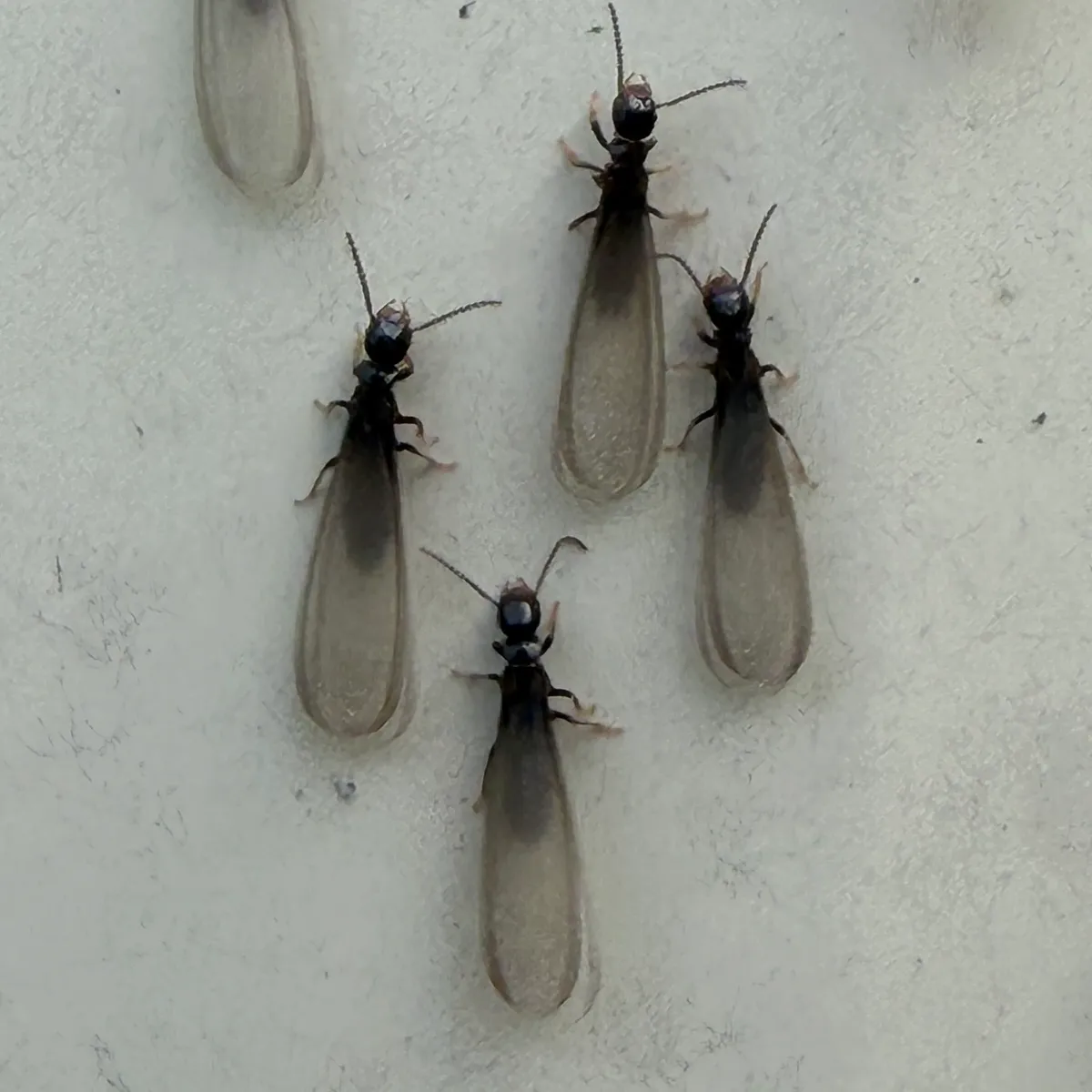
Look at three things: the antennae, the waist and, on a winged insect, the wings. Purdue Extension describes winged termites with straight, bead-like antennae, a thick waist and four long wings of equal length, and the University of Georgia's termite bulletin calls the antennae straight to slightly curved. EPA adds that they may droop, but they do not bend at an angle the way an ant's do.
Termites without wings follow the same body plan. Kansas State University's guide to household pests describes workers as creamy white, soft-bodied, wingless and eyeless, and says they dry out easily, so they stay inside the colony; EPA says termites seldom leave the soil, mud tubes or wood they are tunneling through. A pale insect walking across a shelf or a book is therefore unlikely to be a termite worker.
Swarmers are the termites most people actually see. Purdue puts winged termites at about 1/4 to 3/8 inch, black to yellow-brown, with smoke-gray to brown wings that reach past the body, and Kansas State says the wings lie flat over the back and break off easily after a short flight. The guide to what termites look like covers workers, soldiers and swarmers in turn.
Five checks, with the insect in a jar
- Antennae. Straight and beaded: termite. Bent like an elbow: ant. Long, fine threads on a speck no bigger than 1/12 inch: booklouse.
- Waist. A termite's body runs straight from front to back with no pinch; an ant is pinched in the middle, like a figure 8.
- Wings. Four of the same length, longer than the body and quick to fall off: termite. Front pair longer than the hind pair, and firmly attached: ant.
- Shell. A hard back of wing covers means a beetle; termites are soft-bodied.
- Size and smell. Measure it against a ruler and compare with the quick-ID table; a winged ant that smells of citronella when crushed is probably a larger yellow ant.
Where did you find the bug that looks like a termite?
The place narrows the list before you look at a single antenna; each row gives the usual suspect and the check that confirms it.
| Where you found it | Most likely | Check |
|---|---|---|
| Windowsill, light fixture or wall, often with loose wings, in spring | Termite swarmers or winged ants | Antennae, waist and wing length |
| Coming up through cracks in a basement floor or wall | Larger yellow ants, or termite swarmers | Elbowed antennae; citronella smell when crushed |
| Damp, decaying wood with coarse shavings piled below | Carpenter ants | Dark body and pinched waist; smooth, clean tunnels |
| Wood with soil or mud in its tunnels, or mud tubes on a foundation | Termite workers | Pale, soft, straight-bodied insects crowding the tunnels |
| Damp books, papers, a bathroom or stored grain | Booklice | Tiny, wingless, with long threadlike antennae |
| Hardwood floor, paneling or furniture with tiny round holes and fine powder | Powderpost beetles | Flour-like powder; hard-shelled adults on windowsills |
| Pine framing in an attic or crawl space, with oval holes or gnawing sounds | Old house borer larvae | Oval holes 1/4 to 3/8 inch |
| Near firewood brought indoors | Longhorned and metallic wood-boring beetles | Hard-shelled beetles at lights and windows |
Compiled from the extension, EPA and USDA Forest Service sources linked in the sections below.
Are the winged bugs at the window termites or ants?
They can be either, and three checks tell them apart: an ant has elbowed antennae, a pinched waist and front wings longer than its hind wings, where a termite has straight antennae, no waist and four equal wings. The National Pesticide Information Center notes that many ants look very similar to termites and tend to swarm at the same time. The flying ants vs termites comparison takes each check in turn, and the guide to flying ants explains why ants swarm.
If they are termites, take it seriously: Purdue calls winged termites in a home a near-certain sign of infestation and their shed wings a warning, though Kansas State says one or two may simply have fluttered in from outdoors.
What are the winged bugs coming up through the basement floor?
They may be larger yellow ants. Ohio State University's ant fact sheet says these ants are often mistaken for winged termites, because the winged adults swarm up through cracks in basement walls or floors, crawl around and are drawn to lights. The swarmers are dark brown to blackish-brown with somewhat clouded wings and measure about 1/4 to 3/8 inch to the wing tips; the workers are pale yellowish-brown and 5/32 to 3/16 inch long.
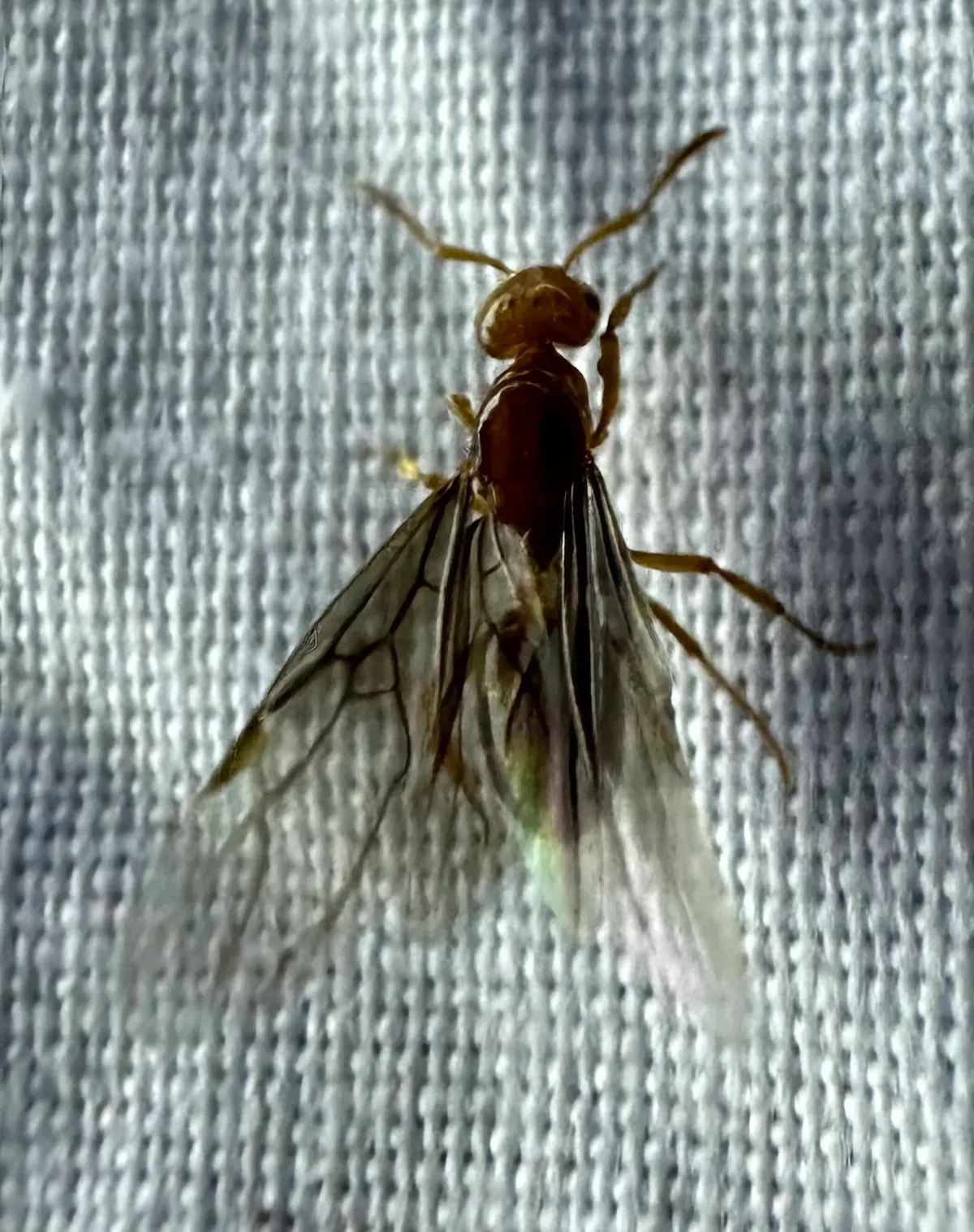
As ants, they have elbowed antennae and a pinched waist, and Ohio State says they give off a strong smell like citronella when crushed. The colony lives in the soil beside the foundation, under the basement floor, in concrete voids or in rotting wood, and the workers feed on honeydew from aphids and mealybugs on the roots of nearby shrubs.
Other insects rise from below too: Penn State Extension's pavement ant page says pavement ants, which nest under sidewalks and building slabs, can swarm at any time of year inside heated buildings, and termites can emerge indoors, so check the antennae and wings of each one.
Is it a carpenter ant or a termite?
A carpenter ant is shiny, dark brown to black and pinched at the waist; a termite worker is creamy white and straight-bodied. Penn State Extension's carpenter ant page says homeowners may mistake one for the other because both live in colonies and excavate wood, and gives carpenter ant workers as 1/4 to 1/2 inch long, with winged ones up to 3/4 inch, against 1/8 to 1/4 inch for eastern subterranean termite workers.
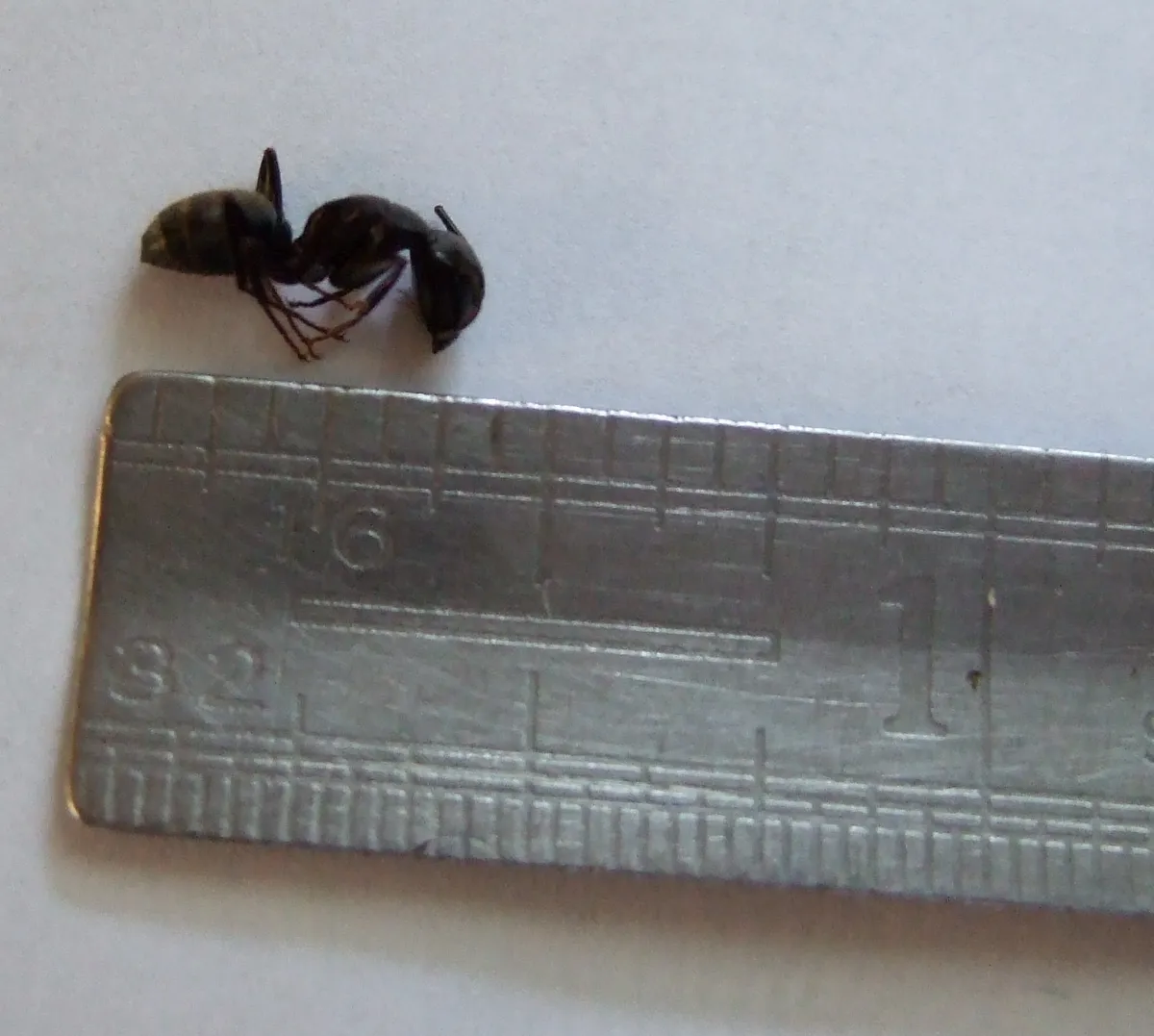
Their work in wood differs too. Carpenter ants do not eat wood: Penn State says they dump piles of coarse, stringy wood particles mixed with dead insect parts outside the nest, and that their galleries are smooth-sided, with no soil or fecal pellets. The USDA Forest Service's Wood Handbook says they prefer wood that is naturally soft or softened by decay, so finding them can point to a moisture problem, and that in certain regions they can cause as much destruction as termites.
How to find a carpenter ant nest walks through the search, and the carpenter ant bite guide tells carpenter ants from other house ants.
Small ants in old termite damage
Ants in old termite galleries are not necessarily termites coming back. Clemson's acrobat ant fact sheet says acrobat ants, 1/16 to 1/8 inch long and black to light brown, may enlarge cavities left by other insects, old termite galleries among them, prefer moist wood softened by decay, and may nest in wall voids and rigid board insulation. The tell is the heart-shaped abdomen, which the ant raises over its thorax and head when disturbed.
What are the tiny pale bugs in books, papers or a damp bathroom?
Booklice. The Bohart Museum of Entomology at UC Davis describes them as tiny, pale insects that resemble minute termites, wingless and about 1/25 inch (1 mm) long as adults. Colorado State puts them at about 1/25 to 1/12 inch (1 to 2 mm) and says that although they somewhat resemble miniature termites, their long, threadlike antennae set them apart, since a termite's are beaded.
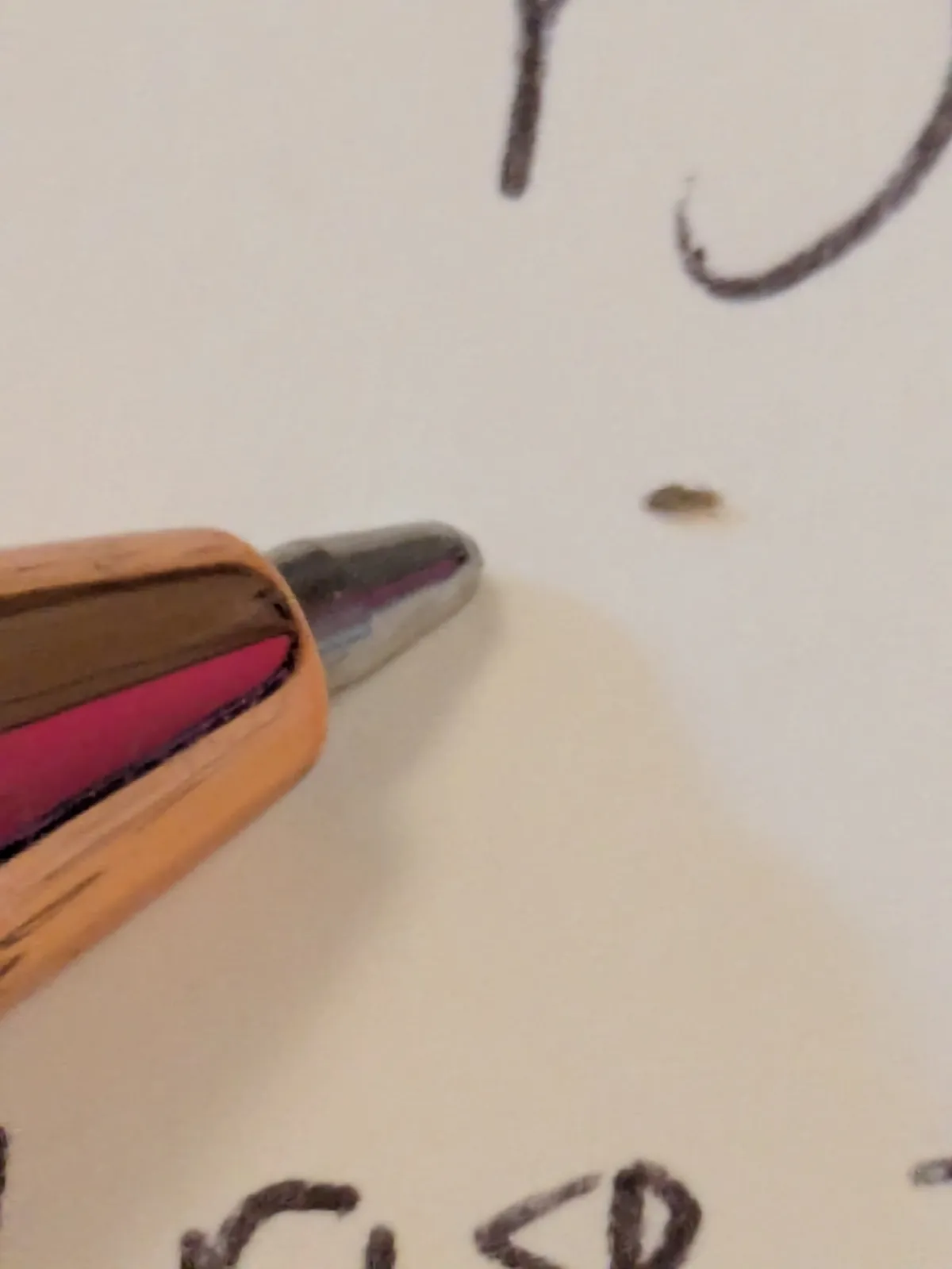
Booklice live on mold, not wood. Colorado State says that indoors they are almost always found in damp places that support the molds they feed on, bathrooms among them, and calls them very minor household pests that cannot bite. The booklice guide covers them in full, and the guide to tiny white bugs sorts the other pale specks found indoors.
What is leaving tiny holes and powder in wood floors and furniture?
Usually powderpost beetles, whose larvae bore through wood and leave as hard-shelled adults. The University of Kentucky ranks them second only to termites at damaging dry, seasoned wood, and University of Missouri Extension says their feeding tunnels can be told apart from termite and carpenter ant damage.
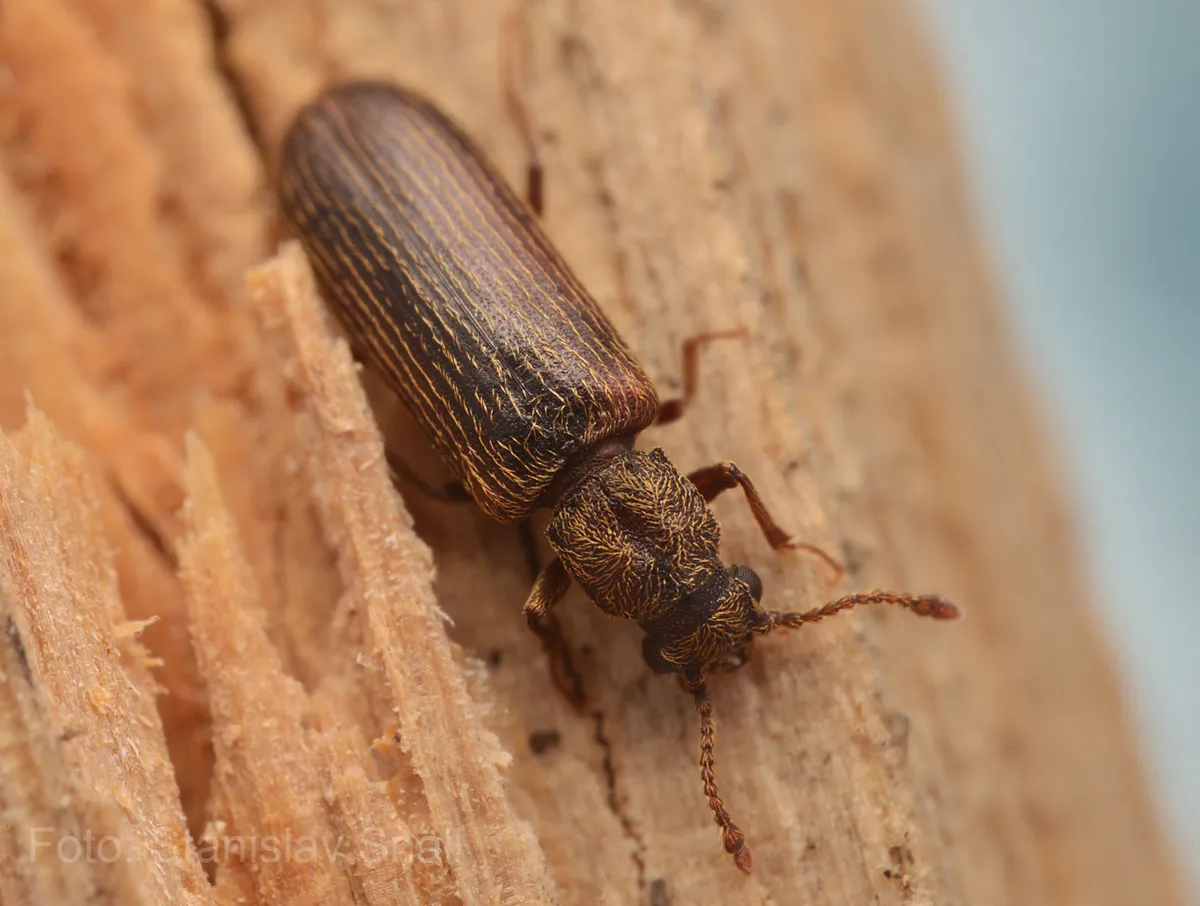
Lyctid powderpost beetles are slender, reddish-brown to black and 1/16 to 1/4 inch long, and Kentucky links their infestations with hardwood flooring, paneling, molding, window and door frames and furniture. Their round exit holes are about the size of a pinhead, and the powder sifting out feels like flour or fine talc. Anobiid beetles leave holes 1/16 to 1/8 inch across and gritty powder, and are worst in damp crawl spaces, basements, garages and unheated outbuildings, where Kentucky says they can seriously damage beams and joists.
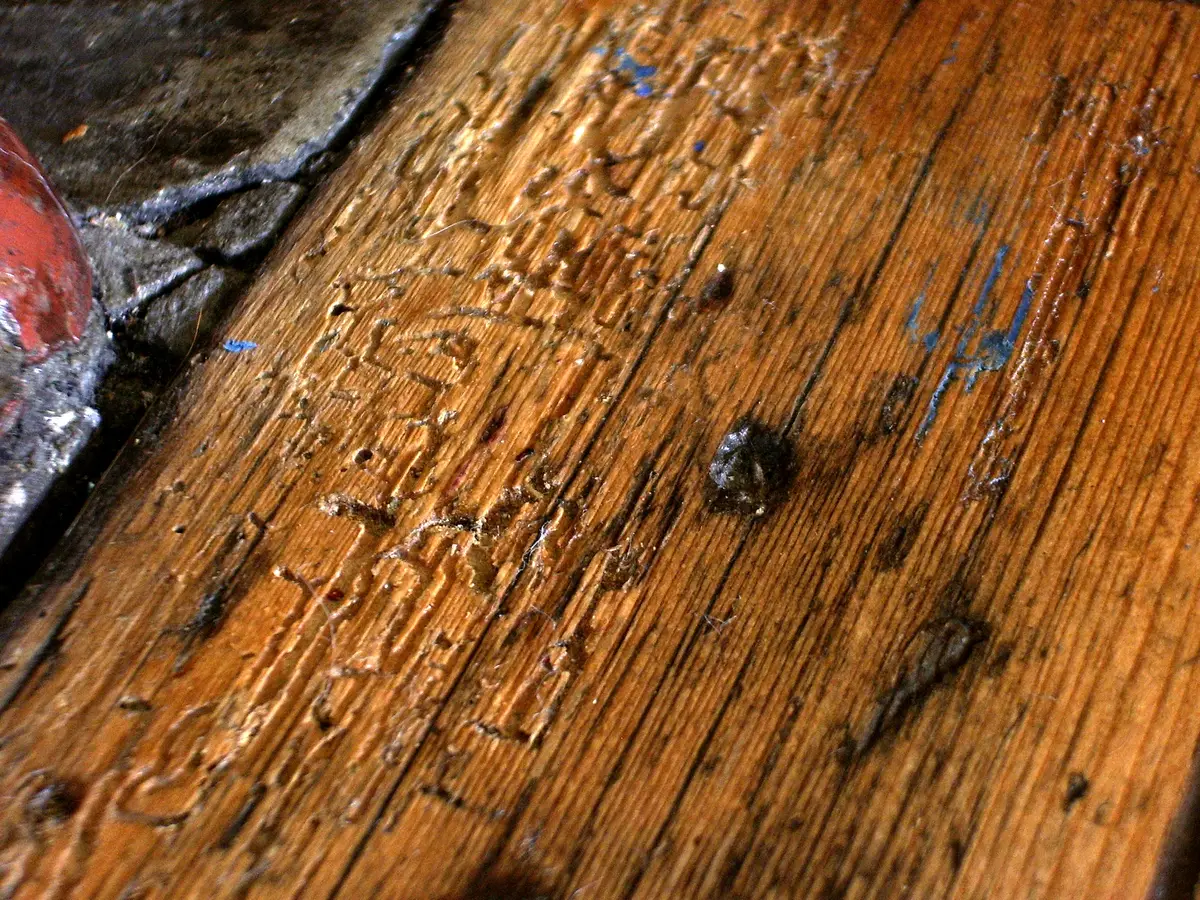
The powder and the mud separate beetle work from termite work. UC IPM's guide to wood-boring beetles in homes says powderpost frass differs from the larger, granular, almost pepperlike pellets drywood termites leave, which carry ridges on their sides, and the Wood Handbook describes subterranean termite galleries speckled with mud, where powderpost tunnels are packed with fine sawdust. UC IPM adds that the adult beetles fly toward light, so dead ones often turn up on windowsills.
What termite damage looks like sets termite, carpenter ant and beetle damage side by side, and the guide to beetles in the house has a pen-tip test for telling powderpost exit holes apart.
Are the white bugs inside the wood termites or beetle grubs?
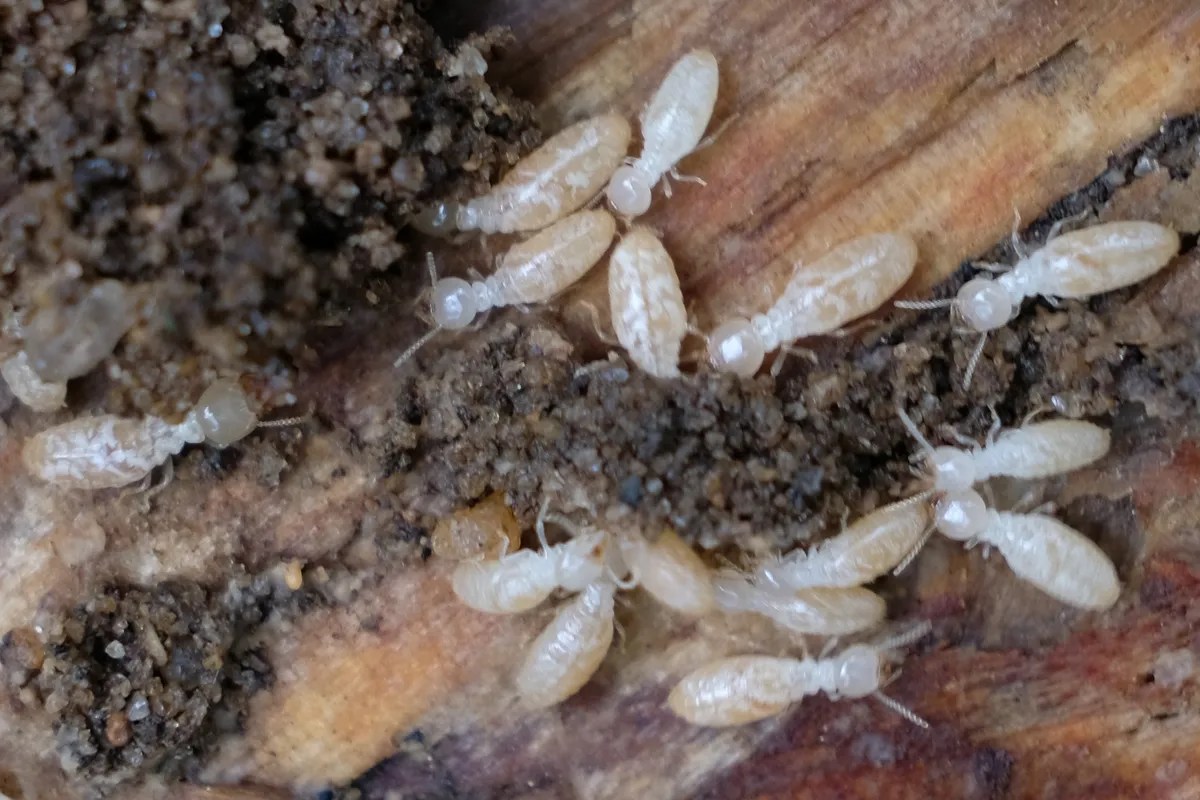
Look at who is in the tunnels and what fills them. In an active termite colony the mud tunnels are filled with workers, Kansas State says: creamy white, soft-bodied insects that do all the colony's labor. Powderpost galleries are instead packed with powder produced by grub-like larvae, according to Kansas State, and Missouri describes most wood-boring beetle larvae as yellowish white with dark jaws.
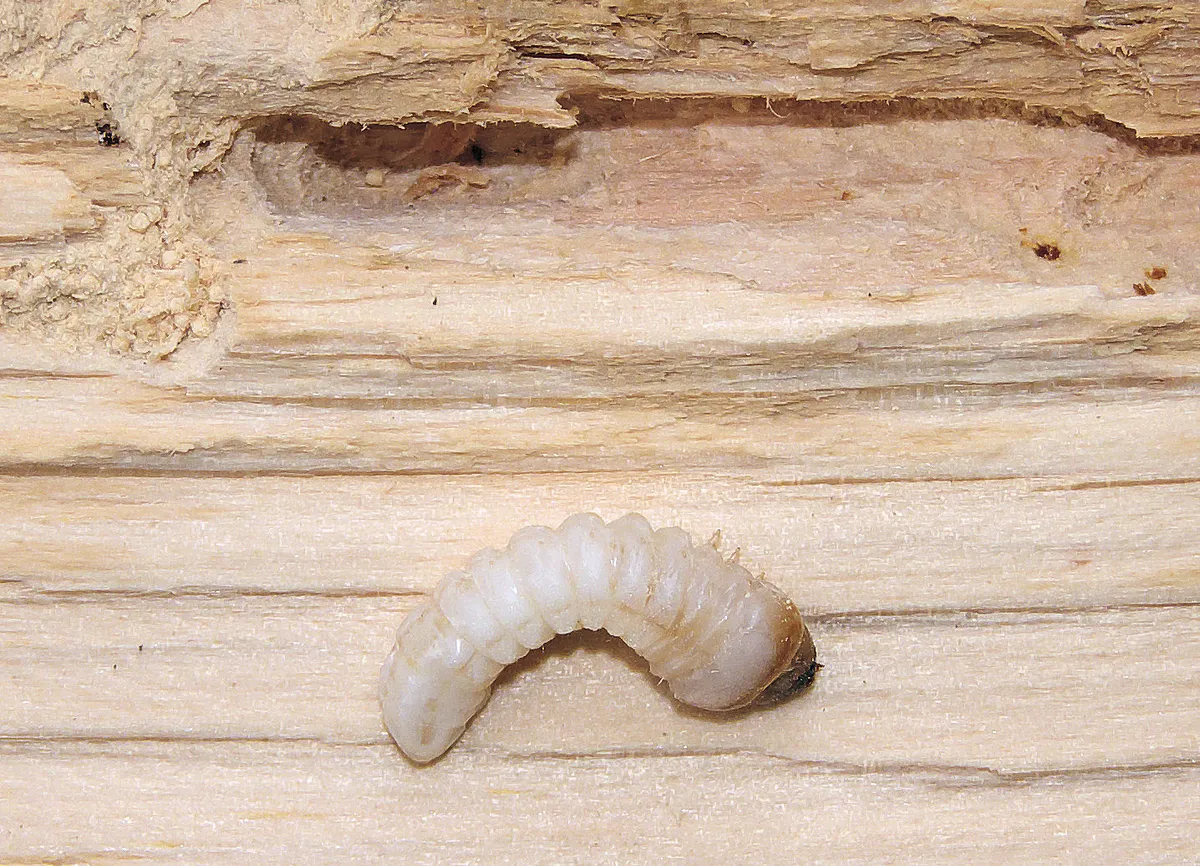
In pine framing, a larger grub may be an old house borer. The University of Kentucky's old house borer fact sheet describes mature larvae about an inch long, with black jaws and three tiny dark eyespots in a row on each side of the head, visible with a hand lens. The beetle infests only softwoods such as pine, fir and spruce, most often in houses less than about 10 years old. Its signs are oval exit holes 1/4 to 3/8 inch across, easiest to spot in attics, crawl spaces and unfinished basements, and gnawing sounds from the wood.
Ant nests hold pale young. Kansas State describes ant larvae as translucent, white, soft-bodied and legless, cared for by adult workers that carry the ant's elbowed antennae and pinched waist.
Beetles that ride in on firewood
Kansas State says longhorned beetles, whose antennae are as long as or longer than their slender bodies, and shiny, metallic, bullet-shaped wood borers come into homes in firewood, and that the adults, 1/2 to 1 1/2 inches long depending on the species, are often seen around lights and windows; the chance of them emerging from firewood and infesting the house is extremely remote, it adds.
Which termite look-alikes damage wood?
Termites and the beetles feed inside wood, while carpenter ants and carpenter bees dig nest tunnels in it; the Wood Handbook sorts their work by what each leaves behind.
| Insect | What it does to wood | What you find |
|---|---|---|
| Subterranean termites | Eat it | Galleries speckled with mud; mud tubes rising from the soil |
| Drywood termites | Eat it | Chambers holding granular pellets with ridged sides |
| Carpenter ants | Dig nests in it; do not eat it | Smooth, clean galleries; coarse shavings and insect parts outside |
| Powderpost beetles | Larvae tunnel through it as they feed | Round holes 1/32 to 1/8 inch; flour-like or gritty powder |
| Old house borer | Larvae tunnel through softwood framing | Oval holes 1/4 to 3/8 inch; tiny barrel-shaped pellets; gnawing sounds |
| Carpenter bees | Females bore nest tunnels | Round holes about 1/2 inch across in unfinished soft wood |
| Booklice | None; they eat mold | Nothing in the wood; a sign of damp air or materials |
From the USDA Forest Service Wood Handbook, Penn State, Kansas State, the University of Kentucky, University of Missouri Extension, UC IPM and Colorado State, linked above.
Carpenter bees are on the list for their holes, not their looks: the Wood Handbook describes large bees that resemble bumblebees but have no hair on the abdomen. A guide to carpenter bees covers the nest holes, and the termite droppings guide shows drywood termite pellets up close.
Commonly confused with
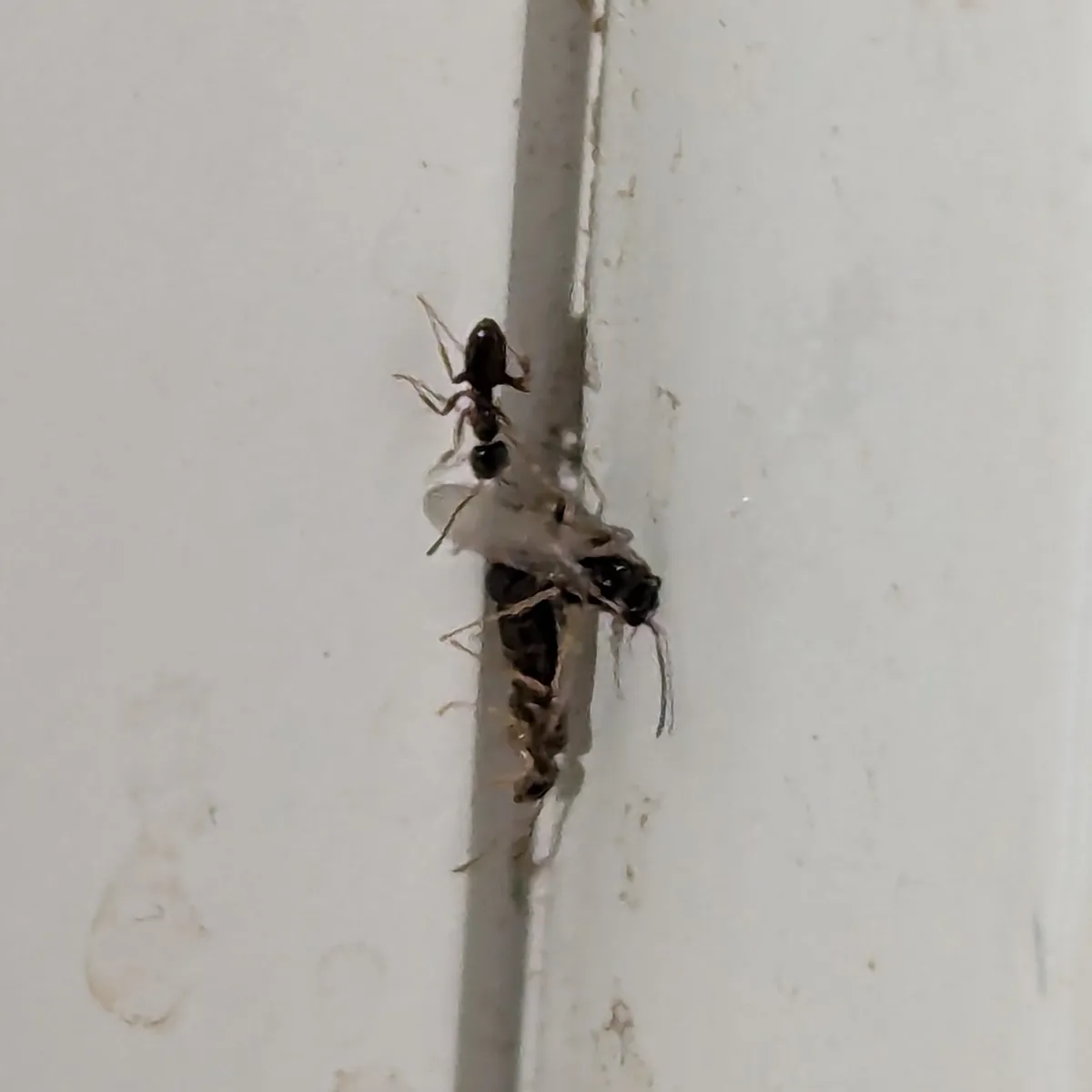 Winged antElbowed antennae, a pinched waist and front wings longer than the hind wings
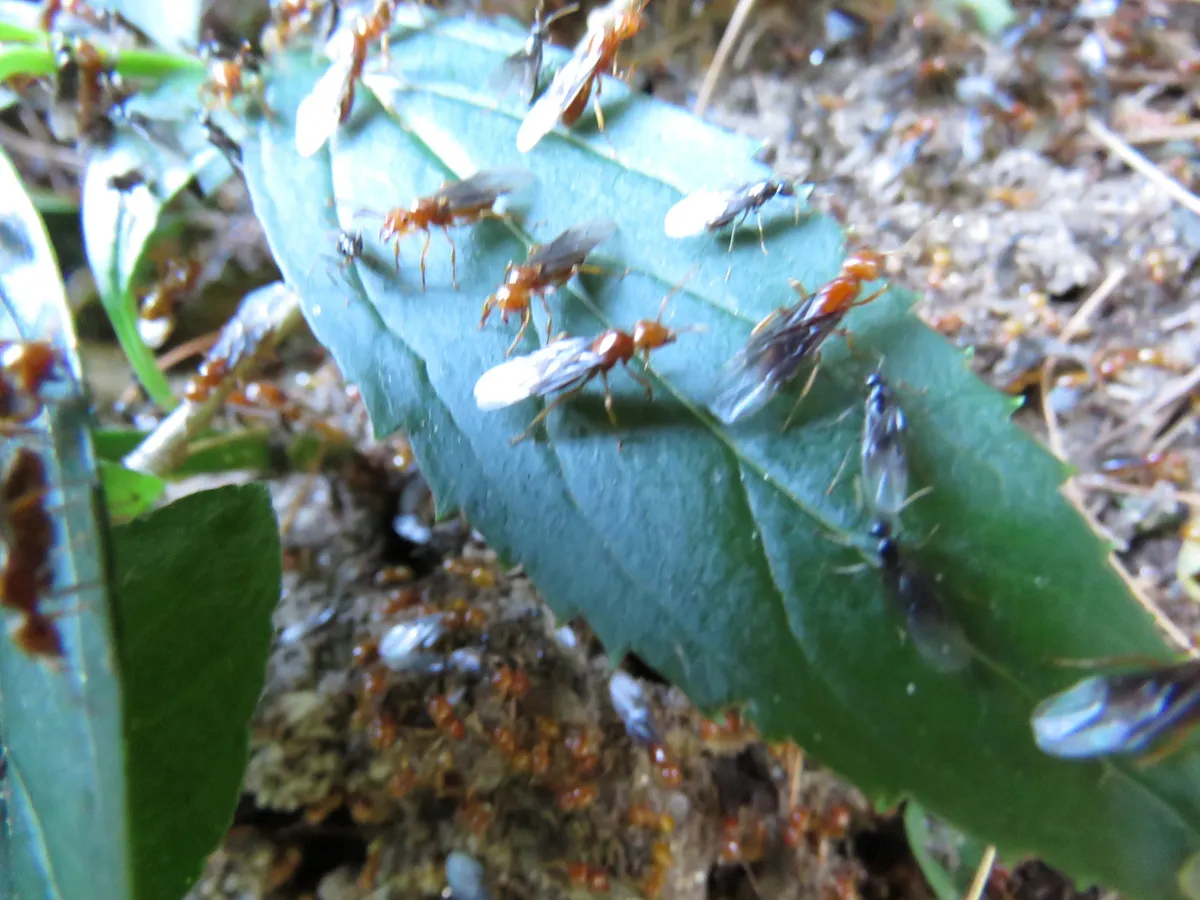 Larger yellow antSwarms up through basement floor cracks; smells of citronella when crushed
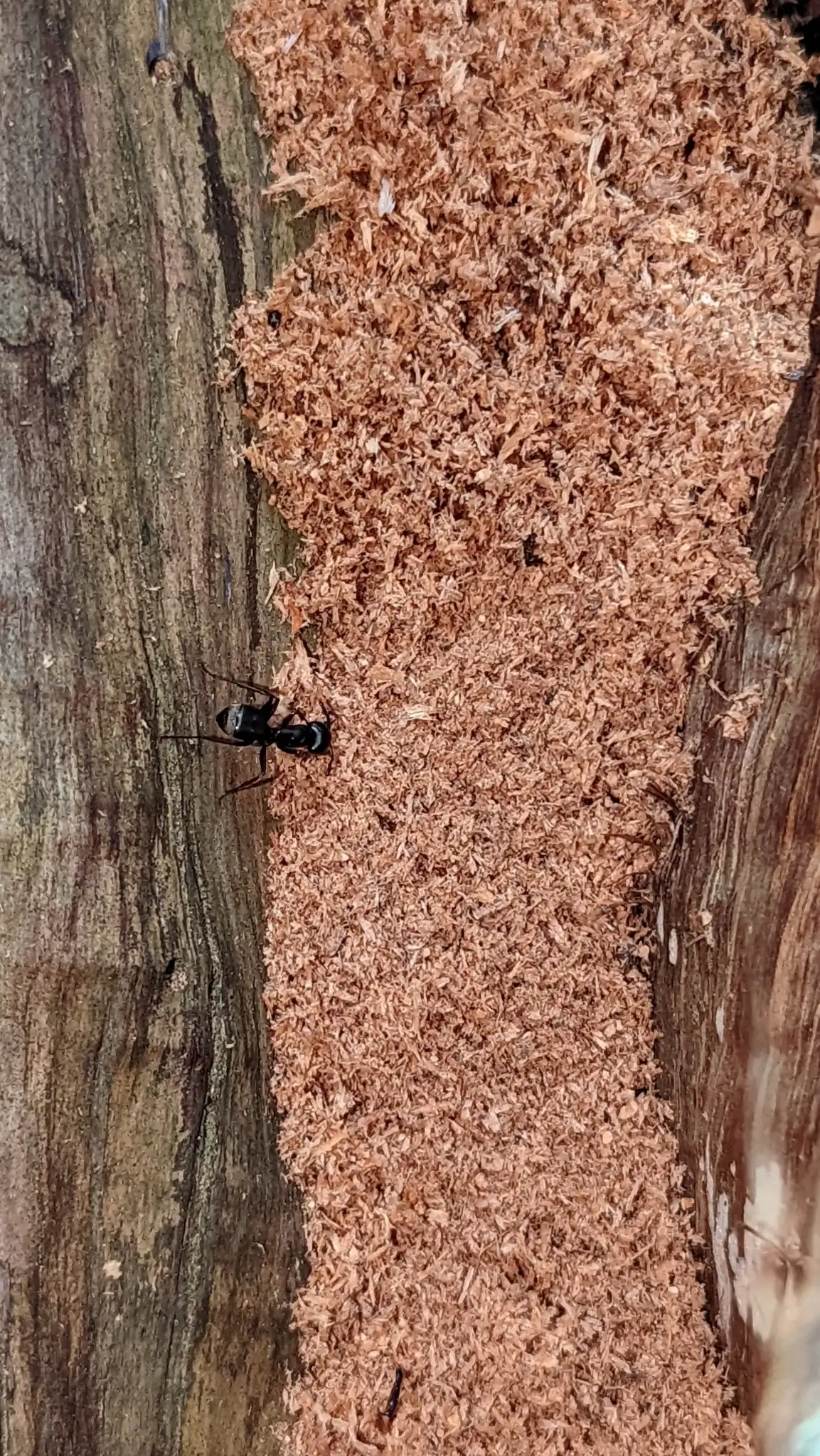 Carpenter antShiny, dark and pinched at the waist; leaves coarse shavings, not mud
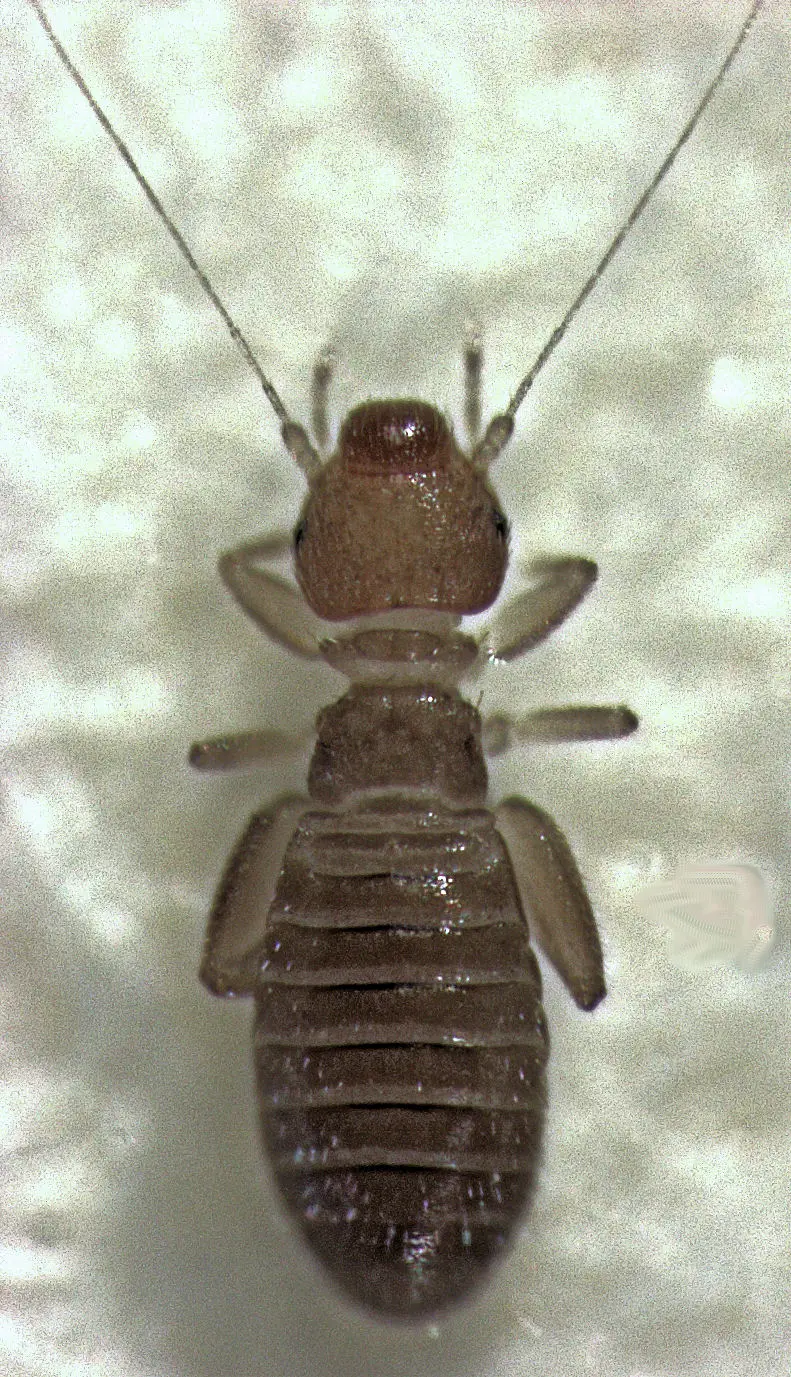 BooklouseAbout 1/25 to 1/12 inch, wingless, with long threadlike antennae; feeds on mold
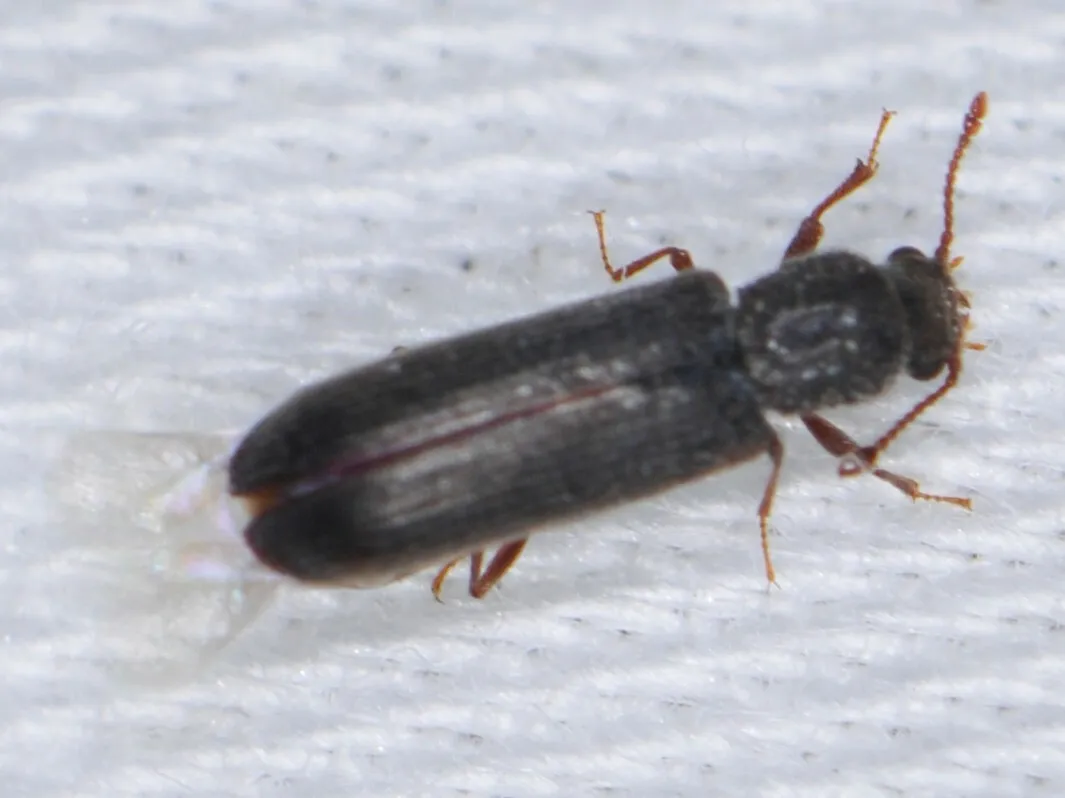 Powderpost beetleHard-shelled beetle 1/16 to 1/4 inch; leaves pinhead holes and flour-like powder
Photos: Winged ant: (c) Emmett Collins-Sussman, some rights reserved (CC BY), via iNaturalist, CC BY 4.0. Larger yellow ant: no rights reserved, via iNaturalist, CC0 1.0. Carpenter ant: (c) John A Haskins, some rights reserved (CC BY), via iNaturalist, CC BY 4.0. Booklouse: S.E. Thorpe, Public domain, via Wikimedia Commons, public domain. Powderpost beetle: (c) Elliott Gordon, some rights reserved (CC BY), via iNaturalist, CC BY 4.0.
What should you do once you know what it is?
Match the next step to the insect; only termites call for a termite inspection.
- Termites. Save a few insects or wings, check the crawl space, foundation and pipe openings for the mud tubes Kansas State describes, and arrange an inspection. Purdue says swarmers indoors call for a professional pest manager, and EPA says termite firms must be licensed by your state.
- Winged ants. Find where they came from; the flying ants guide explains what a swarm indoors means.
- Carpenter ants. Look for the nest and the moisture behind it: Kansas State advises checking wood affected by water seepage, such as window sills, roofs, porch floors, posts and columns.
- Booklice. Dry the room out: Penn State Extension's booklice page says relative humidity below 50% prevents mold growth and booklouse development.
- Powderpost beetles and old house borers. Make sure the infestation is still active. Kentucky's old house borer fact sheet says fresh powder the color of newly sawn wood points to activity, while powder under dust or cobwebs suggests it has stopped, and both Kentucky fact sheets say a definite diagnosis may need an entomologist or a knowledgeable pest professional.
- Firewood beetles. Store firewood outdoors and bring in only what you need, as Kansas State advises.
Frequently Asked Questions
What bug is most often mistaken for a termite?+
Usually winged ants. Kansas State University says winged ants are often mistaken for swarming termites, and the National Pesticide Information Center notes that many ants look very similar to termites and tend to swarm at the same time. Carpenter ants get confused with termites for another reason: Penn State Extension says both live in colonies and excavate wood. Check the antennae, the waist and the wings. Ants have elbowed antennae, a pinched waist and front wings longer than the hind pair; termites have straight antennae, no waist and four equal wings.
What are the white bugs that look like termites?+
Pale, soft, wingless insects crowding damaged wood, soil or mud tubes are most likely termite workers, which Kansas State University describes as creamy white and eyeless. Smaller pale bugs on damp paper or in a bathroom are probably booklice, about 1/25 to 1/12 inch long with long, threadlike antennae, according to Colorado State. A grub-like larva in a tunnel packed with powder is a wood-boring beetle larva; Missouri Extension describes most as yellowish white with dark jaws. White, legless larvae in an ant nest are young ants, Kansas State says.
Do booklice mean you have termites?+
No. Booklice feed on mold and fungi, Penn State Extension says, so a crowd of them points to damp air or damp materials, not to termites. The Bohart Museum at UC Davis notes that these tiny, pale insects resemble minute termites, which is where the mix-up starts, but Colorado State says their long, threadlike antennae tell them apart from a termite's beaded ones. Termite workers stay inside wood, soil or mud tubes. Penn State says keeping relative humidity below 50% prevents booklouse development.
What looks like termite damage but isn't?+
Powderpost beetles, old house borers, carpenter ants and carpenter bees all damage wood. The USDA Forest Service's Wood Handbook sorts them by what they leave: subterranean termite galleries are speckled with mud, carpenter ant galleries are clean and polished, powderpost tunnels are packed with fine sawdust, and carpenter bees bore round holes about 1/2 inch across. The University of Kentucky says lyctid powderpost beetles leave round holes about the size of a pinhead, and old house borers oval holes 1/4 to 3/8 inch across.
How can you tell a termite from an ant without a magnifying glass?+
Look at the color, the wings and where it is. Penn State Extension says carpenter ant workers are shiny, dark brown to black, while eastern subterranean termite workers are creamy white. On winged insects, Ohio State University says termite wings are milky white or grayish, longer than the body and easily shed, while ant wings are clear or brownish and firmly attached, so loose wings of equal size on a sill point to termites. Termite workers also stay hidden inside wood, soil or mud tubes.
Do carpenter ants look like termites?+
Not up close, though the two can be confused. Penn State Extension says homeowners may mistake them because both live in colonies and excavate wood. A carpenter ant worker is shiny, dark brown to black and 1/4 to 1/2 inch long, with a pinched waist and elbowed antennae; an eastern subterranean termite worker is creamy white, 1/8 to 1/4 inch long and straight-bodied. Carpenter ants do not eat wood: they push out coarse shavings, and their galleries are smooth, with no soil.
Why are flying ants coming up through my basement floor?+
They may be larger yellow ants. Ohio State University says these ants live in the soil next to the foundation, under basement floors, in concrete voids or in rotting wood, and that their winged adults swarm up through cracks in basement walls or floors and are drawn to lights, which is why they are often mistaken for winged termites. Ohio State says they give off a strong citronella-like smell when crushed. Check the antennae as well, since termites can also swarm indoors.
Do powderpost beetles look like termites?+
No. They are hard-shelled beetles, slender and reddish-brown to black, 1/16 to 1/4 inch long in the lyctid group, according to the University of Kentucky. The confusion comes from their damage: Kentucky ranks them second only to termites at damaging dry, seasoned wood. Their signs are small round exit holes and powder that feels like flour or fine talc, rather than mud. UC IPM says the adults fly toward light, so dead ones often collect on windowsills.
Are termite look-alikes harmful?+
Some are, in different ways. Carpenter ants, powderpost beetles and old house borers damage wood, and the University of Kentucky says anobiid powderpost beetles can seriously damage beams and joists. Clemson says acrobat ants bite on occasion and sometimes strip the insulation from electrical or telephone wires. Booklice are among the mildest: Colorado State calls them very minor household pests that cannot bite. Larger yellow ants feed on honeydew from aphids and mealybugs on shrub roots, according to Ohio State University.
Do ants and termites swarm at the same time of year?+
Often, yes. The National Pesticide Information Center says many ants tend to swarm at the same time as termites. Kansas State University says termite swarms are most common in spring after the first warm rains, beginning as the day warms, around 10 a.m., and the University of Georgia gives February through April for the eastern subterranean termite, mainly when outdoor temperatures are warm. Some ants break the pattern: Penn State Extension says pavement ants can swarm at any time of year inside heated buildings.
Sources
- Are These Termites or Ants? (Blake Layton, Extension Entomology Specialist) — Mississippi State University Extension Service
- Finding Winged Termites Is a Red Flag (Hot News HN-61-W; Timothy J. Gibb, May 2009) — Purdue Extension, Department of Entomology
- Biology of Subterranean Termites in the Eastern United States (Bulletin 1209; D. R. Suiter, S. C. Jones and B. T. Forschler, reviewed April 2024) — University of Georgia Cooperative Extension
- Termites: How to Identify and Control Them (updated October 8, 2026) — U.S. Environmental Protection Agency
- Household Pests of Kansas (MF3291; Holly N. Davis and R. Jeff Whitworth, July 2018) — Kansas State University Research and Extension
- Termites (updated April 15, 2026) — National Pesticide Information Center (Oregon State University and U.S. EPA)
- Ants In and Around the Home (HYG-2064; David Shetlar, Barbara Bloetscher and Jennifer Andon, 2013) — The Ohio State University, College of Food, Agricultural, and Environmental Sciences
- Pavement Ant (Steve Jacobs, updated May 12, 2026) — Penn State Extension
- Carpenter Ants (Steve Jacobs, updated June 24, 2026) — Penn State Extension
- Chapter 14: Biodeterioration of Wood (Wood Handbook, FPL-GTR-282; R. A. Arango, S. Lebow and J. A. Glaeser, 2021) — USDA Forest Service, Forest Products Laboratory
- Acrobat Ants (HGIC 2400; J. S. Nauman, P. A. Zungoli and E. P. Benson) — Clemson Cooperative Extension, Home & Garden Information Center
- Psocids/Booklice (Information No. 062) — Bohart Museum of Entomology, University of California, Davis
- Colorado Insects of Interest: Booklice — Colorado State University, Department of Agricultural Biology
- Booklice (Steve Jacobs; revised July 2024 by Michael Skvarla) — Penn State Extension
- Powderpost Beetles (ENTFACT-616; Michael F. Potter, revised March 2026) — University of Kentucky Department of Entomology
- Wood-Boring Beetles (G7422; revised by Richard M. Houseman, June 2010) — University of Missouri Extension
- Pest Notes: Wood-Boring Beetles in Homes (UC ANR Publication 7418; V. R. Lewis and S. J. Seybold) — University of California Statewide IPM Program
- Old House Borer (ENTFACT-653; Michael F. Potter, revised March 2026) — University of Kentucky Department of Entomology
Read and approved by Alex Francisco. Found an error? Email support@buzzskito.ca.