
Published by BuzzSkito Mosquito & Tick Control
Published October 29, 2026 · Fact-checked against the sources listed below
What are sweat bees?
Sweat bees are the bee family Halictidae: small bees named for their habit of landing on sweaty people. The Missouri Department of Conservation's field guide to halictid bees (MDC) counts more than 500 species in North America north of Mexico. Most are black or brown, MDC says, but some are bright metallic green or blue, and some have bands like a honey bee's; all are small, and none are aggressive.
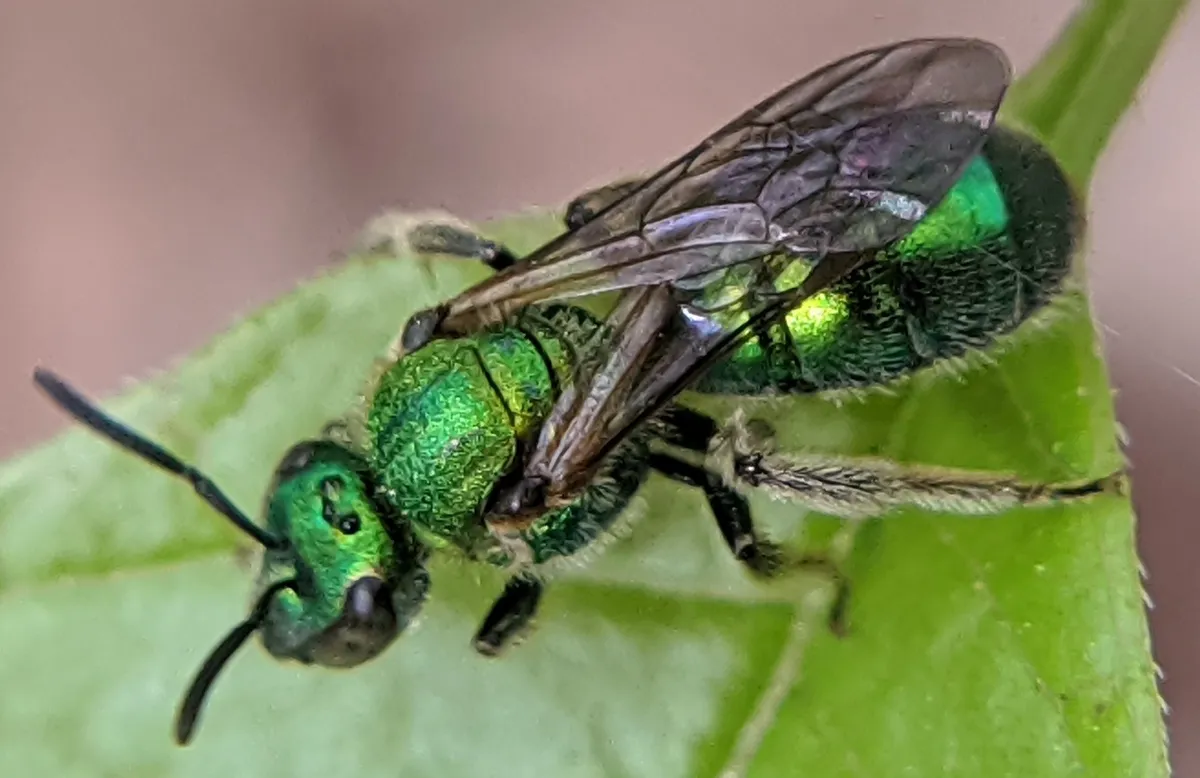
Many live alone. Texas A&M's Apiary Inspection Service describes sweat bees as small, solitary bees, colored from dull or metallic black to metallic green, blue or purple, and drawn to the salt in perspiration; it says they are not aggressive and are only after nutrients. Other species share nests, MDC says, and in those some females may work without laying eggs.
Why do sweat bees land on you?
To lick up the salt in your sweat. MDC says perspiration gives sweat bees moisture and salts. The Maryland Department of Natural Resources compares them to a cow or deer at a salt lick: the bees lap up sweat to add salts, which are often hard to find in nature, to a diet of nectar and pollen, and they do not bite or sting to get it.
In the pure green sweat bee, at least, the females are the ones most drawn to you. The University of Florida's profile of that species (UF/IFAS) says females lick sweat off people and may sting if startled or threatened while doing it, and that males are less attracted to sweat. University of Missouri Extension says sweat bees get their name from this attraction to people who are perspiring.
What do sweat bees look like?
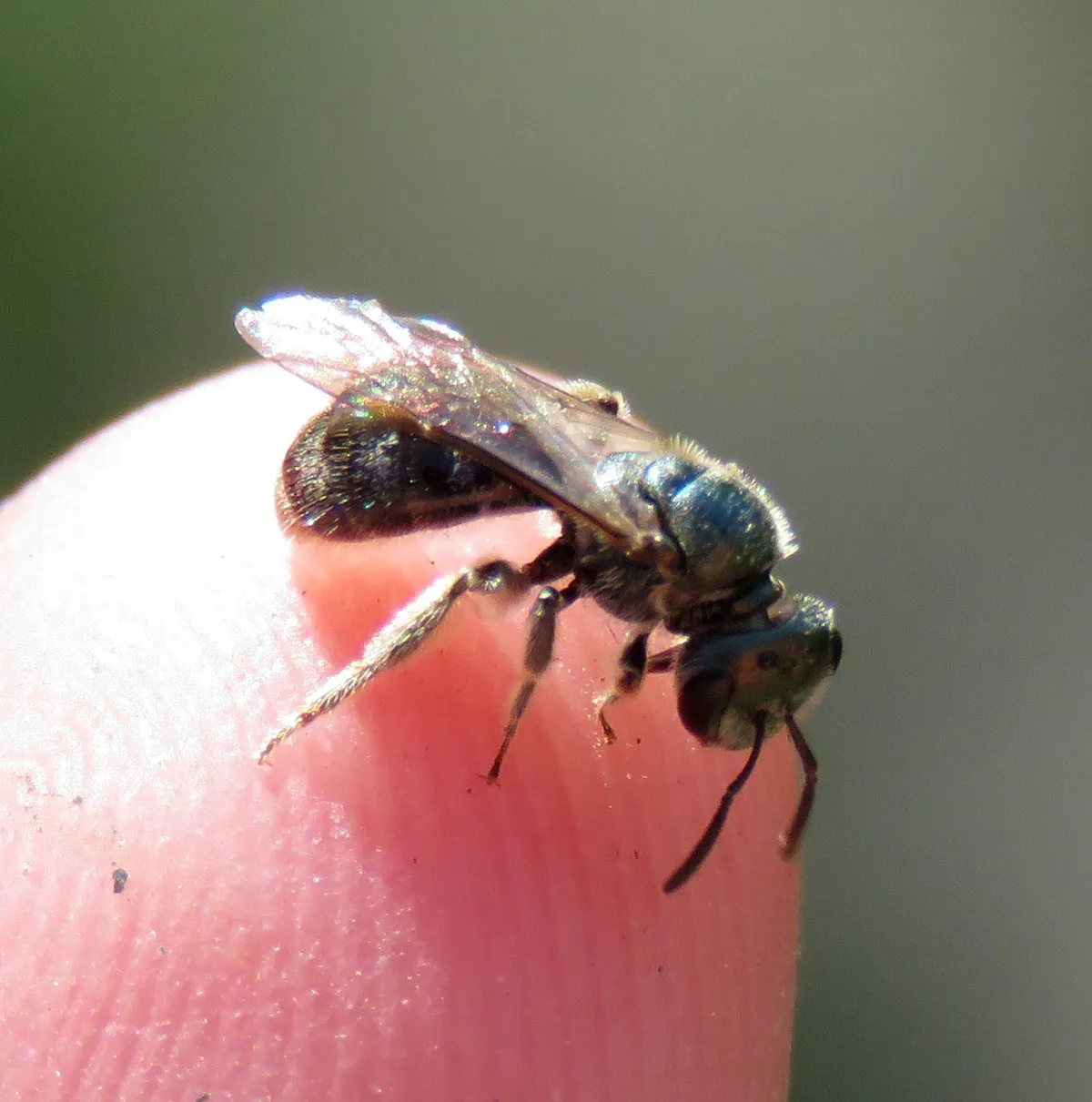
Small and typically dark or metallic, with two pairs of wings, as Purdue University entomologist Christian Krupke describes them. University of Illinois Extension puts the ones in Illinois at about 1/4 inch long and metallic green, brown or black; MDC and Texas A&M give the family's size as 1/4 to 3/4 inch.
Small dark sweat bees
The University of Wisconsin-Milwaukee Field Station says the name sweat bee comes from one drab genus, Lasioglossum, whose members land on sweaty skin and lap up the salt. It is a big, variable group: Maryland DNR counts about 120 sweat bee species in that state, most of them Lasioglossum, in colors from black and deep blue to red (and green or blue in some), and says one, the Gotham bee, is about the size of a grain of rice.
Green sweat bees
Many sweat bees have a vibrant metallic green or blue look, Maryland DNR says. Three groups stand out:
- *Pure green sweat bee (Augochlora pura).* Shiny all over, in colors from green to blue to gold, says UF/IFAS. It lives in the eastern US, from Florida north into Canada and west to a line from Minnesota to Texas, mostly in and near woods, and its females nest only in rotting wood.
- Augochlorella. Bright green bees that MDC calls the smallest and most abundant sweat bees; many are social, but their soil nests rarely hold more than a few bees.
- *Striped sweat bees (Agapostemon).* MDC's Wild Guide to the bicolored striped sweat bee gives it a size of 0.3 to 0.6 inch and a metallic green or blue-green sheen; females have a black abdomen with thin white stripes, males thick yellow bands. Despite its name, MDC says, it does not share other sweat bees' taste for human sweat.
Not every shiny green insect is a sweat bee. MDC says cuckoo wasps are also small and metallic blue or green, but their bodies are usually covered in small pits, they can roll up into a ball for defense, and their females cannot sting. Seen up close, UF/IFAS says, a sharply curved vein near the base of the front wing marks a sweat bee.
Do sweat bees sting?
Yes, but only the females, mildly, and seldom. University of Missouri Extension says only females have stingers, because a stinger is a modified egg-laying structure, and that sweat bees rarely sting except when pinned against the skin. MDC says pressing on a female may prompt a mild sting, and UF/IFAS says male sweat bees cannot sting.
Purdue's Krupke writes that sweat bees will readily sting if accidentally squashed while they are feeding, and that they sometimes sting even when not bothered at all. Maryland DNR calls them unlikely to sting and no more dangerous than any other bee to people without a bee sting allergy.
For other stings and bites, the bug bite and sting chart sorts them by pattern and feel, the bug bite identifier narrows down a culprit in six questions, and bee stings and wasp stings compared covers reactions in more detail.
How do you tell a sweat bee from a hover fly?
Count the wings: a hover fly has one pair, a bee two. Illinois Extension entomologist Phil Nixon describes hover flies, also called syrphid flies, as small flies, usually 1/4 inch or shorter with yellow and black or brown bands, that hover around your arms when you have been sweating and land to lap it up. Although they are commonly called sweat bees, he writes, they cannot sting; on sensitive skin their mouthparts may feel like a slight pinch.
Purdue's Krupke says hover flies come for the moisture and salts in sweat and cannot bite either; their yellow or orange and black stripes mimic bees and wasps. North Dakota State University Extension's guide to insects that look like bees (NDSU) adds two more tells: flies have big eyes that take up most of the head and usually short antennae, while bees have narrower eyes on the sides of the head and longer antennae. NDSU says many hover flies are 1/4 to 1/2 inch long and that some are quite hairy, so fuzz alone proves nothing.
Leave them be. NDSU says some hover fly larvae are key predators of soft-bodied pests such as aphids, and Illinois advises putting up with the flies, which will probably decline naturally within a week or two; it does not recommend insecticides, because hovering flies easily avoid sprays aimed at them.
How do you tell a sweat bee from a yellow jacket?
A yellow jacket is a wasp about 1/2 inch long, bright yellow and black and not densely hairy; most sweat bees are smaller and dark or metallic. The Missouri Department of Conservation's yellowjacket guide says yellowjackets are widely, and wrongly, called sweat bees, and that some people call them ground bees too. Unlike honey bees, MDC says, they are not densely hairy and do not collect pollen.
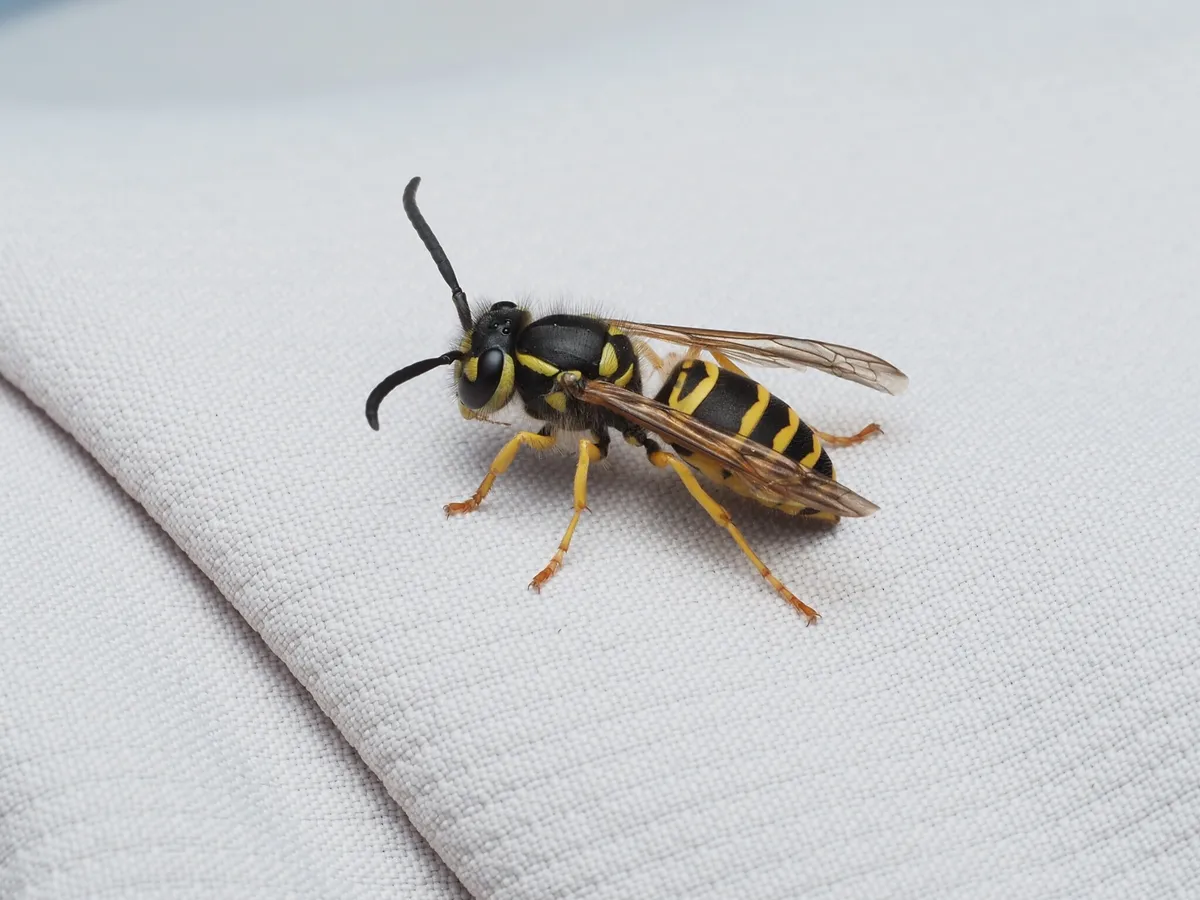
Behavior gives it away. MDC says yellowjackets forage for meat, ripe fruit, sweets and garbage, can crowd picnic areas and soda cans, and are usually most active and abundant from midsummer to the first frosts; Illinois adds that they are the only yellow-and-black stinging insects commonly attracted to perspiration. They can sting repeatedly and defend their nest as a group, MDC says, and the nest is usually underground, often showing only as a hole with a lot of wasps flying in and out.
MDC's advice for one on your body: never swat it, because that could prompt a sting. Wasp vs hornet compares yellowjackets with hornets and paper wasps, the yellow jacket guide covers them in depth, and dealing with wasps that nest in the ground covers their nests.
How is a sweat bee different from a honey bee?
A honey bee is about 1/2 inch long and fuzzy, and it leaves its stinger behind. University of Missouri Extension describes honey bees as fuzzy and light brown to black, with a brown-and-black striped abdomen, and says a honey bee stings only once, because its barbed stinger stays in the skin and the bee dies. Most sweat bees are smaller and dark or metallic, as Purdue and Illinois describe them.
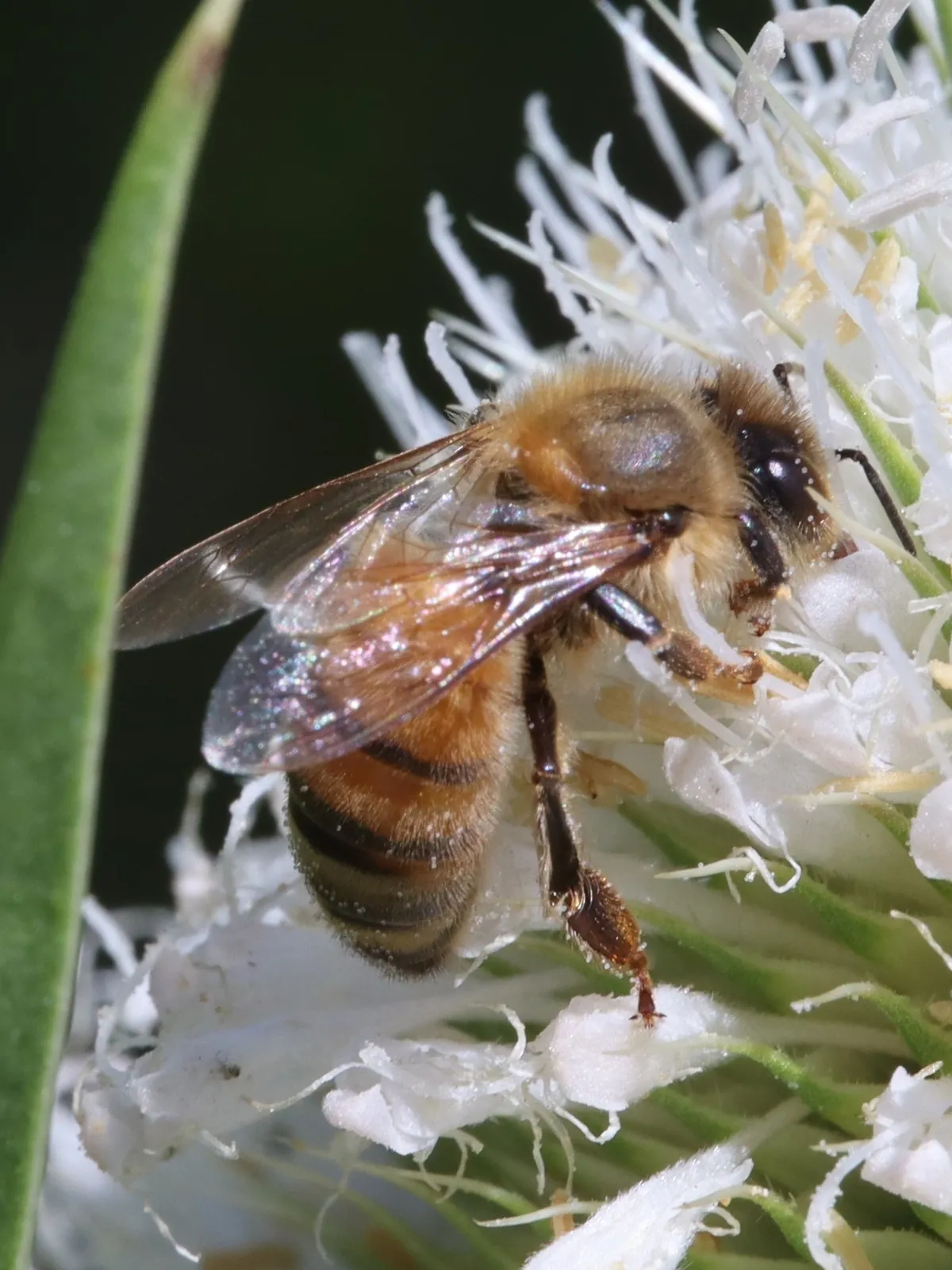
A swimming pool draws bees for another reason: water. NC State Extension says honey bees frequently seek out any available water in hot, dry weather and that even the odor of chlorine may attract them; it adds that some solitary bees look like honey bees, so confirm which you have. A sweat bee that lands on a swimmer's skin is after sweat, as MDC describes.
Where do sweat bees nest?
Mostly in the ground. MDC says nearly all sweat bees nest in the ground and a few in rotten wood, and University of Missouri Extension says these small bees often nest close together in soil where plants are sparse. Texas A&M says a female digs her nest in spring and stocks each cell with pollen, nectar and one egg. MDC's bicolored striped sweat bees dig deep into flat or sloping soil or sometimes banks, and up to 12 females may share a single nest while each builds her own cells.
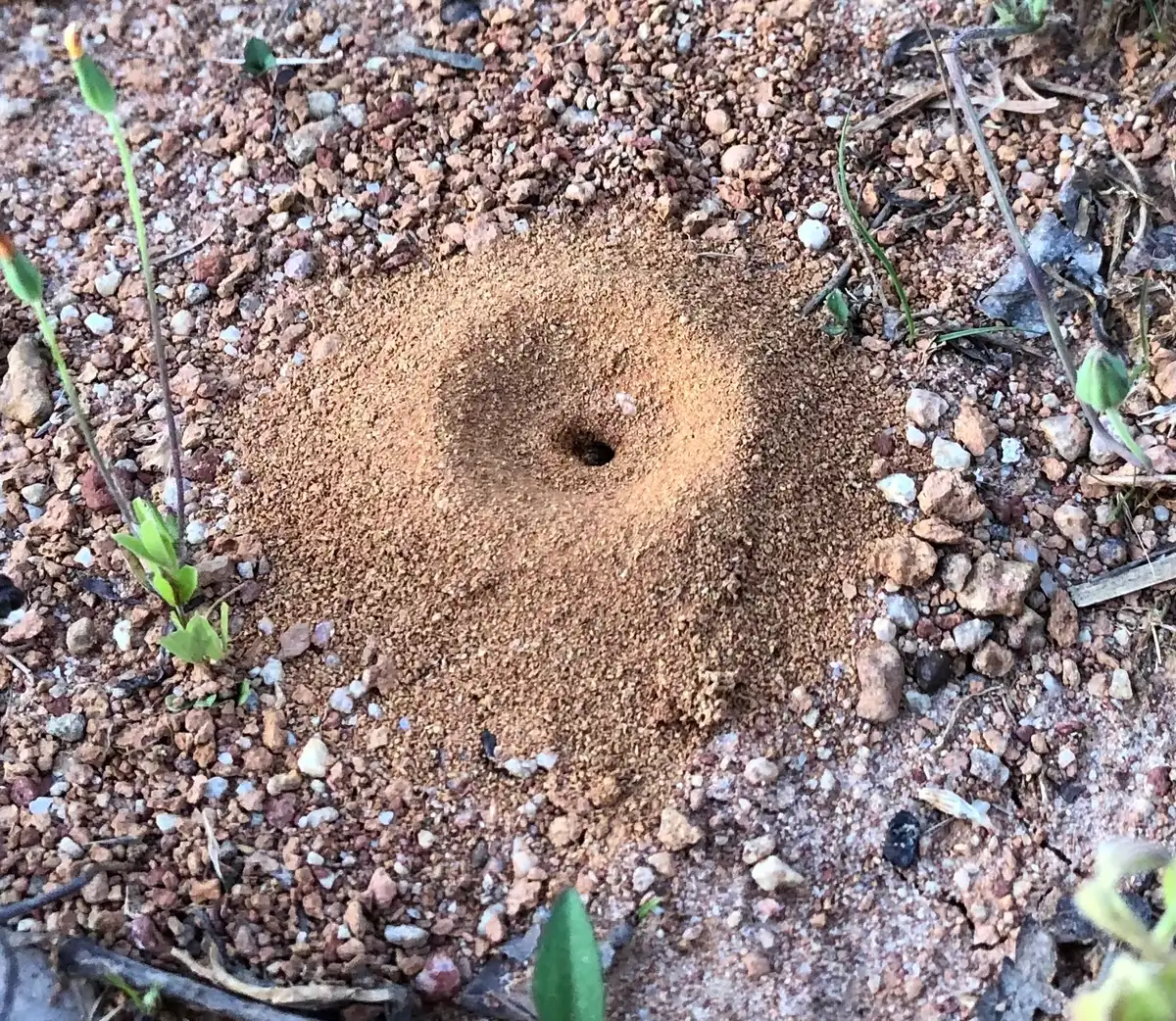
The pure green sweat bee is the exception: UF/IFAS says its females nest only in moist, rotting wood, often in old insect burrows. And some sweat bees build no nest at all; Texas A&M says these enter another bee's nest, destroy its eggs and lay their own.
A patch of small holes in bare, sunny ground in spring may belong to any of several ground-nesting bees. Clemson Extension describes holes about 1/4 inch across in warm, sunny, dry spots, each dug by a single female, and says the bees are active for only a few weeks and do not defend their nests. Ground bees shows those holes and the bees that dig them, and the wasp nest identification guide shows how a yellowjacket's ground nest, with its one busy hole, differs.
When are sweat bees out?
From spring into fall, longer in the South. UF/IFAS says the pure green sweat bee is active from February to November in the southern part of its range but only from April to September in the north. MDC lists the bicolored striped sweat bee as common in May, with females active in early summer and males in late summer in cool regions, and the UW-Milwaukee Field Station says sweat bee colonies are all female until males are produced in late summer or early fall.
Over winter, Texas A&M says, sweat bees stay in the nest as prepupae or adults, depending on the species; UF/IFAS says mated pure green sweat bee females winter, usually in insect burrows or old nests, and the males die by the end of fall.
Commonly confused with
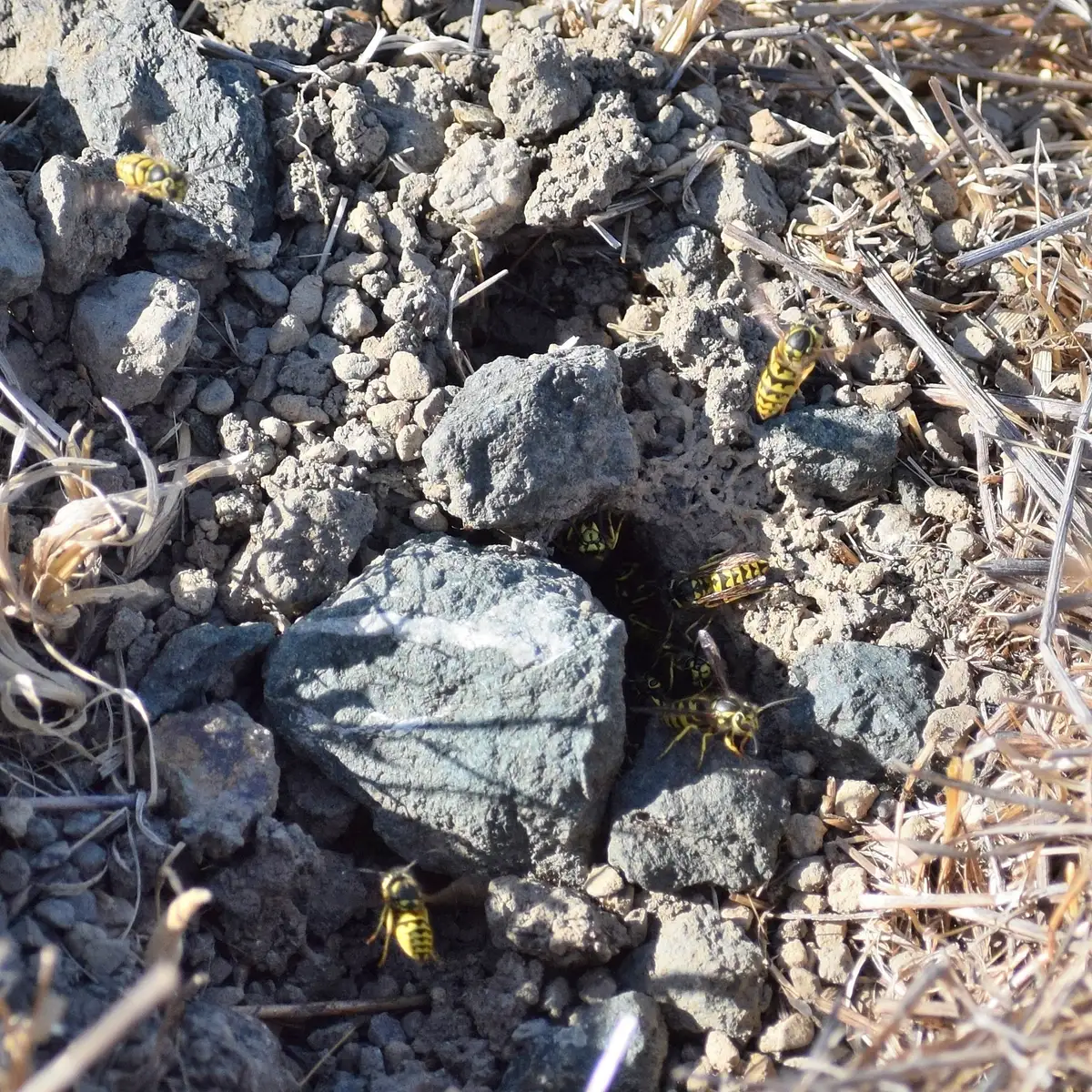 YellowjacketAbout 1/2 inch, bright yellow and black, not densely hairy; drawn to sweets and stings repeatedly
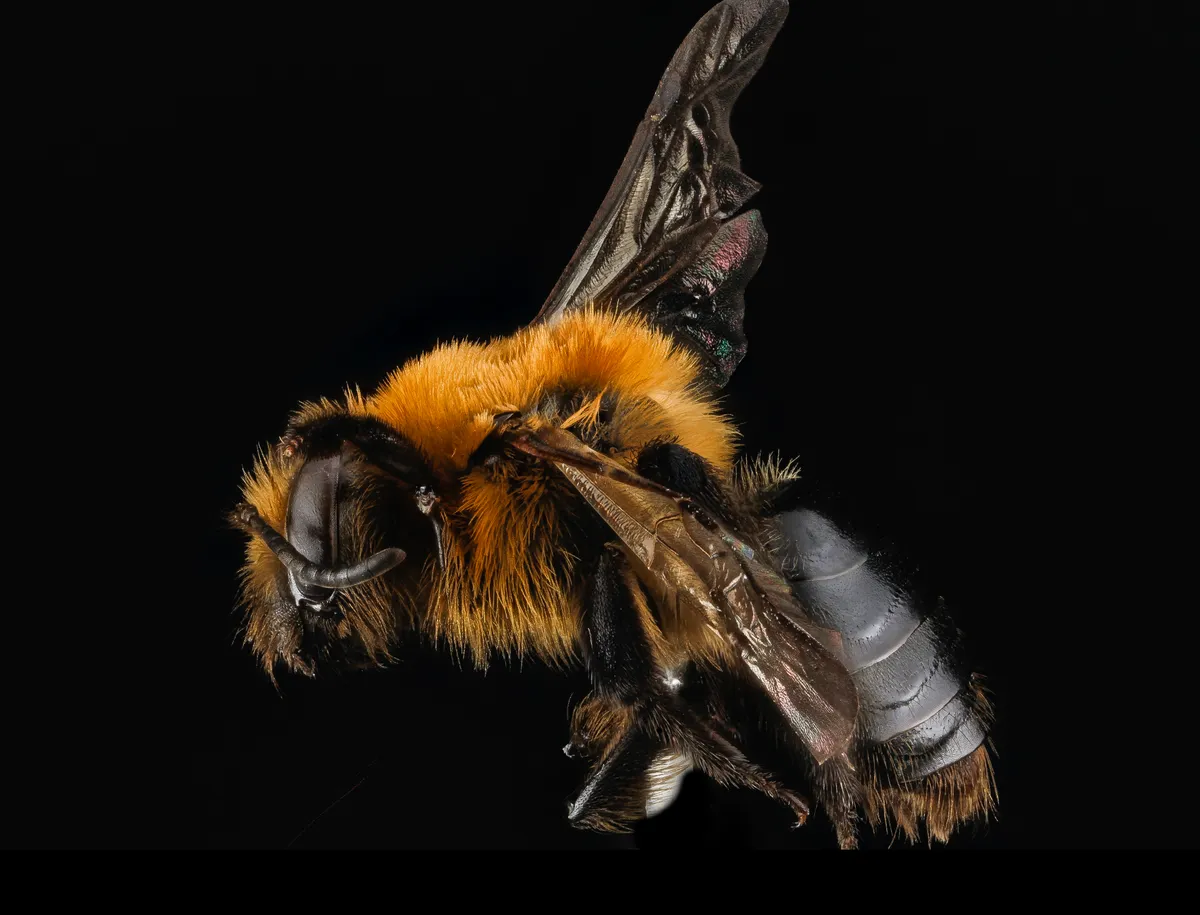 Mining beeDigs a 1/4-inch hole in bare, sunny soil and flies for only a few weeks in spring
Photos: Yellowjacket: no rights reserved, via iNaturalist, CC0 1.0. Mining bee: USGS Bee Inventory and Monitoring Lab from Beltsville, Maryland, USA, Public domain, via Wikimedia Commons, public domain.
How do you keep sweat bees off you?
Brush them away gently and slowly, and never swat. MDC says a gentle scrape will usually persuade a sweat bee to move on, while the UW-Milwaukee Field Station says things go wrong when the bee's salt source makes a sudden move or tries to swat or brush it off. CDC's NIOSH gives the same advice for any stinging insect: stay calm and still if a single one is flying around, because swatting may cause it to sting.
- Do not pin one. University of Missouri Extension says sweat bees rarely sting except when pinned against the skin, so look before you press an arm down on a bee.
- Dress plainly. NIOSH recommends light-colored, smooth-finished clothing and no perfumed soaps, shampoos or deodorants around stinging insects.
- Cover sweet drinks. That is for the yellowjackets: MDC says they are drawn to soda cans, and people are sometimes stung on the lips sipping from a can a yellowjacket is visiting.
None of the sources cited here recommends an insect repellent for sweat bees or hover flies.
Should you get rid of sweat bees?
Usually not: they are pollinators. University of Missouri Extension calls sweat bees and other small solitary bees beneficial because they pollinate plants, and says controlling them is not desirable, even if it were easy. MDC says halictids are among the smallest bees that can buzz-pollinate, shaking pollen loose with their wing muscles in a way honey bees cannot. Texas A&M calls sweat bees major pollinators of wildflowers and of crops such as stone fruits and sunflowers, and UF/IFAS says pure green sweat bees can make up as much as 90 percent of the bees in the canopy of eastern woods.
MDC's advice runs the other way, toward helping them: plant flowers, avoid pesticides and plants or seed treated with neonicotinoids, and mow less so lawn plants can bloom. The ground bees guide covers bees nesting in lawns, and the other stinging insects around homes have their own guides: yellow jackets, paper wasps, mud daubers and more insect identification guides.
This guide is general educational information, not medical advice. If you have symptoms or concerns after a bite or exposure, contact a healthcare provider.
Frequently Asked Questions
Do sweat bees bite or sting you?+
They can sting, but they do not bite. Maryland's Department of Natural Resources says sweat bees gently lap up sweat and do not bite or sting to get the salts they want. Only females have stingers, University of Missouri Extension says, and they rarely sting except when pinned against the skin; the Missouri Department of Conservation describes the sting as mild. The striped hover flies often called sweat bees cannot bite or sting at all, though Illinois Extension says their mouthparts may feel like a slight pinch on sensitive skin.
Does a sweat bee sting hurt?+
Usually only a little. The Missouri Department of Conservation calls it a mild sting, and Maryland's Department of Natural Resources says sweat bees are no more dangerous than any other bee to people without a bee sting allergy. The real danger is an allergic reaction. MedlinePlus says to call 911 if someone who was stung has trouble breathing, wheezing or shortness of breath, swelling of the face or mouth, throat tightness or trouble swallowing, weakness, or turns blue, and CDC's NIOSH calls anaphylaxis potentially life-threatening.
Do male sweat bees sting?+
No. University of Missouri Extension explains that only female bees and wasps have stingers, because a stinger is a modified egg-laying structure, and UF/IFAS says male pure green sweat bees cannot sting. In that species, UF/IFAS adds, males are also less attracted to sweat than females. Males are scarce for much of the year, too; the University of Wisconsin-Milwaukee Field Station says sweat bee colonies are all female until males are produced in late summer or early fall.
Why do they call them sweat bees?+
Because they land on sweaty people. University of Missouri Extension says sweat bees get their name from an attraction to people who are perspiring, and the University of Wisconsin-Milwaukee Field Station traces it to one drab genus, Lasioglossum, whose members land on sweaty skin and lap up the salt. The Missouri Department of Conservation says perspiration gives them moisture and salts, and Maryland's Department of Natural Resources compares the habit to a cow or deer using a salt lick.
What gets mistaken for sweat bees?+
Hover flies and yellowjackets, both called sweat bees by mistake. Illinois Extension says the small, striped hover flies that land on sweaty arms are commonly called sweat bees, though they are flies with one pair of wings and cannot sting. The Missouri Department of Conservation says yellowjackets are widely and wrongly called sweat bees as well; they are about 1/2 inch, bright yellow and black, and can sting repeatedly. For the shiny green kinds, MDC notes that metallic cuckoo wasps look similar but can roll into a ball, and their females cannot sting.
Are green sweat bees dangerous?+
No more than other sweat bees. The Missouri Department of Conservation says none of the sweat bees are aggressive and that a female may give a mild sting if pressed. UF/IFAS says pure green sweat bee females lick sweat off people and may sting if startled or threatened while doing it, and that males cannot sting. The striped green kind is less interested in you: MDC says the bicolored striped sweat bee does not share other sweat bees' taste for human sweat. Maryland's Department of Natural Resources says sweat bees are no more dangerous than any other bee to people without a bee sting allergy.
How can you get rid of sweat bees?+
Usually you should not try. University of Missouri Extension calls sweat bees beneficial pollinators and says controlling them is not desirable, even if it were easy. Deal with the bee on your skin instead: the Missouri Department of Conservation says a gentle scrape will usually persuade it to move on, and CDC's NIOSH advises staying calm and still around a stinging insect, because swatting may cause it to sting. If the insects are hover flies, Illinois Extension does not recommend insecticides and says the flies will probably decline within a week or two.
What time of year are sweat bees out?+
Spring through fall, longer in the South. UF/IFAS says the pure green sweat bee is active from February to November in the southern part of its range but only from April to September in the north. The Missouri Department of Conservation lists the bicolored striped sweat bee as common in May, with females active in early summer and males in late summer in cool regions. In winter, Texas A&M says, sweat bees wait in their nests as prepupae or adults, depending on the species.
Why are there bees around my pool?+
Two things draw them: water and sweat. NC State Extension says honey bees frequently seek out any available water in hot, dry weather and that even the odor of chlorine may attract them; it adds that some solitary bees look like honey bees, so check which you have, and it warns of painful accidents such as stepping on a bee barefoot. Sweat bees that land on swimmers and sunbathers are after sweat: the Missouri Department of Conservation says perspiration gives sweat bees moisture and salts.
Are sweat bees good pollinators?+
Yes. Texas A&M's Apiary Inspection Service calls them major pollinators of wildflowers and of crops such as stone fruits and sunflowers. The Missouri Department of Conservation says halictids are among the smallest bees that can buzz-pollinate, vibrating their wing muscles to shake pollen from flowers in a way honey bees cannot, so some plants depend on native bees. UF/IFAS says pure green sweat bees can make up as much as 90 percent of the bees in the canopy of eastern woods.
Sources
- Halictid Bees (Sweat Bees) (Field Guide) — Missouri Department of Conservation
- Sweat Bees — Texas Apiary Inspection Service, Texas A&M University
- Pure Gold-Green Sweat Bee, Augochlora pura (Say 1837) (EENY-715; Clancy A. Short and Andrea Lucky, September 2018, reviewed May 2022) — University of Florida IFAS Extension, Featured Creatures
- Native Animal Profile: Sweat Bees (Katy Gorsuch, June 1, 2025) — Maryland Department of Natural Resources
- Sweat Bee (Family Halictidae) (Bug of the Week, November 24, 2009) — University of Wisconsin-Milwaukee Field Station
- Wild Guide: Bicolored Striped Sweat Bee (Missouri Conservationist, May 2018) — Missouri Department of Conservation
- Bees and Wasps (G7391; Tamra Reall, reviewed April 2019) — University of Missouri Extension
- Yellowjackets (Vespula Wasps) (Field Guide) — Missouri Department of Conservation
- It's hover fly time again! (Christian Krupke, Pest&Crop newsletter, Issue 2026.21, August 14, 2026) — Purdue University Department of Entomology
- Syrphid Fly (Phil Nixon, Home, Yard & Garden Pest Newsletter, Issue 12, August 1, 2017) — University of Illinois Extension
- Insects That Look Like Bees (E1914; V. Calles-Torrez and others, April 2024) — North Dakota State University Extension
- Insect bites and stings (reviewed October 14, 2025) — MedlinePlus, US National Library of Medicine
- Insects and Scorpions at Work (reviewed September 28, 2026) — CDC National Institute for Occupational Safety and Health
- Unwanted Pool Guests (Michael Waldvogel, June 23, 2018) — NC State Extension, Department of Entomology and Plant Pathology
- Spring Has Sprung and So Have The (Ground-Nesting) Bees (Vicky Bertagnolli, April 7, 2025) — Clemson Cooperative Extension, Home & Garden Information Center
How this guide was made: it was researched and drafted with AI assistance from the sources listed above. A second, independent AI pass then checked each factual claim against those sources. Found an error? Email support@buzzskito.ca.