
Published by BuzzSkito Mosquito & Tick Control
Published October 29, 2026 · Fact-checked against the sources listed below
What do baby snakes look like?
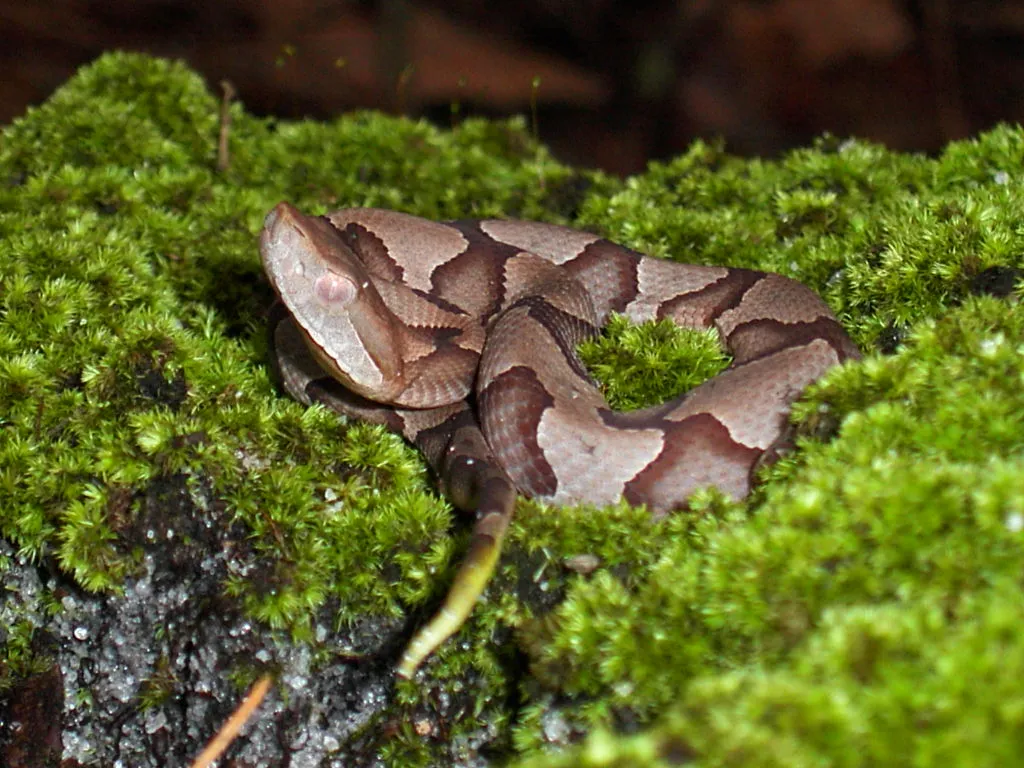
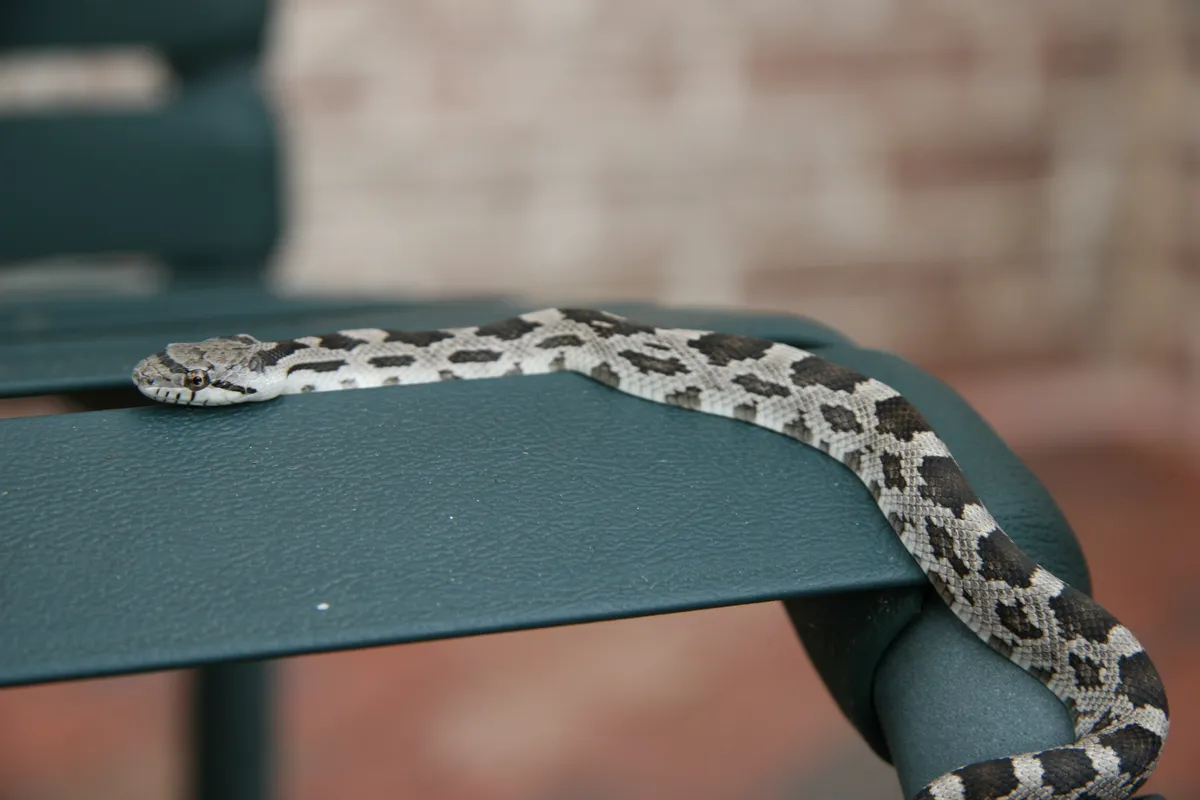
Many look like small versions of their parents, but some do not. Connecticut's Department of Energy and Environmental Protection (DEEP) says young garter snakes resemble the adults, and the Florida Museum of Natural History says young harlequin coral snakes share the adults' colors. But young eastern ratsnakes and northern black racers, the babies most often misidentified, do not turn solid black until they mature, says the Virginia Department of Wildlife Resources (DWR).
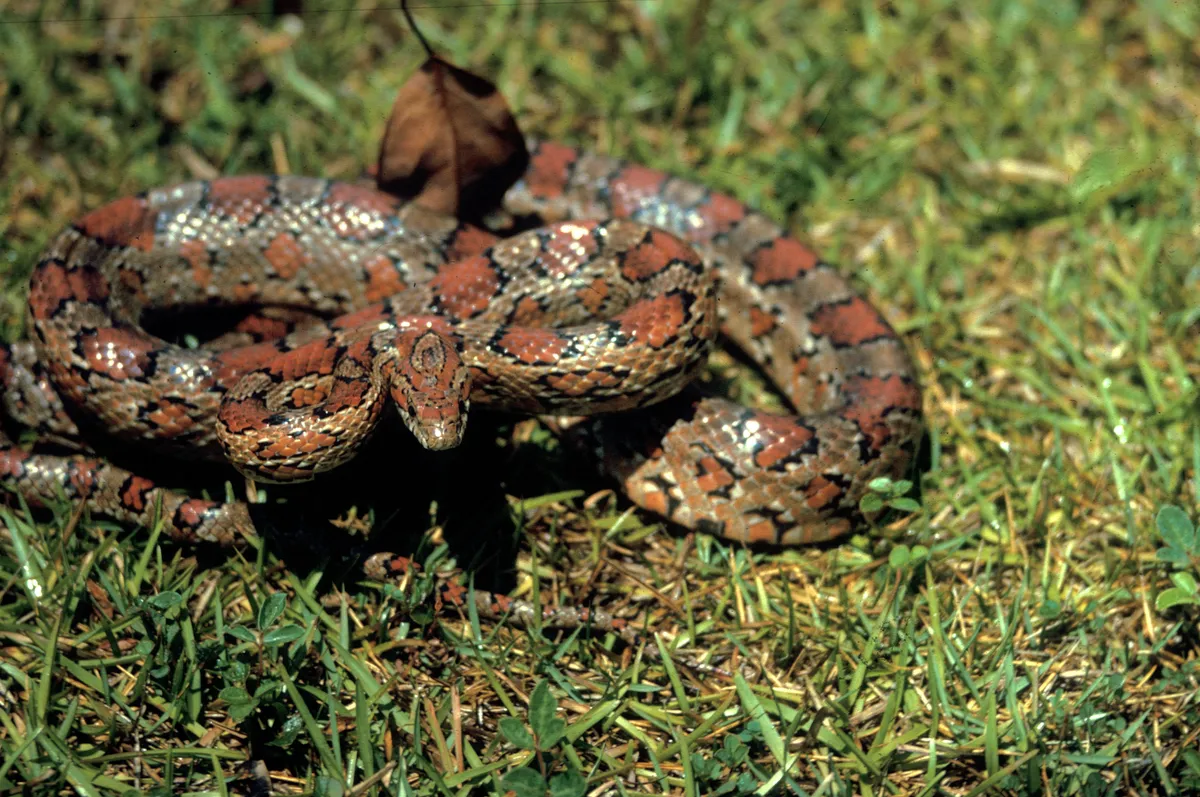
The University of Florida's guide to snakes around homes (UF/IFAS) describes the change. A young black racer has reddish-brown blotches on gray and dark specks on its sides, while the adult is black with a white chin. Young rat snakes look like a dull, brownish copy of the corn snake's blotched pattern, and young yellow rat snakes later trade their blotches for stripes.
Size depends on the species. Poison Control gives 7 to 9 inches for baby copperheads, which usually grow to 2 to 3 feet, and Connecticut DEEP says newborn DeKay's brownsnakes are about 3 1/2 inches. Virginia Cooperative Extension (VCE) says rat snakes, green snakes and milk snakes lay eggs, while copperheads, cottonmouths, timber rattlesnakes, water snakes and eastern garter snakes give birth to live young.
Which baby snakes do people find most often?
That depends on the region. CDC's National Institute for Occupational Safety and Health (NIOSH) names four venomous groups in the US: rattlesnakes, copperheads, cottonmouths and coral snakes. Here is what state agencies and universities describe:
- Florida: UF/IFAS lists black racers, ring-necked snakes, corn and yellow rat snakes, garter snakes, brownsnakes and banded water snakes among the snakes most often found around homes, and the pygmy rattlesnake, about a foot long, as the venomous one Floridians meet most often.
- Virginia: DWR says the great majority of baby snakes people meet are nonvenomous. Of the state's 32 native snakes, VCE says three are venomous: the copperhead statewide, the timber rattlesnake mainly in the western third, and the cottonmouth only in the southeastern Coastal Plain.
- Missouri: the Missouri Department of Conservation (MDC) says the babies people find most are young prairie kingsnakes, water snakes and black rat snakes, gray, tan or cream with dark crossbands, and that they are often mistaken for copperheads and needlessly killed.
- Connecticut: DEEP says DeKay's brownsnakes and common garter snakes live throughout the state, the garter snakes often in yards and around outbuildings.
- California: the University of California's Pest Note on rattlesnakes (UC IPM) counts nine rattlesnake species and names the nonvenomous gopher snake as a look-alike. It has no rattle, but rattles can break off, so a missing rattle proves nothing.
Is it a baby snake or a small adult?
It may be an adult. In the Missouri Conservationist, MDC's Tom R. Johnson noted that people sometimes assume any small snake is a baby, and take one with a bit of red, brown or tan for a baby copperhead. These species stay small for life (adult lengths in Missouri, from MDC):
- Ring-necked snake: 10 to 14 inches, with a yellow or orange neck ring and a yellow, black-spotted belly; UF/IFAS says Florida's rarely pass 12 inches.
- Brownsnakes: 9 to 13 inches, brownish with two rows of dark spots; Connecticut DEEP gives 9 to 15 inches.
- Worm snake: 7 to 11 inches, purplish-brown above and salmon-pink below.
- Red-bellied snake: 8 to 10 inches, with a yellowish-orange to scarlet belly.
- Earth snakes: 7 to 10 inches, gray, brown or reddish-brown and mostly unmarked.
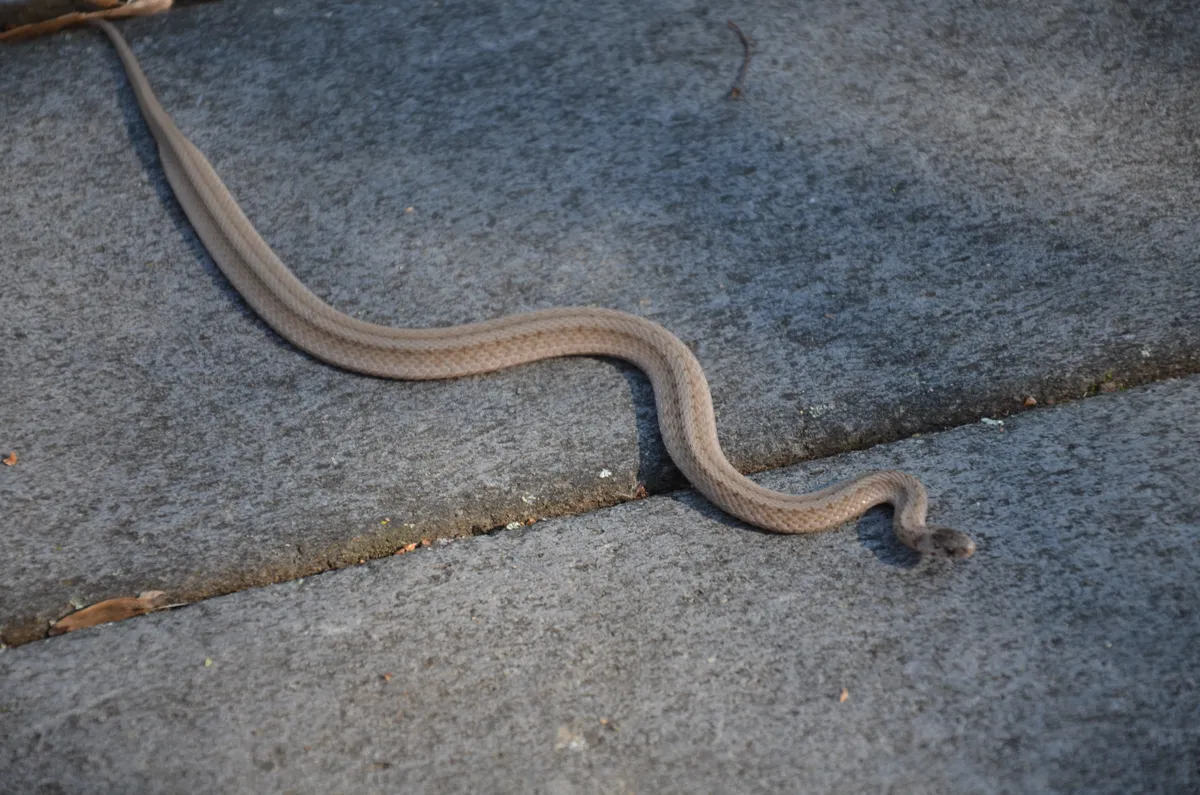
Two details help. Newborn DeKay's brownsnakes have a white neck ring, no spots and a darker body than adults, Connecticut DEEP says, so a pale collar alone does not mean a ring-necked snake. And in peninsular Florida, UF/IFAS says the 2- to 6-inch Brahminy blind snake looks like an earthworm but is smooth and unsegmented, and can slip into houses under doors.
How can you tell if a baby snake is venomous?
Not reliably by any single feature, and not from up close. All the venomous groups but the coral snake are pit vipers, says the Internet Center for Wildlife Damage Management (ICWDM). UF/IFAS lists the traits Florida's pit vipers share: a heavy body for its length, a heat-sensing pit on each side of the face, vertical pupils, usually a dark stripe from the eye to the jaw, keeled scales and a wide, somewhat triangular head on a thin neck.
Each trait fails on its own. UF/IFAS says many nonvenomous snakes also have keeled scales and triangular heads, MDC says water, garter and hognose snakes flatten their heads, and ICWDM says the single row of scales under a pit viper's tail has exceptions and that color is usually unreliable. Nonvenomous racers and rat snakes shake their tails, which can sound like a rattle in dry leaves, UF/IFAS's guide to preventing encounters warns, and Poison Control says getting close enough to check pits and pupils is unsafe.
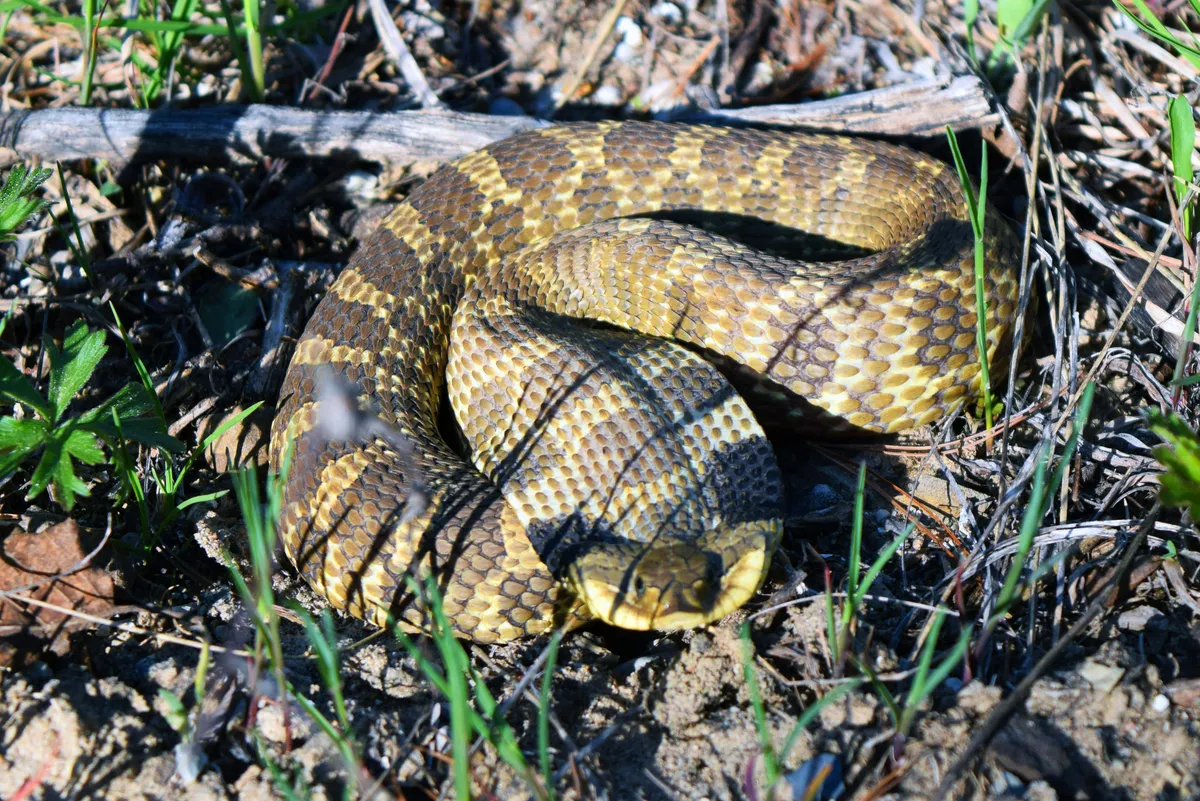
So MDC says to avoid any snake you cannot identify, and UF/IFAS to give it space when unsure. From a distance, the young of each venomous group do have marks worth knowing.
Young copperheads
Young copperheads look much like the adults, with dark hourglass bands, though their base color can be tan or gray rather than coppery, Poison Control says. Virginia DWR says their bright yellow tail tip works like a fishing lure for small frogs and toads, and MDC's copperhead profile notes that some adults keep it. CDC places copperheads in eastern states west to Texas; in Missouri the young are born from August through early October with working fangs and venom glands, MDC says.
A 1999 MDC article lists hatchling rat snakes, with their narrower heads, and milk snakes among the nonvenomous snakes mistaken for copperheads; the guide to snakes that look like copperheads compares them.
Young cottonmouths
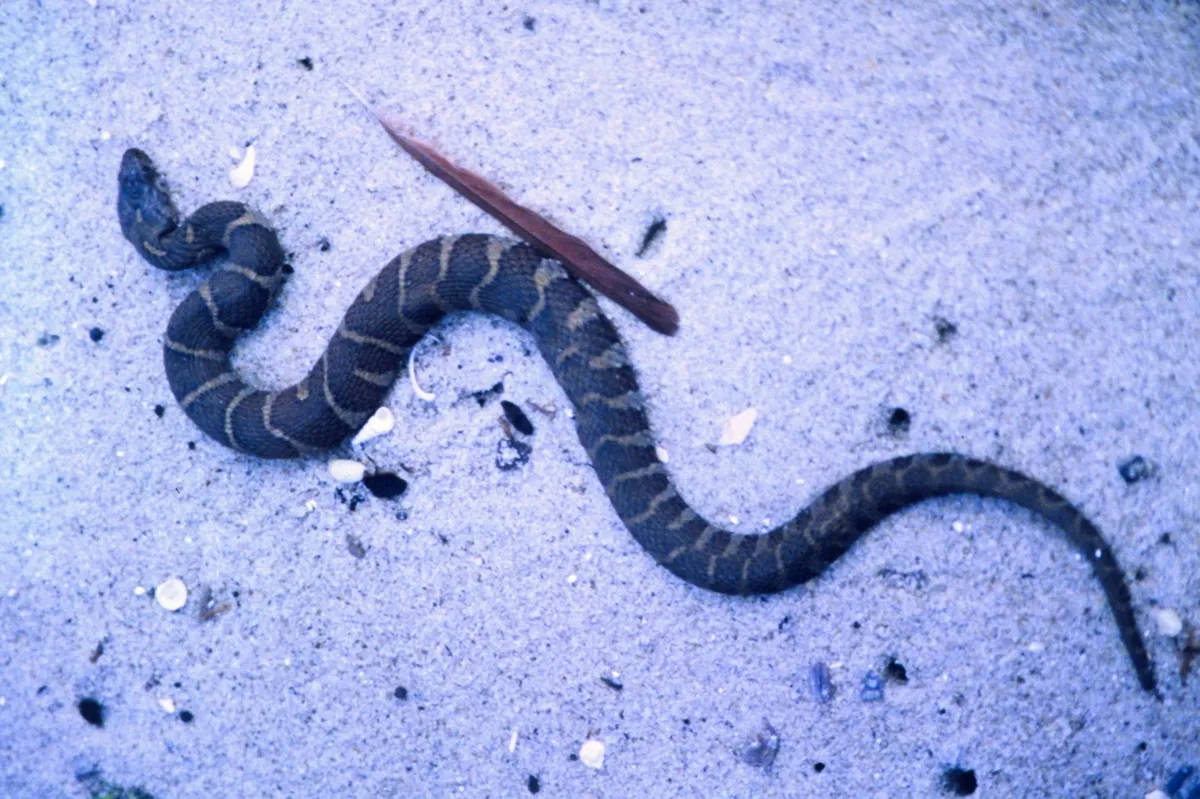
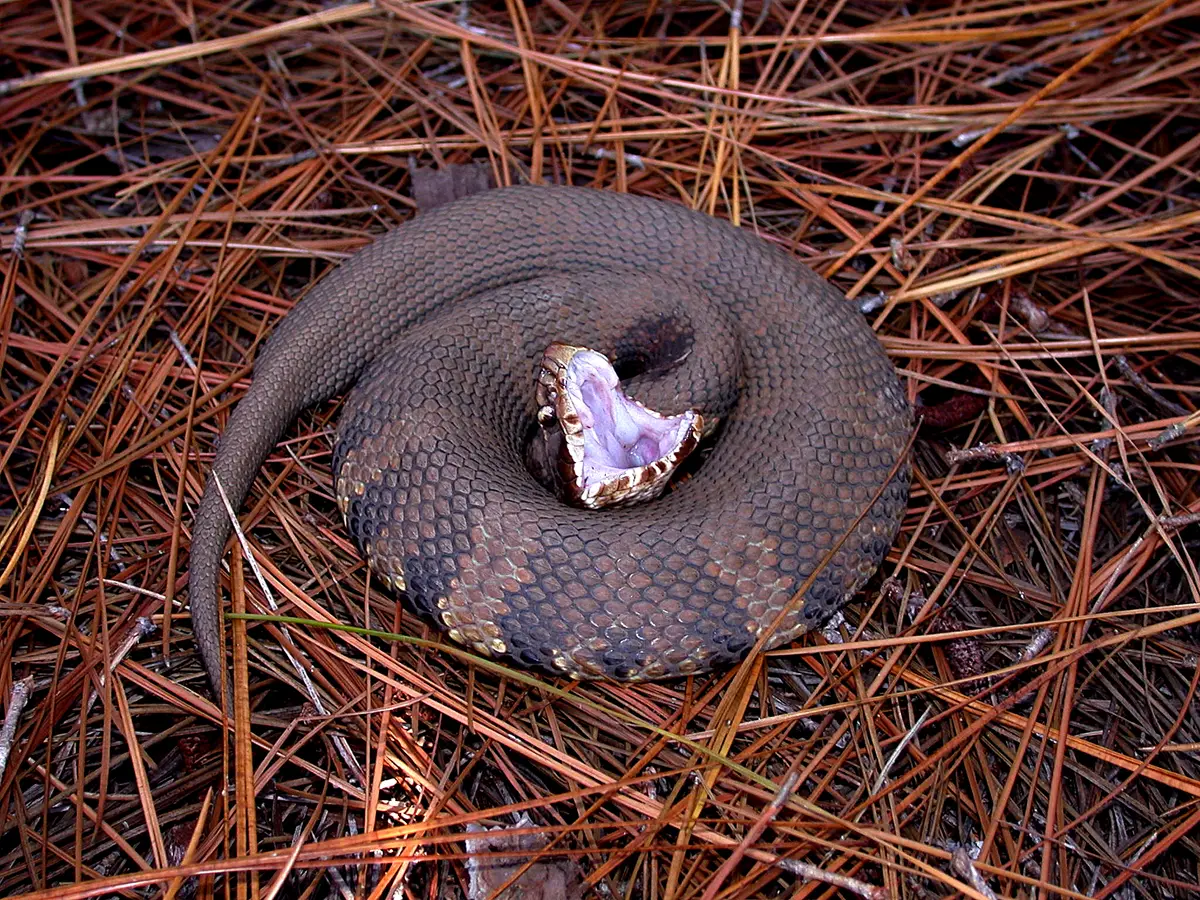
Young cottonmouths resemble copperheads, UF/IFAS says, with reddish-brown, splotched crossbands, a dark stripe through the eye and a bright yellow tail tip; the bands darken with age. CDC places cottonmouths in the Southeast, in or around water. UF/IFAS calls the southern water snakes that share those ditches and ponds perhaps the most misidentified nonvenomous snakes, often taken for cottonmouths, and says to leave alone any large, dark snake near water that you cannot identify.
Baby rattlesnakes
UC IPM says rattlesnakes are born alive with a small rattle or button, and that babies are venomous and can and do bite. A silent or missing rattle settles nothing: CDC says rattlesnakes do not always rattle, UC IPM says rattles can break off, and UF/IFAS says a pygmy rattlesnake's buzz is barely audible. Young pygmy rattlesnakes have a bright yellowish tail tip, UF/IFAS adds. CDC says rattlesnakes live across the country, from mountains and prairies to deserts and beaches.
Coral snakes
Young harlequin coral snakes hatch from eggs with the adults' red, yellow and black rings and black snout, the Florida Museum says. In the venomous coral snake red touches yellow, UF/IFAS says, while in the nonvenomous scarlet kingsnake and scarlet snake red touches black and the snout is red. ICWDM says the familiar rhyme holds only in the US and Canada, and the Florida Museum warns that unusual color variations can break it. CDC places coral snakes in the southern US; the Florida Museum says bites can be very dangerous but are extremely rare, and nearly all happen when one is handled.
Are baby venomous snakes more dangerous than adults?
Not for rattlesnakes, though they are venomous from birth. In a 2026 paper in the journal Toxins, Loma Linda University biologists William K. Hayes and M. Cale Morris call the idea that baby rattlesnakes are more dangerous than adults a myth that persists despite the evidence. Babies, they write, have far less venom, inject less and can control how much they use, as adults do; clinical studies have found their bites less severe, even though the young of many species have more toxic venom.
Small is not safe, though: UC IPM says baby rattlesnakes can and do bite, and MDC says newborn copperheads have working fangs and venom glands. The first aid is below.
When do baby snakes show up?
Mostly from midsummer into fall. VCE says egg-laying snakes lay 2 to 50 eggs, depending on the species, in late spring or early summer, in mulch piles, rotting leaves or other decaying debris, and the young hatch from midsummer to early fall. Live-bearers give birth in the same stretch: August through early October for copperheads in Missouri (MDC), and July through October for garter snakes and mid-July through August for DeKay's brownsnakes in Connecticut (DEEP).
MDC says the young then travel from late August through early October, looking for hiding places, food and a place to spend the winter.
Does one baby snake mean there is a nest nearby?
Not a nest with a mother guarding it. VCE says snakes have no further contact with their eggs once they are laid and give no care after live birth, so the young are on their own from the start. A baby shows that a clutch hatched or a litter was born, and MDC describes the young moving around on their own.
Indoors, look for why it came in. VCE says snakes often enter buildings while hunting mice, and also to lay eggs, shed, hide from predators or warm up or cool off, and that a shed skin in a cellar, closet or attic is a clear sign one has been inside. UF/IFAS says rat snakes in buildings with rodents leave once the rodents are gone. What snake poop looks like covers another sign, and the guide to holes in the yard helps work out what dug a hole a snake disappears into.
What should you do if you find a baby snake?
Leave it alone and give it room, as Virginia DWR advises. UF/IFAS says to keep children and pets away while you identify it from a safe distance, without standing between it and the cover it will usually head for. Then:
- Outdoors: let it go. University of Georgia Extension (UGA) says nonvenomous snakes outdoors should be left alone rather than killed, and UC IPM says an undisturbed snake will likely move on.
- In the house: keep everyone out, close off the room and call a professional, as UGA suggests. UF/IFAS and VCE say not to handle or catch a snake you cannot identify.
- In a garage or shed: close the door into the house and open the outside doors a crack so it can leave, UF/IFAS suggests.
- If it might be venomous: photograph it from a distance and call a professional (UF/IFAS); UGA says to consult a qualified nuisance-wildlife removal specialist for one in a house or barn. UF/IFAS and VCE point to Florida's and Virginia's lists of wildlife removal operators, and in California UC IPM says the county agricultural commissioner or UC Cooperative Extension office may be able to suggest one.
Do not try to kill it. UF/IFAS says that greatly increases your chance of being bitten, and UGA says most US snakebites happen to inexperienced people trying to handle, remove or kill snakes. ICWDM says snakes are generally protected as nongame wildlife, and VCE says killing one is illegal in Virginia unless it is an imminent threat. UF/IFAS also advises against glue traps.
Keep pets away too. If a pet is bitten, Texas A&M's veterinary school says to take it to the nearest veterinary clinic as quickly and safely as you can, even if you think the snake was nonvenomous.
What should you do after a snakebite?
For any snakebite, Poison Control says to call your poison center at 1-800-222-1222; after a venomous bite, CDC says to get emergency medical care as soon as possible, and its advice makes no exception for small snakes. CDC estimates 7,000 to 8,000 venomous snakebites and about 5 deaths a year in the US, and says prompt treatment can reduce the risk of death and serious injury.
CDC's list of what not to do:
- Do not pick up the snake or try to trap it. Never handle a venomous snake, even a dead one or its head.
- Do not wait for symptoms before getting care.
- Do not use a tourniquet, electric shock or folk remedies.
- Do not cut the wound or try to suck out the venom.
- Do not apply ice or soak the wound in water.
- Do not drink alcohol as a painkiller or take pain relievers such as aspirin, ibuprofen or naproxen.
How do you keep baby snakes out of the house?
Close the gaps and remove what draws them. UF/IFAS says some snakes, especially small ones, can enter through an opening no larger than a pencil, and VCE advises sealing every opening 1/4 inch or larger: if a rodent can get in, so can a snake. Check these first:
- Doors: door sweeps and garage door threshold weather strips, checked for wear (UF/IFAS); VCE points to the gap under a large garage door.
- Pipes, wires and vents: caulk or foam around wiring and plumbing, and hardware cloth over roof vents and plumbing vent stacks, which climbing snakes such as rat snakes can use (UF/IFAS); VCE adds dryer vents, bulkheads and the foundation sill.
- Pet doors: UF/IFAS says the only effective fix is to seal or remove them, and that outdoor cats often carry snakes in through them.
- Cover: mow, trim shrubs back from the house, keep brush piles away from buildings and stack firewood on a rack (UF/IFAS); VCE suggests thinning plantings against the foundation.
- Rodent food: clean up spilled birdseed and pet food and store dry goods in sealed metal or glass containers (VCE).
Rodent control does double duty; UF/IFAS suggests traps over poison, since poisoned rats may be eaten by wildlife or pets. The guide to mice in US homes covers sealing and trapping, the fall mouse-proofing checklist goes gap by gap (with an edition for Canadian homes), a four-step plan for getting rid of mice covers the 1/4-inch rule, and what mouse droppings look like helps you check for mice.
Skip the repellents. UF/IFAS says advertised snake repellents do not work; UGA says repellent products often rely on naphthalene, the chemical in mothballs, and no research shows it repels snakes; and VCE says homemade repellents from materials without an EPA product registration violate federal law. Why mothballs fail against mice too explains their label. A buried fence of 1/4-inch hardware cloth, flashing or silt fencing, 2 to 3 feet high, should deter most snakes from part of a yard, UF/IFAS says, but it can be costly and is a last resort.
This guide is general educational information, not medical advice. If you have symptoms or concerns after a bite or exposure, contact a healthcare provider.
Frequently Asked Questions
Can a baby snake bite you?+
Yes. Nonvenomous snakes can bite in self-defense: Connecticut DEEP says garter snakes will bite if captured, and the bite can be painful. Venomous babies are venomous from birth. MDC says newborn copperheads already have working fangs and venom glands, and UC IPM says baby rattlesnakes can and do bite. Loma Linda University researchers report that baby rattlesnakes carry less venom than adults, but Poison Control says to call your poison center at 1-800-222-1222 for any snakebite, and CDC says to get emergency care after a venomous one.
How big are baby snakes?+
It depends on the species. Poison Control gives 7 to 9 inches for baby copperheads, which usually grow to 2 to 3 feet, and Connecticut DEEP says newborn DeKay's brownsnakes are about 3 1/2 inches long. Many small snakes are not babies at all: MDC gives adult lengths of 7 to 11 inches for worm snakes, 8 to 10 inches for red-bellied snakes and 10 to 14 inches for ring-necked snakes, and UF/IFAS says the earthworm-like Brahminy blind snake of peninsular Florida is 2 to 6 inches long.
Do baby rattlesnakes have rattles?+
They are born with a small rattle or button at the tip of the tail, the University of California's Pest Note on rattlesnakes says. Do not count on hearing it: CDC says rattlesnakes may rattle as a warning but do not always, UF/IFAS says the pygmy rattlesnake's rattle is so small its buzz is barely audible, and UC IPM says a rattle can break off. Nonvenomous racers and rat snakes shake their tails in dry leaves, which can sound like a rattle, so neither the sound nor its absence identifies a snake.
What does a baby garter snake look like?+
Like a small adult. Connecticut DEEP says young garter snakes resemble the adults: three light stripes on a dark body, the stripes usually yellow but sometimes blue, green or brown. UF/IFAS adds a checkerboard of black blotches between the stripes, which occasionally leads people in Florida to mistake garter snakes for pygmy rattlesnakes. Garter snakes give birth to live young, from July to October in Connecticut, in litters of 10 to 40, and they often turn up in yards and around outbuildings.
What does a baby rat snake look like?+
Blotched, not black. Virginia DWR says young eastern ratsnakes do not take on the solid black look of the adults until they begin to mature, and UF/IFAS describes young rat snakes as a dull, brownish version of the corn snake's blotched pattern. A 1999 MDC article says hatchling black rat snakes have narrow heads and a gray ground color with black markings, unlike a copperhead's wide head and pinkish-tan color. Rat snakes are nonvenomous egg-layers, and VCE says eggs hatch from midsummer to early fall.
Is it a baby snake or a worm?+
Look for scales and segments. UF/IFAS says the Brahminy blind snake of peninsular Florida, 2 to 6 inches long and brownish-black, looks like an earthworm but is smooth and not segmented, with nearly invisible eyes. Elsewhere, small adult snakes are the usual suspects: MDC describes the worm snake as 7 to 11 inches long, purplish-brown above and salmon-pink below, with a cone-shaped head. Either way, leave it where it is or let it leave on its own rather than picking it up.
Do baby snakes stay with their mother?+
No. Virginia Cooperative Extension says egg-laying snakes have no further contact with their eggs once they are laid, and that live-bearing species, including copperheads, cottonmouths, timber rattlesnakes, water snakes and eastern garter snakes, give no care after birth: the young are on their own from the start. Connecticut DEEP says newborn DeKay's brownsnakes tend to stay near the female for a short time, but she does not care for them. MDC describes young snakes moving around from late August through early October in search of hiding places, food and a place to spend the winter.
What time of year do baby snakes come out?+
Mostly from midsummer into fall. Virginia Cooperative Extension says snakes that lay eggs do so in late spring or early summer and the young hatch from midsummer to early fall. Live-bearers arrive in the same season: MDC gives August through early October for copperheads in Missouri, and Connecticut DEEP gives July through October for garter snakes and mid-July through August for DeKay's brownsnakes. MDC says young snakes are on the move from late August through early October.
How do I get a baby snake out of my house?+
Do not try to catch it yourself. Keep children and pets away and identify it from a safe distance, as UF/IFAS advises. The University of Georgia suggests closing the snake off in one room and calling a professional, and in a garage or shed UF/IFAS suggests shutting the door into the house and opening the outside doors a crack so it can leave on its own. If it might be venomous, photograph it from a distance and call a licensed wildlife control operator. Then seal the gap it used.
Do mothballs keep snakes away?+
No research shows that they do. The University of Georgia says there are no effective snake repellents on the market, that repellent products often use naphthalene, the chemical in mothballs, and that no research shows it repels snakes. UF/IFAS says advertised snake repellents simply do not work, and Virginia Cooperative Extension says homemade repellents made from materials without an EPA product registration violate federal law. Sealing gaps of 1/4 inch or more, removing cover and controlling rodents are what the extension services recommend instead.
Sources
- Venomous Snakes at Work — CDC, National Institute for Occupational Safety and Health
- Dealing with Snakes in Florida's Residential Areas: Identifying Commonly Encountered Snakes (WEC220/UW258; S. A. Johnson and M. E. McGarrity) — University of Florida IFAS Extension
- Dealing with Snakes in Florida's Residential Areas: Preventing Encounters (WEC221/UW260; S. A. Johnson and M. E. McGarrity) — University of Florida IFAS Extension
- Managing Wildlife Damage: Snakes (420-021; J. A. Parkhurst, August 20, 2025) — Virginia Cooperative Extension, Virginia Tech
- It's Baby Snake Season! (J. D. Kleopfer, September 18, 2019) — Virginia Department of Wildlife Resources
- Native Animal Profile: Eastern Ratsnake (Pantherophis alleghaniensis) (HabiChat, Wild Acres program, June 14, 2019) — Maryland Department of Natural Resources
- Slithering Baby Snakes (J. Todoroff, September 28, 2015) — Missouri Department of Conservation
- Eastern Copperhead (Field Guide) — Missouri Department of Conservation
- Missouri Copperheads (T. R. Johnson, Missouri Conservationist, May 1999) — Missouri Department of Conservation
- Tiny Snakes (T. R. Johnson, Missouri Conservationist, May 2007) — Missouri Department of Conservation
- Dekay's Brownsnake (fact sheet, updated August 15, 2022) — Connecticut Department of Energy and Environmental Protection
- Common Gartersnake (fact sheet, updated March 9, 2018) — Connecticut Department of Energy and Environmental Protection
- Pest Notes: Rattlesnakes (UC ANR Publication 74119; B. D. Todd, updated December 2014) — University of California Statewide IPM Program
- Harlequin Coralsnake (Florida Snake ID Guide) — Florida Museum of Natural History, University of Florida
- Snakes (species overview) — Internet Center for Wildlife Damage Management
- Snakes around houses and buildings don't have to be killed (M. A. Foster, July 4, 2018) — University of Georgia College of Agricultural and Environmental Sciences, Field Report
- Are Baby Rattlesnakes More Dangerous than Adults? Origin, Transmission, and Prevalence of a Media-Driven Myth, with Evidence of Effective Messaging to Dispel It (W. K. Hayes and M. C. Morris, Toxins 18(3):144, 2026) — PubMed Central, U.S. National Library of Medicine (authors at Loma Linda University)
- Are copperhead snakes venomous? — Poison Control (National Capital Poison Center)
- What To Do If Your Pet Is Bitten By A Snake (November 3, 2022) — Texas A&M School of Veterinary Medicine & Biomedical Sciences
How this guide was made: it was researched and drafted with AI assistance from the sources listed above. A second, independent AI pass then checked each factual claim against those sources. Found an error? Email support@buzzskito.ca.