
Published by BuzzSkito Mosquito & Tick Control
Published October 29, 2026 · Fact-checked against the sources listed below
What does a baby copperhead look like?
Like a small adult with a bright tail tip. The North Carolina Wildlife Resources Commission's species profile (NC Wildlife) says the young resemble adults except for a bright sulfur-yellow tail tip. MDC's field guide describes the shared pattern: dark brown hourglass-shaped crossbands, often edged in white, on a gray, copper, tan or pinkish-tan body, and an unmarked top of the head.
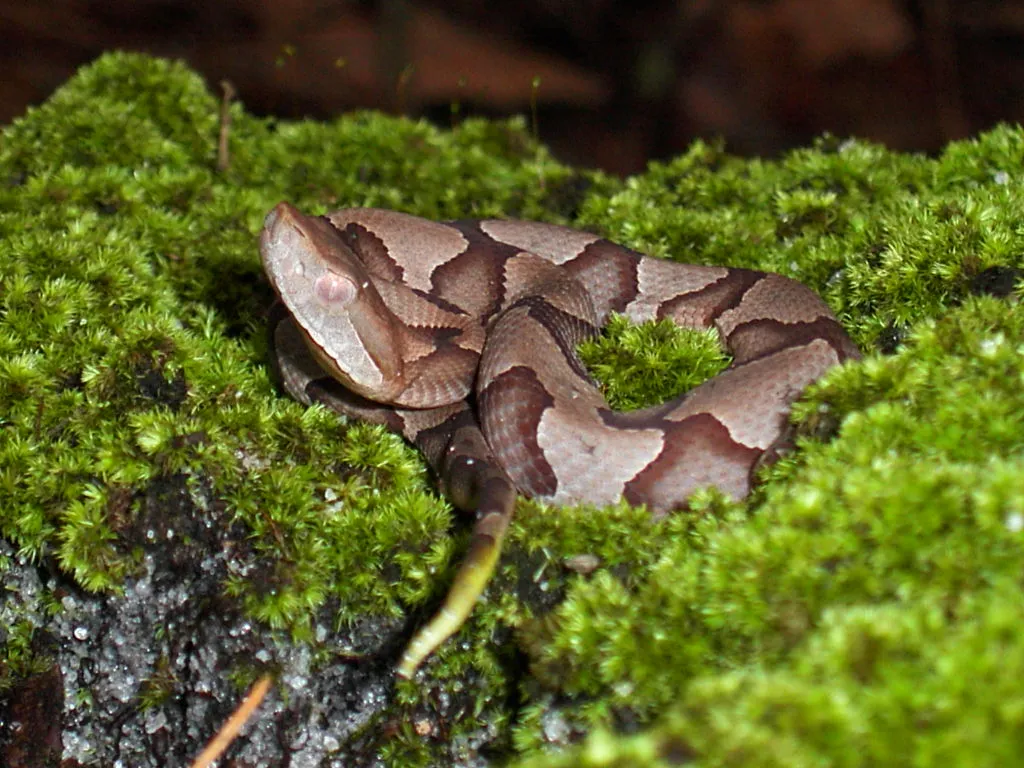
The yellow tail tip
A 1999 MDC article on Missouri copperheads describes the last inch or so of a young one's tail as greenish yellow with 8 or 10 small black-edged white marks. A coiled baby raises and wiggles it when a small lizard or frog comes near, and to the prey it may look like a green caterpillar. The article says the color is gone by age 2, though MDC's field guide notes that some adults keep a yellow tip.
Size and color
Poison Control gives 7 to 9 inches for newborns, NC Wildlife 8 to 10 and the MDC article 7 or 8, against 2 to 3 feet for adults. Poison Control says a baby's base color can be tan or gray rather than coppery, and the MDC article that young ones are slightly paler than adults but carry the same markings.
How do you tell a baby copperhead from a nonvenomous snake?
By the whole pattern, judged from a safe distance, not by one feature. Clemson Extension describes the hourglass lying sideways: widest on one side of the body, narrowing over the spine and widening again down the other side. Bands occasionally mismatch or break up along the center, say Clemson and NC Wildlife, but nearly every copperhead has at least some complete hourglasses.
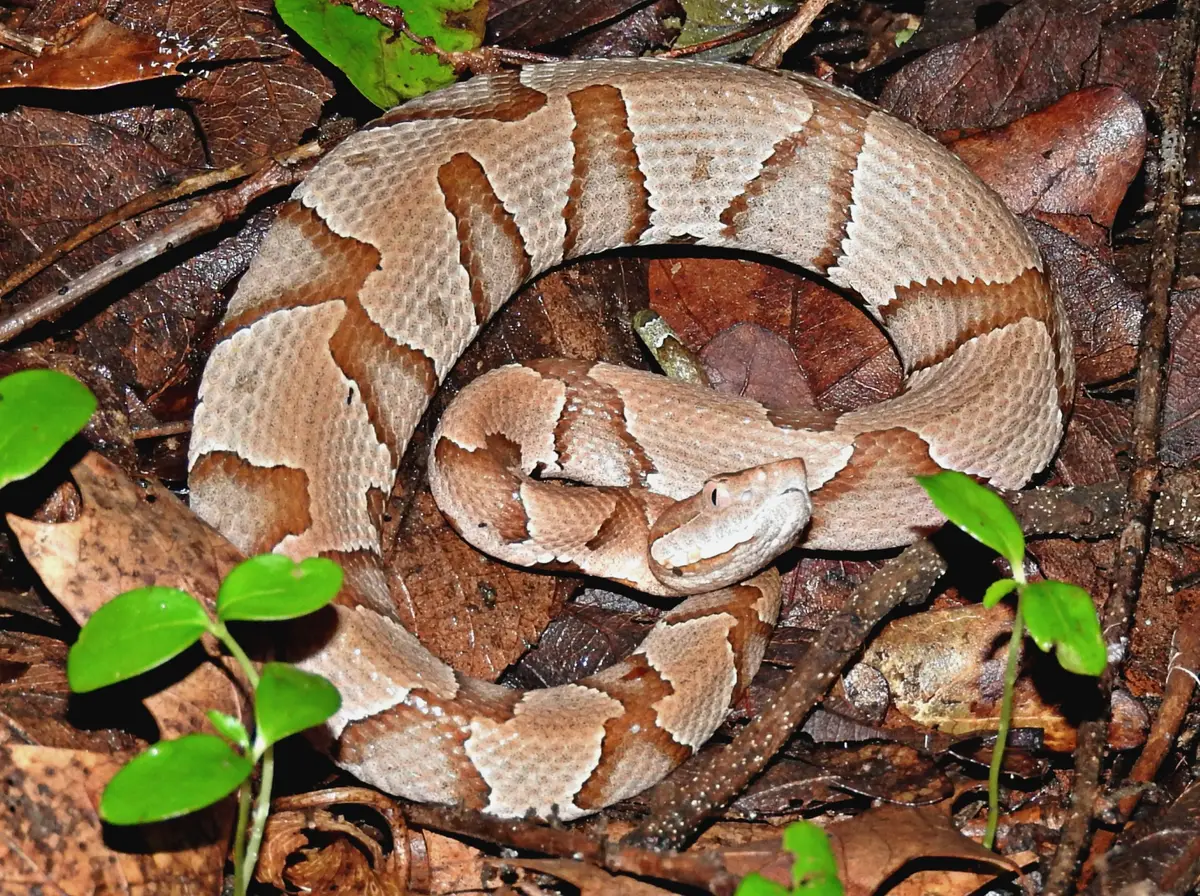
Several rules of thumb fail on their own:
- Head shape. NC Wildlife calls the copperhead's head somewhat triangular, but UF/IFAS Extension says many nonvenomous snakes have triangular heads too, and water and garter snakes flatten theirs when threatened.
- Pupils, pits and tail scales. Vertical pupils, facial pits and a single row of scales under the tail are real copperhead features, but Poison Control says it is unsafe to get close enough to check the pits and eye shape, and Clemson warns against getting near enough to see the pupils.
- A rattling tail. Clemson says a copperhead may shake its tail as you come closer, and UF/IFAS says cottonmouths and many nonvenomous snakes do too.
- A yellow tail tip. UF/IFAS says young cottonmouths and young pygmy rattlesnakes, both venomous, have one as well.
- Color. Poison Control says babies can be tan or gray rather than coppery, and the MDC article that most Missouri copperheads have a head about the same pinkish tan as the body.
From a safe distance, check all of these
- Bands. Wide on the sides and narrow over the back fits a copperhead; blotches centered on the back, or bands widest at the backbone, fit a look-alike.
- Head. A plain top fits a copperhead; an upturned snout points to a hognose.
- Tail. A yellow tip fits a young copperhead, cottonmouth or pygmy rattlesnake.
- Place. Is it inside the copperhead range below? Near water in the Southeast, think cottonmouth too.
- Doubt. If anything is unclear, treat the snake as venomous and leave it alone.
Which snakes are mistaken for baby copperheads?
Mostly young nonvenomous snakes with blotches or bands. Virginia's Department of Wildlife Resources says the babies most often misidentified are young eastern ratsnakes and northern black racers; Clemson and the 1999 MDC article add corn snakes, water snakes, prairie kingsnakes, hognose snakes and milk snakes.
Baby copperhead vs young rat snake
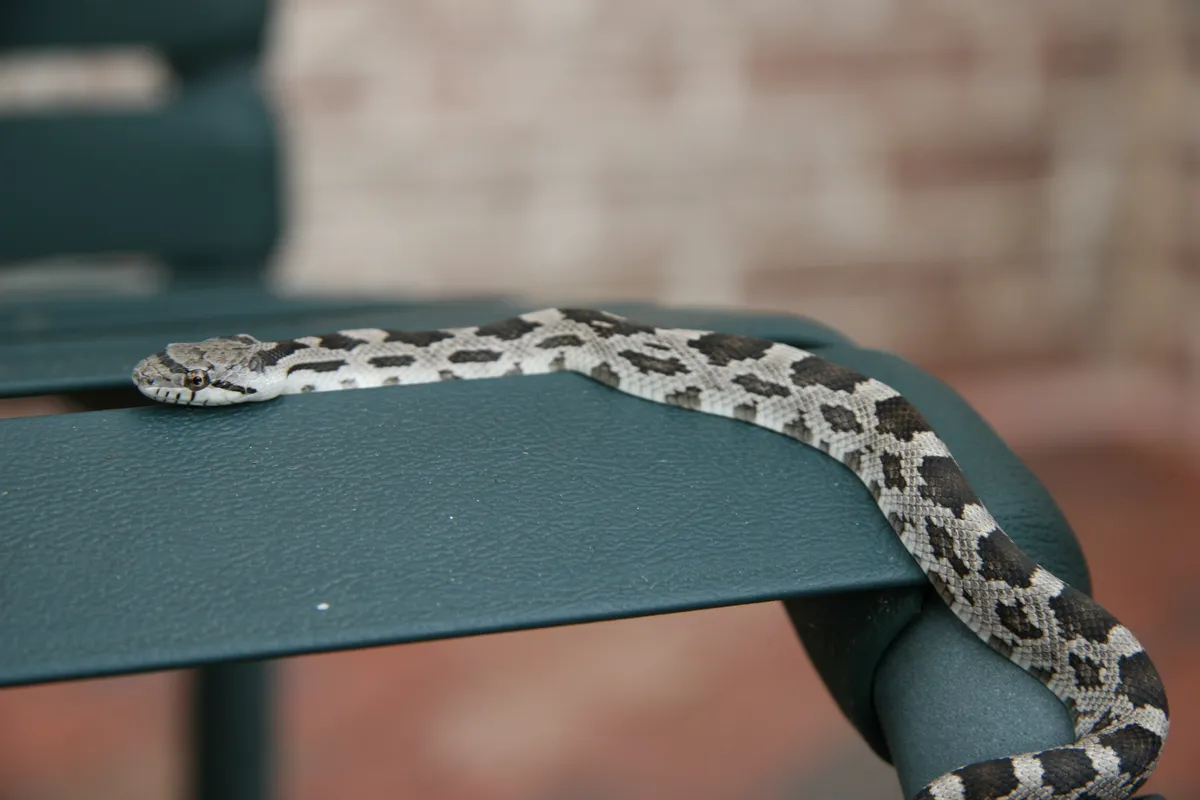
The classic mix-up. Maryland's Department of Natural Resources (DNR) describes young central ratsnakes as strongly patterned, with gray and brown blotches on pale gray, and adults as plain shiny black. Clemson says the blotches run down the center of the back, where a copperhead's bands are narrowest; the MDC article says hatchlings average 10 inches in late summer and early fall, have a gray ground color, and are sometimes spotted in backyards, garages and basements.
DNR finds rat snakes statewide in Maryland, where they may live in attics unnoticed, and copperheads everywhere but several Eastern Shore counties; MDC places hatchling black rat snakes throughout Missouri. Young black racers are blotched too: UF/IFAS describes reddish-brown blotches down the middle of a gray back and many small dark specks.
Copperhead vs corn snake
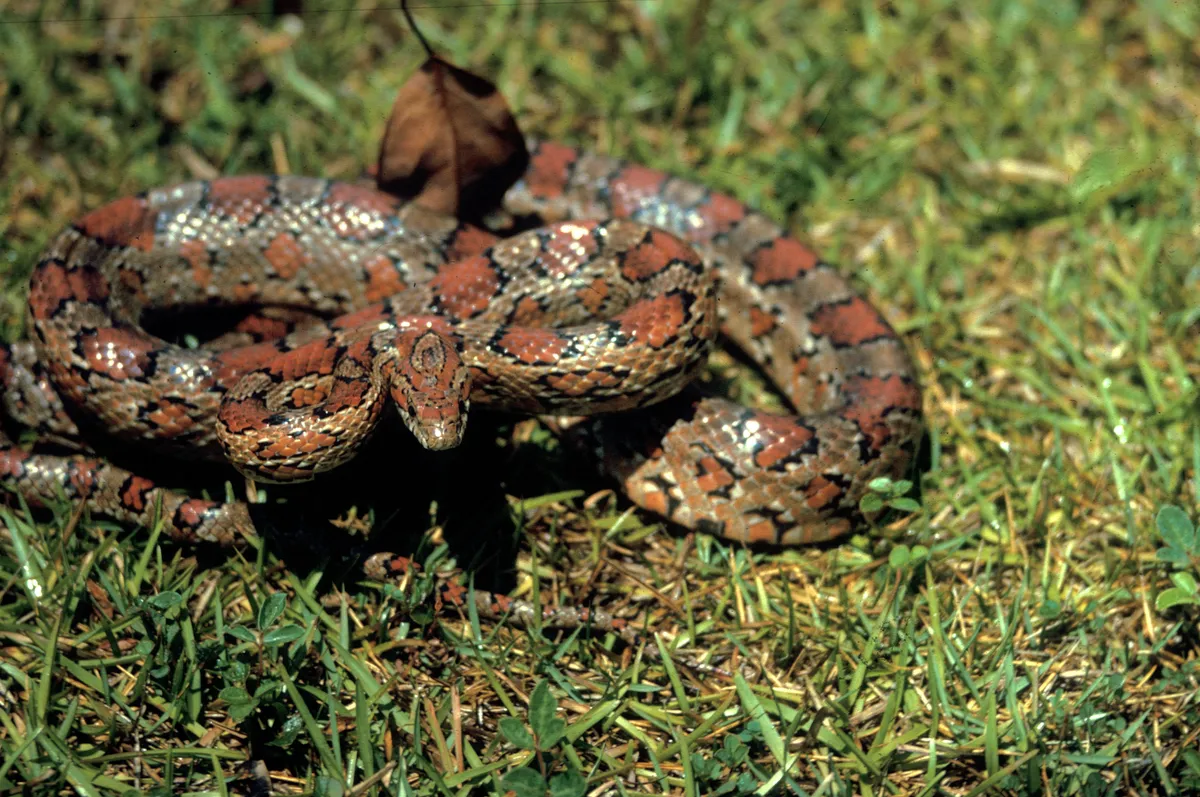
Clemson says corn snakes are usually redder than a copperhead, with square blotches widest down the center of the back and a black-and-white checkerboard belly. UF/IFAS describes reddish-orange blotches, usually outlined in black, on a tan, gray or yellow-orange background, and adults 3 to 5 feet long.
In Florida, range helps. UF/IFAS finds corn snakes in urban areas throughout the state, but its guide to Florida's venomous snakes places copperheads only just west of Tallahassee, mainly along the Apalachicola River, and in several westernmost counties. The guide also warns that young cottonmouths, found statewide, look very similar to copperheads, says to check range maps, and advises against trying to capture or harm any snake.
Copperhead vs northern water snake
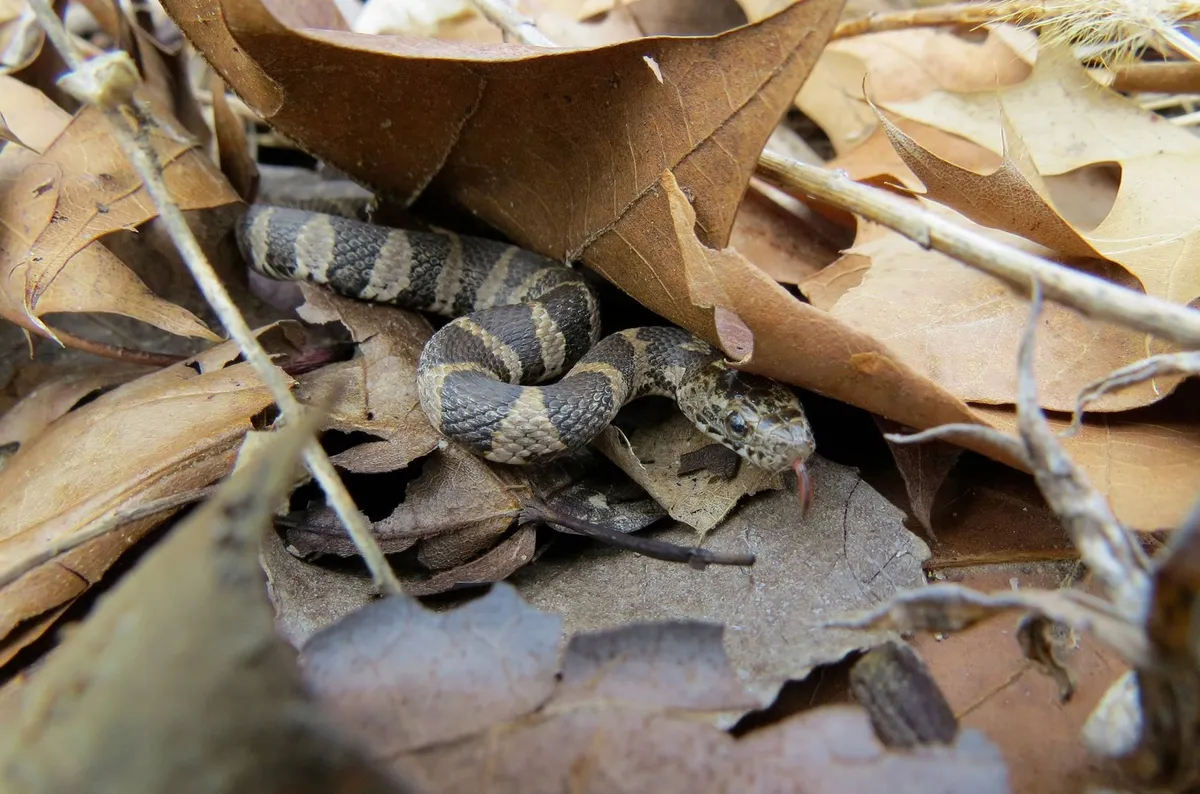
Look at where the bands are widest: Clemson says the water snake's blotches are narrow on the sides and wider toward the backbone, the opposite of a copperhead's. Maryland DNR, which calls it the common watersnake, adds a heavy body, reddish half-moons on the belly, and young patterned black on pale gray or light brown; older ones may look all one dark color.
DNR finds it throughout Maryland, in or near every kind of wetland, and says it is often mistaken for a water moccasin, which does not occur in Maryland. It readily bites and releases musk when handled: nonvenomous does not mean safe to pick up.
Copperhead vs eastern hognose snake
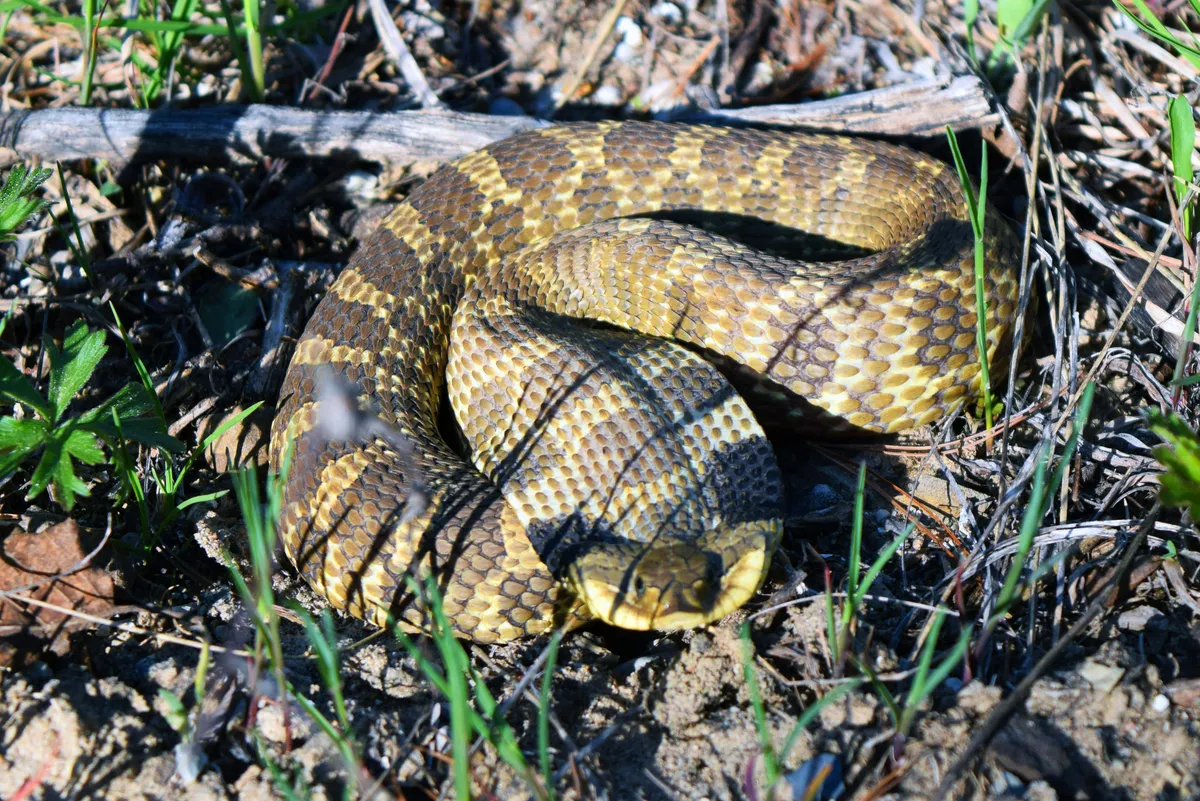
Check the snout: Maryland DNR describes it as upturned with a keel on top. Color varies, from yellow, brown, gray, orange or red with dark blotches to plain black or dark gray, and DNR says the hognose is often mistaken for a copperhead. The MDC article says a hognose never has a copperhead's pinkish tan with hourglass markings, though it may have a wider head than most nonvenomous snakes.
Approached, it hisses and spreads its neck like a cobra, then may roll over and play dead, DNR says; MDC notes that copperheads cannot hiss at length like a hognose. DNR considers it nonvenomous, though rear-fanged with mildly toxic saliva, and finds it statewide where soils are sandy, most of all on the Coastal Plain; MDC finds it throughout Missouri.
Copperhead vs milk snake
Maryland DNR describes the eastern milksnake as slender and tan to light brown, with 32 or more broad red blotches bordered in black, a gray or tan patch shaped like a Y, V, U or A at the nape, and a checkerboard belly. MDC describes a copperhead's bands, by contrast, as dark brown hourglasses often edged in white. DNR places milk snakes from the Fall Line, roughly I-95, west, plus a Coastal Plain color form, and says they turn up around barns when mice are plentiful; in Missouri, the MDC article describes the red milk snake, 21 to 28 inches, on rocky, open hillsides.
Baby copperhead vs brown snake
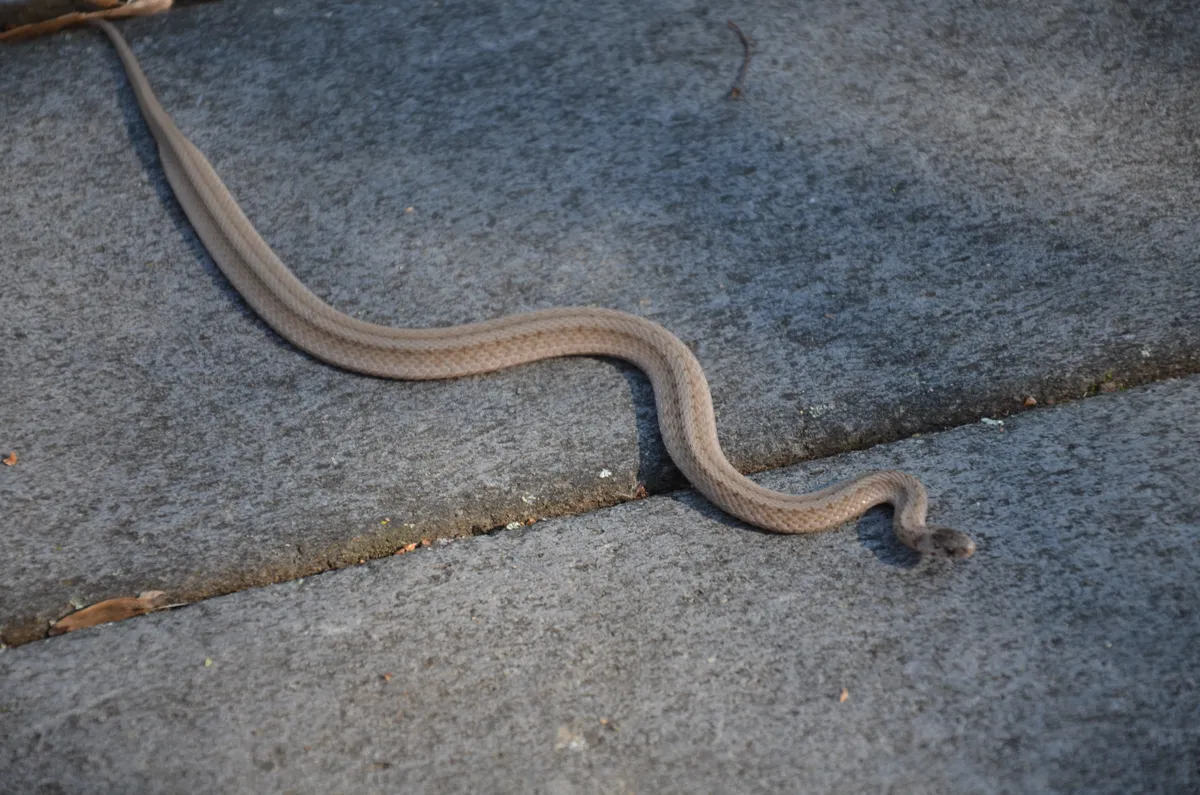
A small adult, not a baby. Maryland DNR gives 9 to 13 inches for grown DeKay's brownsnakes, close to a newborn copperhead's length, and describes two parallel rows of black spots on a brown or gray back, a lighter band between them and a thin dark line behind the eye; the young have a yellow collar. Rows of small spots, not broad hourglasses, set it apart. DNR finds it throughout Maryland, including urban parks and backyards.
Is it a water moccasin or a water snake?
Often a water snake, but leave alone any you cannot identify. The cottonmouth, or water moccasin, lives in the Southeastern US, in or around water, says CDC's National Institute for Occupational Safety and Health (NIOSH). UF/IFAS calls it closely related to the copperhead and says young cottonmouths resemble copperheads, with bright reddish-brown crossbands, a dark stripe from the eye to the jaw and a bright yellow tail tip, and darken with age.
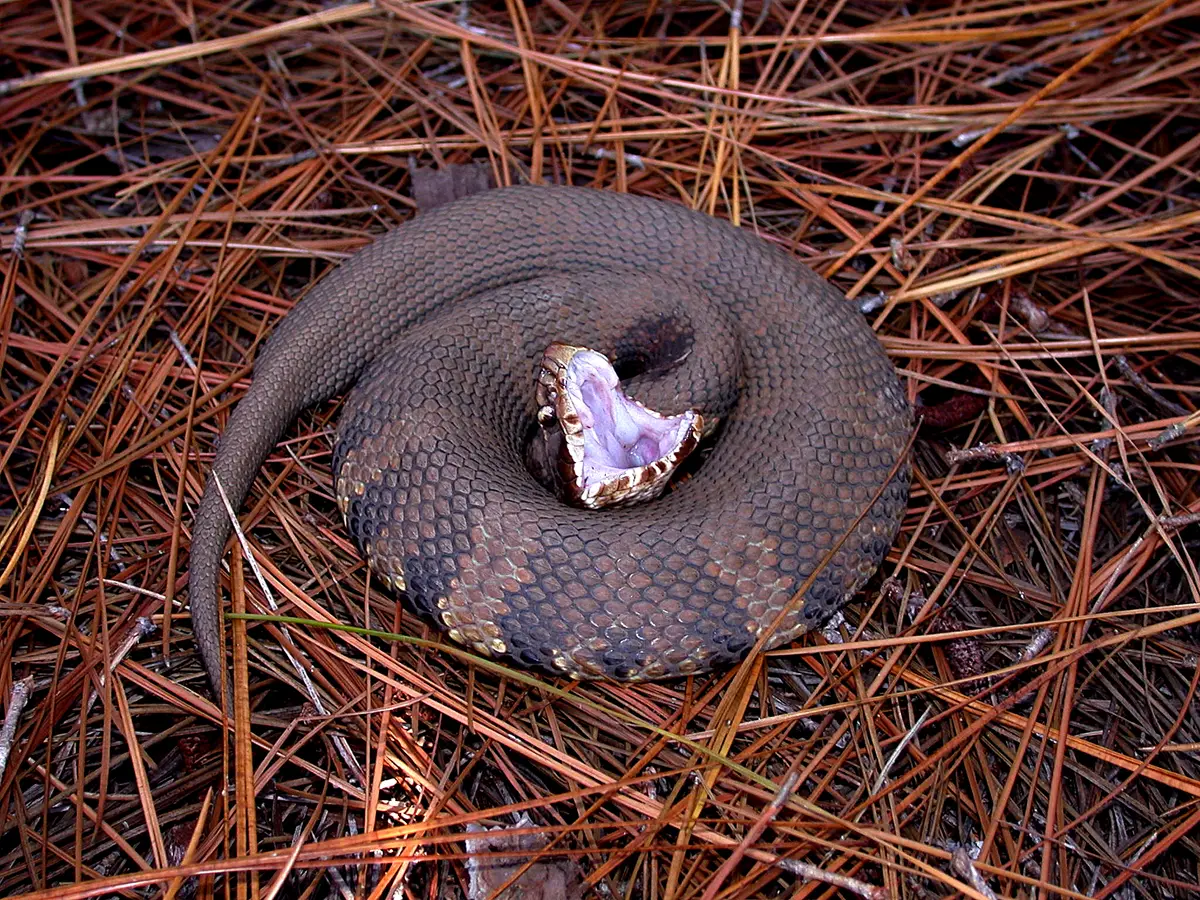
Water snakes are the usual mix-up. UF/IFAS calls southern water snakes perhaps the most commonly misidentified nonvenomous snakes, often confused with cottonmouths: their crossbands tend to darken with age, large ones have a dark eye stripe, they flatten their heads when threatened, and they share the same ditches and ponds. MDC's cottonmouth guide says watersnakes vastly outnumber cottonmouths in Missouri, and that snakes in shrubs and small trees along the water's edge are most likely watersnakes, since cottonmouths rarely if ever climb trees.
MDC describes adult cottonmouths as heavy-bodied, dark olive brown to nearly black, with normally indistinct bands and a head noticeably wider than the neck; when alarmed, one typically opens its mouth wide to show the white lining. Range helps: MDC places them mainly in Missouri's southeastern corner, none north of the Missouri River; Maryland DNR says none occur in Maryland; UF/IFAS finds them throughout Florida. UF/IFAS's advice: leave alone any large, dark snake you cannot confidently identify, particularly near water.
Where do baby copperheads live?
Across much of the eastern and central US: from southern New England to northern Florida and west to southern Indiana, southern and western Illinois, Missouri, southeastern Nebraska and much of Oklahoma and Texas, the 1999 MDC article says. They live statewide in Missouri except the far northern border with Iowa (MDC) and in North Carolina (NC Wildlife), but in Florida only in small parts of the Panhandle (UF/IFAS).
They live on wooded, rocky hillsides, along brushy creeks and around swamps with plenty of cover, and near abandoned farm buildings, old sawmills and trash dumps, MDC says. NC Wildlife says they tolerate living near people and are the only venomous snake in most of the larger urban areas of North Carolina; Poison Control lists woodpiles, rock piles, the ground under bushes and suburban housing areas.
In winter, MDC says, Missouri copperheads shelter on south-facing rocky ledges and in quarries, animal burrows, hollow logs and caves. If a snake vanished into a hole in your lawn, the guide to holes in the yard helps work out what dug it.
When do baby copperheads appear?
In late summer and early fall. Copperheads bear live young from August through early October in Missouri (MDC), and usually in August, September or early October in North Carolina (NC Wildlife). Litters usually hold 3 to 11 young in Missouri and 3 to 14, up to 20, in North Carolina, and MDC says many females apparently give birth every other year.
Finding one does not mean another is beside it: the 1999 MDC article calls the idea that copperheads move in pairs a myth, since they compete for food and shelter. For other signs of a snake, see what snake poop looks like; for small snakes without hourglass bands, the guide to identifying baby snakes covers the young of other species.
Are baby copperheads dangerous?
Yes: they are venomous from birth, though no more dangerous than adults. MDC says newborns have working fangs and venom glands, and Clemson says not to approach a yellow-tailed juvenile. NC Wildlife says young copperheads have less venom than adults and can give dry bites with no venom, so they are no more or less dangerous.
NC Wildlife says a copperhead bite is painful and should be treated as serious, though it is not considered life-threatening. Poison Control lists pain, progressive swelling, redness, bruising and blood blisters, sometimes nausea, weakness, low blood pressure or bleeding, and says 20 to 25 percent of bites inject no venom. MDC estimates 100 or more copperhead bites a year in Missouri, with a fatality rate of about 0.01 percent.
What should you do if you find a baby copperhead?
Leave it alone and give it room: NC Wildlife says that, given time, a snake will in most cases move off on its own. Do not try to kill or catch it: MDC says most bites happen when people try to kill or handle venomous snakes, and that even a freshly killed one can bite by reflex.
If it must move now, from a doorstep or driveway, NC Wildlife suggests spraying it with a water hose from a safe distance; the commission does not send staff to remove wildlife. Poison Control says to call animal control to remove a copperhead on your property. Missouri protects native snakes by law, MDC says, and allows a venomous one to be killed only when it is so close to people that someone might be bitten.
To make a yard less inviting, Poison Control suggests clearing leaves, rocks, trash, other debris and tall vegetation from around the house, and taking extra care from April to September. Mice and voles are most of a copperhead's diet (MDC), and keeping mice out of a house has its own guide. The baby snake guide covers getting a small snake out of a garage or house, and there are more wildlife and pest identification guides too.
What should you do if a copperhead bites you?
Get emergency medical care at once, whatever the snake's size. CDC's NIOSH estimates 7,000 to 8,000 venomous snakebites and about 5 deaths a year in the US, says prompt treatment can reduce the risk of death and serious injury, and says antivenom given as soon as possible after a copperhead bite helps the limb recover faster and lessens the chance it will be disabled.
Also call Poison Help at 1-800-222-1222: Poison Control says to call your poison center for expert help after any snakebite. Its first-aid guidance is to call 911 immediately if the person collapses, has a seizure, has trouble breathing or can't be awakened. CDC's list of what not to do:
- Do not pick up the snake or try to trap it, and never handle a venomous snake, even a dead one or its cut-off head.
- Do not wait for symptoms to appear; get medical help right away.
- Do not use a tourniquet, electric shock or folk remedies.
- Do not cut the wound in any way, and do not try to suck out the venom.
- Do not put ice on the wound or soak it in water.
- Do not drink alcohol to dull the pain or take pain relievers such as aspirin, ibuprofen or naproxen.
This guide is general educational information, not medical advice. If you have symptoms or concerns after a bite or exposure, contact a healthcare provider.
Frequently Asked Questions
How big is a baby copperhead?+
About 7 to 10 inches at birth. Poison Control gives 7 to 9 inches, the North Carolina Wildlife Resources Commission's species profile gives 8 to 10, and a 1999 Missouri Department of Conservation article gives 7 or 8. Adults usually reach 2 to 3 feet. Length alone does not identify a snake: Maryland's Department of Natural Resources says adult DeKay's brownsnakes, which are nonvenomous, are only 9 to 13 inches long, close to the length of a newborn copperhead.
When is baby copperhead season?+
Late summer into early fall. The Missouri Department of Conservation says young copperheads are born from August through early October, and the North Carolina Wildlife Resources Commission says births usually come in August, September or early October. Copperheads give birth to live young rather than laying eggs. MDC says most Missouri copperheads move into winter shelters from mid to late October, and Poison Control says copperheads in general are most active from April to September.
How long does a baby copperhead's tail stay yellow?+
About two years. A 1999 Missouri Department of Conservation article says that after about 18 months to two years copperheads can catch larger prey and their tails become less colorful, and that the yellow is gone by age 2. MDC's field guide notes that some adult copperheads keep a yellow tail tip. A yellow tail is not proof of a copperhead: UF/IFAS Extension says young cottonmouths and young pygmy rattlesnakes, both venomous, have bright yellow tail tips too.
If you find one baby copperhead, are there more around?+
Not necessarily. A 1999 Missouri Department of Conservation article calls the belief that copperheads move in pairs a myth: they compete for food and shelter, and when they are found together, it is because the habitat can support more than one or the spot is a winter den. A litter can hold 3 to 14 young, up to 20, the North Carolina Wildlife Resources Commission says. Wherever you saw one, look before you reach into vegetation or under rocks and logs, as Poison Control and MDC advise.
What happens if a baby copperhead bites you?+
Treat it like any copperhead bite and get emergency care. The North Carolina Wildlife Resources Commission says young copperheads have less venom than adults but are no more or less dangerous, and that a copperhead bite is painful and should be treated as serious, though it is not considered life-threatening. Poison Control lists pain, progressive swelling, redness, bruising and blood blisters, sometimes with nausea or low blood pressure, says symptoms develop over 8 to 12 hours, and says to call Poison Help at 1-800-222-1222.
Are baby copperheads more venomous than adults?+
No, say two state wildlife agencies. The North Carolina Wildlife Resources Commission says young copperheads have less venom than adults and, like adults, can give dry bites with no venom, so they are no more or less dangerous. A 1999 Missouri Department of Conservation article calls the idea that babies are more dangerous a myth, pointing to their smaller venom glands and tiny fangs. They are still venomous from birth: MDC says newborns have working fangs and venom glands.
How long do you have after a copperhead bite?+
Do not wait to find out. CDC says not to wait for symptoms to appear but to get medical help right away, and that antivenom given as soon as possible after a copperhead bite helps the limb recover faster and lessens the chance of lasting disability. Poison Control says symptoms develop over 8 to 12 hours and serious body-wide effects are rare, and the Missouri Department of Conservation puts the fatality rate in Missouri at about 0.01 percent, but none of that is a reason to delay care.
What color is a baby copperhead's belly?+
Pale with dark marks along the edges, as on adults. The Missouri Department of Conservation describes a cream belly with large dark gray or brown blotches along the edges, and the North Carolina Wildlife Resources Commission a whitish or yellowish-white belly with dark brown or black spots or smudges along the sides; its profile says the young resemble adults apart from the yellow tail tip. Seeing a belly means handling a snake or getting very close, which CDC and Poison Control advise against.
What snake gets mistaken for a copperhead most often?+
Young rat snakes are on every list. Virginia's Department of Wildlife Resources says young eastern ratsnakes and northern black racers are the baby snakes most often misidentified, and Clemson Extension names the corn snake, the juvenile rat snake and the northern water snake among the common mix-ups in South Carolina. Near water, UF/IFAS Extension says southern water snakes are perhaps the most commonly misidentified nonvenomous snakes, often confused with cottonmouths. In Missouri, MDC adds hatchling prairie kingsnakes, eastern hognose snakes and milk snakes.
What attracts copperheads to a yard?+
Cover and food. The Missouri Department of Conservation says mice and voles make up most of a copperhead's diet and that copperheads live where there is plenty of ground cover, such as rocks, logs and brush piles, as well as near abandoned farm buildings and trash dumps; the North Carolina Wildlife Resources Commission adds woodland edges, ivy thickets and old sawdust piles. To make a property less inviting, Poison Control suggests clearing leaves, rocks, trash, other debris and tall vegetation from around the house.
Sources
- Eastern Copperhead (Field Guide) — Missouri Department of Conservation
- Missouri Copperheads (T. Johnson, Missouri Conservationist, May 1999; archived) — Missouri Department of Conservation
- Northern Cottonmouth (Field Guide) — Missouri Department of Conservation
- Copperhead (species page) — North Carolina Wildlife Resources Commission
- North Carolina Wildlife Profiles: Copperhead (J. Beane; updated by D. Robertson and J. Hall, 2018) — North Carolina Wildlife Resources Commission
- It's Baby Snake Season! (J. D. Kleopfer, September 18, 2019) — Virginia Department of Wildlife Resources
- Field Guide to Maryland's Snakes: Eastern Copperhead — Maryland Department of Natural Resources
- Field Guide to Maryland's Snakes: Central Ratsnake — Maryland Department of Natural Resources
- Field Guide to Maryland's Snakes: Common Watersnake — Maryland Department of Natural Resources
- Field Guide to Maryland's Snakes: Eastern Hog-nosed Snake — Maryland Department of Natural Resources
- Field Guide to Maryland's Snakes: Eastern Milksnake — Maryland Department of Natural Resources
- Field Guide to Maryland's Snakes: Dekay's Brownsnake — Maryland Department of Natural Resources
- Identifying Copperhead Snakes (HGIC 2907; M. Maher and P. D. Johnson, revised September 14, 2023) — Clemson Cooperative Extension, Home & Garden Information Center
- Dealing with Snakes in Florida's Residential Areas: Identifying Commonly Encountered Snakes (WEC220/UW258; S. A. Johnson and M. E. McGarrity) — University of Florida IFAS Extension
- Recognizing Florida's Venomous Snakes (WEC 202/UW229; S. Johnson and M. Main) — University of Florida IFAS Extension
- Venomous Snakes at Work (September 23, 2026) — CDC, National Institute for Occupational Safety and Health
- Are copperhead snakes venomous? (W. Klein-Schwartz) — Poison Control (National Capital Poison Center)
- First aid guidelines — Poison Control (National Capital Poison Center)
How this guide was made: it was researched and drafted with AI assistance from the sources listed above. A second, independent AI pass then checked each factual claim against those sources. Found an error? Email support@buzzskito.ca.