Published by BuzzSkito Mosquito & Tick Control
Published October 16, 2026 · Drafted with AI assistance and fact-checked against the sources listed below
Are there ticks in Alberta?
Yes, and many kinds. Alberta's Lyme disease and tick surveillance page says the province is home to many species of ticks and that most of them do not carry Borrelia burgdorferi, the bacterium that causes Lyme disease. Some ticks live in Alberta year-round, and migrating birds bring others in from warmer areas each spring.
Most of the ticks people find are wood ticks and dog ticks, plus winter ticks, which live mainly on moose. Ticks that can carry the Lyme bacterium turn up in small numbers: in 2025 the province's tick surveillance dashboard counted 167 of them among 1,332 ticks picked up in Alberta, and it says there is no evidence they have formed established populations.
That sets Alberta apart from Manitoba, Ontario and Nova Scotia, where PHAC lists blacklegged ticks as established in at least part of the province. Our province-by-province guide to ticks and Lyme disease compares all ten.
Which ticks live in Alberta?
Three Dermacentor ticks make up most of what Albertans find. In Alberta Health's 2017 tick surveillance summary, American dog ticks, Rocky Mountain wood ticks and winter ticks were two-thirds of the 1,242 ticks from residents who had not travelled in the previous two weeks. Alberta Health's later summaries and the current dashboard group ticks by whether they can carry the Lyme bacterium, not by species.
| Tick | Reported in Alberta, 2017 | Removed from people, 2000 to 2019 | What it can spread |
|---|---|---|---|
| American dog tick, Dermacentor variabilis | 305 | 410 | Rocky Mountain spotted fever, tularemia |
| Rocky Mountain wood tick, Dermacentor andersoni | 283 | 1,376 | Rocky Mountain spotted fever, tularemia; tick paralysis |
| Winter (moose) tick, Dermacentor albipictus | 248 | 8 | Not known to spread disease to people |
| Blacklegged (deer) tick, Ixodes scapularis | 182 | 67 | Lyme disease, anaplasmosis, babesiosis, Powassan virus disease |
| Ixodes kingi | 114 | Not listed | Not tested; no evidence it carries the Lyme bacterium |
| Brown dog tick, Rhipicephalus sanguineus | 51 | 5 | Rocky Mountain spotted fever |
2017: Alberta Health, Tick Surveillance 2017 Summary, Table 4, residents with no travel in the previous two weeks, pets and people combined; contains information licensed under the Open Government Licence – Alberta. People: Kanji and colleagues, 2022, ticks from patients sent to Alberta's diagnostic labs; 338 more Dermacentor ticks were identified only to genus. Diseases: PHAC, Alberta, the veterinary college (tick paralysis) and Alberta Environment and Protected Areas (winter tick).
PHAC lists the Rocky Mountain wood tick as established in Alberta, British Columbia and some western areas of Saskatchewan, and the University of Saskatchewan's Western College of Veterinary Medicine places it mainly in the southern half of Alberta and British Columbia. Unfed adult females are 5 to 7 mm long and can double in size when fed.
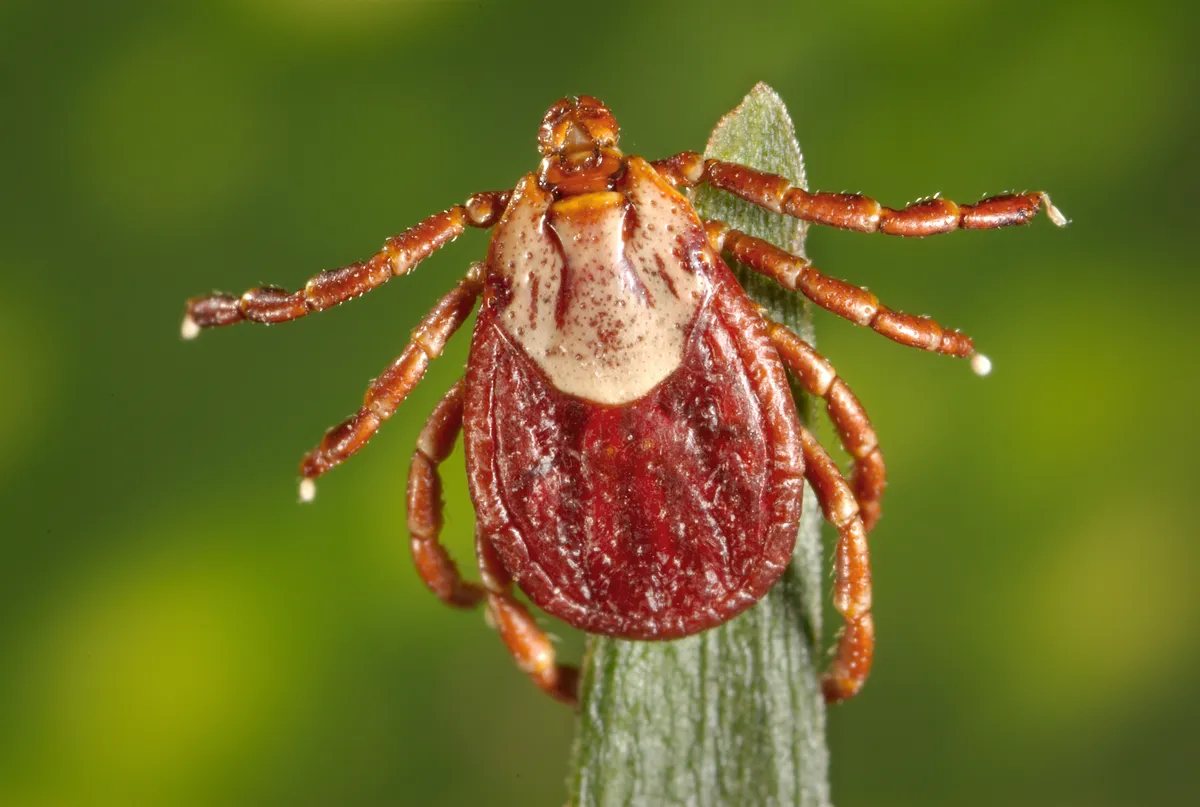
These ticks wait on tall grass and low brush along trails, pastures and wooded edges, and the college says they increasingly turn up in urban green spaces such as river valleys, parks and off-leash areas. In 2017, Rocky Mountain wood ticks came mostly from residents of the Calgary (135) and South (101) zones, while American dog ticks came from all five health zones. To tell either from a blacklegged tick, see our deer tick versus dog tick guide.

Which tick bites people most in Alberta?
The Rocky Mountain wood tick. A 2022 study by Alberta laboratory and public health researchers reviewed 2,326 ticks removed from patients, sent to the province's diagnostic labs from 2000 to 2019 and judged to have been picked up in Alberta. Of these, 1,376 were confirmed Rocky Mountain wood ticks, 410 American dog ticks and 8 winter ticks, while 67 were blacklegged ticks and 11 western blacklegged ticks. The authors note that many ticks are thrown away rather than sent in.
What are winter ticks?
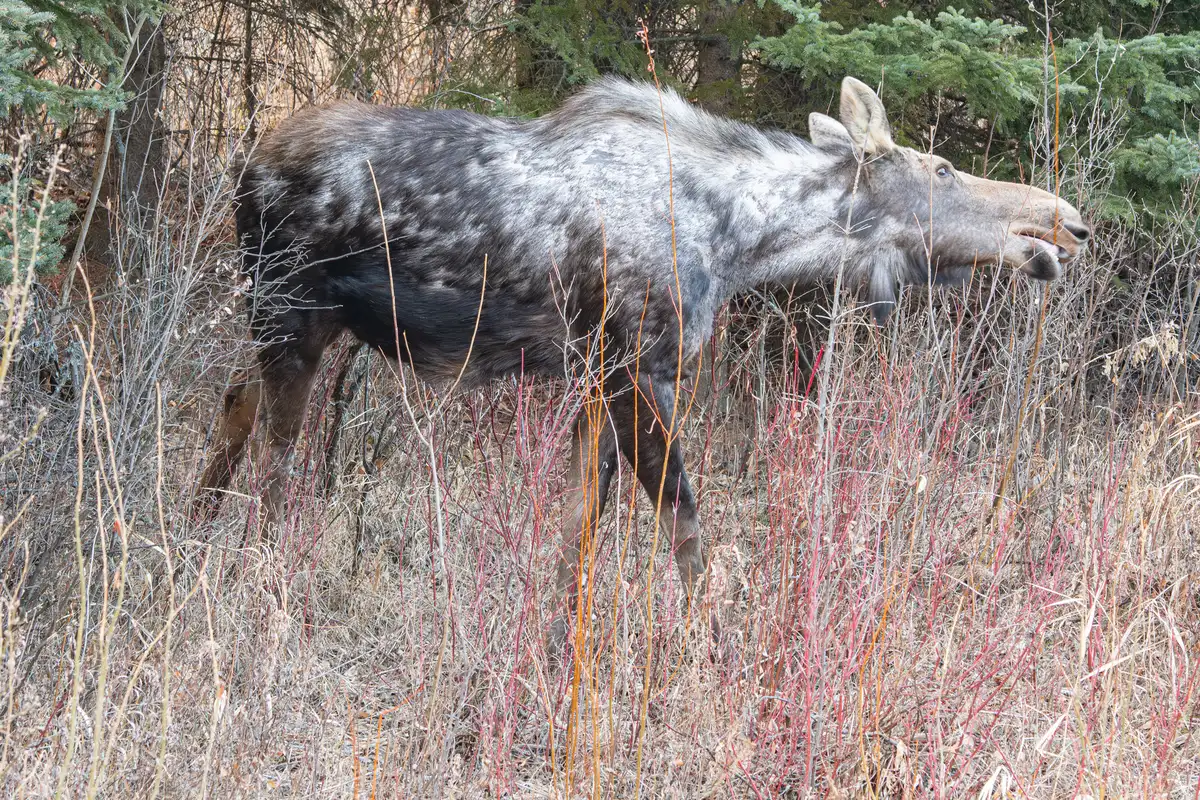
Winter ticks, or moose ticks, spend their whole feeding life on one animal, usually a moose, though they also live on elk and deer. Alberta Environment and Protected Areas' winter tick fact sheet, published in April 2024, says they are common in the foothills and boreal forest and increasingly seen in parkland and prairie. The larvae climb vegetation in late September and early October to catch a passing host and feed through the winter; the province's record is about 140,000 on one moose calf.
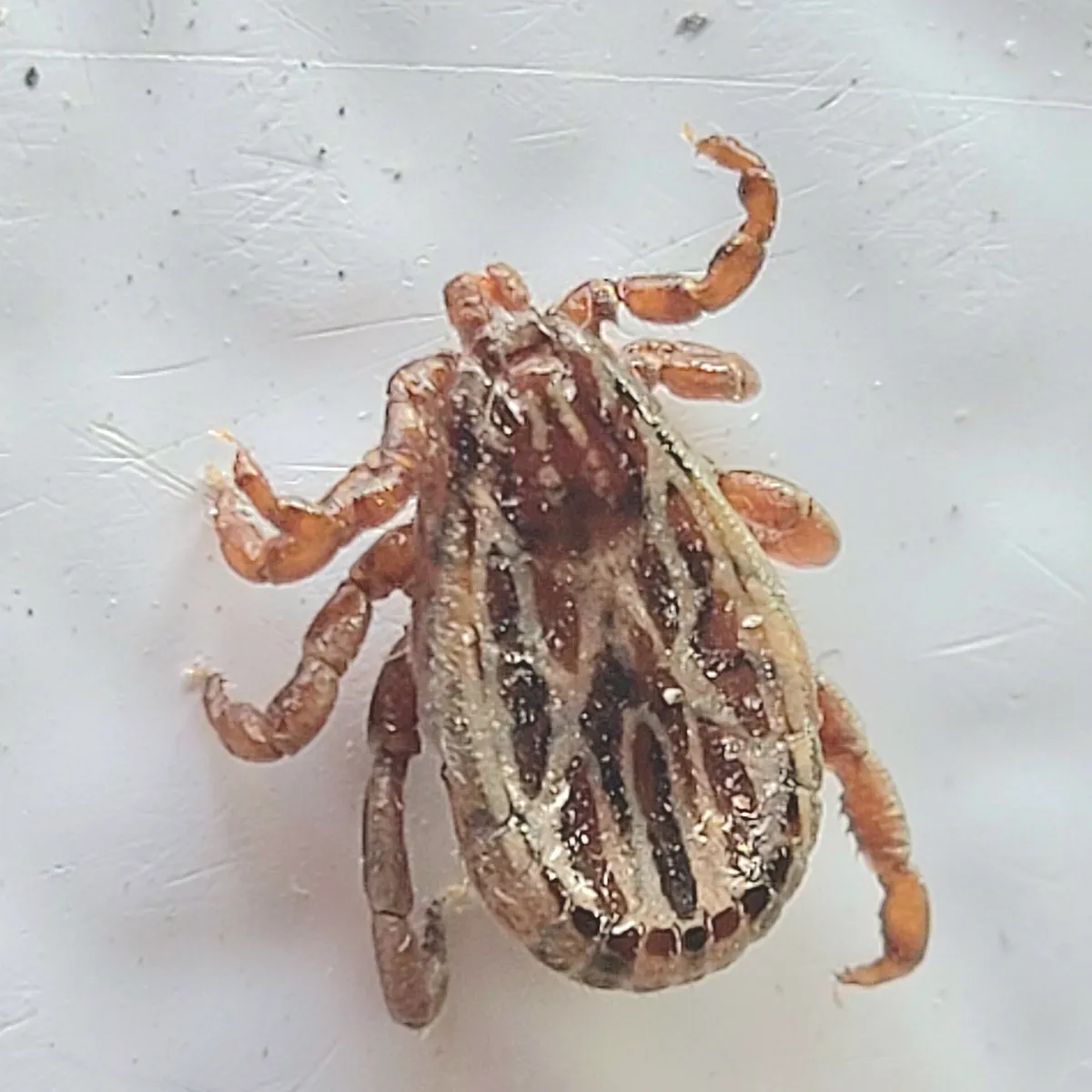
The fact sheet says winter ticks very rarely bite humans and are not known to transmit diseases to people. Moose suffer instead: heavily infested animals rub and chew at their coats, leaving large white patches by late winter, and major moose die-offs, which the sheet says seem to occur every 12 to 15 years, have come at times of high tick numbers. Our winter tick guide has more.
A few other ticks turn up. Alberta does not test Ixodes kingi (114 in 2017), because there is no evidence it can carry or transmit the Lyme bacterium. Brown dog ticks (51 that year) have been reported in Canada in kennels and indoor places with dogs, not in natural outdoor settings, PHAC says, and PHAC lists the lone star tick as found in southern Alberta.
Do ticks in Alberta carry Lyme disease?
A few do. Lyme disease is spread by infected blacklegged ticks and western blacklegged ticks, PHAC says. Alberta counts both species, plus Ixodes ticks that cannot be identified further, as ticks able to carry the bacterium, and asks for those ticks to be sent to its lab for testing.
The dashboard says there is no evidence these ticks have formed established populations in Alberta and that the ones found were likely brought in on migratory birds or other animals. Field sampling agrees: after Ixodes nymphs and adults were submitted in 2017 from hosts that had not left the province, drag sampling near Lethbridge and Vermilion found no Ixodes ticks of concern, the 2017 summary reports, and the 2022 study says field sampling from 2014 to 2017 found no blacklegged or western blacklegged ticks. PHAC's 2025 list of Lyme disease risk areas, searchable by municipality or postal code, includes no place in Alberta.
| Year | Ticks reported, picked up in Alberta | Ixodes ticks able to carry the Lyme bacterium | Ixodes ticks tested | Positive for the Lyme bacterium |
|---|---|---|---|---|
| 2016 | 1,729 | 171 | 171 | 30 (17.5%) |
| 2017 | 1,776 | 262 | 262 | 48 (18.3%) |
| 2018 | 2,076 | 128 | 128 | 22 (17.2%) |
| 2019 | 1,750 | 63 | 63 | 3 (4.8%) |
| 2020 | 1,183 | 85 | 85 | 13 (15.3%) |
| 2021 | 629 | 70 | 31 | 8 (25.8%) |
| 2022 | 1,235 | 127 | 79 | 14 (17.7%) |
| 2023 | 1,242 | 184 | 117 | 22 (18.8%) |
| 2024 | 1,912 | 124 | 79 | 13 (16.5%) |
| 2025 | 1,332 | 167 | 100 | 20 (20.0%) |
Percentages are of ticks tested. Before 2021 every tick had to be sent in, so nearly all Ixodes ticks were tested; since then photos go to eTick first and only requested ticks reach the lab, and in 2021 testing began only in August. From the summer of 2020, COVID-19 measures stopped submissions from people and the environment, and the dashboard's 2020 counts are all ticks from animals. Submissions are voluntary, so the years are not averaged. Sources: Alberta's dashboard, data through December 31, 2025; Alberta Health's 2020 summary.
Keep two numbers apart. Among Ixodes ticks tested, 15% to 20% carried the bacterium in eight of the ten years, with 2019 (4.8%) and 2021 (25.8%) the outliers. Among all ticks reported, the share is small: the 20 positive ticks of 2025 were 1.5% of the 1,332 reported. For ticks removed from people, the 2022 study found 8 positives among 76 blacklegged and western blacklegged ticks tested and put the chance that a tick taken off a person in Alberta carried the bacterium at about 0.35%.
Ixodes ticks turn up more in the north than in the south. In 2025, they were 48% of the ticks reported from the North Zone (61 of 128) and 41% from the Edmonton Zone (60 of 147), against 3% in the Calgary Zone and under 1% in the South Zone, and most of the year's positive ticks came from the Edmonton (8) and North (6) zones. The dashboard warns that voluntary submissions are not a representative sample of where ticks live.
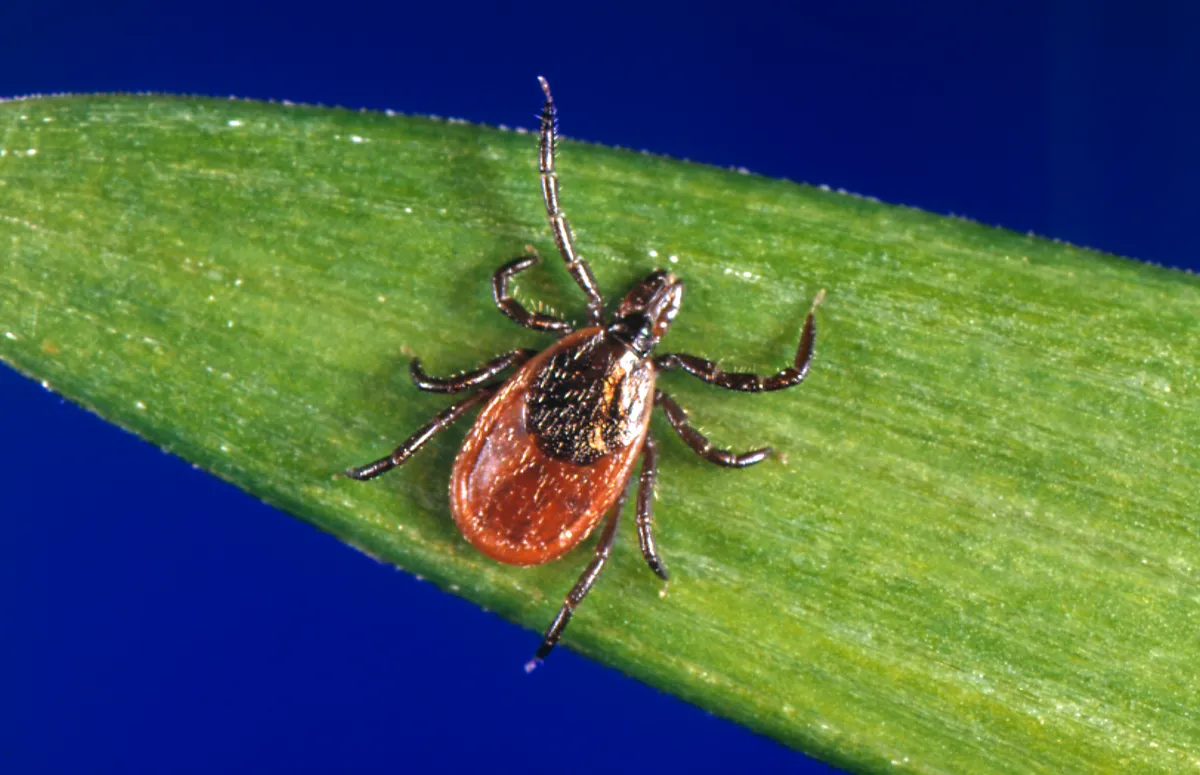
How many Lyme disease cases does Alberta have?
Between 3 and 31 a year since 2011, by PHAC's count. Alberta's Lyme disease page says all 184 cases reported to the province's Ministry of Health from 1991 to 2023 were acquired while travelling outside Alberta, and it rates the risk of getting Lyme disease from a tick bite in the province as very low. PHAC's 2009 to 2019 review and its annual editions for 2020, 2021 and 2022 also describe Alberta's cases with a known exposure as travel-related.
Lyme disease cases reported in Alberta, 2011 to 2024
Cases reported per year, Alberta residents
Show the numbers
| Confirmed and probable cases | |
|---|---|
| 2011 | 7 |
| 2012 | 8 |
| 2013 | 19 |
| 2014 | 9 |
| 2015 | 14 |
| 2016 | 10 |
| 2017 | 12 |
| 2018 | 15 |
| 2019 | 14 |
| 2020 | 3 |
| 2021 | 16 |
| 2022 | 17 |
| 2023 | 20 |
| 2024 | 31 |
The counts swing from 3 in 2020 to 31 in 2024, the highest in this series. When comparing years, keep in mind that PHAC revised the national case definition in 2016 and again in 2024 and says the updates may have affected the data, according to its Lyme disease monitoring page. And because the cases were acquired outside Alberta, the count is not a measure of the risk from Alberta's own ticks.
Nationally, Alberta's 31 cases in 2024 were about half of one per cent of Canada's 5,809, PHAC's annual report shows. Its western neighbours also reported few: British Columbia 21 (ticks and Lyme disease in British Columbia) and Saskatchewan 2 (ticks in Saskatchewan). For every province's figures, see Canada's Lyme disease statistics.
When is tick season in Alberta?
Mainly April to July, with a peak in May and June. Alberta says ticks are most active in spring, summer and fall and can be active when temperatures are above 4 °C, and PHAC adds that ticks can be active whenever it stays above freezing and the ground is free of snow. Our tally of the province's monthly counts shows how lopsided the season is: May and June brought 61% of the 5,721 ticks reported from 2022 to 2025, and April to July brought 84%.
Ticks picked up in Alberta and reported to the province, by month, 2022 to 2025 combined
Ticks reported per month, four years combined
- Found on animals
- Found on people or outdoors
Show the numbers
| Found on animals | Found on people or outdoors | Total | |
|---|---|---|---|
| Jan | 83 | 15 | 98 |
| Feb | 68 | 9 | 77 |
| Mar | 78 | 47 | 125 |
| Apr | 291 | 376 | 667 |
| May | 849 | 1,123 | 1,972 |
| Jun | 788 | 716 | 1,504 |
| Jul | 401 | 255 | 656 |
| Aug | 67 | 35 | 102 |
| Sep | 33 | 14 | 47 |
| Oct | 212 | 19 | 231 |
| Nov | 102 | 5 | 107 |
| Dec | 109 | 26 | 135 |
The season lines up with the temperature. Average daily temperatures in Calgary and Edmonton are close to 4 °C in April and October and below freezing from November to March, according to Environment and Climate Change Canada's 1991–2020 normals for the Calgary and Edmonton airports. April afternoons average 10.8 °C in Calgary and 10.1 °C in Edmonton.
| Month | Calgary, average daily temperature | Edmonton, average daily temperature | Ticks that month |
|---|---|---|---|
| January | −7.6 °C | −12.3 °C | Winter tick nymphs start feeding on moose and deer |
| February | −5.9 °C | −10.4 °C | Few reports, almost all from animals |
| March | −2.2 °C | −5.3 °C | Adult winter ticks appear on their hosts |
| April | 4.5 °C | 3.5 °C | Wood ticks come out after snowmelt; 12% of reports |
| May | 9.9 °C | 10.1 °C | Peak month: 34% of reports |
| June | 13.7 °C | 14.1 °C | 26% of reports |
| July | 16.9 °C | 16.2 °C | 11% of reports; wood ticks retreat as days turn hot and dry |
| August | 16.2 °C | 15.1 °C | Under 2% of reports |
| September | 11.5 °C | 10.3 °C | Fewest reports, under 1% |
| October | 4.9 °C | 3.4 °C | Winter tick larvae climb vegetation; a small rise in reports, mostly from animals |
| November | −1.7 °C | −5.2 °C | Few reports, almost all from animals |
| December | −6.3 °C | −11.0 °C | Few reports, mostly from animals |
Temperatures: Environment and Climate Change Canada, Canadian Climate Normals 1991–2020, Calgary (Airport) and Edmonton (Airport), daily average; based on Environment and Climate Change Canada data. Reports: our shares of the monthly counts on Alberta's dashboard, 2022 to 2025. Wood ticks: the veterinary college. Winter ticks: Alberta Environment and Protected Areas.
Each tick keeps its own calendar. Rocky Mountain wood tick adults peak in May and June and retreat as days turn hot and dry, the veterinary college says, while winter ticks board moose and deer in the fall and stay on them all winter. Ixodes ticks show a spring peak and a smaller fall one: of the 100 tested in 2025, 37 were from May and 16 from October. Mosquitoes follow a different calendar; see when mosquitoes peak in Alberta.
How do you get a tick identified or tested in Alberta?
Through the province's Submit-a-Tick program, which starts with a photo. Alberta asks anyone who finds a tick on a person, a pet or outdoors to consider submitting a photo through eTick's free app or its website. As of October 2026, the steps are:
- Photograph the tick and submit it through eTick; the species identification typically arrives within 2 business days.
- Keep the tick for at least 10 days in a clean, empty plastic container with a tight-fitting lid and no air holes, in case more photos are needed; a fridge or freezer is fine.
- If it is a type that can transmit the Lyme bacterium, or cannot be identified from the photo, you will be asked to send it to Alberta Precision Laboratories (APL) with a completed APL Tick Testing Request form, by mail or at a participating lab.
- Put one tick in each container, each with its own form and labelled with its eTick ID number, or the lab cannot return results.
- APL mails results within 2 to 3 weeks. Ticks of other species can be thrown away.
APL confirms the species and, where it applies, tests for the Lyme bacterium; testing ticks for other tick-borne diseases is not available in Alberta, and the province says the results are not meant to diagnose or treat illness. Hospital labs and Alberta Health Services Environmental Public Health and First Nations and Inuit Health Branch offices do not accept ticks. APL answers questions about ticks sent to it at 780-407-7121 (press 1), 8 am to 4 pm, Monday to Friday.
PHAC's tick removal guide says tick testing is not intended to guide diagnosis or treatment, partly because a person may have been bitten by another tick without noticing and because a health care provider can consider preventive treatment without a tick test. Alberta adds that a provider does not need the tick to make a diagnosis.
What should you do after a tick bite in Alberta?
Remove the tick as soon as you find it. Prompt removal reduces the chance of infection, PHAC says, and Alberta notes that removing a tick within 24 hours of a bite can greatly reduce the chance of Lyme disease or other tick-borne diseases. PHAC's steps:
- Use clean, fine-point tweezers to grasp the tick's head as close to the skin as possible, and pull slowly straight out.
- Try not to twist or squeeze the tick.
- If the mouthparts break off, remove them with the tweezers; if they will not come out easily, leave them and let the skin heal.
- Wash the bite with soap and water or an alcohol-based sanitizer.
Do not burn the tick or smother it with nail polish, nail polish remover, essential oils or petroleum jelly; PHAC warns this can make it release its stomach contents, which can be infected, into the bite. In Alberta, keep the tick for Submit-a-Tick; afterwards, PHAC suggests drowning it in rubbing alcohol or freezing it for several days before putting it in the garbage. Our step-by-step tick removal guide shows the technique.
Then watch your health for a month. Alberta asks anyone with a rash, fever or flu-like symptoms within 30 days of a known tick exposure to tell a health care provider when and where they may have been exposed, and to consult a provider right away if symptoms develop after a bite. Health Link, at 811, can refer callers to a resource that suits their situation.
In most cases an infected tick needs to be attached for at least 24 hours to pass on the Lyme bacterium, PHAC says. Because Alberta's cases were acquired elsewhere, mention recent travel: PHAC lists where you were when bitten among the questions a provider may ask.
What symptoms should you watch for?
Early Lyme disease can bring a rash, fever, chills, fatigue, headache, swollen lymph nodes and muscle and joint aches, PHAC says. The rash, erythema migrans, is the most commonly reported sign: it typically begins at the bite and slowly grows to more than 5 cm across over several days, may look like a bull's-eye and can go unnoticed on dark skin, and some people do not develop one. Alberta says symptoms can begin 3 to 30 days after a bite.

Lyme disease is treated with antibiotics, and the earlier the treatment, the greater the chance of a successful recovery, PHAC says. The stages of Lyme disease symptoms covers what can follow if it is not treated.
| What you need | Where to go in Alberta | What to know |
|---|---|---|
| A name for the tick | Submit-a-Tick, by photo through eTick | Typically within 2 business days; keep the tick for 10 days |
| A lab test of the tick | Alberta Precision Laboratories, only when the program asks | Lyme bacterium only; results by mail in 2 to 3 weeks; not a diagnosis |
| Advice by phone | Health Link, 811 | Refers callers to a resource that suits them |
| Care for a rash, fever or flu-like symptoms within 30 days | A health care provider | Say when and where you may have been exposed, including travel |
| Questions about a tick at the lab | APL, 780-407-7121 (press 1) | 8 am to 4 pm, Monday to Friday |
As of October 2026. Sources: Alberta's Lyme disease and tick surveillance page; PHAC's tick removal guide.
Which other tick-borne diseases occur in Alberta?
A few, rarely. Alberta lists Rocky Mountain spotted fever (spread by Rocky Mountain wood ticks and American dog ticks), Powassan virus disease (groundhog and blacklegged ticks) and tularemia (American dog ticks), and says the number of these cases reported each year varies from 0 to 3, mainly acquired locally. It adds that there is a low risk that anaplasmosis, babesiosis, ehrlichiosis or southern tick-associated rash illness may occur in the province.
Rocky Mountain wood ticks carry one more risk. Some females produce a toxin in their saliva that causes tick paralysis in pets, livestock and people, seen mainly in central British Columbia, and even one tick can cause a progressive paralysis that can be fatal if it is not found and removed, the veterinary college says. It adds that this tick passes the germs behind Rocky Mountain spotted fever, tularemia and Colorado tick fever to people only very rarely in Canada. Our Rocky Mountain wood tick guide has more.
PHAC also links the lone star tick, found in southern Alberta, to tularemia and ehrlichiosis, and says some people bitten by it can develop alpha-gal syndrome, an allergic reaction to red meat from mammals.
How can you avoid tick bites in Alberta?
Dress for ticks, use a repellent that lists them on its label, and check yourself and your pets afterwards. Before going into areas where ticks live, PHAC recommends closed-toe shoes, light-coloured long sleeves and pants, tucking your shirt into your pants and your pants into your socks, permethrin-treated clothing, and a repellent with DEET or icaridin on clothing and exposed skin, following the label. Outdoors, walk on cleared paths and avoid trails made by animals such as deer and moose, since ticks are often found on the grass and plants along them.
Back inside, check yourself, children and gear, shower soon, and put dry clothes in a dryer on high heat for at least 10 minutes; PHAC notes that ticks can survive a cold-warm wash cycle. Our guide to a full-body tick check shows where ticks hide. Around the home, PHAC suggests mowing often, clearing leaf piles, brush and long grass from the edge of the lawn, and pruning shrubs and trees to let in sunlight.
Health Canada caps DEET at 30% for adults and children over 12, and at 10% for children 2 to 12 (up to three times a day) and 6 months to 2 years (once a day), with no DEET for babies under 6 months and no daily use for more than a month in children under 12. Icaridin repels mosquitoes and ticks and should not be used on infants under 6 months. Permethrin-treated clothing can be worn by adults, including pregnant women, but is not available for children under 16. Check that the label lists ticks, since a product that repels mosquitoes might not work on them, and look for the PCP registration number.
Pets can bring ticks into your yard and home, so PHAC advises talking to your veterinarian about tick prevention for them. About half the ticks reported to the province in 2025 came from animals (656 of 1,332), and 91% of those were from household pets, the dashboard shows.
This guide is general educational information, not medical advice. If you have symptoms or concerns after a bite or exposure, contact a healthcare provider.
Use any pest control product exactly as its label directs. In Canada, pest control products are registered by Health Canada’s Pest Management Regulatory Agency: look for the PCP registration number on the label. Some provinces restrict certain products further.
Frequently Asked Questions
Is there Lyme disease in Alberta?+
Albertans do get Lyme disease, but the province says all 184 cases reported from 1991 to 2023 were acquired while travelling outside Alberta, and PHAC counted 31 cases in Alberta residents in 2024. Blacklegged ticks, which spread the bacterium, turn up in Alberta each year, likely carried in by migrating birds or other animals, and 20 of the 100 tested in 2025 carried it. There is no evidence they have formed established populations, and the province rates the risk of getting Lyme disease from a tick bite in Alberta as very low.
What is the most common tick in Alberta?+
It depends on who finds it. Among ticks removed from people and sent to Alberta labs from 2000 to 2019, the Rocky Mountain wood tick was by far the most common, at 1,376 of 2,326. Among ticks reported by residents in 2017, many of them from pets, American dog ticks (305), Rocky Mountain wood ticks (283) and winter ticks (248) were the top three. Rocky Mountain wood ticks are found mainly in the southern half of the province, and winter ticks live mainly on moose.
When does tick season start in Alberta?+
Usually in April, as the snow melts. Alberta says ticks can be active whenever temperatures are above 4 °C, and average daily temperatures in Calgary and Edmonton reach about that level in April. Reports climb through April and peak in May and June, which together brought 61% of the ticks reported from 2022 to 2025, then drop sharply after July. A smaller rise comes in October, mostly ticks found on animals, and a few ticks are reported in every month.
Can I get a tick tested for Lyme disease in Alberta?+
Sometimes. Alberta's Submit-a-Tick program first identifies the tick from a photo sent through eTick. If it is a type that can carry the Lyme bacterium, or cannot be identified from the photo, you will be asked to send it to Alberta Precision Laboratories with a request form, and the lab mails results within 2 to 3 weeks. The lab tests only for the Lyme bacterium, and the province says the results are not meant to diagnose or treat illness, so see a health care provider if you feel unwell.
Are there ticks in Calgary and Edmonton?+
Yes. Ticks were reported from all five Alberta health zones in 2025, including 260 from the Calgary Zone and 147 from the Edmonton Zone, the provincial dashboard shows, and the University of Saskatchewan's veterinary college says wood ticks are increasingly found in urban green spaces such as river valleys, parks and off-leash areas. In the Edmonton Zone, 41% of the ticks reported in 2025 were Ixodes ticks able to carry the Lyme bacterium, against 3% in the Calgary Zone, though submissions are voluntary and not a representative sample.
Do wood ticks carry Lyme disease?+
No. PHAC names only the blacklegged tick and the western blacklegged tick as spreaders of Lyme disease. Rocky Mountain wood ticks and American dog ticks can carry the germs behind Rocky Mountain spotted fever and tularemia, but Alberta says only 0 to 3 cases of those diseases and Powassan virus disease are reported in the province each year. Winter ticks, the third common tick of this group, very rarely bite people and are not known to spread any disease to them.
Sources
- Lyme disease and tick surveillance — Government of Alberta
- Alberta Passive Tick Surveillance Dashboard (data to December 31, 2025) — Government of Alberta
- Tick surveillance summary (annual reports for 2013 to 2020, including the 2017 and 2020 summaries) — Alberta Health, Open Government Licence – Alberta
- Winter tick (April 2024) — Alberta Environment and Protected Areas, Open Government Licence – Alberta
- Epidemiology of ticks submitted from human hosts in Alberta, Canada (2000–2019) — Kanji JN, et al., Emerging Microbes & Infections 11(1), 2022 (CC BY 4.0)
- Dermacentor andersoni: the Rocky Mountain wood tick (March 2021) — Western College of Veterinary Medicine, University of Saskatchewan
- Ticks in Canada (page dated August 7, 2026) — Public Health Agency of Canada
- Lyme disease: Spread, prevention and risks (including Lyme disease risk areas, 2025) — Public Health Agency of Canada
- Lyme disease: Monitoring (page dated July 27, 2026) — Public Health Agency of Canada
- Tick-borne disease surveillance: Annual reports (2024 data) — Public Health Agency of Canada, Health Infobase
- Surveillance for Lyme disease in Canada, 2009 to 2019 — Canada Communicable Disease Report 48(5), Public Health Agency of Canada, May 2022 (CC BY 4.0)
- Lyme disease surveillance in Canada: Annual edition 2020 — Public Health Agency of Canada
- Lyme disease surveillance in Canada: Annual edition 2021 — Public Health Agency of Canada
- Lyme disease surveillance in Canada: Annual edition 2022 — Public Health Agency of Canada
- How to remove a tick (page dated July 29, 2025) — Public Health Agency of Canada
- Lyme disease: Symptoms and treatment (page dated July 3, 2026) — Public Health Agency of Canada
- How to prevent tick bites (page dated September 9, 2025) — Public Health Agency of Canada
- Personal insect repellents — Health Canada
- Canadian Climate Normals 1991–2020 Data: Calgary (Airport) — Environment and Climate Change Canada
- Canadian Climate Normals 1991–2020 Data: Edmonton (Airport) — Environment and Climate Change Canada
How this guide was made: it was researched and drafted with AI assistance from the sources listed above. A second, independent AI pass then checked each factual claim against those sources. Found an error? Email support@buzzskito.ca.