Quick Answer
Ontario’s 2026 tick season is running 2–3 weeks ahead of typical years, with blacklegged tick nymphs peaking from May through July. The recommended yard approach is a professional tick barrier spray starting in late May to early June and renewed roughly monthly through September — five treatments across the season — plus habitat modification: the spray puts a residual acaricide on the shaded edges and leaf litter where ticks quest, and the habitat work removes the humidity they need to survive there between hosts. Neither eliminates ticks, so keep doing tick checks.
- Public health experts confirmed in May 2026 that tick activity across Southern Ontario is running 2–3 weeks ahead of typical years.
- Ontario reported 2,369 confirmed and probable Lyme disease cases in 2024 — up 27% over 2023 and the most of any province (PHAC). 2024 is the newest published year.
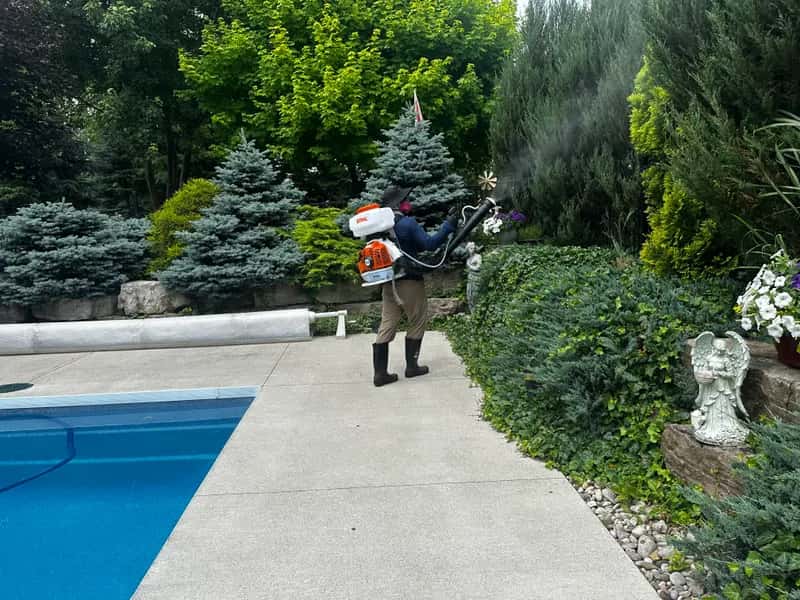
- Professional tick barrier spray puts a PCP-registered residual acaricide on the fence lines, leaf litter and wood-edge transitions where ticks quest — not the open lawn — and is renewed roughly monthly, five times across a May-to-September season.
- Habitat modification — leaf-litter removal, short mowing, and a 3-foot gravel or wood-chip buffer — works on a different mechanism: it dries out the shaded litter layer ticks need to survive between hosts.
- Blacklegged tick nymphs, the stage most associated with Lyme transmission, are active in Ontario from May through July.
- Lyme transmission typically requires 24–36 hours of tick attachment, so a daily tick-check habit dramatically reduces risk.
— BuzzSkito, GTA mosquito & tick control · 150+ five-star Google reviews
TL;DR: Ontario’s tick population is running 2-3 weeks ahead of normal in 2026. Toronto is now classified as a hot spot. Blacklegged tick nymphs (the most dangerous Lyme-carrying stage) are peaking right now through July. Professional barrier spray puts a PCP-registered residual acaricide on the shaded edges and leaf litter where ticks quest, and habitat modification takes away the humidity they need there. The window for spring application is closing.
As an Amazon Associate I earn from qualifying purchases. BuzzSkito only points to products we would genuinely use or recommend, at no extra cost to you.
As an Amazon Associate I earn from qualifying purchases. Price shown on Amazon.ca, at no extra cost to you.
🏆 Our Top Pick — Step 5 of the Plan
Fine-Tipped Tick Removal Tool (tweezers + tick key)
Every step of the plan below ends the same way: you find a tick and need it out cleanly. A fine-tipped remover grips at the skin and lifts the whole tick straight out, where blunt bathroom tweezers squeeze the body. In a surge year, have one in the house before you need it.
Pros
- Grips at skin level for a clean, straight pull
- Small enough for the car and the hiking bag
- Far less likely to leave mouthparts behind than flat tweezers
Cons
- Fiddly on poppy-seed nymphs without good light
The 2026 tick surge, in one sentence
Three Ontario-wide news outlets ran the same story in May 2026: ticks are emerging earlier, in higher numbers, and in more neighbourhoods than at any point on public health record. The Toronto Star flagged Toronto as a hot spot; CityNews Toronto warned of a “bad mosquito season ahead”; TorontoToday confirmed the surge based on Public Health Ontario surveillance data. The cause is a stack of three factors — a mild winter, a wet spring, and the ongoing northward climate-driven expansion of the blacklegged tick range.
For GTA homeowners, the practical question is simple: what does this mean for my family, my pets, and my yard?
Why 2026 is worse than recent years
The blacklegged tick (Ixodes scapularis) — the only Ontario tick that transmits Lyme disease — has a two-year life cycle that is unusually sensitive to overwinter survival rates. Mild winters allow more nymphs to survive into the next active season. Ontario’s 2025-2026 winter was the third-mildest in the last 15 years across most of Southern Ontario, which means the nymph cohort emerging in May 2026 is significantly larger than the long-term average.
Layer on a wet early spring (which boosted deer mouse populations — the primary tick host during the nymph stage), and you get the conditions for a population spike. Public Health Ontario’s sentinel surveillance program — which tracks tick density and Lyme bacterium presence in collected ticks — recorded a measurable jump in both metrics in early May 2026 compared to the same week in 2025.
Where it’s worst — the GTA hot spots
The highest-pressure neighbourhoods in 2026 are the ones with the most ecological overlap between deer, mice, and human-occupied land:
- Toronto — the Don Valley ravine system, Rouge National Urban Park, High Park, the Beaches escarpment, Lawrence Park ravines, Sunnybrook Park. Any home backing onto a forested ravine is in the highest-risk category.
- Mississauga — the Credit River corridor, Riverwood, Lakeside Park, Erindale Park, Sawmill Creek.
- Hamilton + Burlington — the Niagara Escarpment edge, Cootes Paradise, Bruce Trail proximity, RBG.
- Halton Region — Bronte Creek, Mountsberg, Crawford Lake Conservation Area edges.
- York Region — Oak Ridges Moraine, Vivian Forest, the headwaters of the Rouge and Don.
If your property is within 1 km of any of these features, you are in the elevated-risk zone. The free yard risk report tool generates a 1-100 score specific to your address using neighbourhood pressure data + lot-size + family-situation factors.
Your 5-step protection plan
- Schedule a professional tick barrier spray now. Late May to early June is the optimal window — it targets active nymphs where they wait for hosts. Then keep treatments on schedule: applications run roughly monthly through September, five across the season, because one treatment’s residual lasts weeks rather than months and wildlife keeps walking fresh ticks in from the woodline all summer. A spring-and-fall pair would leave the May-July nymph peak open in between.
- Modify the high-risk zones in your yard. Rake out leaf litter from garden beds, clear brush along fence lines, and install a 3-foot gravel or wood-chip buffer between any lawn and adjacent forest/conservation area. Mow grass short.
- Establish a daily tick-check habit. After any outdoor activity — even just gardening — check yourself, kids, and pets. Ticks favour warm areas: behind ears, scalp, armpits, groin, behind knees. On dogs, check ears, between toes, and the chest/belly area.
- Use repellent strategically. 20-30% DEET on exposed skin and permethrin-treated clothing for outdoor activity in high-risk zones (hiking, gardening near naturalized edges). Light-coloured clothing makes ticks easier to spot.
- Know what to do if you find a tick. Remove immediately with fine-tipped tweezers, pulling straight out without twisting. Save the tick in a sealed bag. If you develop a bull’s-eye rash or flu-like symptoms in the following 3-30 days, see a doctor and bring the tick.
For step 4, look for a repellent whose label lists icaridin or 20–30% DEET and carries a PCP registration number. Check price on Amazon.ca →
The 24-hour timeline that matters
The single most important fact about Lyme disease in Ontario: Borrelia transmission from a blacklegged tick to a human typically requires 24-36 hours of attachment. A tick removed within 24 hours of attachment dramatically reduces — but does not eliminate — the risk. This is why the daily tick-check habit, especially during May-July nymph activity, is the single highest-leverage thing a family can do.
What about the news momentum?
The May 2026 news cycle is a one-time event. Public attention will move on. The ticks will not. If you are a GTA homeowner who has been meaning to deal with the yard situation, this is the moment — the conditions that triggered the news coverage are the same conditions raising your property’s tick pressure right now.
Our team has been treating GTA properties for both mosquitoes and ticks since 2024, and 2026 is the heaviest tick year we have seen on the field. Same-week service is available across Toronto, Mississauga, Hamilton, Oakville, and 15 other GTA cities. We book a visit window, never an exact arrival time.
And for the outside-the-yard half of the plan — trail days, the dog walk, the ravine path — the short list is a repellent for skin and a remover for the drawer. See tick repellent on Amazon.ca →
Related guides
- Lyme Disease Risk Areas Ontario 2026 (Endemic Map)
- Tick Surge Ontario 2026: Complete Yard Control Guide
- Are Ticks Dangerous in Ontario? What Every Family Should Know
- Ontario Lyme Disease Tracker — PHU-by-PHU live data
Frequently Asked Questions
What's causing the tick surge in Ontario in 2026?+
Three factors are stacking this year: an unusually mild winter that let more nymphs survive, a wet early spring that boosted deer mouse populations (the primary nymph host), and continued northward expansion of the blacklegged tick range driven by climate trends. Public health experts confirmed in May 2026 that adult and nymph tick activity is running 2-3 weeks ahead of typical years across Southern Ontario.
How dangerous is the surge for families and pets?+
More ticks means more bite encounters, and a higher percentage of blacklegged ticks in 2026 are testing positive for Borrelia burgdorferi (the Lyme disease bacterium). Pets — especially dogs that walk in long grass, ravines, or wooded areas — are at significantly higher exposure risk. Children playing in backyards bordering naturalized areas face the same risk. Ontario reported 2,369 confirmed and probable Lyme disease cases in 2024 — up 27% over the 1,859 reported in 2023, and about 41% of Canada's national total, according to the Public Health Agency of Canada. 2024 is the most recent year for which a provincial figure has been published; no 2025 Ontario total has been released.
What's the most effective protection for my yard?+
A professional tick barrier spray puts a PCP-registered residual acaricide on the perimeter zones where blacklegged ticks actually sit — fence lines, garden beds, wood-edge transitions, leaf-litter areas and under decks — instead of the open lawn, where they largely do not. Applications are spaced roughly monthly from May through September — five across the season — because the residual from one treatment lasts weeks rather than months; that cadence keeps treatments on schedule through the May-July nymph peak and into the fall adult resurgence, whereas a spring-and-fall pair would leave the peak months open. Habitat modification (leaf removal, regular mowing, and a gravel or wood-chip buffer between lawn and forest) removes the shaded humidity ticks need to survive between hosts, so the two work together. Neither eliminates ticks: wildlife carries new ones onto the property all season, which is why treatment is repeated on a schedule rather than done once or twice.
When should I start tick prevention?+
Now. Tick nymphs (the smallest, hardest-to-spot, and most dangerous stage for Lyme transmission) are active from May through July in Ontario. If you have not yet had a yard treatment in 2026, the optimal window is closing fast — late May to early June is the highest-value application. From there the barrier is renewed roughly monthly through September, five treatments across the season, because one application's residual lasts weeks rather than months and wildlife keeps carrying fresh ticks in from adjacent woodland. That cadence keeps treatments running through the May-July nymph months, and the late-season applications continue into the fall, when adult ticks re-emerge and stay active into November in mild years.
Should I be worried about Lyme disease specifically?+
Yes, especially if your property borders a ravine, conservation area, golf course, forest, or any naturalized space. The blacklegged tick (the Lyme vector) is now established throughout the GTA. Symptoms of Lyme disease — including the characteristic bull's-eye rash, flu-like fatigue, and joint pain — often appear 3-30 days after a bite. Early treatment is highly effective; delayed treatment can lead to chronic symptoms. Tick checks after any outdoor activity and prompt medical attention for any suspicious bite are essential.