Quick Answer
Richmond Hill and Markham sit directly on the Oak Ridges Moraine, so blacklegged tick populations here are established and self-sustaining. Yards backing onto forest, ravines, or Rouge National Urban Park need five barrier treatments per season — spaced roughly monthly from May through September, so peak nymph season is never left with a multi-month gap and the barrier still stands when fall adults return.
- The Oak Ridges Moraine is a 160 km glacial landform running directly through Richmond Hill and Markham.
- Rouge National Urban Park covers over 79 square kilometres and contains confirmed blacklegged tick populations.
- Blacklegged ticks stay active from April into November — nymphs through spring and summer, adults again in the fall.
- Poppy-seed-sized nymphs are active May through July and cause most Ontario Lyme disease transmission.
- Five treatments, roughly one a month from May through September, renew the barrier as it fades — the acaricide residual is temporary and wildlife keeps walking new ticks in from the woodland edge.
- Lyme transmission becomes a real possibility after 24–36 hours of tick attachment.
- Highest-risk areas: Oak Ridges and Jefferson Forest in Richmond Hill; Cornell, Cathedraltown, and Rouge Park in Markham.
— BuzzSkito, GTA mosquito & tick control · 150+ five-star Google reviews
Richmond Hill and Markham sit directly on the Oak Ridges Moraine — one of Ontario’s most ecologically sensitive areas and one of the province’s highest-density tick habitats. If your property backs onto forest, a ravine, or conservation land in either city, this guide is for you. Start with our Richmond Hill tick control or Markham tick control service pages for treatment options.
As an Amazon Associate I earn from qualifying purchases. BuzzSkito only points to products we would genuinely use or recommend, at no extra cost to you.
As an Amazon Associate I earn from qualifying purchases. Price shown on Amazon.ca, at no extra cost to you.
🏆 Our Top Pick — For Moraine Trail Walks
A barrier treatment lowers how many ticks wait in your own yard. It does not follow you onto the Oak Ridges Trail, into Rouge National Urban Park, or through the Jefferson Forest — and those walks are where many York Region ticks get onto people and dogs. A fine-tipped remover grips at the head, right against the skin, and lifts the tick out in one piece. Keep one at the back door and one in the car.
Pros
- Grips at the head, so the body is never squeezed
- Works on the poppy-seed nymphs active May through July
- Small enough for the glovebox and the dog-walking bag
Cons
- Easy to misplace without a keyring loop
- Still needs a slow, steady straight pull
What Is the Oak Ridges Moraine and Why Does It Drive Tick Risk?
The Oak Ridges Moraine is a 160-kilometre glacial landform stretching from Caledon in the west to Rice Lake in the east, passing directly through Richmond Hill and Markham. Its rolling topography, complex mix of forests, wetlands, and kettle lakes, and year-round groundwater discharge create an exceptionally diverse habitat — and that habitat supports the entire blacklegged tick lifecycle.
Blacklegged ticks (also called deer ticks, Ixodes scapularis) need three hosts across a two-year lifecycle: typically a small mammal (white-footed mouse) as larvae, a larger mammal (deer, raccoon) as nymphs, and a large mammal (deer, dog, or human) as adults. The moraine’s forests and meadows support white-tailed deer populations and white-footed mice at densities high enough to sustain self-reproducing tick colonies.
This is why Richmond Hill and Markham consistently appear in York Region Public Health’s tick surveillance data. It is not random — the geography creates the conditions.
Richmond Hill: Where Tick Risk Is Concentrated
Not every block in Richmond Hill carries equal risk. The highest-exposure areas are:
- Oak Ridges: Sits on the moraine itself. Lake Wilcox Conservation Area and the Oak Ridges Trail bring ticks to trail edges and adjacent properties year-round. Homes with rear yards facing the lake or the Oak Ridges Corridor Conservation Reserve face the most direct exposure.
- Jefferson Forest area: The Jefferson Forest, north of Major Mackenzie Drive, is a regionally significant natural area with documented tick activity. Adjacent streets in Jefferson and Bayview Hill neighbourhoods are at elevated risk.
- Mill Pond: The Mill Pond park and trail system in Richmond Hill’s town centre has documented tick activity along the vegetated trail margins.
- North Richvale ravines: Properties backing onto ravine corridors north of Highway 7 can see tick activity from April through November.
Markham: Rouge National Urban Park and the Forest Edge Problem
Markham’s eastern edge borders Rouge National Urban Park — Canada’s largest urban national park at over 79 square kilometres. The park contains extensive mixed hardwood forest, meadows, and river valley habitat (Milner Creek, Little Rouge Creek, the Rouge River itself) that support established blacklegged tick populations.
For homeowners in Cornell, Cathedraltown, Rouge Park, and parts of Wismer, this is a meaningful risk. Properties on streets that face the park boundary or that have direct rear-yard access to forest edges are most exposed. Even a 100-metre gap between your property and the forest is not necessarily protective — ticks travel on deer, which routinely cross that distance.
See our Markham mosquito control page if you’re dealing with both pests — which is common in these areas.
The Lyme Disease Piece: Why Nymphs Are the Real Danger
Most Lyme disease transmission in Ontario comes not from adult ticks, which are relatively large and easier to spot, but from nymphs — the second life stage. Nymphs are active May through July and are the size of a poppy seed. They are extremely difficult to feel and easy to miss during a tick check.
Both Richmond Hill and Markham fall within Ontario’s established Lyme disease risk zone as defined by Public Health Ontario. If a tick is attached for more than 24–36 hours, Lyme disease transmission becomes a real possibility. Alongside tick checks, one practical step is to cut down the ticks in your own yard by treating it.
For the Oak Ridges Trail and Rouge park walks themselves, factory-treated permethrin socks, gaiters, and hiking pants are the ready-to-wear layer for the lower leg, where a questing nymph climbs aboard. Check price on Amazon.ca →
What Treatment Looks Like for These Properties
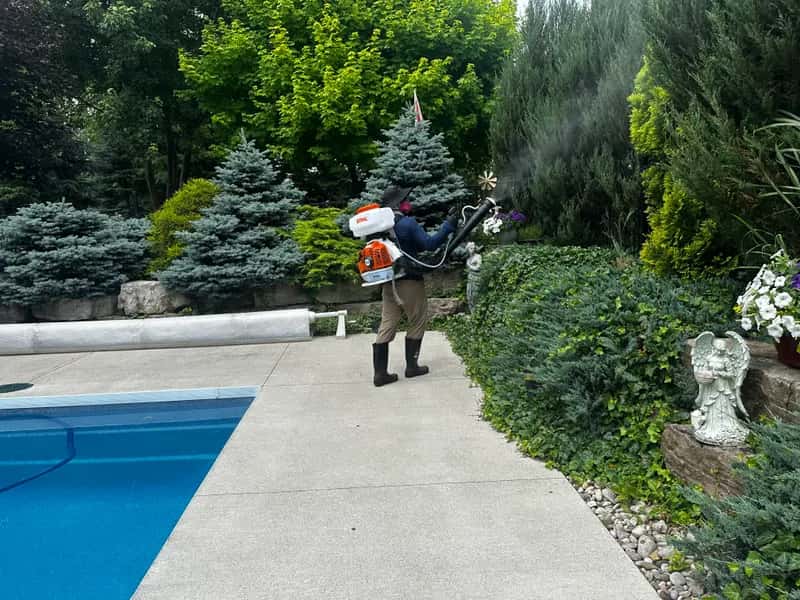
BuzzSkito’s tick barrier spray targets the transition zones where ticks concentrate: leaf litter margins at the lawn edge, low ground cover, the base of shrubs, and shaded mulch beds. These are the areas where ticks quest (climb and wait) for passing hosts.
For Richmond Hill and Markham properties with forest or ravine backing, we recommend the full five-treatment season — applications spaced roughly a month apart from May through September. The first goes down in early May, ahead of the nymph emergence peak. Nymphs stay active through July, and because they are poppy-seed sized and easily missed they account for most Lyme transmission in Ontario, so the June and July applications cover the highest-risk stretch of the year. The August and September treatments carry the barrier into the adult-tick period, which runs into November in mild years.
The reason a season needs five visits rather than one or two comes down to how the product works and where the ticks come from. The acaricide residual is temporary, and the deer, mice, and birds moving between the moraine forest and your yard reintroduce ticks continuously — so the barrier has to be renewed, not just established. Monthly coverage also means there is no multi-month hole in the middle of nymph season, which is exactly what a spring-and-fall pair of visits leaves open. Tick control runs $597 for the season on its own, or $497 when added to any mosquito plan; single treatments start at $99.
Related Guides and Services
- Richmond Hill Tick Control Service
- Richmond Hill Mosquito Control Service
- Markham Tick Control Service
- Markham Mosquito Control Service
- Thornhill Tick Control Service
- All GTA Tick Control Services
- The Ultimate Tick Control Guide for Ontario Homeowners
- Lyme Disease Prevention in Ontario
What to Keep on Hand Between Treatments
As an Amazon Associate I earn from qualifying purchases. BuzzSkito only points to products we would genuinely use or recommend, at no extra cost to you.
A barrier treatment lowers how many ticks are waiting in your own yard. It does not follow you onto the Oak Ridges Trail, into Rouge National Urban Park, or through the Jefferson Forest — and in York Region those walks are where a large share of ticks get onto people and dogs in the first place. So the other half of the routine is the check when you come back in, and a proper tool for the moment a check finds something. A fine-tipped remover or tick hook grips at the head, right against the skin, and lifts the tick out in one piece rather than leaving mouthparts behind or squeezing the body. That matters most with the poppy-seed-sized nymphs this region produces from May through July, and on a dog, where you are working blind through fur. Keep one at the back door and one in the car. Check tick-removal tools on Amazon.ca →
Frequently Asked Questions
Why does the Oak Ridges Moraine make tick risk higher in Richmond Hill and Markham?
The Oak Ridges Moraine is a 160-km geological feature running east–west through York and Durham regions. Its mix of forests, wetlands, and meadows creates ideal habitat for white-tailed deer and white-footed mice — the two primary hosts that sustain blacklegged tick (deer tick) populations. Richmond Hill and Markham sit directly on the moraine, meaning tick populations here are established and self-sustaining, not just passing through.
Which areas of Richmond Hill have the highest tick risk?
Oak Ridges is the highest-risk community in Richmond Hill — it sits on the moraine itself, with direct access to the Lake Wilcox Conservation Area and Jefferson Forest. Homes on the north side of Oak Ridges with ravine or forest backing are most exposed. The Mill Pond area in the town centre also has documented tick activity along the trail network.
Is Markham's Rouge National Urban Park actually a tick risk for homeowners?
Yes. Rouge National Urban Park is one of Canada's largest urban parks — over 79 square kilometres of mixed habitat that includes confirmed blacklegged tick populations. Markham neighbourhoods like Cornell, Cathedraltown, and Rouge Park that border the park boundary are the highest-risk residential areas. Homes with rear yards facing the park edge are essentially adjacent to established tick habitat.
When should Richmond Hill and Markham homeowners treat for ticks?
Treatment runs May through September — five barrier applications spaced roughly a month apart. The first goes down in early May, ahead of the nymph emergence peak. Nymphs are the poppy-seed-sized life stage that drives most Ontario Lyme transmission, and they stay active from May through July, so the June and July applications carry as much weight as the first one. The August and September treatments hold the barrier as adults re-emerge and stay active into November in mild years. Monthly spacing matters because the acaricide residual is temporary and deer, mice, and birds continually reintroduce ticks from adjacent woodland — a spring-and-fall pair of visits leaves the entire peak nymph window uncovered.