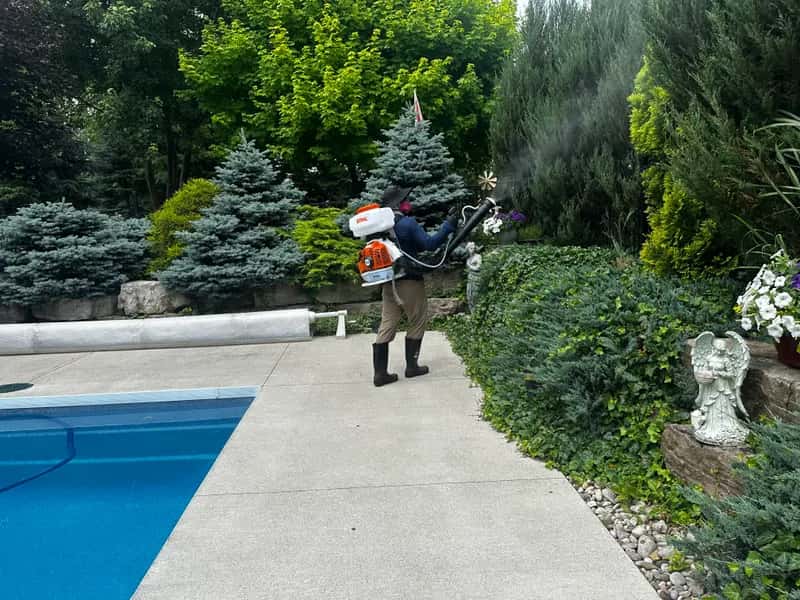
Vaughan sits in the middle of the Humber River watershed — and that geography makes it one of York Region’s most challenging cities for mosquito control. This guide explains exactly why, and what actually works for Vaughan homeowners. See our Vaughan mosquito control service page for treatment details.
Why Vaughan Has a Mosquito Problem That Won’t Fix Itself
Most GTA cities have mosquito pressure. Vaughan has a structural mosquito problem — meaning the conditions that create mosquitoes are baked into the landscape and will not change on their own.
The Humber River runs through the city’s western edge, with extensive floodplain and valley land that holds water for days after rainfall. Boyd Conservation Area (1,700 acres in the heart of Vaughan) provides dense forest canopy, wetland margins, and slow-moving creek habitat that supports mosquito breeding from May through September. The Kortright Centre for Conservation in Woodbridge adds another 325 acres of managed woodland adjacent to residential streets.
On top of the natural features, Vaughan has been one of Ontario’s fastest-growing cities for 20 years. Construction sites and newly graded land hold water in low spots. Detention ponds built into new subdivisions in Kleinburg, Maple, and Vellore Village provide the perfect shallow, warm-water breeding environment. These aren’t temporary problems — the ponds are permanent stormwater infrastructure.
Which Vaughan Neighbourhoods See the Worst Mosquito Activity?
Not all of Vaughan is equally affected. Properties that back onto or are within a few hundred metres of the following areas consistently see the heaviest mosquito pressure:
- Islington Woods and Weston Downs — Back lot lines abut the Humber River valley. Mosquitoes emerging from the floodplain travel into yards every evening from late May onward.
- Pine Valley and East Woodbridge — Dense mature canopy provides daytime harbouring cover. Evening activity here starts earlier in the season than most Vaughan neighbourhoods.
- Kleinburg estates — Large lots near the Humber River and Boyd Conservation Area. Rural-scale mosquito pressure in a residential setting.
- Sonoma Heights and Vellore Village — Retention ponds in the stormwater network seed mosquitoes directly into residential areas. Newer neighbourhoods, but the problem is already well established.
- Patterson and Maple — Newer subdivisions near Rutherford Road and Highway 400 with stormwater management ponds nearby.
The Tick Problem in Vaughan That Most Homeowners Don’t Know About
Most Vaughan homeowners are focused on mosquitoes, but the same conservation areas that drive mosquito pressure — Boyd Conservation Area, the Humber River valley, Kortright Centre — are confirmed blacklegged tick habitat. The City of Vaughan and York Region Public Health have documented established tick populations in these areas.
If your property backs onto any forested area in Vaughan, you should be treating for both. See our Vaughan tick control service page for details on how barrier spray targets the shaded edges and leaf litter where ticks wait for a host.
What Mosquito Season Actually Looks Like in Vaughan
Based on the microclimates created by the Humber River and conservation lands, here is how the Vaughan mosquito season typically unfolds:
- Late April: First adults emerge near the Humber floodplain and conservation area edges. Most homeowners don’t notice yet.
- May: Populations build quickly. Properties near Boyd and the Humber River valley are noticeably affected by mid-May.
- June–July: Peak season. Evening activity makes backyards unusable without treatment. This is when we get the most calls — and when it’s hardest to get a quick booking.
- August: Sustained pressure. Late-summer rain events spike activity even on properties that were well-managed earlier.
- September: Activity declines but continues. Homeowners who stop treatment in August often see mosquitoes return for Labour Day gatherings.
What Actually Works: Barrier Spray for Vaughan Properties
The most effective approach for Vaughan homeowners is professional barrier spray targeting the daytime resting sites on your property — shrub undersides, hedge interiors, the shaded edge between lawn and garden beds, and lower tree canopy. This is where adult mosquitoes harbour during the day and from where they emerge at dusk.
Store-bought products, citronella candles, and backyard foggers provide temporary relief but don’t break the cycle. Because Vaughan properties are continuously re-seeded by mosquitoes from adjacent conservation lands, you need ongoing residual protection — not a one-time fix.
BuzzSkito’s barrier spray uses registered products applied according to label directions, and because the residual wears down with time and rain, it is repeated through the season. For Vaughan properties adjacent to Boyd or the Humber River, we typically recommend a 5-treatment program running May through September.
Related Guides and Services
- Vaughan Mosquito Control Service
- Vaughan Tick Control Service
- Woodbridge Mosquito Control
- Thornhill Mosquito Control
- King City Mosquito Control
- All GTA Mosquito Control Services
- The Ultimate Backyard Mosquito Control Guide (GTA Edition)
- When to Book Your First Treatment of the Season
Frequently Asked Questions: Vaughan Mosquito Control
Why is mosquito pressure so intense in Vaughan?
Vaughan sits in the Humber River watershed. Boyd Conservation Area, the Humber River floodplain, and Kortright Centre for Conservation all provide extensive standing water and dense canopy cover — ideal mosquito breeding and harbouring habitat. On top of that, Vaughan's rapid new-build developments leave construction ponds and graded land that holds water for weeks after rain, seeding populations right in residential areas.
Which Vaughan neighbourhoods have the worst mosquito problems?
Properties in Islington Woods, Weston Downs, and Pine Valley back directly onto the Humber River valley. Kleinburg and Woodbridge estates near the conservation lands also experience heavy pressure. Even newer developments in Vellore Village and Sonoma Heights can see significant mosquito activity due to retention ponds and detention basins built into the stormwater systems.
How many treatments do Vaughan homeowners typically need per season?
Most Vaughan properties are well served by a monthly schedule: 5 treatments from May through September. Properties adjacent to Boyd Conservation Area or the Humber River corridor need that full season with no gaps, and some step up to a treatment every 2 weeks, since mosquitoes continuously re-enter from the conserved lands next door. We'll assess your specific lot and recommend a schedule that makes sense.
Is professional mosquito spray safe near the conservation areas?
BuzzSkito uses registered products applied according to label directions, and only on your private property — we target resting sites like hedges, shrub undersides, and tree canopy edges where adult mosquitoes harbour during the day. We don't treat open water or land beyond your property boundaries, and we don't spray flowering plants where pollinators forage. Keep kids and pets off treated areas until the spray has dried, as the product label directs.