BuzzSkito Mosquito & Tick Control Specialists · Published August 22, 2026
Why a Green Pool Out-Breeds Everything Else in the Yard
Everyone has heard that a mosquito can breed in a teaspoon of water, and it is true. What that framing hides is the part that matters operationally: mosquitoes lay on the surface of still water, so breeding capacity scales with surface area, not volume. A bird bath offers roughly a square foot. A 16 x 32 ft inground pool offers about 512. That is the whole explanation for why one neglected pool can make a street miserable while a dozen conscientious neighbours empty their saucers.
A working pool breeds nothing: free chlorine in the normal 1–3 ppm range makes the water hostile, and a running circulation pump keeps the surface too disturbed for a Culex female to lay a raft that survives. Both protections fail together the moment the pump goes off. Sunlight and organic load consume the remaining chlorine within days, algae blooms in warm weather, and the algae becomes the food supply for the larvae. Two or three weeks later you have a warm, green, undisturbed, nutrient-rich body of water with no predators in it. Timing on the ground is fast — eggs hatch inside 24–48 hours here and larvae reach biting adults in roughly 7 to 10 days, so a pool that goes still on the first of the month is producing adults before the month is out. Our guide to identifying mosquito larvae covers what you are actually looking at when you lean over the edge.
The species that takes it over matters. Culex pipiens, the northern house mosquito, is the primary West Nile virus vector in southern Ontario, and it specifically prefers stagnant, organically enriched water — the kind other species find unattractive. That is also why the risk profile peaks late: Culex numbers and West Nile risk in Ontario climb through late August and September, well after most homeowners have stopped thinking about mosquito season.
Option 1: Keep It Circulating — Usually the Cheapest Correct Answer
This is still the recommendation we give most often on pool calls, because most green pools are not abandoned — they belong to someone who went away, got busy, or had a pump failure they have not booked yet. If the pool is sound and it will be opened next May, restoring circulation is cheaper, faster and better than any cover.
Four to six hours a day of circulation, plus chlorine held in the normal range, removes both conditions the larvae need: moving water is a poor laying surface, and larvae that do hatch get drawn through the skimmer. Where people go wrong is running the pump for an hour and calling it done, or shocking a green pool with no circulation to distribute it. If the water is already green, expect a filter cleaning or two, and keep larviciding until it clears — the two jobs run in parallel, not in sequence.
A solar cover belongs in this scenario and nowhere else on this page. It is a heat-retention tool for an open, circulating pool, not a mosquito barrier — a solar blanket floats directly on the water, and any wrinkle or sag in it holds a shallow puddle on top that mosquitoes will happily use.
Option 2: Cover It — And Why Mesh Beats Solid for This Job
If the answer is “we are not opening it this year,” a cover is the durable fix. The specification that decides whether it works is not the brand, the warranty or the thickness. It is whether water can get through it.
A mesh safety cover drains. Rain and snowmelt pass straight through the weave into the pool below, so there is never standing water on the surface to lay in. The pool underneath still goes green, because mesh lets light through, but green water under a taut cover with no surface access is not a breeding site — the females cannot reach it. Mesh covers anchor into the deck with brass anchors that wind flush when the cover is off, and they are a multi-season purchase rather than an annual one. In the $400–$600 range for a typical pool, custom-cut to the shape, this is the buy we point people at.
A solid cover does not drain — that is its whole design. It blocks light as well as debris, which keeps the water underneath far clearer over a long closure. But every rainfall collects on the surface, and a shallow, warm, undisturbed layer of rainwater spread across 500 square feet of vinyl is a better breeding site than the pool ever was. We have walked up to pools where the water below was pristine and the cover on top was the problem.
The fix is an automatic cover pump living on the cover from the day it goes on to the day it comes off. Automatic, not manual: a manual pump only clears water on the days somebody remembers, and mosquitoes do not need many of those. Check the draw-down spec — a pump that stops with an inch left behind is leaving hundreds of litres spread across the sheet. Pull it before a hard freeze or you will be chipping it out of the ice in March.
Above-ground pools have no deck to anchor into, so a winter cover is held by a cable-and-winch kit threaded through the grommets. Tension is everything: a taut cover sheds rain off the edge, a slack one forms a basin in the middle that fills and stays full. Re-tension after every windstorm. On a treed lot, add a leaf net over the cover each autumn — not a mosquito product directly, but leaf litter is the organic matter that feeds the algae that feeds the larvae.
The water-bag trap
Tarp-style covers are often weighted with water tube bags instead of a cable. They work, but they are a breeding hazard almost nobody inspects: a bag with a cracked cap or split seam sits half full of rainwater in full sun all season. Walk the perimeter twice a season and replace any bag that is not completely full — or use the cable-and-winch kit and remove the problem entirely.
Option 3: Bti Larvicide — The Bridge, Not the Plan
Bti (Bacillus thuringiensis israelensis) is a naturally occurring soil bacterium producing a toxin that targets mosquito larvae specifically. Canadian Bti products carry a PCP registration number for use in standing water, and Bti is what municipal programs use in catch basins. Consumer form comes two ways, and the difference matters when you are shutting a pool down this week:
- Bits are granular and disperse immediately. Use these when you need larvae dead in a day or two.
- Dunks are compressed and release slowly, holding a site for roughly 30 days each at the labelled rate. Use these to keep the pool suppressed while a cover is ordered.
The professional caveat, and it catches people out: Bti does not kill pupae. Pupae have stopped feeding, so they never ingest it. Treat a pool that already has tumblers in it and you will still get a hatch over the next few days — that is not the product failing, that is the cohort that was already past the vulnerable stage. Dose to the surface area of the pool and re-dose on a calendar rather than by eye; our full mosquito dunks guide for Canada covers rates and the dunks-versus-bits decision. What Bti cannot do is end the problem — a treated pool is still stagnant water needing re-dosing every month indefinitely. It is the breathing room you buy while the cover ships.
Should You Just Drain It?
Sometimes yes, but this is the option where a wrong move gets expensive. Two risks:
- Hydrostatic uplift. An inground shell is held down by the weight of the water in it. Empty it when the water table is high — clay-till lots, near ravines, after a wet spring — and the shell can float, crack or shift. Pools carry hydrostatic relief plugs for exactly this reason. If you are unsure about your water table, this is a call for a pool contractor, not a weekend.
- It does not end the breeding. An empty shell still collects rainwater in the deep end, and a few inches of warm rain in a concrete basin breeds mosquitoes perfectly well.
Draining is right when the pool is being filled in or rebuilt, when the liner is done, or when the water is so far past recovery that chemistry is throwing money at it. A 1/2 HP submersible utility pump moves a residential pool’s volume in a day or two and earns its keep afterwards on flooded window wells. Read the flow rating at your actual lift height, not the headline figure. Check the bylaw first: most Ontario municipalities require pool water to be dechlorinated and directed to a sanitary sewer or across your own property, not into a storm drain that runs to a creek.
The Green Pool Next Door
What you can escalate. Nearly every Ontario municipality has a property standards bylaw covering stagnant water and pool enclosures, and bylaw enforcement can order an owner — or a bank or estate holding a vacant property — to remediate. Separately, your local public health unit runs West Nile surveillance and larviciding and takes standing-water reports, because a neglected pool is precisely the Culex habitat those programs exist to find. Report to both, with photos and a date; they act on different timelines and different authorities.
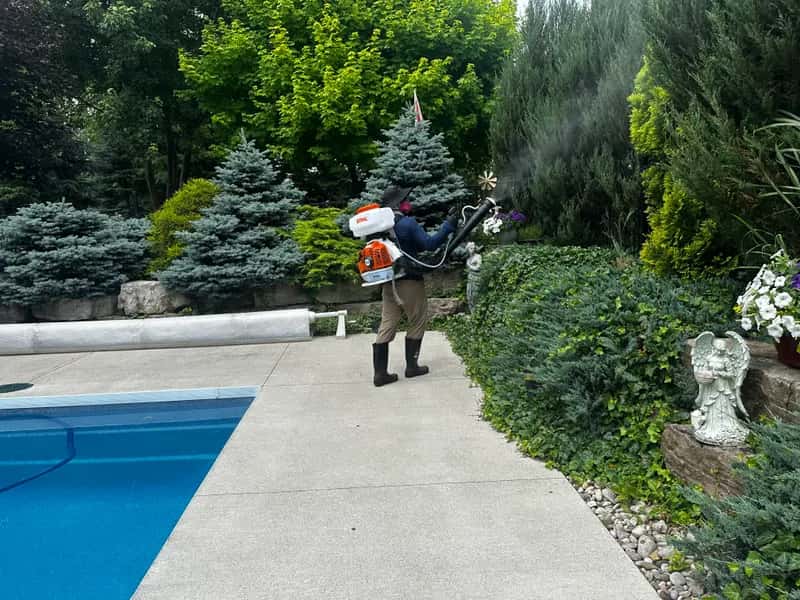
What you can do meanwhile. Culex will fly a few hundred metres to a few kilometres from where they hatched, so eliminating water on your side of the fence will not save you from a pool on theirs. Shift from source reduction to adult control: deny the adults somewhere to rest. They spend the day in shaded, humid vegetation — under deck skirting, in cedar hedges, in ivy, on the undersides of low foliage. A barrier treatment of that resting habitat is the mechanism that works when the breeding site is not yours to fix. While you are at it, our list of the 12 hidden breeding spots in a GTA backyard is the checklist we use on assessments, and how standing water attracts mosquitoes explains the surface-area logic behind all of it.
Where to Buy Pool Covers and Larvicide in Canada
Custom-cut safety covers for inground pools come through a pool retailer or installer rather than off a shelf, because they are cut to your pool’s shape and the anchors set into the deck. Stock rectangular covers, above-ground covers, cable-and-winch kits, water tubes and cover pumps are seasonal at Canadian Tire, Home Depot Canada, Rona and Walmart Canada — heavy from late August through October, thin the rest of the year. Bti dunks and bits sit with the garden chemicals at Canadian Tire, Home Depot and most garden centres from spring onward. Amazon.ca carries the accessory end year-round, which matters in the exact situation this page is about: mid-season, the pool is already green, and you need a cover pump before the weekend rather than in October.
The Bottom Line
A green pool is not a slightly worse bird bath — it is several hundred square feet of still, nutrient-rich egg-laying surface, and it out-produces every other breeding site nearby combined. If the pool is coming back next season and someone is on site, run the pump and hold chlorine; that costs nothing and works. If it is not coming back, put an anchored mesh safety cover on it, because mesh drains and solid does not — and if you go solid anyway, buy the cover pump in the same order. Bti is the bridge between deciding and doing. If the green pool is next door, escalate to bylaw and public health, then treat the shaded vegetation on your own side, because that is the only lever you control.
Frequently Asked Questions
Do green pools actually breed mosquitoes?
Yes, and more of them than anything else on a residential street. Mosquitoes lay on the water surface, so what matters is surface area, not depth — a 16 x 32 ft pool is roughly 512 square feet of egg-laying surface, versus about one square foot for a bird bath. Once circulation stops and free chlorine falls away, algae blooms, the water fills with the organic matter larvae eat, and nothing is left to disturb the surface film. In southern Ontario summer temperatures, eggs laid on a Monday can be biting adults inside 7 to 10 days. A properly chlorinated, circulating pool breeds nothing at all; a still green one is the single largest breeding site a residential pest operator ever walks up to.
What is the fastest way to stop a green pool from breeding mosquitoes?
Bti — Bacillus thuringiensis israelensis, sold in Canada as mosquito dunks and mosquito bits. It is a bacterial larvicide that kills mosquito larvae in the water; the Canadian products carry a PCP registration number and are labelled for use in standing water. Bits give you knockdown within a day or two because the granules disperse immediately; dunks release slowly and hold the site for roughly 30 days per dunk at the labelled dose. Two things to know: Bti does not kill pupae, because pupae have stopped feeding, so the tumblers already in the water will still hatch over the following few days; and Bti is a stopgap, not a fix. It buys you the four weeks you need to get a cover on, get circulation running, or get the pool drained.
What kind of pool cover actually stops mosquito breeding?
A mesh safety cover, anchored to the deck. This is the specification most buyers get backwards. A solid cover blocks the pool underneath but collects every rainfall and snowmelt on top of itself, and within a week that puddle is a shallow, warm, undisturbed breeding site sitting directly above the pool — the problem has simply moved up two feet. A mesh safety cover lets rain drain straight through into the pool below, so nothing pools on the surface. If you already own a solid cover, or you want a solid one to keep debris and light out, you must pair it with an automatic cover pump and actually leave the pump on the cover all season.
The house next door is vacant and the pool is green. What can I do?
Two routes, and you can use both. First, your municipality: almost every Ontario municipality has a property standards bylaw that covers stagnant water and pool enclosures, and bylaw enforcement can order an owner or a bank holding the property to remediate. Second, your local public health unit: Ontario public health units run West Nile virus surveillance and larviciding programs and take standing-water complaints, because Culex pipiens — the main West Nile vector here — is exactly the species that thrives in stagnant, organically rich water like a neglected pool. Neither route is instant. In the meantime, treat your own property as though the pressure is coming from next door, because it is: mosquitoes bred there will feed here.
Should I just drain an abandoned pool?
Sometimes — but do not drain it blind. A drained inground pool can float out of the ground if the water table is high, which happens on clay-till and near-ravine lots across the GTA, and an empty shell still collects rainwater in the deep end, so you can end up with a smaller breeding site and a structural bill. Draining is the right call when the pool is being filled in or replaced, when the liner is finished, or when the water has gone so far past recovery that chemical treatment is throwing money at it. If you do drain, a 1/2 HP submersible utility pump moves the volume in a day or two, and you need to check your municipality's rules first: most Ontario municipalities require pool water to be dechlorinated and discharged to a sanitary sewer or over your own grass, not into a storm drain.
Can I just run the pump instead of covering the pool?
Yes, and it is often the cheapest correct answer. Mosquitoes need still water — a surface that is being turned over by a running circulation pump is a poor place to lay, and larvae get pulled through the skimmer. If the pool is structurally fine and you are opening it next May anyway, running the pump four to six hours a day and holding free chlorine in the normal 1–3 ppm range costs far less than a $400–$600 safety cover and keeps the water usable. Cover the pool when the answer is "we are not opening it this year", when nobody is there to run the pump, or when you want the leaf load off the water for winter.
Do winter cover water bags breed mosquitoes themselves?
They can, and this is the detail almost nobody checks. Water tube bags are the anchoring method on above-ground and tarp-style covers, and a bag with a cracked cap or a split seam sits half full of rainwater all summer — a warm, undisturbed few litres in full sun, which is close to ideal for Culex. Walk the perimeter twice a season, top up or replace any bag that is not full, and make sure the caps are seated. If you would rather not manage them, a cable-and-winch kit on an above-ground pool or brass deck anchors on an inground safety cover eliminate the water bags entirely.
How long can a neglected pool go before it becomes a mosquito problem?
Faster than owners expect. Free chlorine in an uncirculated pool is consumed by sunlight and organic load within days, not weeks, and once it is gone the algae bloom follows quickly in warm weather. Realistically, a pool that stops circulating in early July is green and productive by late July, and it stays productive through the exact part of the season that matters most in Ontario — Culex populations and West Nile risk peak in late August and September here, not in June. If you know you are closing a pool mid-season, get the cover or the Bti in place at the same time you shut the pump off, not a month later.