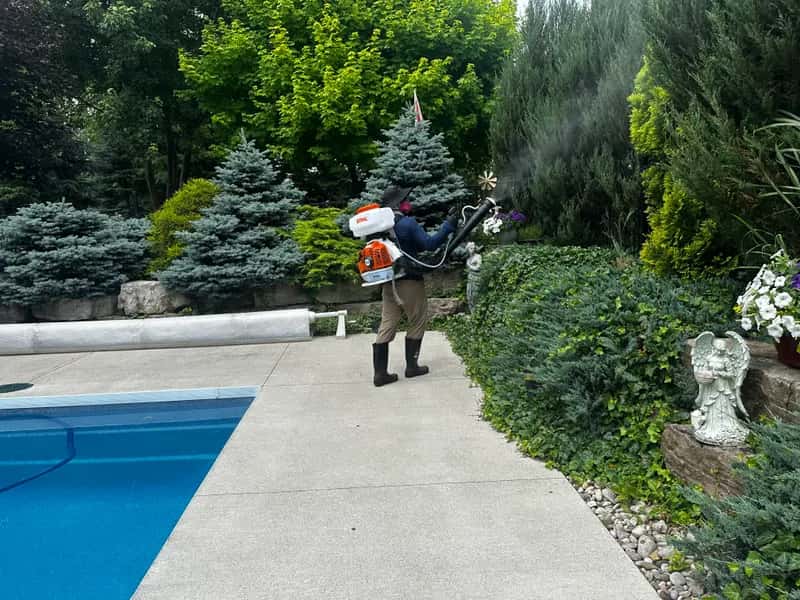
BuzzSkito Mosquito & Tick Control Specialists · Published August 22, 2026
The Roof Is Not What Keeps Mosquitoes Out
This is the single most useful thing to understand before you spend the money. A screened gazebo excludes mosquitoes because of the zip-around mesh curtains that hang from the frame — and a $450 soft-top and a $1,500 aluminium hardtop hang the same style of curtain, often in the same footprints. Swap the netting sets between them and the bite count in each does not change.
So the hardtop premium does not buy you fewer mosquitoes. It buys you three things: a structure that survives an Ontario winter assembled, a roof that does not degrade in UV, and — the one people never think of until year two — a rigid frame that holds the curtain line square. That last one matters more than it sounds. On a fabric-canopy gazebo, the whole assembly flexes; over a couple of seasons the posts settle a few millimetres out of plumb and the curtains stop meeting cleanly at the corners. A gap at a corner post at 9pm is the entire ballgame. On a bolted aluminium frame, the geometry stays where you built it.
That is the real case for the hardtop, stated honestly. It is a durability and geometry argument, not a bug argument.
Mesh Density: The Spec That Actually Changes Your Evening
Netting is sold in broadly two grades. Standard mosquito mesh stops mosquitoes and blackflies comfortably — both are far larger than the openings. No-see-um mesh is a finer weave that also stops biting midges, which are small enough to walk straight through standard netting. If you have ever sat inside a properly zipped gazebo and still been bitten at dusk, midges are almost always the answer, and no amount of zipping harder fixes it.
Where this bites in Ontario: properties backing onto a ravine, a creek, a marsh, a stormwater pond, or anywhere in cottage country. If that is you, buy the finer mesh and accept the trade — noticeably less airflow on a still August night, and a slightly darker view out. We wrote up what those insects actually are and when they peak in our guide to no-see-ums and biting midges in Ontario.
If you are in an open suburban yard with no standing water within a couple of hundred metres, standard netting is the better buy: it breathes, it is cheaper, and it is what most gazebos ship with. That is not a downgrade — it is matching the spec to the site.
Zippers Fail First — On Both Roof Types
Look at any gazebo that has been in a backyard for four seasons and the frame is usually fine. What has failed is a zipper, a seam, or the bottom hem. That order almost never varies, and it is the same on a hardtop as on a soft-top, because the curtains are the same product.
What to look for on the listing photos before you buy:
- Chunky zippers, ideally dual-pull. Fine zippers on a curtain that gets opened four times an evening are a one-season part. Dual pulls let you open from the top down when your hands are full.
- Reinforced, double-stitched seams where the mesh meets the header tape and the zipper tape. That join carries the whole panel weight in wind.
- A weighted or hook-and-loop bottom edge. A hem that drags loose on concrete abrades, and a hem that lifts in a breeze is an open door at ankle height — which is precisely where mosquitoes fly.
- Removable panels. If the curtains come off independently, you can store them dry indoors over winter, which roughly doubles their life.
Practical habit that costs nothing: brush grit off the zipper track a couple of times a season and never force a stuck slider — a bent slider tears the tape, and a torn tape is not repairable.
Snow Load: What an Ontario Winter Actually Does
A fabric canopy is not rated to carry snow. That is not a durability quibble, it is a structural fact — the top pockets, the pocket fills with wet snow, and the frame folds. In the GTA the realistic deadline is late October to mid-November: canopy off, mesh walls off, both stored dry. Plenty of owners leave the bare frame standing all winter, which is fine as long as it is still anchored, because an empty frame catches almost no wind.
Hardtops are built to stay assembled, and the polycarbonate or galvanised-steel roof will shed rain and moderate snow. Two caveats from watching these things live and die in GTA backyards. First, check the manufacturer snow-load rating for your region before buying — the snow belt north and east of the city is a different climate from lakeshore Mississauga. Second, treat the rating as a floor, not a guarantee: clear deep wet accumulation off the roof after a big storm instead of trusting the spec sheet, and pay attention to the cross-bracing on the frame, because it is the frame, not the panel, that gives way.
And take the mesh curtains down even on a hardtop. Fabric hanging through five months of ice, freeze-thaw and wind comes out stretched, and the zippers stiffen. Curtains cost nothing to store and a lot to replace.
Wind Kills More Gazebos Here Than Snow
Southern Ontario produces fast-building summer gust fronts — a still, humid afternoon becomes 60–90 km/h with about fifteen minutes of warning. Every gazebo we see wrecked in the GTA was wrecked by wind, not by winter. Anchoring is the difference:
- Concrete pad: concrete anchors or expansion bolts through the post feet. Best case.
- Wooden deck: lag screws into the joists underneath. Screwing into surface boards alone pulls the boards up, gazebo and all.
- Grass or soil: auger-style ground anchors plus guy lines to solid points, with weight bags or leg plates at each post as a backstop rather than as the primary method.
Then a habit: unzip or roll up the mesh walls when weather is coming. Open walls let wind blow through the structure instead of pushing on it. For a severe thunderstorm watch, drop a soft-top canopy entirely — two minutes of work against a bent frame.
The Year-Three Question: Can You Still Buy the Netting?
This is the operator’s test, and it separates a gazebo that lasts a decade from one that becomes scrap in year three. The mesh always fails before the frame. So the question that decides real cost of ownership is: when it does, can you buy a replacement that fits?
Two protections. Buy a common footprint. Universal replacement mosquito netting and add-on screen wall panels are sold by size — 10x10, 10x12, 12x12 — not by model. Anything close to a standard rectangle has options. A gazebo in an unusual size from a brand with no spare-parts listings has none. And check for spares before you commit, not after: does the brand list a replacement canopy and a replacement curtain set at all? Two otherwise identical gazebos can differ by hundreds of dollars over five years on that answer alone.
Sizing It for Your Deck
Size to the furniture and then go one step up. A 10x10 covers a bistro set or a four-seat table. A 10x12 or 10x13 takes a six-seat dining table with room to walk around one side — the most common Canadian backyard footprint, and the size where the widest range of replacement netting exists. A 12x14 or larger handles a sectional plus a dining set.
Leave roughly 30 cm of clearance on every side. Mesh that rubs against chair backs tears at the seam, and a curtain that has to be pushed past furniture never gets zipped fully closed — which is how a properly specified gazebo ends up full of mosquitoes. On a raised deck, also confirm the post feet land over joists and that you have room for the anchor hardware without splitting a board edge.
If you are still deciding between a gazebo and something lighter, our comparison of every patio mosquito screen option covers pop-up screen houses, clip-on pergola netting and door curtains side by side, and the best gazebos with mosquito netting in Canada guide runs through specific models once you have settled on the roof type. For something you pack into a bag for camping instead, see the best screen tents in Canada.
When the Soft-Top Is Genuinely the Right Call
We sell nothing here, so we will say it plainly: most Canadian backyards do not need a hardtop. Buy the soft-top if any of these are true.
- You rent, or you might move within a few years. A bolted hardtop is effectively a fixture. A soft-top comes apart and goes in the truck.
- The deck or ground is not level and you are not pouring a pad. A hardtop on an uneven surface racks the frame and the panels never sit right.
- You use the yard from June to Labour Day. If the season is three months, you are stripping the canopy anyway; the four-season roof buys nothing.
- The budget is the constraint. A soft-top with no-see-um mesh, a proper anchor kit and a spare curtain set will deliver more comfortable evenings than a bare-minimum hardtop with coarse netting and four sandbags. That trade is not close.
- The spot is under mature tree cover. Shade is the biggest single extender of fabric life, and it removes most of the argument about UV.
Buy the hardtop when you are staying put, the surface is solid, you want it standing in April without a weekend of setup, and you have quietly decided you never want to do the October strip-down again. That is a real reason, and it is worth money — just not for the reason most listings imply.
Where to Buy in Canada
Gazebos are aggressively seasonal in Canadian retail. Canadian Tire, Home Depot Canada and Rona put soft-tops and a narrower hardtop selection on the floor from roughly April through July, thinning fast by August. Costco Canada runs the sharpest hardtop pricing of the year in its spring outdoor-living sale, and those sell through in weeks. Amazon.ca carries the widest year-round range — and, more usefully, it is where the parts live: universal replacement netting, add-on wall panels, anchor kits, winter covers, replacement canopy tops.
The practical sequence: buy the structure in spring when big-box selection is deepest and you can look at frame gauge in person, then buy the consumables online whenever you need them. If you are buying in August, the in-store shelves are already picked over and online is effectively the only place with a real choice.
The Bottom Line
Hardtop versus soft-top is a question about how long the structure lasts and how many autumns you spend on a ladder — not about how many mosquitoes get in. Spend on mesh density first, anchoring second, and the roof third. A soft-top in a standard 10x12 footprint, hung with no-see-um mesh, bolted down properly and stripped every October, is the right answer for most Canadian backyards. A hardtop earns its price when you are staying in the house, the pad is level, and you want to stop thinking about it. And whichever way you go, remember the boundary: mesh protects the space it encloses. The lawn, the garden beds, the play structure and the ticks in the long grass need the yard treated, not screened.
Frequently Asked Questions
Hardtop or soft-top gazebo for mosquitoes — which is better?
Neither roof keeps mosquitoes out. The mesh curtains do that, and both roof types hang the same style of zip-around netting. The roof decides how long the structure lasts, not how bug-proof it is. Buy a hardtop if the gazebo will live in one spot for years, you have a level pad or a properly framed deck to anchor into, and you want it standing in April and still standing in November. Buy a soft-top if you rent, if you might move it, if the budget is tight, or if you are happy to strip the canopy every fall. A soft-top with fine no-see-um mesh and proper anchoring will out-perform a hardtop with coarse netting and four sandbags every single evening of the season.
Can a hardtop gazebo stay up all winter in Ontario?
Usually yes for the roof, no for the netting. Aluminium-framed gazebos with polycarbonate or galvanised steel roof panels are built to stay assembled year-round and shed rain and moderate snow. What you should still do in the GTA: check the manufacturer snow-load rating before you buy, clear heavy wet accumulation off the roof after a big storm rather than trusting the number, and take the mesh curtains and any fabric privacy panels down in late October. Fabric left up all winter takes ice, freeze-thaw and wind loading for five months and comes out of it stretched, and the zippers stiffen. Curtains are cheap to store and expensive to replace.
Can a soft-top gazebo be left up over winter?
No. A fabric canopy is not rated to carry snow load, and a single heavy wet Ontario snowfall is enough to pocket the top and fold the frame. The standard practice is to remove the canopy and the mesh walls before the first real snow — many owners leave the bare frame standing, which is fine as long as it is still anchored, since an empty frame catches very little wind. If you would rather not do that every October, that is the single most honest argument for spending the extra money on a hardtop.
What mesh density do I need to stop no-see-ums, not just mosquitoes?
Standard mosquito netting stops mosquitoes and blackflies but lets no-see-ums (biting midges) through, because midges are physically smaller than the openings. No-see-um mesh is a finer weave and blocks them, at the cost of some airflow and a slightly darker view out. If your property backs onto a ravine, a creek, a marsh or a lake, or you mainly sit outside at dusk, pay for the finer mesh and accept the airflow trade. In an open suburban yard with no water nearby, standard netting breathes better and is genuinely the right call.
How do I anchor a gazebo so it does not blow over in a GTA storm?
Wind destroys far more gazebos in southern Ontario than snow does, because a July gust front builds in fifteen minutes and the roof is a sail. On a concrete pad, use concrete anchors or expansion bolts through the post feet. On a wooden deck, lag-screw into the joists underneath, not into the surface boards alone. On grass, use auger-style ground anchors plus guy lines to solid points, and add weight plates or filled leg bags at every post as a backstop. Unzip or roll up the mesh walls when a storm is forecast so wind passes through the structure instead of pushing on it, and drop a soft-top canopy entirely for a severe thunderstorm watch.
Will I still be able to buy replacement netting in three years?
That is the question almost nobody asks before buying and almost everybody asks in year three, because the mesh and the zippers always fail before the frame does. Two things protect you. First, buy a common footprint — 10x10, 10x12, 12x12 — because universal replacement mosquito netting and add-on screen wall panels are sold by size and will fit anything close to standard. Second, before you order, check whether the manufacturer lists replacement curtains and a replacement canopy at all. A gazebo in an odd size from a brand with no spare-parts listings becomes scrap the day the netting tears, which turns a cheap gazebo into an expensive one.
What size screened gazebo do I need?
Size to the furniture, then go one step larger. A 10x10 (about 100 sq ft) covers a bistro set or a four-seat dining table. A 10x12 or 10x13 fits a six-seat table with room to walk around one side, and is the most common backyard footprint in Canada. A 12x14 or larger takes a sectional plus a dining set for entertaining. Leave roughly 30 cm of clearance on every side so the mesh curtains hang straight and zip cleanly instead of dragging on chair backs — mesh that rubs on furniture is mesh that tears at the seam.
Where can I buy a screened gazebo in Canada?
Canadian Tire, Home Depot Canada, Rona and Lowe’s carry soft-tops and a smaller hardtop selection from roughly April through July, and Costco Canada runs the sharpest hardtop pricing of the year during its spring outdoor-living sale — which sells through fast. Amazon.ca has the widest year-round selection and, more usefully, is where the universal replacement netting, wall panels, anchor kits and winter covers actually live. Buy the structure in spring when the big-box selection is deepest; buy the consumables whenever you need them.