Quick Answer
Public Health Ontario classifies virtually all of Southern Ontario — including every GTA municipality — as a blacklegged tick and Lyme disease risk area in 2026. If your yard borders forest, ravine, or conservation land, treat it as elevated risk.
- Public Health Ontario maps established and emerging blacklegged tick risk areas in its Vector-Borne Disease Tool, which is updated each year — check it for the current classification where you live.
- Ontario reported 2,369 confirmed and probable Lyme disease cases in 2024 — up 27% over the 1,859 reported in 2023, per the Public Health Agency of Canada. 2024 is the newest year published; there is no 2025 Ontario total yet.
- The blacklegged tick range expands roughly 35–55 km north per decade, driven by milder winters and migratory birds.
- Confirmed GTA risk zones include the Don Valley, Rouge Park, Credit River, Bronte Creek, 16 Mile Creek, and the Oak Ridges Moraine.
- An area is classed “established risk” once blacklegged ticks are found in consecutive years and at least one tests positive for Borrelia.
- Professional tick barrier spray places a residual acaricide on the perimeter zones where ticks quest — a layer alongside tick checks, not a replacement for them.
— BuzzSkito, GTA mosquito & tick control · 150+ five-star Google reviews. General information, not medical advice.
Medical disclaimer: This article provides general public health information about Lyme disease risk zones in Ontario. Always consult a licensed healthcare provider for medical advice, diagnosis, and treatment. Part of our Ultimate Tick Control Guide for Ontario Homeowners.
As an Amazon Associate I earn from qualifying purchases. BuzzSkito only points to products we would genuinely use or recommend, at no extra cost to you.
What to do right now
- Look up your own address, not your city — free, two minutes. Risk areas are drawn from field surveillance, not municipal lines. Check the blacklegged tick layer in Public Health Ontario's Vector-Borne Disease Tool, then tuck trousers into socks and do a full-body check within two hours of coming in.
- Cover the cuffs and socks, because that is what a tick reaches first. A tick quests at ankle and shin height and climbs; repellent on your arms does nothing about it. Factory permethrin-treated clothing is the format sold for this in Canada — the treatment is bonded into the fabric at manufacture rather than sprayed on at home, and it is labelled for ages 16 and over. Read the garment label before you buy for anyone younger.Check price on Amazon.ca →
- Put a repellent in the bag you take to the trail. Both actives named further down this page — icaridin (picaridin) and DEET — are sold in Canada under a Pest Control Products (PCP) registration number printed on the label. Check that the number is there before you buy, since marketplaces carry imported bottles that were never registered here, and then follow the label's own directions, which differ by age.Check price on Amazon.ca →
None of this is a substitute for the daily tick check, and none of it is medical advice. If you find an attached tick, remove it and watch the site for 3 to 30 days.
Ontario Lyme Disease Risk: 2026 Overview
Lyme disease continues to be one of the fastest-growing infectious diseases in Canada, and 2026 marks another year of geographic expansion. The Public Health Agency of Canada and Ontario Public Health have documented a sustained northward migration of blacklegged tick (Ixodes scapularis) populations, driven by warming winters and expanding deer and rodent habitats. The result: more Ontario communities now fall within confirmed Lyme disease risk zones than at any previous point on record.
For GTA homeowners, the message is straightforward — Lyme disease risk is no longer confined to provincial parks or rural properties. Urban ravines, suburban conservation areas, and backyard gardens throughout Southern Ontario now harbour established blacklegged tick populations capable of transmitting Borrelia burgdorferi, the bacterium that causes Lyme disease.
Confirmed Risk Areas in the GTA (2026)
Every major municipality in the Greater Toronto Area is now classified as a Lyme disease risk area. Here is the current risk landscape by region:
Toronto
Toronto Public Health confirms blacklegged tick populations in the Don Valley, Rouge National Urban Park, High Park, Humber River valley, and smaller ravine systems throughout the city. Toronto has reported increasing numbers of locally acquired Lyme disease cases each year. Homeowners in neighbourhoods adjacent to ravines and wooded corridors face the highest risk.
Exposure is not spread evenly across the city, though. The Don and West Don valley network puts ravine-edge yards on the front line right through the middle of the old suburbs, which is why tick spray for North York yards is aimed at the lawn-to-ravine transition rather than the open lawn; the Humber corridor does the same job on the west side, where Etobicoke tick control concentrates on the same wooded edge.
The reason the city keeps turning up on this list at all is structural rather than seasonal: Toronto’s ravine network runs continuous wooded habitat deep into residential neighbourhoods, and deer and mice use it as a corridor. Why Toronto is a tick hot spot in 2026 breaks that down ravine by ravine and explains what it means for a backyard that meets one.
See: Toronto tick control services
Mississauga and Peel Region
Credit Valley Conservation lands, Rattray Marsh, Erindale Park, and the Credit River corridor are confirmed blacklegged tick habitats. Peel Region public health has documented positive tick submissions from Mississauga, Brampton, and Caledon. New residential developments bordering conservation lands are particularly exposed as wildlife corridors bring ticks into suburban yards.
Risk is not evenly spread across the city, either. We mapped it street by street in Mississauga tick hot spots by neighbourhood for 2026, which ranks the areas backing onto the Credit corridor and Rattray Marsh against the drier inland subdivisions.
See: Mississauga tick control | Brampton tick control | Caledon tick control
Hamilton and Niagara Escarpment
Hamilton has consistently ranked among the highest-risk municipalities in Ontario for Lyme disease. Dundas Valley, Cootes Paradise, the Bruce Trail corridor, and Royal Botanical Gardens are established blacklegged tick zones. The escarpment microclimate — sheltered, moist forest floor with abundant white-footed mice — creates ideal conditions for year-round tick survival.
The escarpment shelf carries the same conditions east across the city, where Stoney Creek runs from the Fifty Point shoreline up to the brow with the Red Hill ravine between. We rank that stretch area by area in the Stoney Creek mosquito and tick guide.
West of the harbour the same escarpment conditions run through Dundas Valley and the Ancaster woodlots — that corridor is covered neighbourhood by neighbourhood in our Ancaster, Dundas and Hamilton tick control guide.
Oakville and Burlington
Bronte Creek Provincial Park, Sixteen Mile Creek, Sheldon Creek, and the Lake Ontario shoreline trail systems are confirmed risk zones. Burlington's proximity to the RBG and Escarpment trails further elevates risk. Halton Region public health actively monitors tick populations and reports positive findings each season.
Across both Peel and Halton the case mix has shifted from travel-acquired infections toward locally acquired ones. Our breakdown of Lyme case trends in Mississauga and Oakville walks through that shift and explains what reported counts leave out.
For a neighbourhood-level view of which Halton streets sit closest to those creek and escarpment corridors, see our Oakville and Burlington tick hot spots for 2026.
Risk also moves with the calendar in each town: tick season in Oakville tracks the nymph peak through the Sixteen Mile and Bronte Creek corridors, while tick season in Burlington covers the escarpment edge and the RBG lands month by month.
See: Oakville tick control | Burlington tick control
York Region (Richmond Hill, Markham, Vaughan)
The Oak Ridges Moraine — running through Richmond Hill, Markham, and into Vaughan — is a significant tick corridor. Boyd Conservation Area, Kortright Centre for Conservation, and King Township forest edges have confirmed blacklegged tick populations. Rapid residential development along the moraine fringe brings homeowners into direct contact with tick habitat.
See: Richmond Hill & Markham tick guide | Vaughan & King City tick guide
Halton Hills, Milton, and Caledon
Rural and semi-rural properties in Halton Hills, Milton, and Caledon face some of the highest tick densities in the GTA. Properties bordering the Niagara Escarpment, Bruce Trail, and Conservation Halton lands are particularly exposed. Large lots with wooded edges, tall grass, and abundant wildlife provide ideal tick habitat.
See: Caledon & Halton Hills tick prevention
Beyond the GTA: Ontario-Wide Risk Expansion
Outside the GTA, Lyme disease risk areas continue to expand across Ontario:
- Niagara Region: Established blacklegged tick populations along the Niagara Escarpment, Welland Canal corridor, and Lake Erie shoreline
- Simcoe County: Emerging risk area with increasing tick submissions and confirmed Lyme disease cases
- Durham Region: Rouge Park extension, Ganaraska Forest, and Lake Ontario bluffs are confirmed zones
- Kingston and Eastern Ontario: Among the earliest established risk areas in the province, with the highest per-capita Lyme disease rates
- Ottawa Valley: Established risk, particularly in the Gatineau Hills and along the Rideau corridor
Why the Risk Zone Keeps Expanding
Several factors drive the ongoing expansion of Lyme disease risk in Ontario:
- Climate change: Warmer winters allow blacklegged ticks to survive further north. Ticks that once could not overwinter in central Ontario now thrive year-round
- Migratory birds: Spring bird migration transports ticks into new regions each year, seeding new populations hundreds of kilometres from existing ones
- White-tailed deer expansion: Deer are the primary hosts for adult blacklegged ticks. Growing deer populations across Southern Ontario provide the blood meals ticks need to reproduce
- Suburbanization: New housing developments at the urban-rural interface create habitat where humans, deer, rodents, and ticks overlap
Public Health Surveillance: How Risk Areas Are Determined
Ontario determines Lyme disease risk areas through several surveillance methods:
- Passive tick surveillance: Residents and healthcare providers submit ticks found on humans to public health labs for species identification and pathogen testing
- Active tick dragging: Public health teams conduct systematic tick dragging surveys in parks, trails, and conservation areas to measure population density
- Human case reporting: Lyme disease is a reportable disease in Ontario — confirmed cases are mapped geographically to identify emerging risk zones
- Rodent surveillance: White-footed mouse populations are sampled to measure Borrelia burgdorferi infection rates in the tick host reservoir
An area is classified as "established risk" when blacklegged ticks are found in consecutive years through active surveillance and at least one tick tests positive for Lyme disease bacteria.
That threshold is deliberately low, which is why a risk-area map says nothing about how many ticks in it are actually infected. For the testing rates behind the map, see what percentage of Ontario ticks carry Lyme.
What GTA Homeowners Should Do in 2026
Given the current risk landscape, GTA homeowners should take a layered approach to lowering Lyme disease risk:
1. Professional Tick Yard Treatment
Professional tick barrier spray targets the high-risk perimeter zones where ticks are most concentrated — garden edges, fence lines, shaded areas, stone walls, and the transition between lawn and wooded areas — with a registered residual acaricide applied according to label directions. Because the residual is temporary and wildlife keeps reintroducing ticks, it is repeated rather than done once. A full season is five treatments spaced roughly monthly from May through September. The early applications cover the May–July nymph peak, when the ticks driving most Lyme transmission are poppy-seed sized and easily missed on a body check, and the later ones carry the barrier into the start of fall adult activity, which can run into November in mild years. Deer, mice and birds keep walking new ticks in from adjacent woodland the whole time, so the point of monthly repetition is that there is never a multi-month gap in the middle of the season — which is exactly what a two-visit schedule leaves open.
2. Habitat Modification
- Remove leaf litter from yard edges — this is the single most important habitat ticks use for overwintering
- Keep lawn mowed short (under 3 inches) especially near play areas and patios
- Create a 1-metre gravel or wood chip barrier between lawn and wooded borders
- Stack firewood neatly in dry, sunny locations away from the house
- Remove brush piles and overgrown vegetation along fence lines
3. Personal Protection
- Wear light-coloured clothing when in wooded or grassy areas
- Apply DEET (20–30%) or icaridin repellent to exposed skin
- Tuck pants into socks in high-risk environments
- Do full-body tick checks within 2 hours of being outdoors
- Shower promptly to wash off unattached ticks
On the repellent line specifically, both actives named above are sold in Canada under a Pest Control Products (PCP) registration number printed on the label. Check for that number before you buy — online marketplaces carry imported repellents that were never registered here, and an unregistered bottle tells you nothing reliable about what is in it. Then follow the label directions for the person actually wearing it, since the directions differ for young children.
As an Amazon Associate I earn from qualifying purchases. BuzzSkito only points to products we would genuinely use or recommend, at no extra cost to you.
Check icaridin and DEET repellents on Amazon.ca →
4. Know the Symptoms
Early Lyme disease symptoms include an expanding bull's-eye rash (erythema migrans), fever, fatigue, headache, and muscle or joint pain. Not everyone develops the rash. If you have had a tick bite and develop any of these symptoms within 3 to 30 days, see a doctor promptly. Early antibiotic treatment is highly effective.
See: Tick Bite Symptoms & What to Do in Ontario
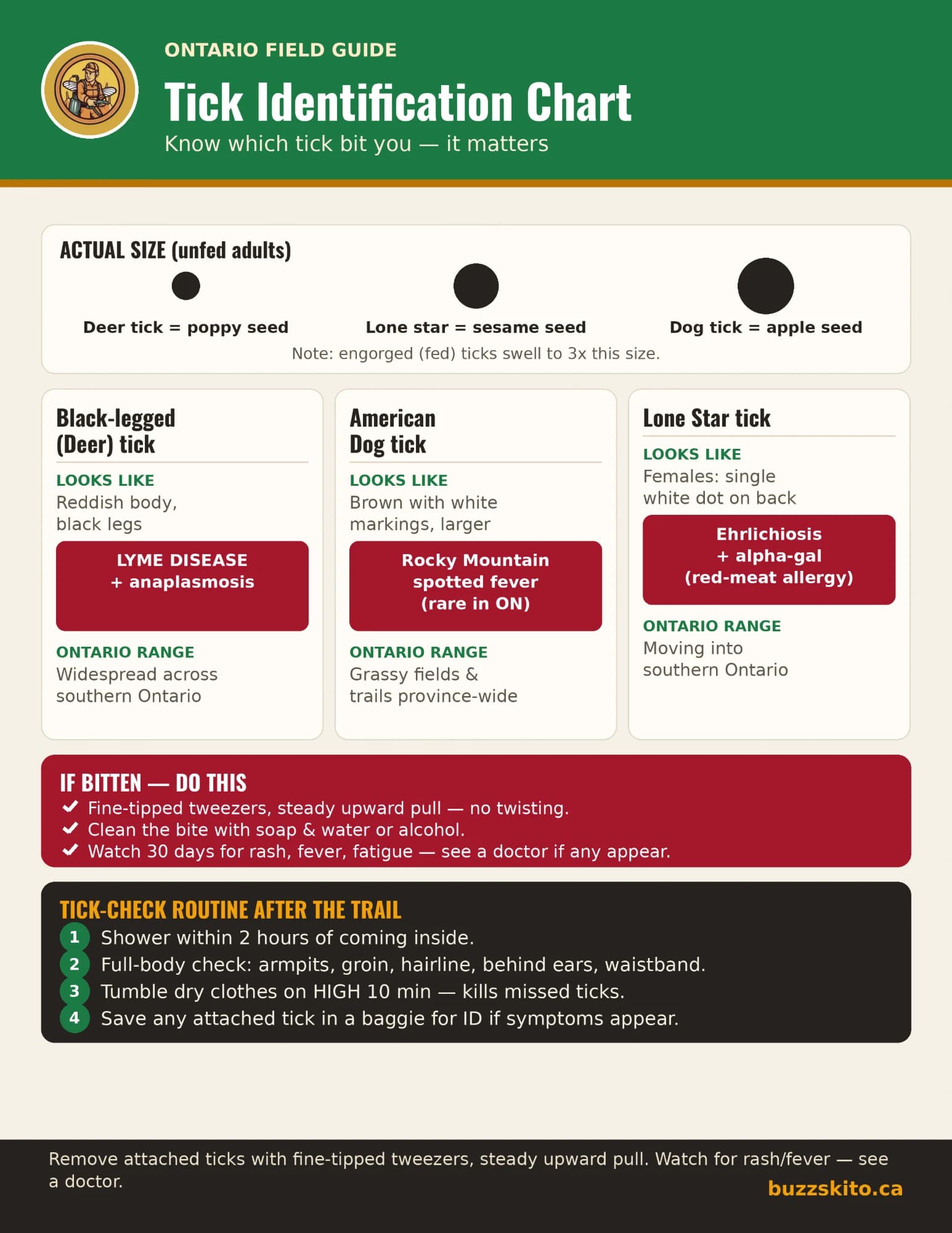
The practical companion to knowing the symptoms is owning the tool before the night you need it. Grasp an attached tick with a fine-tipped tool as close to the skin as possible and lift straight up with steady pressure — no twisting, no squeezing the body, nothing smeared over it. Household tweezers have a blunt, wide tip that grips the body rather than the mouthparts, which is exactly the wrong end on a nymph the size of a poppy seed, and the nymphs are the stage most of this page is about. Keep the tool in the first-aid kit, and keep a small screw-top vial with it so the tick can be bagged and dated.
Frequently Asked Questions
Is there a Lyme disease map of Ontario for 2026?
Yes, and it is published by Public Health Ontario rather than by any private company. The blacklegged tick risk-area layer inside Ontario's Vector-Borne Disease Tool is the authoritative map, it is free to consult, and it is redrawn each year — the 2026 version reflects field surveillance collected during the 2025 season. One detail changes how you read it: risk areas are drawn as geographic areas from field data, not along municipal or health-unit boundaries, so a single city can contain both mapped risk areas and areas with no identified risk. Look up your own address rather than your city name. This page summarises what has already been classified region by region across Ontario; it is a plain-language reading of PHO's map, not a separate map of our own.
Which Ontario cities are confirmed Lyme disease risk areas in 2026?
Public Health Ontario classifies much of Southern Ontario as an established blacklegged tick risk zone. Confirmed risk areas in 2026 include Toronto, Mississauga, Hamilton, Burlington, Oakville, Brampton, Richmond Hill, Markham, Vaughan, Caledon, Milton, and virtually every municipality bordering Lake Ontario and the Niagara Escarpment. The risk zone expands northward each year as warming winters allow blacklegged tick populations to establish in new regions.
Is the GTA a Lyme disease risk area?
Yes. The entire Greater Toronto Area is now classified as a Lyme disease risk area by Ontario public health authorities. Blacklegged ticks carrying Borrelia burgdorferi (the Lyme disease bacterium) have been confirmed in every GTA municipality. Toronto ravines, Mississauga conservation areas, Hamilton escarpment trails, and York Region forests are among the highest-activity zones. Homeowners across the GTA should consider professional tick yard treatment and routine tick checks.
How fast is Lyme disease expanding in Ontario?
The blacklegged tick range in Ontario expands approximately 35–55 km northward per decade, driven by warming winters and migratory birds carrying ticks into new habitats. The number of confirmed Lyme disease cases in Canada has increased more than tenfold since 2009. Areas that were considered low-risk five years ago — including parts of York Region, Halton Region, and Simcoe County — now have established tick populations and confirmed human Lyme disease cases.
What should I do if I live in a Lyme disease risk area?
If you live in a Lyme disease risk area (which now includes virtually all of Southern Ontario), take these steps: schedule professional tick yard treatment on a monthly cadence through the season — five applications from May through September, so nothing is left uncovered during the May–July nymph peak or the fall adult resurgence; do thorough tick checks after any outdoor activity; wear light-coloured clothing and DEET-based repellent in wooded or grassy areas; keep your yard trimmed and remove leaf litter; and consult a doctor promptly if you develop a bull's-eye rash or flu-like symptoms after a tick bite.
Does professional tick spray reduce Lyme disease risk?
It helps, with limits worth stating plainly. Professional tick barrier spray applies a registered residual acaricide, according to label directions, to your yard perimeter and the high-risk zones inside it — garden edges, fence lines, shaded areas, wood borders — because that is where blacklegged ticks quest, rather than out in the open lawn. That lowers the number of ticks sitting in those zones, which lowers the odds of an encounter on your own property. It does not eliminate ticks: the residual wears off, and deer, birds and rodents carry new ticks in through the season. Treat it as one layer alongside personal protection and daily tick checks, not as a replacement for them.