Quick Answer
The highest-pressure tick zones in Mississauga in 2026 are the Credit River corridor — Erindale, Streetsville, and Credit Valley — with the Lorne Park/Mineola pocket close behind. If your property sits in these zones, tick control is a season-long program, not a one-time spray.
- Erindale, Streetsville, and Credit Valley rank Tier 1 on 2026 Peel Public Health tick surveillance.
- Lorne Park and Mineola are boxed in by tick habitat: Rattray Marsh, Jack Darling Park, and the Credit River.
- Properties within roughly 1 km of the Credit River run consistently higher tick pressure than inland lots.
- A 3-foot gravel or wood-chip buffer along a forest fence line cuts tick migration into the lawn by 50–70%.
- Port Credit, Lakeview, and Clarkson are Tier 2 — migratory birds drop new ticks along the waterfront each spring and fall.
- In Tier 1–2 zones, get the first barrier spray down before May 25 — earlier for ravine-adjacent properties.
— BuzzSkito, GTA mosquito & tick control · 150+ five-star Google reviews
TL;DR: The Credit River corridor — Erindale, Streetsville, Credit Valley — is the highest-pressure tick zone in Mississauga in 2026. Lorne Park and Mineola are close behind because they sit between Rattray Marsh and Jack Darling Park. Port Credit, Lakeview, and Clarkson are high-risk along the waterfront. If your property is in any of these zones, treat tick control as a season-long program, not a one-time spray.
As an Amazon Associate I earn from qualifying purchases. BuzzSkito only points to products we would genuinely use or recommend, at no extra cost to you.
As an Amazon Associate I earn from qualifying purchases. Price shown on Amazon.ca, at no extra cost to you.
🏆 Our Top Pick — For Credit River Walks
Every tier on this map comes with the same advice: check the dog and the kids after a Riverwood, Erindale Park, or Rattray Marsh walk. The check only pays off if you can get the tick out cleanly on the spot. A fine-tipped remover grips at the skin line and lifts the whole tick out in one piece — keep one in the glovebox and one by the back door.
Pros
- Grips at the head, so the body is never squeezed
- Small enough for the glovebox and the dog-walking bag
- Works on poppy-seed nymphs and engorged adults alike
Cons
- Easy to misplace without a keyring loop
- Still needs a slow, steady straight pull
The 2026 Mississauga hot spot ranking
This ranking pulls together three data sources: Peel Public Health\'s active tick surveillance (drag-cloth sampling at fixed sites and passive submissions from residents), Public Health Ontario\'s Lyme estimated risk area maps, and BuzzSkito\'s own 2026 service-call density — which neighbourhoods are actually generating the most "we found a tick on the dog" calls. The three data sets agree on the top of the list. They disagree mildly on the middle, and that\'s reflected in the bands below.
Tier 1 — Highest pressure: the Credit Valley spine
Erindale, Streetsville, Credit Valley. These three connected neighbourhoods run along the Credit River and share the densest blacklegged tick population in the city. Riverwood Conservancy, Erindale Park, and the Sawmill Valley Trail all anchor the corridor. Properties on the river side of Mississauga Road, on Mavis south of Burnhamthorpe, and along Old Derry Road in Streetsville are all extreme-risk addresses. The combination of mature deciduous canopy, deep leaf litter, deer and chipmunk traffic, and direct backyard-to-forest adjacency creates conditions where even a heavily managed lawn will see ticks every season without barrier spray protection.
Tier 1 — Highest pressure: the Lorne Park / Mineola pocket
Lorne Park, Mineola, Sherwood Forrest. This pocket is essentially boxed in by tick habitat — Rattray Marsh Conservation Area on the west, Jack Darling Memorial Park on the south, the Credit River on the east, and several internal ravine sections. Many properties have wooded ravine lots or share fence lines with conservation land. Resident submissions from this area lead Peel\'s passive surveillance by a wide margin. Dogs walking the Rattray Marsh boardwalk return with ticks at a steady rate from April through October. If you live in this pocket, treat barrier spray as standard maintenance, not an option.
Tier 2 — High pressure: the waterfront corridor
Port Credit, Lakeview, Clarkson. The Lake Ontario shoreline is a migratory bird stopover, which means new ticks arrive each spring and fall. Lakefront Promenade Park, Marie Curtis Park (on the Lakeview/Etobicoke line, along Etobicoke Creek), Jack Darling, and the Clarkson lakeshore parks all show consistent tick activity. Port Credit looks like clean urban space but the ravines feeding into it from the north — and the river mouth itself — concentrate risk. Properties south of Lakeshore in any of these neighbourhoods, especially those with mature landscaping or wooded edges, should plan on a barrier spray program.
Tier 2 — High pressure: north Meadowvale and the Aquitaine corridor
Meadowvale (north sections), the Lake Aquitaine Park edge. Lake Aquitaine Park and the surrounding wooded subdivisions hold stable tick populations because the lake itself, the surrounding forest, and the connected greenways support deer movement and dense leaf litter. Streets backing onto Lake Aquitaine Park, sections of Aquitaine Avenue, and properties adjacent to the Meadowvale Conservation Area woodlot all run high. Inland Meadowvale on standard subdivision lots with full lawn coverage scores notably lower.
Tier 3 — Moderate pressure
Erin Mills (treed sections), Churchill Meadows (west edge near Credit Valley), Applewood, Cooksville (ravine-adjacent streets only), Credit Valley\'s eastern subdivisions. These are the "depends on the lot" neighbourhoods. A property on a corner lot with mature trees backing onto a ravine in Erin Mills will run higher than a midblock lot two streets over with full sun and minimal landscaping. The free Yard Risk Report is built precisely for this band — it distinguishes within-neighbourhood variation that broad maps miss.
Tier 4 — Lower (but not zero)
Malton, central Cooksville apartment corridors, fully mown subdivisions in Applewood and East Credit, Square One area. These zones are still capable of producing tick encounters — particularly via dogs that walk in higher-risk parks elsewhere and bring ticks home — but the resident yard population pressure is low. Single-treatment service is often appropriate here, not a full season program.
What the hot spot map actually means for your yard
Living in a Tier 1 neighbourhood doesn\'t mean every yard is identical. A modern build with minimal landscaping in central Streetsville will run lower than a 1980s ravine-lot home in the same postal code. What matters more than the broad tier is the specific lot:
- Does your fence line touch forest, ravine, or naturalized green space? This is the single biggest factor. A 3-foot gravel or wood-chip buffer along that edge cuts tick migration into the lawn by 50-70%.
- How much leaf litter accumulates in your beds? Deep, moist leaf litter is tick paradise. Rake it out by mid-April and again in October.
- Do deer come into the yard? If you see deer tracks or browse damage, you have an adult tick deposition source on the property.
- Do you have unmaintained transition zones? Tall grass at the edge of a wooded section, brush piles, woodpiles touching the lawn, dense shrub beds along the fence — every one of these is an ambush point.
The Credit River wildlife corridor is the engine
If you only remember one thing from this report: the Credit River is the engine that makes Mississauga a meaningful tick zone. The river itself doesn\'t breed ticks, but the unbroken riparian forest along it — running from north of Streetsville all the way to Port Credit\'s lake outlet — supports the continuous host populations that ticks need. Cut that habitat into isolated parcels and the local tick population would crash. Connect it as one corridor, and you have a stable, self-perpetuating system. That\'s why this corridor anchors the hot spot map, and why properties within roughly 1 km of the river run consistently higher than properties further inland.
The Oakville side of the western GTA has its own version of this in the 16 Mile Creek watershed, and the reported case data has followed both corridors upward — see how Lyme case counts have climbed across Peel and Halton since 2020.
The same logic applies, smaller, to Etobicoke Creek
Etobicoke Creek runs along Mississauga\'s eastern boundary and supports a smaller version of the same dynamic. Marie Curtis Park at the mouth, the creek corridor through Applewood, and the upstream woodlots all support local tick populations. Properties adjacent to the creek itself, especially in lower Applewood and Lakeview east of Cawthra, see meaningful pressure.
Action steps if you\'re in a Tier 1 or Tier 2 zone
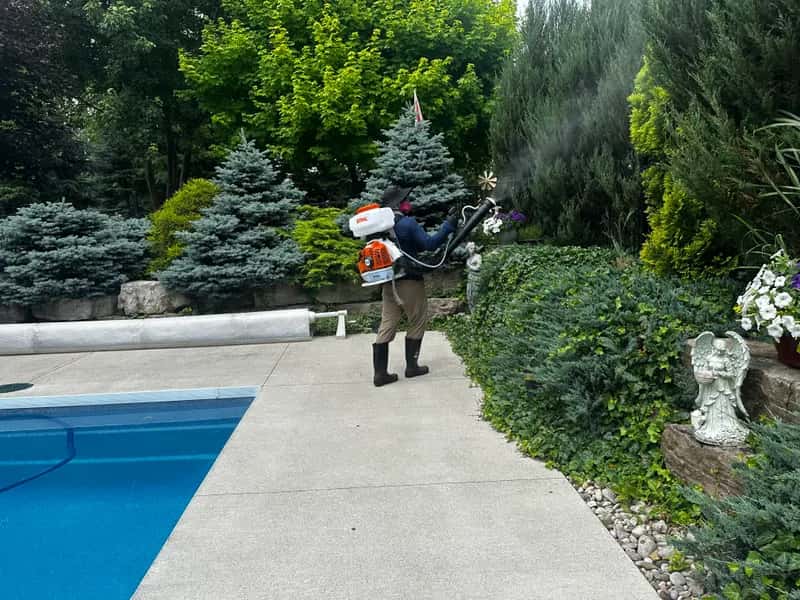
The protocol is the same whether you're in Lorne Park, Erindale, or Streetsville. First, get the first barrier spray down before May 25 — earlier if your property is directly ravine-adjacent. Second, keep treatments going roughly monthly through August and September — a BuzzSkito tick season is five treatments from May through September. Third, do the habitat work: leaf-litter cleanup, fence-line buffer, brush pile removal, short grass. Fourth, brief the household — daily tick checks after any outdoor time, including yard time. Fifth, if you have dogs, talk to your vet about a Bravecto / NexGard / Simparica regimen and check thoroughly after every Credit River walk.
For that fifth step, a fine-toothed flea-and-tick comb run against the coat at the ears, collar line, armpits, and between the toes catches an unattached tick before it reaches skin. Check price on Amazon.ca →
Same-week tick service across every Mississauga hot spot
BuzzSkito services every neighbourhood on this map with same-week availability. Whether you're booking a one-time spray or a full Mississauga tick spray season program, the quote process is the same: send your address and lot size, get a written quote within 24 hours, schedule inside 7 days. Combined Mississauga mosquito control + tick programs save $100 versus standalone.
The one thing worth keeping in the car
Step five of that protocol — check the dog after every Credit River walk — is the step that fails in practice, and it fails for a logistical reason rather than a lack of intent. The walk ends, the dog goes in the car, the check gets postponed to whenever you next think of it, and by then an unattached tick has had an hour of quiet to find skin. Doing it in the parking lot instead costs two minutes: comb or part the coat at the ears, collar line, armpits and between the toes, and have a fine-tipped remover in the glovebox for the one that has already latched on. A tick found at the Rattray Marsh boardwalk is a non-event. The same tick found on the bedroom floor two days later is a very different conversation.
As an Amazon Associate I earn from qualifying purchases. BuzzSkito only points to products we would genuinely use or recommend, at no extra cost to you.
Our tick-removal tool guide compares the common types, or check tick-removal tools on Amazon.ca →
Related guides
- Tick Season in Mississauga 2026: When Ticks Are Most Active
- Lyme Disease Risk Areas Ontario 2026
- Tick Surge Ontario 2026: Complete Yard Control Guide
- GTA Mosquito + Tick Pressure Map
Stay safe out there.
— Alex & The BuzzSkito Team
Frequently Asked Questions
Which Mississauga neighbourhood has the worst tick problem?+
On 2026 surveillance data, the worst tick pressure in Mississauga sits along the Credit River corridor — specifically Erindale, Streetsville, and Credit Valley. These three neighbourhoods share continuous ravine habitat with stable white-tailed deer and white-footed mouse populations, deep leaf litter that holds humidity through dry weeks, and direct backyard-to-forest adjacency for hundreds of properties. Drag-cloth sampling along the Sawmill Valley Trail and Riverwood Conservancy consistently produces the highest blacklegged tick captures per hour anywhere in the city. Lorne Park and Mineola are close behind because they sit between Rattray Marsh and Jack Darling Park.
Are ticks bad in Port Credit?+
Worse than people think. Port Credit's waterfront looks like clean, manicured urban space, but the parks and trail systems — J.J. Plaus Park, Lakefront Promenade, the trails along the mouth of the Credit River — are confirmed tick habitat. Migratory birds drop ticks into the area each spring and fall, and the Credit River brings ticks down from the upstream Erindale corridor. Properties south of Lakeshore Road and east of Mississauga Road, especially those with mature landscaping, see real tick pressure from June through October. Off-leash dogs along the waterfront pick up ticks regularly. It's not the worst zone in the city, but it's far from low-risk.
Is Lorne Park safe from ticks?+
No — Lorne Park is one of the highest-pressure tick neighbourhoods in Mississauga. The community is essentially surrounded by tick habitat: Rattray Marsh Conservation Area on the west, Jack Darling Memorial Park on the south, several wooded ravine sections running through the residential streets, and the Credit River corridor immediately to the east. Many Lorne Park properties have mature deciduous trees, deep leaf litter, and direct fence-line adjacency to forest or ravine. That combination of microclimate humidity, host animal access, and backyard proximity makes Lorne Park a textbook high-risk zone. A barrier spray program is the standard recommendation here, not a single treatment.
Why are ticks worse near the Credit River?+
The Credit River corridor concentrates four factors that ticks need: continuous host habitat (deer, mice, ground-feeding birds moving through unbroken green space), persistent ground-level humidity from riparian leaf litter, sheltered overwintering cover, and dense human/dog foot traffic that physically transports ticks into adjacent residential yards. The corridor also acts as a wildlife highway connecting the Niagara Escarpment tick populations upstream to the Lake Ontario shoreline, meaning new ticks are constantly arriving. That's why neighbourhoods like Erindale, Streetsville, Credit Valley, and Mississauga Road consistently outscore inland subdivisions on every metric Peel Public Health tracks.
Should I avoid Erindale Park in summer?+
You don't need to avoid it — but you do need to be deliberate. Erindale Park is one of the best green spaces in the GTA and the off-leash area is genuinely valuable. The risk-reduction protocol is: stay on the wide gravel paths and avoid bushwhacking through tall grass or leaf litter, wear long light-coloured pants tucked into socks (factory-treated permethrin clothing adds a layer; in Canada, consumer permethrin sprays for treating your own clothing are not registered, so buy garments already treated), do a full body tick check within an hour of getting home, and check your dog meticulously before they get back in the car. The danger isn't the park — it's skipping the protocol and treating it like a neutral environment.