Published by BuzzSkito Mosquito & Tick Control
Published October 29, 2026 · Fact-checked against the sources listed below
What are lovebugs?
Lovebugs are flies, not bugs. The lovebug, Plecia nearctica, is a March fly (family Bibionidae), a family of small flies related to gnats and mosquitoes, says UF/IFAS's Living with Lovebugs, which also lists the names honeymoon flies, double-headed bugs and united bugs.
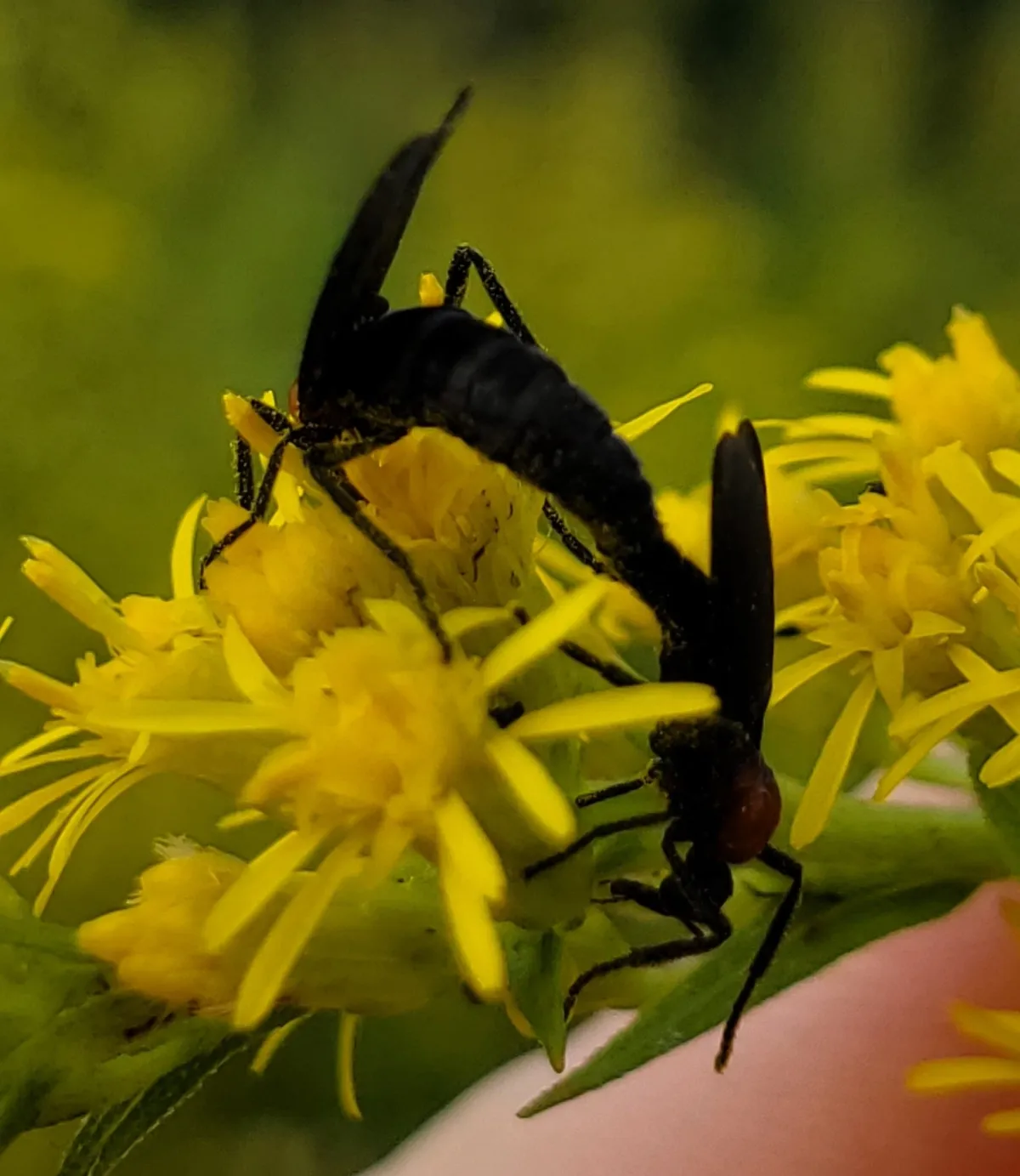
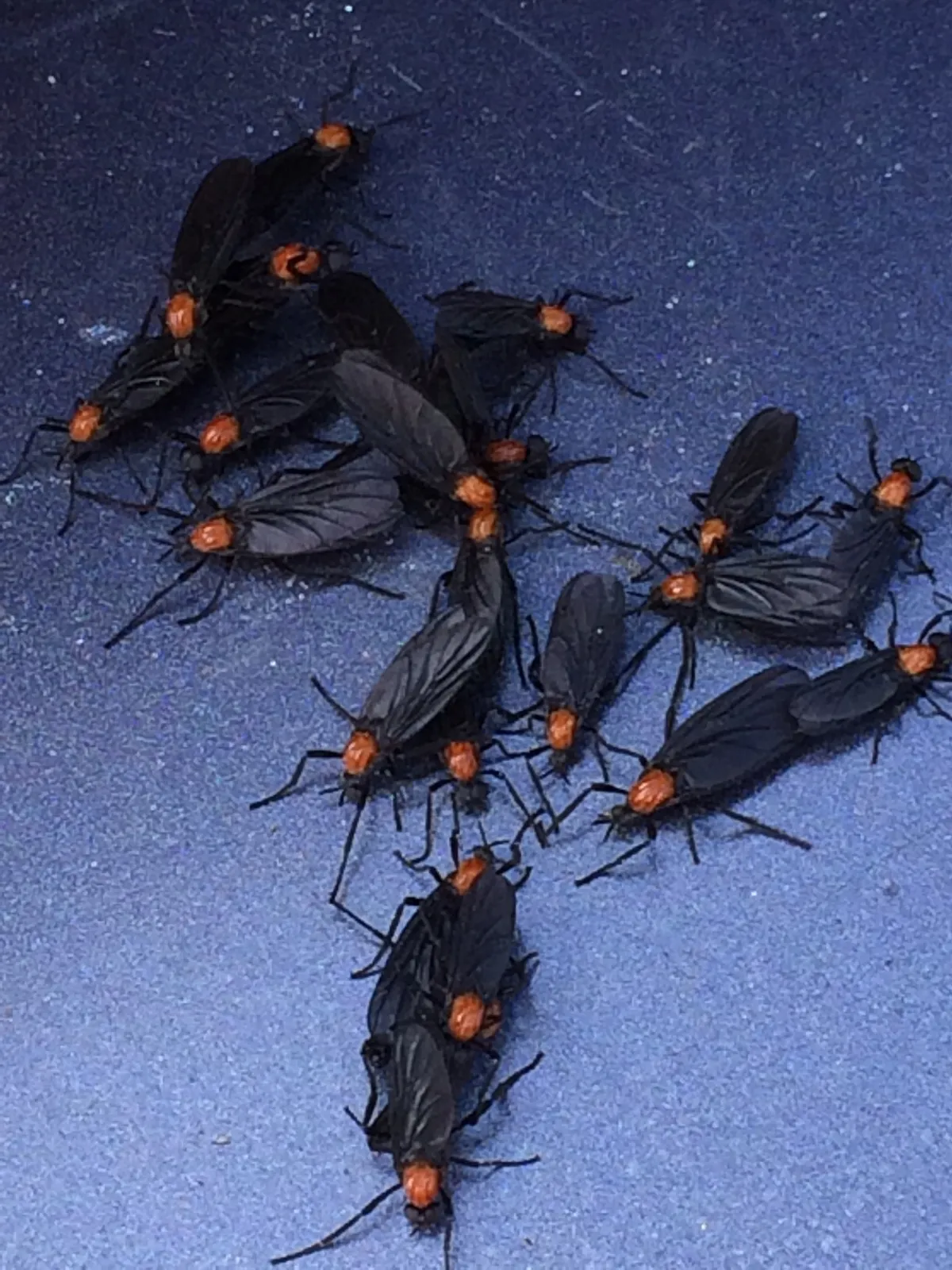
Look for a small black fly with a red patch right behind the head, usually joined to a second one. UF/IFAS Featured Creatures describes dull, somewhat velvety black flies with the top of the thorax red; Mississippi State University Extension calls them orange and black. Males measure about 1/4 inch (6 to 7 mm) and females about 1/4 to 1/3 inch (6 to 9 mm), Featured Creatures says, and Living with Lovebugs puts a joined pair at about 0.6 inch from head to head.
Do lovebugs bite or sting?
No. Lovebugs do not bite, sting or transmit diseases and are not poisonous, UF/IFAS says, and UF/IFAS experts called them harmless to people and pets in a May 2026 UF News story. Adults feed on nectar and pollen, and Texas A&M Forest Service says that feeding aids pollination.
A small fly that bites is something else, such as a black fly or a no-see-um; both live in the Southeast and are in the look-alike section below.
Why are lovebugs stuck together?
They are mating pairs, and they stay joined long after mating begins. Living with Lovebugs describes males swarming over the ground they emerged from, peaking around 10 to 11 a.m. and 6 to 8 p.m.; a female flies into the swarm, a male grabs her almost at once, and the pair lands on a plant to mate.
Sperm transfer averages about 12.5 hours, but a pair can stay coupled for several days while it feeds and drifts, the female steering, UF/IFAS says. Pairs that form in the evening rest on plants overnight; lovebugs do not fly at night.
Pairs part on their own: Clemson's Home & Garden Information Center says the female eventually rubs the male off or releases him, and UF/IFAS says both may mate again.
What else looks like a lovebug?
Mostly other small dark flies and one red-and-black bug; a red-topped thorax on a black fly traveling in joined pairs sorts them. UF/IFAS says other insects are often misidentified as lovebugs.
Two lovebug relatives
Plecia americana, the other US lovebug, is a woodland fly that does not seem to cause problems on highways, UF/IFAS says; its thorax is red almost all over, sides included, and it has been collected only in April, May and June, so fall lovebugs are the common species. Dilophus sayi, from the same family, may be confused with lovebugs too. It is smaller and all black, and its adults do not gather on highways, though UF/IFAS's profile records them drawn to recently parked cars and barbecue grills in Gainesville.
Red-shouldered bug
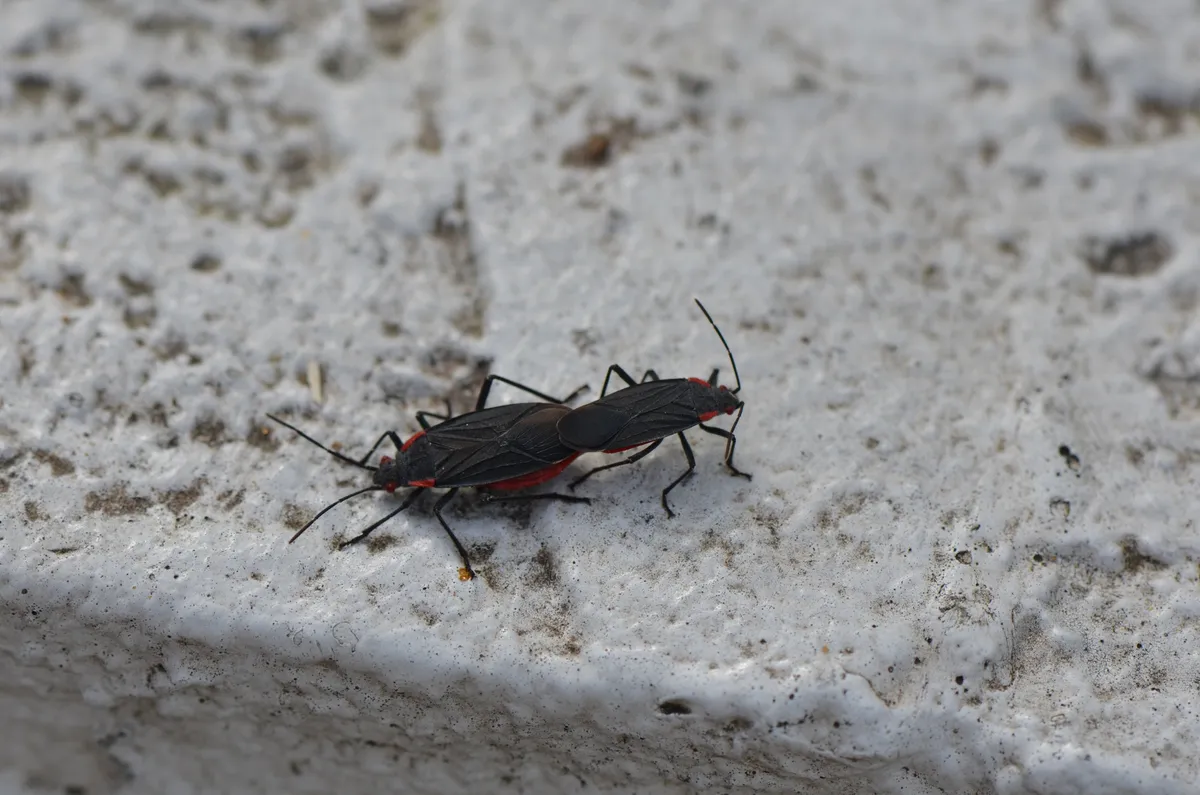
This one is a true bug, not a fly. UF/IFAS's Jadera bug profile describes adults about 1/3 to 1/2 inch long, mostly black with red eyes, red shoulders and red edges on the abdomen, gathering under trees that drop seeds, especially goldenrain trees. The guide to red and black bugs sorts it from the boxelder bugs it is often confused with.
Black flies (buffalo gnats)
Mississippi State University Extension describes black flies as tiny blood-sucking flies, sometimes gray, tan or even greenish despite the name, that usually breed in fast-moving streams and rivers. Mississippi's two main pest species can be found from March to June and bite by day, often around the head and neck; the black fly guide has more.
No-see-ums (biting midges)
No-see-ums are far smaller, usually 0.04 to 0.08 inch long, and the females bite, says UF/IFAS's biting midge profile; coastal species breed in marshes, swamps and mangroves. What no-see-ums are and how to keep them out covers the rest.
Small flies breeding indoors, around fruit, drains or houseplants, belong to another group, sorted in why there are so many flies in your house.
Commonly confused with
- Red-shouldered bugA true bug about 1/3 to 1/2 inch; red eyes, red shoulders and red abdomen edges
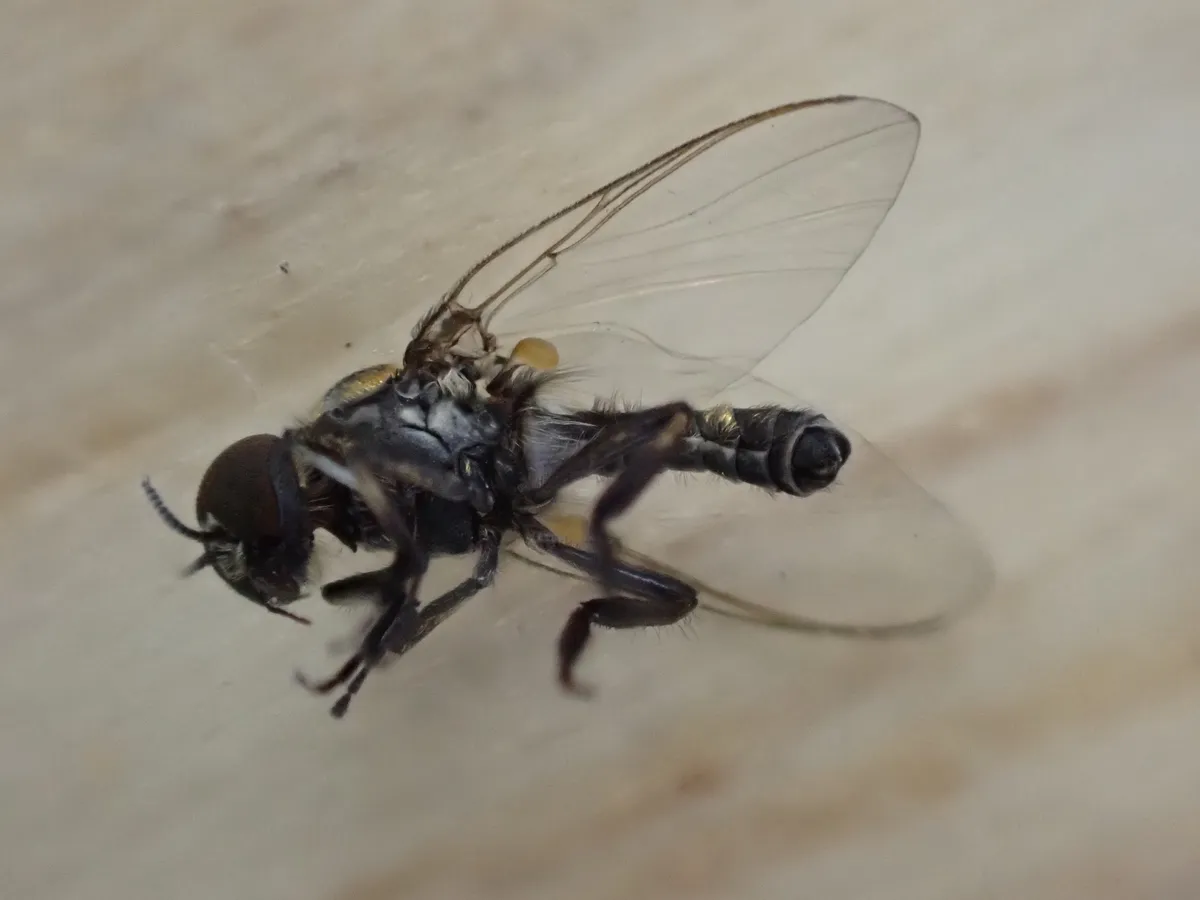 Black fly (buffalo gnat)A tiny biting fly, usually from streams and rivers; bites by day, often around the head and neck
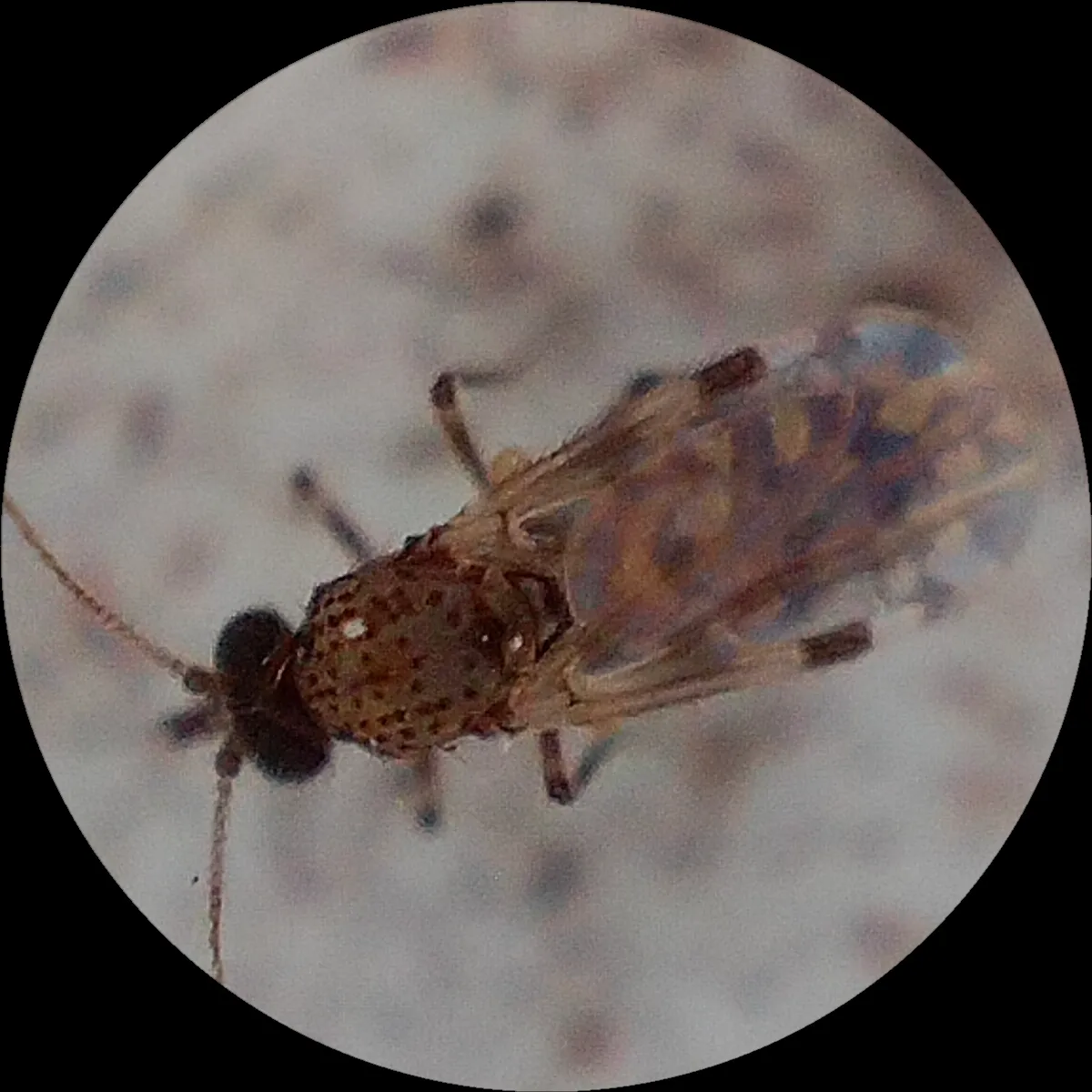 No-see-um (biting midge)Usually 0.04 to 0.08 inch long; the females bite, especially in coastal areas
Photos: Red-shouldered bug: no rights reserved, via iNaturalist, CC0 1.0. Black fly (buffalo gnat): no rights reserved, via iNaturalist, CC0 1.0. No-see-um (biting midge): no rights reserved, via iNaturalist, CC0 1.0.
When is lovebug season?
Twice a year, in late spring and late summer, and each flight lasts about four weeks. In Texas, numbers peak about two weeks in, Texas A&M Forest Service says. By state:
| Where | Spring flight | Late-summer flight | What the source adds |
|---|---|---|---|
| Florida | April–May | August–September | Most south Florida adults seem to come in April; a small December peak is recorded |
| Texas | May | September | Mostly East Texas and wetter areas; spring is the big emergence |
| Mississippi | Late spring | September | The fall flight is usually much larger; most numerous in southern counties |
| South Carolina | Around May | Around September | About four weeks each time |
| South Georgia | Late April and May | September and October | An early-October frost probably ended the 2000 fall flight |
Sources: UF/IFAS; Texas A&M Forest Service and Texas A&M AgriLife; Mississippi State; Clemson; University of Georgia (2000). Exact weeks shift with the weather.
Some years are far worse than others. Texas A&M AgriLife entomologist Molly Keck says the wetter the winter, the bigger the emergence, because more eggs and larvae survive; Texas A&M Forest Service adds that cold winters and dry weather kill many larvae and that massive outbreaks do not come every year.
Where do lovebugs come from?
Locally, from the grass nearby. Mississippi State says the larvae feed unnoticed on decaying vegetation in the thatch of lawns, pastures and roadsides, then emerge together as adults. UF's Norman Leppla told UF News that lovebugs are abundant where they become adults and almost absent elsewhere.
Where lovebugs are established in the US, according to UF/IFAS
- Established
- Reported (Wilmington, 2006)
- No record
Show the list
Established (7): Alabama, Florida, Georgia, Texas, Mississippi, South Carolina, Louisiana
Reported (Wilmington, 2006) (1): North Carolina
No record (43): Alaska, Arizona, Colorado, Indiana, Kansas, Maine, Massachusetts, Minnesota, New Jersey, North Dakota, Oklahoma, Pennsylvania, South Dakota, Wyoming, Connecticut, Missouri, West Virginia, Illinois, New Mexico, Arkansas, California, Delaware, District of Columbia, Hawaii, Iowa, Kentucky, Maryland, Michigan, Montana, New Hampshire, New York, Ohio, Oregon, Tennessee, Utah, Virginia, Washington, Wisconsin, Nebraska, Idaho, Nevada, Vermont, Rhode Island
Historically, from Central America. Featured Creatures says the species was described in 1940 from Galveston, Texas, and first collected in Florida in 1949, in the western panhandle; it now lives throughout the state. Living with Lovebugs says it is not native to most of the southern US and spread east across the Gulf states, perhaps helped by winds, traffic, sod shipments and new pastures and roadside habitat.
Did the University of Florida create lovebugs?
No. UF/IFAS Featured Creatures calls the story that University of Florida entomologists introduced lovebugs a widely held myth: a 1976 study documented the fly's steady spread around the Gulf Coast into Florida, and UF and USDA scientists studied it only after it was well established. The Florida Legislature funded UF's lovebug research during the early-1970s outbreak, Living with Lovebugs adds.
Nobody knows how the story started: UF/IFAS extension entomologist Tom Fasulo told UF/IFAS News in 2004 that he first heard it in 1979 and that other entomologists had heard it long before. One version says UF made lovebugs to kill mosquitoes, but they feed on nectar and pollen; the animals that really eat mosquitoes are another list, and the crane fly's similar myth is explained in why people call it a mosquito hawk.
What is the purpose of lovebugs?
Their larvae recycle dead plants, which is why UF/IFAS calls them beneficial. The larvae are slate gray with a darker head, about 1/2 inch long when full grown, and live in groups beneath decaying plant material where the ground stays moist, often in pastures under cow manure; Fasulo described them in the thatch that cut grass leaves behind, returning nutrients to the soil.
The larval stage lasts about 120 days in the summer generation and 240 in the winter one, and the pupal stage 7 to 9 days, UF/IFAS says. The larvae also feed some birds and insects, according to Texas A&M Forest Service.
Why are lovebugs all over roads and cars?
Roadsides give them breeding sites and the smells that draw them, and traffic cuts through their flight path. Texas A&M Forest Service says lovebugs are attracted to vehicle exhaust that sunlight has acted on, apparently because some of its chemicals match those of the decaying vegetation where females lay eggs. UF/IFAS adds heat; in studies the pull of exhaust ran from 10 a.m. to 4 p.m. above 82.4°F (28°C), and hot engines and vibration apparently contribute.
UF/IFAS cites the largest populations in grassy places such as pastures and roadsides, and Clemson calls rotting grass clippings along highways ideal for larvae. UF/IFAS Gardening Solutions says mating swarms are densest 1 to 5 feet above the ground, right where a car's front end passes. Weak-flying pairs drift across the wind into obstacles, especially fast vehicles, and UF guidance says they do not target cars on purpose.
Will lovebugs ruin your car?
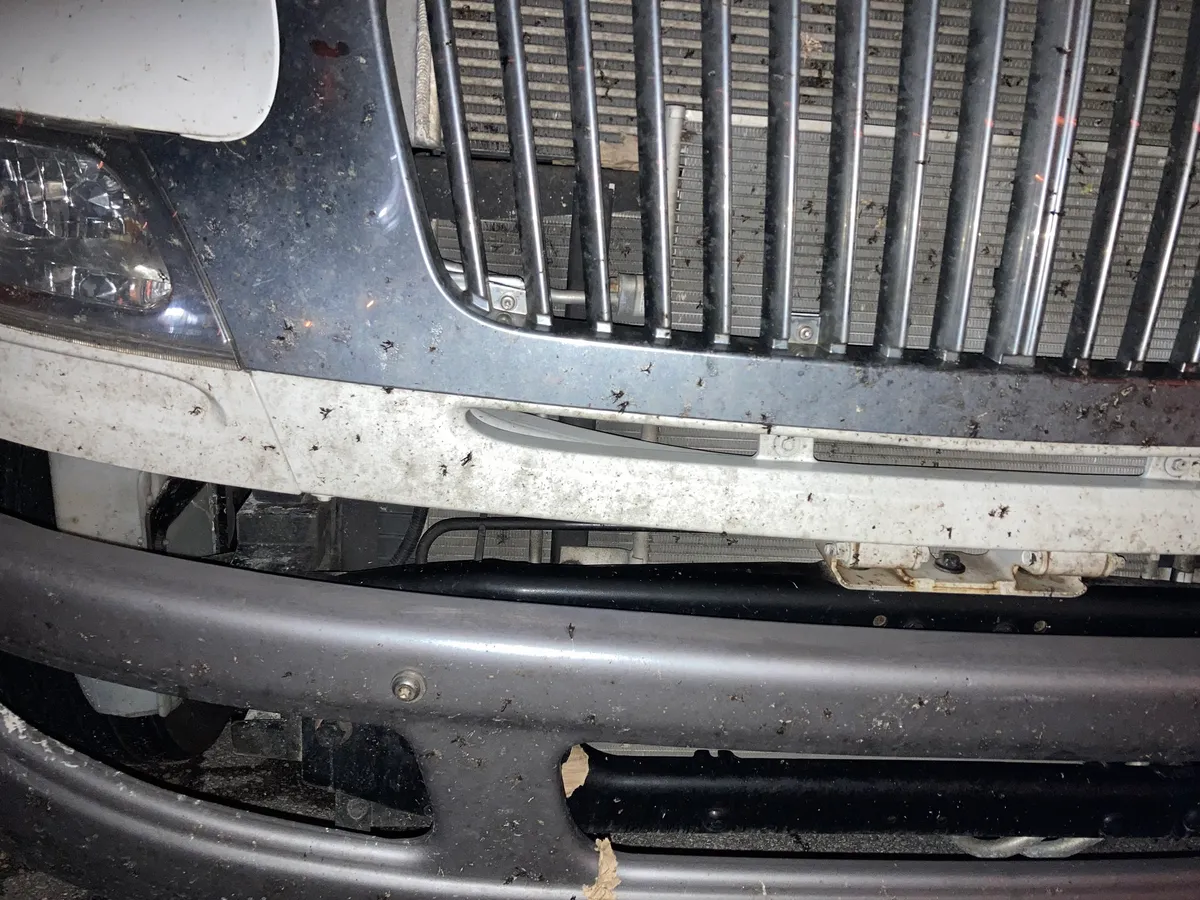
They can if the remains stay on. Masses of lovebugs can clog radiators and overheat liquid-cooled engines, blur the windshield and etch paint, UF/IFAS says; Texas A&M Forest Service adds that they can make the cooling units of refrigerated vans malfunction, and Mississippi State advises checking radiators regularly.
Paint damage takes time and sun. Living with Lovebugs reports crushed lovebugs close to neutral, at a pH of 6.5, turning acidic, at 4.25, within 24 hours, yet paint coated with them for 21 days in humid indoor air was not damaged. The risk is a coating, egg masses especially, left to bake in the sun; Featured Creatures says bacteria working over several days raise the acidity until it etches, though better paint coatings have made that less of a problem.
How do you get lovebugs off your car?
Soak them, scrub, and do it within a day or so, as Clemson advises (Living with Lovebugs says within 24 hours). UF/IFAS Featured Creatures says soaking the spattered area with water for about five minutes, then scrubbing within 15 to 20 minutes, should remove most lovebugs without harming the paint.
- Soak before you scrub. Mississippi State suggests wetting the surface, letting it soak a few minutes, then washing with soapy water, repeating as needed.
- Wipe off heavy buildup. UF's Norman Leppla suggests a moist cloth or a dryer sheet, and UF News advises cleaning the grille, headlights and paint soon after driving, because dried residue can be harder to remove.
- Use washer fluid early. In dense swarms, UF advises using windshield washer fluid as you go, not after the glass is coated.
Then protect the car for the rest of the flight:
- Wax it. A well-waxed car suffers less paint damage, Clemson says, and UF/IFAS Gardening Solutions says lovebugs come off a recently waxed finish more easily.
- Screen the grille. A screen or cover on the grille protects the radiator and paint, Clemson says; Gardening Solutions suggests a large screen in front of the grille or a small one behind it.
- Add a hood deflector. UF/IFAS and Mississippi State say one cuts the number that splatter.
- Drive later and slower. Lovebugs fly from about 10 a.m. until dusk, Clemson says, so early-evening or night trips and slower speeds can mean fewer splattered.
How do you get rid of lovebugs?
Mostly you wait them out: no spray stops a flight, and each passes within a few weeks. UF/IFAS says chemical controls are ineffective because adults keep drifting in from nearby areas; household insecticides kill the adults present, but more return almost immediately, and the products carry risks around people and pets and can kill beneficial insects.
University of Georgia entomologist Will Hudson put a number on it in a 2000 UGA report: spraying would mean treating the whole grassy roadside every two hours for several weeks.
Around the house, moving air and barriers work better. Lovebugs are weak fliers, so UF/IFAS suggests fans near outdoor work and play areas, screens on windows and doors (especially on the windward side) and over decks and pools, positive air pressure from an air conditioner, and a vacuum for the few that get in. Mississippi State suggests putting off outdoor painting during heavy flights.
For other insects around the house, browse more pest identification guides, or try the bug identifier quiz.
Frequently Asked Questions
What happens if you separate lovebugs?+
None of the sources on this page describes any harm or benefit from pulling a pair apart, and pairs separate on their own anyway. Clemson says the female eventually rubs the male off or releases him, and UF/IFAS says males and females often separate even when left alone and mate a second time, while bigger males pull smaller rivals off a female about 20 percent of the time. Separating pairs will not thin a flight either: Mississippi State notes that during heavy flights new lovebugs arrive hourly.
Which lovebug is the male?+
The smaller one with the big, round eyes. UF/IFAS says lovebug males are considerably smaller than females and have much larger compound eyes, and Featured Creatures gives males about 1/4 inch and females about 1/4 to 1/3 inch. The female's head is longer, ending in a snout-like extension. In a joined pair the two face opposite directions, and Living with Lovebugs says the female starts and steers the flight, with the male helping if he can feed.
How long do lovebugs live?+
Adults live only a few days: about three to four in nature, according to UF/IFAS, or three to five, according to Texas A&M Forest Service. Most of a lovebug's life is spent as a larva under decaying plants, about 120 days in the summer generation and 240 in the winter one, followed by a pupal stage of 7 to 9 days. A flight still lasts about four weeks, because adults keep emerging; Texas A&M Forest Service says numbers peak about two weeks in.
Do lovebugs eat mosquitoes?+
No. Adult lovebugs feed on nectar and pollen from flowers. Answering the myth that University of Florida researchers engineered lovebugs to kill mosquitoes, UF/IFAS's Living with Lovebugs points out that they lack the jaws, grasping legs and speed of predatory insects such as dragonflies, that they are active by day while most mosquitoes are active at twilight or at night, and that they are adults for only a few weeks each year. Their larvae eat decaying plants, not insects.
Why do lovebugs fly on you?+
Light colors and wind are the likely reasons. Texas A&M Forest Service says lovebugs are drawn to light-colored objects, especially white, and UF/IFAS says the weak-flying pairs drift across the wind and get blown against whatever is in their way. They do not bite or sting, so one that lands on you can be brushed off. During a flight, UF News suggests shady paths away from freshly mowed grass, a portable fan for moving air and protective eyewear to cut irritation.
What smell do love bugs hate?+
None of the extension sources on this page names a smell that repels lovebugs, and UF/IFAS says they cannot be controlled effectively with poisons or repellents. Research has found smells that attract them instead: anethole, a plant oil that also draws bees; phenylacetaldehyde, a floral scent; and aldehydes in vehicle exhaust after sunlight acts on them. What does keep them away is moving air. Lovebugs are weak fliers, so UF/IFAS suggests fans around outdoor work and play areas and positive air pressure indoors.
What naturally kills love bugs?+
Weather does the most, according to Texas A&M Forest Service: cold winters and dry weather kill many larvae. Fungi may matter too. In tests reported by UF/IFAS, the fungus Beauveria bassiana killed 27 to 33 percent of adults and immatures, though Texas A&M Forest Service says diseases, fungi included, do not notably affect lovebugs. Sources disagree about predators as well. UF/IFAS says spiders, dragonflies and birds eat adults now and then while fire ants avoid them, Clemson says birds, small animals and other insects readily eat them, and Texas A&M Forest Service says adults have no significant natural enemies.
Why are there so many lovebugs this year?+
Weather is the main reason the sources give. Texas A&M AgriLife entomologist Molly Keck says a wetter winter, and even a wetter summer, means a bigger emergence, because more eggs survive and the larvae have plenty of decaying food, while drier years probably bring fewer. Mississippi State calls lovebug numbers cyclic, Texas A&M Forest Service says massive outbreaks do not come every year, and UF/IFAS says places 20 to 30 miles apart can see very different emergences, so local hotspots can shift from year to year.
What state has the worst love bugs?+
None of the extension sources on this page ranks the states today; Featured Creatures notes only that when the lovebug was described in 1940, it was more common in Texas and Louisiana than in other Gulf Coast states. UF/IFAS lists Alabama, Florida, Georgia, Louisiana, Mississippi, South Carolina and Texas as the states where lovebugs are established, and within them the numbers are patchy. Mississippi State says that state's lovebugs are consistently most numerous in its southern counties, Texas A&M AgriLife places Texas's in the eastern, wetter part of the state, and UF/IFAS says Florida can see outbreak levels in some areas and none in others during the same flight.
Do lovebugs come out at night?+
No. Texas A&M Forest Service says lovebugs are not active at night and are not attracted to electric lights, so a porch light will not draw them. UF/IFAS says pairs settle on plants as the light fades and stay there overnight, and UF's Norman Leppla says they are also less active in the early morning and late evening. That is why Clemson suggests driving in the early evening or at night during a flight, when fewer lovebugs end up on the car.
Sources
- Lovebug, Plecia nearctica Hardy (EENY-47/IN204; H. A. Denmark, F. W. Mead and T. R. Fasulo) — University of Florida, UF/IFAS Featured Creatures
- Living with Lovebugs (ENY-840/IN694; Norman C. Leppla) — University of Florida IFAS Extension
- Lovebugs are back! But experts say the familiar Florida pest is a harmless nuisance (Jamie Groh, May 19, 2026) — University of Florida, UF News
- Fact or Fiction? The Truth About Those Pesky Lovebugs (May 27, 2004; last updated June 17, 2021) — University of Florida, UF/IFAS News
- Lovebugs (Gardening with Wildlife) — University of Florida, UF/IFAS Gardening Solutions
- Lovebugs (HGIC 2432; A. L. Kilpatrick, P. A. Zungoli and E. P. Benson, published August 2004) — Clemson University Cooperative Extension, Home & Garden Information Center
- Lovebug (Bug's Eye View, Vol. 4, No. 26, 2018; Blake Layton) — Mississippi State University Extension Service
- Lovebugs — Texas A&M Forest Service
- Love in the air: lovebug fun facts (Brooke McDonald, February 9, 2023) — Texas A&M AgriLife Today
- Plague of Lovebugs Probably Over (October 11, 2000) — University of Georgia College of Agricultural and Environmental Sciences, CAES Field Report
- Scentless Plant Bugs, Jadera sp. (EENY-130/IN287; F. W. Mead and T. R. Fasulo) — University of Florida, UF/IFAS Featured Creatures
- What to Do about Black Flies (Buffalo Gnats) (Publication 3755; Jerome Goddard) — Mississippi State University Extension Service
- Biting Midges, No-See-Ums, Culicoides spp. (EENY-349/IN626; N. Burkett-Cadena, V. Cooper, C. Addae, C. R. Connelly and E. Buckner) — University of Florida, UF/IFAS Featured Creatures
How this guide was made: it was researched and drafted with AI assistance from the sources listed above. A second, independent AI pass then checked each factual claim against those sources. Found an error? Email support@buzzskito.ca.