BuzzSkito Mosquito & Tick Control Specialists · Published March 25, 2026 · Updated July 12, 2026
This guide breaks down exactly how long different mosquito treatments last, what shortens or extends protection, and how to build a schedule that keeps your GTA yard covered all season. Part of our Ultimate Mosquito Control Guide.
How Long Each Type of Mosquito Spray Lasts
| Treatment Type | Duration | Rain Resistant? |
|---|---|---|
| Professional barrier spray (BuzzSkito) | Renewed on your plan’s schedule | Rain-back guarantee |
| Consumer yard fogger spray | 1–7 days | Partially |
| Citronella candles/torches | While burning only | No |
| DEET personal repellent | 4–8 hours (on skin) | Minimal |
| Mosquito dunks (standing water) | 30 days in water | N/A |
As an Amazon Associate I earn from qualifying purchases. BuzzSkito only points to products we would genuinely use or recommend, at no extra cost to you.
The one DIY item from that table worth pairing with professional treatment: BTi mosquito dunks for any standing water you cannot drain (rain barrels, pond edges). They stop larvae for 30 days and complement — rather than replace — the barrier spray doing the yard-wide work. Check Mosquito Dunks on Amazon.ca →
How Professional Spray Differs From DIY Options
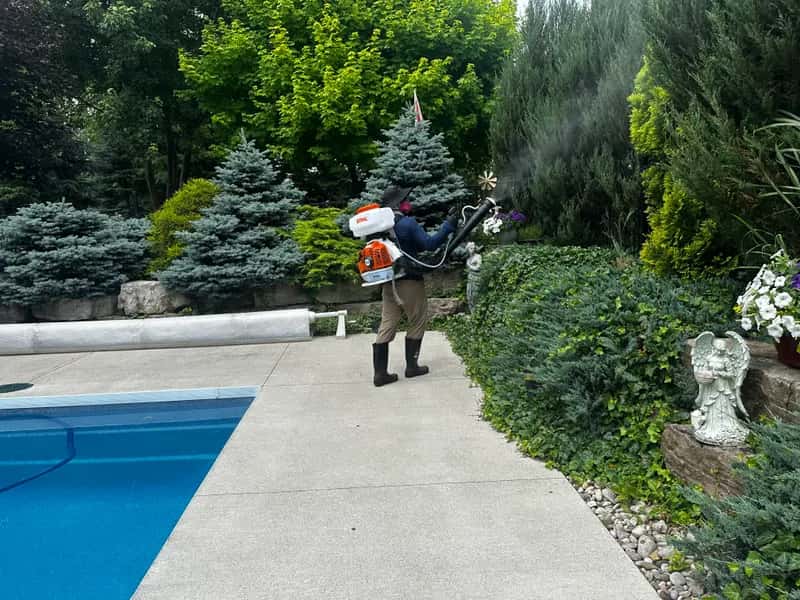
BuzzSkito’s residual treatment is a licensed application according to label directions, aimed at the vegetation surfaces where mosquitoes rest, and it dries onto those leaves. That residual is renewed on your plan’s schedule — every 2 weeks on the Standard plan, monthly on Basic — rather than left to fade. Consumer products are labelled for homeowner use, and each label sets its own application rate and re-application interval. Fogging works differently again: a thermal or ULV fogger kills the mosquitoes flying at the moment of application and leaves essentially no residual behind, so the yard is open again within hours — our guide to mosquito fogging covers when that short-term knockdown is still worth doing. For a full side-by-side breakdown, see our guide on DIY vs. professional mosquito control.
If what you actually want is that few-hours knockdown before a specific evening — a backyard party, a graduation, a Saturday barbecue — the fogger is the tool built for it, and it is a different purchase from a sprayer. One Canadian caveat decides what you can put in it: the fogging concentrate has to carry a Canadian PCP registration number on the label, and the US-market concentrates are EPA-registered only, so buy the insecticide here rather than importing it with the machine. Check backyard foggers on Amazon.ca →
If you do apply your own registered concentrate between visits, the equipment decides how even the coverage actually is — and evenness is what buys you duration. The target is the underside of shaded leaves and the shrub line rather than the open lawn, and a one-litre trigger bottle holds neither the pressure nor the volume to wet that much foliage consistently, so you end up with patchy cover that thins out days before the rest. Perimeter and shrub work is done with a pump or backpack sprayer, at the rate and re-application interval printed on your product label. Check backpack sprayers on Amazon.ca →
Check what you are allowed to put in it first. A homeowner in Ontario may only apply a product whose label carries a Pest Control Products (PCP) registration number and reads DOMESTIC class — Commercial and Restricted class products require an Ontario exterminator licence, which is the licence a professional company holds. Ontario’s cosmetic pesticides ban (O. Reg. 63/09 under the Pesticides Act) prohibits many lawn-and-garden pesticide uses outright, with specific pathways for health-protection uses. Our Canadian backpack sprayer guide walks through the rules and the models, and the Field King review covers the one most homeowners end up with.
Does Spraying for Mosquitoes Actually Work?
Yes — with an important clarification. Barrier spray works by reducing the adult mosquitoes resting on your property, not by removing the source. Mosquitoes breed in standing water — ravines, ditches, neighbours' yards — and fly to your property looking for a place to rest and feed. When they land on treated vegetation, the residual insecticide kills them.
This is why the barrier is renewed on a schedule (every 2 weeks on the Standard plan, monthly on Basic, weekly on Exclusive): you're maintaining an ongoing barrier against a continuous source, not making a one-time fix. The barrier also only ever deals with the mosquitoes that reach your yard, so any standing water you do control — rain barrels, clogged gutters, plant saucers — is worth treating with a BTI larvicide such as granular BTI mosquito bits, which kill the larvae before they ever emerge as adults. Homeowners near Toronto's ravines, Mississauga's Credit River, or any natural watercourse will see the most dramatic results because their mosquito pressure is highest and the treated barrier makes the biggest difference.
Gutters are the standing water most people never look at. A blocked run holds a shallow film of warm water for days after a storm, which is exactly the nursery Culex wants, and it sits directly above the yard you just paid to have treated. Clearing them each spring and autumn is the fix; a mesh or micro-screen guard over the trough is what stops them filling with leaf litter again by August. Check gutter guards on Amazon.ca →
What Affects How Long Mosquito Spray Lasts?
Rainfall
Heavy rain before the product has dried can wash it off. At BuzzSkito, we monitor weather forecasts and won't apply before heavy rain. Rain within 1 hour of your treatment? We come back and re-treat free, on every plan.
Temperature and UV Exposure
Extended periods of intense heat and direct sunlight can accelerate the breakdown of residual insecticides. In areas of your property in full sun, the residual may break down faster than in shaded areas. This is why we apply thorough coverage to all vegetation, including shaded areas where breakdown is slower.
Best Time to Spray: Morning vs. Evening
Morning application — after dew has dried, typically between 9 and 11 AM — gives the best results. This allows maximum drying time before evening humidity. We avoid direct midday sun applications in peak summer as intense UV can interfere with the curing process. Evening application is possible but leaves less drying time before overnight dew.
Vegetation Density
Dense shrubs and thick plant canopy require more product to achieve thorough coverage. Properties with heavy landscaping may need more frequent treatments to maintain effective protection through the vegetation.
There is a homeowner-side lever here that costs nothing per visit: thinning the densest cover. Mosquitoes spend the day resting inside shaded, still, humid foliage, so an overgrown cedar run or a shrub bed that has closed in on itself is both more resting habitat and harder for any spray to penetrate to the leaf undersides. Opening those beds up with a trim in late spring means less habitat and better coverage on every treatment that follows. Check hedge trimmers on Amazon.ca →
Mosquito Pressure from Neighbouring Properties
If adjacent properties have significant mosquito breeding or have dense untreated vegetation, you may experience more pressure at your property boundaries. This is normal — barrier spray is most effective when applied comprehensively, including property perimeters.
Where that boundary pressure lands on one spot — a deck, a fire-pit ring, a dining table near the fence line — a heat-activated zone repeller is a reasonable second layer for a still evening. It holds a defined area around the furniture rather than treating the yard, so it complements the residual on the vegetation instead of replacing it, and it loses most of its effect in a breeze. Check patio zone repellers on Amazon.ca →
Re-Application Schedule for GTA Properties
| Plan | Schedule | Why |
|---|---|---|
| Basic — 5 sprays | Monthly, May to September | One visit a month, starting at mosquito season onset in May and running into early fall, when GTA mosquitoes are still active |
| Standard — 10 sprays (most popular) | Every 2 weeks, May to September | Half the gap between visits, including through the June–July peak of mosquito activity |
| Exclusive — 20+ sprays | Weekly, May to September | For yards beside ravines, creeks, or wetlands with late-summer pressure from nearby water |
| Tick add-on — 5 sprays | Through the season, with your mosquito visits | Includes the early-June tick nymph peak — $497 added to any mosquito plan, or $597 on its own, plus HST |
Whichever plan you choose, each visit renews the residual on the leaves, and every plan includes a rain-back guarantee: rain within 1 hour of a treatment and we come back and re-treat free. Timing your first spray to the local start of mosquito season keeps the barrier ahead of peak populations.
None of those schedules covers your skin once you leave the property — a neighbour’s patio, a ball diamond, a ravine trail at dusk. That layer is a personal repellent carrying a Canadian PCP registration number, which in practice means DEET or icaridin (picaridin). The label sets the concentration, how often to reapply, and which products are appropriate for children, so read it rather than guessing from the bottle size. Check DEET and picaridin repellents on Amazon.ca →
How Long After Mosquito Spray Can You Go Outside?
People and pets can re-enter the treated area once the spray has dried, as the product label directs. During application and while the product is wet, people and pets should remain indoors or away from the yard.
For reference, the full safety guide for mosquito spray around kids and pets covers all re-entry protocols in detail.