BuzzSkito Mosquito & Tick Control Specialists · Published April 29, 2026
As an Amazon Associate, BuzzSkito earns from qualifying purchases. BuzzSkito only points to products we would genuinely use or recommend, at no extra cost to you.
1. Waiting Until July to Start Treatment
Most mosquito control failures start with timing, not product choice. By July, mosquito populations are 5–10× larger than they were in May. Starting treatment in May (when populations are tiny) keeps them tiny all season. Starting in July means playing catch-up against an established population that takes weeks to bring under control.
2. Trusting Citronella Candles for Full-Yard Protection
Citronella candles work in a 2–3 foot bubble around the candle — not for the yard. Multiple research studies confirm this. They're ambiance, not protection. If you want yard-wide mosquito control, you need barrier spray + source elimination, not candles. For the patio zone itself, a rechargeable spatial repellent like the Thermacell E90 protects roughly a 20-foot radius — a far more effective seat-level tool than any candle. See our Thermacell E90 Canada review for how it performs here.
As an Amazon Associate, BuzzSkito earns from qualifying purchases. Price shown on Amazon.ca, at no extra cost to you.
🏆 Best Patio-Zone Fix
8.4/10· BuzzSkito ratingThermacell E90 Rechargeable Mosquito Repeller
For the one job candles fail at — protecting the seat you're actually sitting in — a rechargeable spatial repeller creates roughly a 20-foot scent-free protection zone in minutes. It won't treat the whole yard (that's what barrier spray is for), but at the table or on the deck it's the honest upgrade over citronella.
Pros
- Roughly 20-ft protection zone
- No smoke, flame, or spray
- Rechargeable — ready in minutes
Cons
- Patio-zone only, not yard-wide
- Needs periodic refill cartridges
3. Ignoring Rain Barrels and Birdbaths as Breeding Sites
A single uncovered rain barrel or birdbath can produce thousands of mosquitoes per week. Many Ontario homeowners think they've eliminated standing water because the lawn drains well — without realizing their rain barrel and birdbath are pumping out mosquitoes daily. Cover the barrel, change birdbath water weekly, or use BTI dunks.
4. Spraying Grass Instead of Leaf Undersides
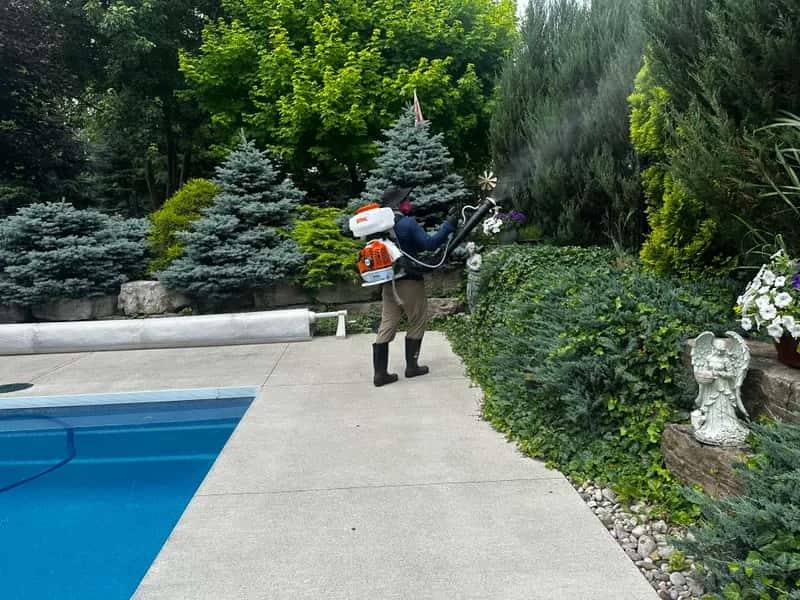
Mosquitoes don't rest on grass during the day. They rest on shaded undersides of leaves, in shrub interiors, on fence-line vegetation, and on the underside of deck joists. DIY sprays applied to lawns hit nothing. Professional barrier spray applied with backpack sprayers reaches actual resting surfaces — that's why it works and DIY doesn't.
5. Stopping Treatments After One Bad Weekend
A single rainy weekend doesn't mean treatments aren't working — it means mosquitoes that were already present took advantage of the humidity spike. Continued treatment through that week eliminates the population. Stopping treatments hands them a week to multiply.
6. Using Consumer Foggers Expecting 30-Day Protection
Hardware-store foggers (Black Flag, Cutter, etc.) provide 1–6 hours of relief — they kill mosquitoes flying through the fog at the moment of application. Professional barrier spray bonds to leaf surfaces and provides up to 30 days of residual protection. They're different products. Comparing them by price is comparing a band-aid to a vaccine.
7. Trusting "Mosquito Plants" as a Standalone Solution
Lavender, citronella plants, and basil have mild mosquito-repellent properties. They reduce ambient mosquito pressure within 1–3 metres of the plant — which is genuinely useful near a patio or doorway. They're not a yard-wide solution. Plants + barrier spray = good. Plants alone = not enough.
8. Overlooking Pool Covers and Tarps
Active chlorinated pools can't breed mosquitoes — chlorine kills larvae. But pool covers that collect rainwater can produce mosquitoes for weeks. Tarps with creases, kiddie pool covers, hot tub covers — all major breeding sites that get overlooked. Drain weekly or treat with BTI dunks.
9. Hiring a Generalist Pest Control Company
General pest control companies cover 10–20 pests. Their technicians rotate between ant jobs, mouse jobs, mosquito jobs, etc. Specialist mosquito-and-tick companies (like BuzzSkito) do nothing else — meaning their technicians know exactly where mosquitoes rest in your specific Ontario neighborhood and exactly where ticks concentrate in your specific lawn-to-woods transition. Specialization compounds.
10. Not Bundling Tick Control When Near Ravines
Ontario homeowners whose properties back onto ravines, conservation areas, or wooded edges have confirmed blacklegged tick exposure. Treating mosquitoes alone leaves the bigger health risk (Lyme disease) unaddressed. Bundling tick control adds modest cost but addresses both pests simultaneously.
11. Treating Only the Deck While Leaving Fence-Line Vegetation Untreated
Mosquitoes spend the day in fence-line vegetation, shrub interiors, and shaded perimeter areas — then move to the deck at dusk. Treating only the deck means the mosquitoes are still arriving from the perimeter. Full-yard barrier spray treats the resting habitat AND the activity zone.
12. Cancelling Treatments After a Cold Week Thinking the Season Is Over
Ontario mosquito season runs through mid-September in normal years. A cold snap in mid-August doesn't end the season — it pauses it. Mosquitoes return immediately when temperatures rebound. Final treatment of the season should be early September minimum, sometimes late September for ravine-adjacent properties.
Bottom Line
Most Ontario mosquito-control failures aren't product failures — they're strategy failures. A homeowner doing the right things in the wrong order, on the wrong surfaces, at the wrong times, will spend money and still have mosquitoes. The pattern that works is consistent across every successful yard: start in May, eliminate breeding sources, apply professional barrier spray to actual resting surfaces, maintain through September, and don't cancel during temporary dips.
Related Guides
- The Ultimate Backyard Mosquito Control Guide (GTA Edition)
- The Ultimate Tick Control Guide for Ontario Homeowners
- Hidden Mosquito Breeding Spots in Your GTA Backyard
- Best Backpack Sprayers in Canada
- Lyme Disease Prevention in Ontario
- View Our Mosquito Control Services
- View Our Tick Control Services
Frequently Asked Questions
Waiting Until July to Start Treatment+
Most mosquito control failures start with timing, not product choice. By July, mosquito populations are 5–10× larger than they were in May. Starting treatment in May (when populations are tiny) keeps them tiny all season. Starting in July means playing catch-up against an established population that takes weeks to bring under control.
Trusting Citronella Candles for Full-Yard Protection+
Citronella candles work in a 2–3 foot bubble around the candle — not for the yard. Multiple research studies confirm this. They're ambiance, not protection. If you want yard-wide mosquito control, you need barrier spray + source elimination, not candles.
Ignoring Rain Barrels and Birdbaths as Breeding Sites+
A single uncovered rain barrel or birdbath can produce thousands of mosquitoes per week. Many Ontario homeowners think they've eliminated standing water because the lawn drains well — without realizing their rain barrel and birdbath are pumping out mosquitoes daily. Cover the barrel, change birdbath water weekly, or use BTI dunks.
Spraying Grass Instead of Leaf Undersides+
Mosquitoes don't rest on grass during the day. They rest on shaded undersides of leaves, in shrub interiors, on fence-line vegetation, and on the underside of deck joists. DIY sprays applied to lawns hit nothing. Professional barrier spray applied with backpack sprayers reaches actual resting surfaces — that's why it works and DIY doesn't.
Stopping Treatments After One Bad Weekend+
A single rainy weekend doesn't mean treatments aren't working — it means mosquitoes that were already present took advantage of the humidity spike. Continued treatment through that week eliminates the population. Stopping treatments hands them a week to multiply.
Using Consumer Foggers Expecting 30-Day Protection+
Hardware-store foggers (Black Flag, Cutter, etc.) provide 1–6 hours of relief — they kill mosquitoes flying through the fog at the moment of application. Professional barrier spray bonds to leaf surfaces and provides up to 30 days of residual protection. They're different products. Comparing them by price is comparing a band-aid to a vaccine.