BuzzSkito Mosquito & Tick Control Specialists · Published April 25, 2026
Quick Answer
Some natural mosquito control genuinely works in Ontario: BTi dunks are highly effective against larvae in standing water, while garlic and cedar-oil sprays give adult mosquitoes only 7–14 days of light repellency. High-pressure yards near ravines or water still need a professional barrier spray.
- BTi dunks kill mosquito larvae in standing water with a toxin that targets mosquito and black fly larvae specifically — the City of Toronto uses BTi as its primary larviciding tool.
- Cedar-oil yard sprays provide 7–14 days of light residual, a shorter-lived residual than professional synthetic barrier spray.
- A female mosquito lays 100–300 eggs in water as shallow as a bottle cap, with a new generation of adults roughly every 10 days.
- Essential oils applied to yard vegetation evaporate too quickly to give meaningful residual protection outdoors.
- Oil of lemon eucalyptus (OLE) is the best-evidenced plant-based personal repellent, and the US CDC lists it among the repellent actives it recommends.
- Ravine-adjacent and waterfront properties typically need professional seasonal treatment; low-pressure urban lots can often manage with BTi plus standing-water elimination.
— BuzzSkito, GTA mosquito & tick control · 150+ five-star Google reviews
More GTA homeowners are asking us about natural and eco-friendly mosquito control options — and it's a fair question. This guide gives you an honest breakdown of what natural options actually do, where they fall short in Ontario's climate, and the right combination strategy for different property types.
As an Amazon Associate I earn from qualifying purchases. Price shown on Amazon.ca, at no extra cost to you.
🏆 Best Natural Pick
8.7/10· BuzzSkito ratingOf every natural option, BTi dunks are the one that genuinely works — a soil-bacterium larvicide that kills mosquito larvae in standing water, with a toxin that targets mosquito and black fly larvae specifically (use it as the label directs). It's the same tool the City of Toronto relies on for larviciding. Drop one in rain barrels, ponds, and birdbaths to stop the next generation before it can bite.
Pros
- Toxin targets mosquito & black fly larvae
- Kills larvae before they become biting adults
- Long-lasting — one dunk treats water for ~30 days
Cons
- Larvae only — does not repel adult mosquitoes
- Needs standing water to be useful
- High-pressure yards still need a barrier treatment
The Natural vs. Synthetic Spectrum: What We're Actually Comparing
When Ontario homeowners ask about “natural” mosquito control, they usually mean one of four things: plant-based repellent sprays applied to the yard, biological larvicides like BTi that target the larvae, essential oils used as personal repellents, or mosquito-repelling plants in the garden. Each of these exists on a spectrum from genuinely effective to mostly wishful thinking.
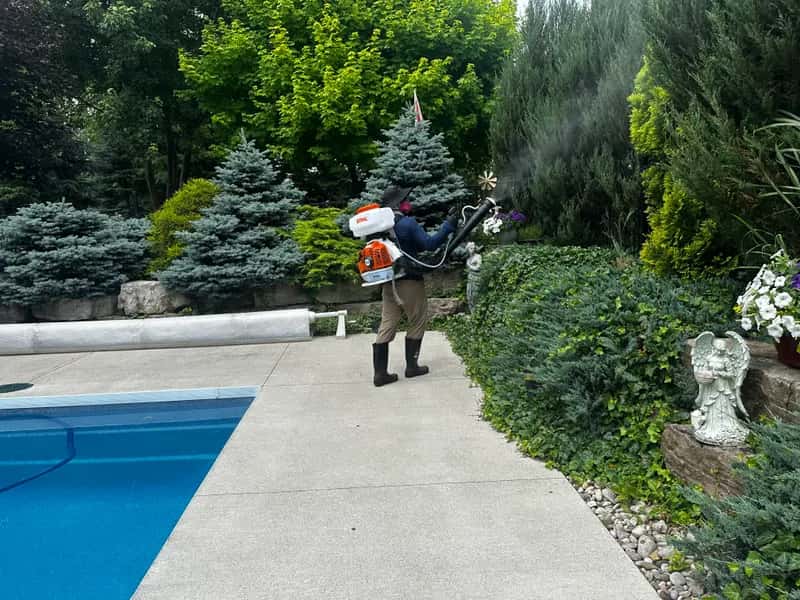
Professional barrier spray, by contrast, typically uses a synthetic pyrethroid (permethrin or bifenthrin) that is a synthetic analogue of naturally occurring pyrethrins found in chrysanthemum flowers. It is not “organic.” Products sold for this use in Canada carry a PCP registration number, and the label sets out how, where and at what rate they may be applied, including restrictions near water and flowering plants.
The honest answer: a layered approach — combining the genuinely effective natural methods with targeted professional treatment where it's warranted — keeps professional treatment to the places it is actually warranted.
Natural Mosquito Control Methods: An Honest Assessment
1. Bacillus thuringiensis israelensis (BTi) — Highly Effective for Larvae
BTi is a naturally occurring soil bacterium that produces proteins toxic specifically to mosquito (and blackfly) larvae. It is available in “dunk” or “granule” form and is the most effective natural tool available for Ontario homeowners with standing water on their property.
Drop a BTi dunk into rain barrels, ornamental ponds, birdbaths, and any standing water that can't be eliminated. The bacterium reproduces in the water and kills larvae before they develop into biting adults. Its toxin targets mosquito and black fly larvae specifically; use it as the label directs. The City of Toronto uses BTi as its primary larviciding tool across the city each year.
Best for: Any property with decorative ponds, birdbaths, rain barrels, or areas of persistent standing water. Works in combination with other methods.
2. Garlic-Based Barrier Sprays — Modest Adult Repellent
Concentrated garlic juice sprayed onto vegetation creates an odour barrier that adult mosquitoes find repellent. Products like Mosquito Barrier use food-grade garlic extract and claim to provide 2–4 weeks of residual repellency. In practice, Ontario homeowners report mixed results — garlic sprays work well in low-pressure environments but are typically insufficient for properties near water or with significant natural mosquito habitat nearby.
Best for: Urban properties in lower-pressure areas (few trees, no nearby water) where homeowners want to minimize chemical use. Less effective for ravine-adjacent or waterfront properties.
3. Cedar Oil Yard Treatments — Short Residual, Mild Effect
Cedar oil-based products are marketed as “natural” yard sprays and do have mosquito-repelling and insecticidal properties. The practical limitation for Ontario use is residual time — cedar oil volatilizes rapidly in heat and breaks down quickly in rain, typically providing 7–14 days of light protection, a shorter residual than professional synthetic barrier spray.
The best-known cedar-oil yard spray is Wondercide — we break down exactly how it holds up in GTA conditions in our full Wondercide Canada review.
Best for: Supplemental perimeter treatment between professional spray visits. Not sufficient as a standalone solution for high-pressure GTA properties.
4. Essential Oils as Personal Repellents — Works on People, Not Yards
Lemon eucalyptus oil (OLE, not the essential oil) is the best-evidenced plant-based personal repellent, and the US CDC lists it among the repellent actives it recommends against mosquitoes. Citronella, lavender, and other essential oils provide brief personal repellency but degrade within 20–30 minutes on skin.
Essential oils applied to yard vegetation have negligible residual effect — they evaporate too quickly to serve as a practical barrier spray. They're useful as personal repellents, not as yard treatments.
5. Mosquito-Repelling Plants — Modest Passive Effect
Lavender, citronella grass, lemon balm, basil, catnip, and marigolds all contain volatile compounds that mosquitoes dislike. Planting them near seating areas provides a modest ambient repellent effect when leaves are brushed or disturbed. They do not project a chemical barrier around the yard — you need to be near the plants for any effect.
For a detailed guide on which plants work best in Ontario gardens, see our Ontario mosquito-repelling plants guide.
6. Eliminating Standing Water — Non-Negotiable Foundation
No mosquito control method — natural or professional — works as well as it should on a property with unaddressed breeding sources. A female mosquito lays 100–300 eggs in water as shallow as a bottle cap. Every 10 days, a new generation of biting adults emerges. Eliminating every standing water source on your property before any treatment dramatically reduces the local population and the amount of product needed to maintain control.
See our guide to hidden mosquito breeding spots in GTA backyards for a comprehensive checklist.
7. Encouraging Natural Predators — Pleasant, Rarely Decisive
Bat houses, purple martin boxes, backyard ponds stocked with minnows, and leaving opossums alone all get recommended as the chemical-free route. Each predator does eat mosquitoes or ticks; the honest question is how many, and whether that number is large enough to change how often you get bitten in your own yard. We ranked them one by one in what eats ticks and mosquitoes — worth reading before you spend a weekend building a bat box.
When Natural Control Is Enough — and When It Isn't
| Property Type | Natural Methods Alone | Recommended Approach |
|---|---|---|
| Urban townhouse, minimal yard | Often sufficient | BTi + water elimination + plants |
| Suburban lot, no nearby water | May be sufficient | BTi + garlic spray + plants |
| Property near creek or pond | Typically insufficient | BTi + professional barrier spray |
| Ravine-adjacent or conservation-border | Insufficient | Professional barrier spray (seasonal) |
| Rural / large lot / near marsh | Insufficient | Professional seasonal package required |
BuzzSkito's Approach: Licensed, Label-Directed, Responsibly Applied
BuzzSkito's treatments are applied under our Ontario Pesticide Operator Licence L-240-2436835197, according to product label directions. Our applications are targeted — we treat the specific surfaces and zones where mosquitoes live and rest, not the entire yard. We avoid open water and flowering plants, and follow the label's application rate and pollinator directions.
This approach is not “organic” in the strictest sense, but it is a licensed, label-directed approach to residential mosquito control, chosen for how it holds up in Ontario's climate. We are transparent about what we use, at what concentration, and why — every service visit includes a product log that you can keep for your records.
Frequently Asked Questions
Is professional mosquito barrier spray safe for the environment?
BuzzSkito uses products that carry a Canadian PCP registration number, applied by an Ontario-licensed operator according to label directions. Registration under the Pest Control Products Act includes an environmental risk assessment, and the label sets the rules for where and how a product may be applied. Synthetic pyrethroids — the active ingredient in most professional barrier sprays — are toxic to fish and aquatic insects, which is why labels restrict spraying near water. The formula is applied only to targeted vegetation surfaces, not broadcast across soil or water.
Are there truly natural mosquito control products that work for Ontario yards?
Yes, within limits. Bacillus thuringiensis israelensis (BTi) dunks are a genuinely natural and effective larvicide for standing water — their toxin targets mosquito and black fly larvae specifically. For adult mosquito control, garlic-based perimeter sprays reduce activity modestly but don't provide the residual knockdown of professional barrier spray. The most effective natural approach combines thorough source elimination (removing all standing water) with BTi for water features, plus a plant-based barrier spray for the perimeter.
Are plant-based mosquito sprays as effective as synthetic ones?
For most Ontario properties, no. Plant-based repellent sprays (cedar oil, rosemary, citronella) degrade faster in our climate — particularly in the humid GTA summers with frequent rain — providing 7–14 days of light residual, a shorter-lived residual than professional synthetic barrier spray. For low-pressure properties away from water, they can be sufficient. For properties near ravines, creeks, or conservation areas, they typically don't provide adequate coverage through peak season.
Do essential oils actually repel mosquitoes in the yard?
Essential oils (lavender, citronella, eucalyptus, peppermint) have real mosquito-repelling properties when applied directly to skin as personal repellents. As a yard treatment applied to vegetation, they evaporate too quickly to provide meaningful residual protection outdoors in Ontario's climate. They're best used to supplement other control methods — not as a standalone yard treatment.
Is BuzzSkito's barrier spray safe for pollinators like bees?
BuzzSkito technicians apply barrier spray to foliage, fence lines, and shaded resting surfaces — not to open flowers or actively blooming plants. Pyrethroids are toxic to bees, which is why product labels restrict spraying blooming plants and areas where bees are foraging. We follow those label directions and avoid treating flowering plants — that is how the risk to pollinators is managed.
Related Guides
- The Ultimate Backyard Mosquito Control Guide (GTA Edition)
- Wondercide Canada — Honest Review + Where to Buy
- Best Mosquito-Repelling Plants for Ontario Gardens
- Hidden Mosquito Breeding Spots in Your GTA Backyard
- DIY vs. Professional Mosquito Control: What Actually Works in Ontario
- Is Professional Mosquito Spray Safe for Kids and Pets?
- View Our Mosquito Control Services