BuzzSkito Mosquito & Tick Control Specialists · Published May 22, 2026
The headline: black flies arrived early this year
By the second week of May 2026, Mississauga residents were already posting in neighbourhood Facebook groups about being chased indoors. Toronto Star and CityNews both ran early-season coverage flagging an unusually aggressive insect spring. The pattern is consistent with what we see at BuzzSkito on our own service routes: black fly emergence is running roughly two weeks ahead of the typical curve, and the suburban GTA — Mississauga, Oakville, Burlington, Vaughan, Markham — is bearing most of the impact.
This is not unusual in the broad sense. Black flies emerge every spring in Ontario. What is unusual is the timing and the intensity, which we believe is driven by a mild April that warmed streams faster than usual and pushed the larval development cycle forward.
The cottage-country migration pattern (and why it matters for the GTA)
Most GTA homeowners think of black flies as a Muskoka problem. They are not wrong — Muskoka, Algonquin, Haliburton, and Parry Sound see the heaviest black fly seasons in the province. But Ontario’s black flies do not stay there. Black flies are strong fliers, capable of travelling 5–10 km from their natal stream in search of a blood meal. A subset of the cottage-country population pushes south as adults, riding prevailing winds into the GTA over a multi-week period.
Layer that migrating northern population on top of the GTA’s own resident populations — emerging from the Credit River, the Humber, the Don, the Rouge, 16 Mile Creek, Bronte Creek, and dozens of smaller tributaries — and you have a wave that compounds across May and June. The GTA black fly experience is genuinely worse than most homeowners realize, because the pressure builds from multiple geographic sources at once.
Why suburban GTA gets hit before downtown Toronto
Black flies need three things to be a problem in your yard: a nearby clean flowing stream (where they breed), suitable rest habitat (dense shrubs, leeward tree canopies, fence-line vegetation), and a hospitable microclimate (humid, shaded). Downtown Toronto largely fails the first two tests. The Don River runs through the city, but the concrete-dominated urban landscape between the river and most residential lots does not provide the chain of rest habitat black flies need to settle in.
Mississauga, by contrast, fits the profile perfectly. The Credit River bisects the city. The watershed includes Cooksville Creek, Etobicoke Creek, and the secondary streams running through Erindale Park, Riverwood, Streetsville, and the Meadowvale conservation lands. Properties throughout the city are within 1–3 km of active black fly breeding habitat, and the suburban yard environment — lots with mature trees, ornamental shrubs, fenced perimeters — provides ideal rest sites. The result: Mississauga sees substantially more black fly pressure per capita than downtown Toronto.
The GTA black fly map (2026)
Mississauga — the Credit River corridor
The single highest-pressure zone in the GTA. The Credit River produces enormous emergence waves from mid-May through mid-June. Neighbourhoods near Rattray Marsh, Erindale Park, Streetsville, Meadowvale, Riverwood, Mississauga Valleys, and any property within 2 km of the Credit see heavy pressure. Properties along Cooksville Creek (Cooksville, Mississauga City Centre edge) and Etobicoke Creek (Mississauga’s east border) also report sustained pressure. Mississauga mosquito control bookings in mid-May routinely cite black flies as the trigger.
Oakville and Burlington — 16 Mile Creek, Bronte Creek, RBG
16 Mile Creek runs north–south through the heart of Oakville, generating significant black fly populations in Bronte, Old Oakville, Glen Abbey, Joshua Creek, and West Oak Trails. Bronte Creek straddles the Oakville–Burlington border and adds pressure to both cities. In Burlington, the Royal Botanical Gardens (RBG) ravine network plus the Aldershot creek system pushes pressure into neighbourhoods backing onto the escarpment foot. Aldershot, Tyandaga, and the Burlington Heights ravine edges report heavy emergence weeks. See Oakville mosquito control and Burlington mosquito spray for area-specific protection.
Toronto — Don Valley, Humber, Rouge, High Park
The Don Valley corridor (Leaside, Don Mills, Rosedale ravine edges, Riverdale, Cabbagetown ravine slopes) generates the Toronto resident black fly population, with the Humber River pushing pressure through Etobicoke, the Junction, and Baby Point. Rouge Park margins push pressure into east Scarborough and northeast Toronto. High Park sees localized emergence around the pond and ravine system. Central downtown Toronto remains a relative refuge — but only relative. Properties anywhere with a ravine view should expect some black fly activity from mid-May through mid-June. Toronto mosquito control coverage spans every neighbourhood.
Hamilton — Cootes Paradise and the Niagara Escarpment
The Niagara Escarpment streams plus Cootes Paradise generate Hamilton’s black fly waves. Ancaster, Dundas, West Hamilton (Aberdeen-Westdale), and any property backing onto the escarpment foot see heavy pressure. Stoney Creek and Red Hill Creek add pressure to east Hamilton. Hamilton mosquito control is most-requested in mid-to-late May for exactly this reason.
Brampton, Vaughan, Markham — Heart Lake, Boyd Conservation, Rouge Park North
Brampton’s Heart Lake Conservation Area and the upper Etobicoke Creek/Mimico Creek systems push black flies into north and central Brampton. The Humber River through Vaughan (Boyd Conservation Area, Woodbridge, Kleinburg) plus the East and West Humber tributaries produce sustained pressure across Vaughan. Markham’s Rouge Park north section and the Rouge tributaries pressure east Markham, Box Grove, and Cornell. See Brampton, Vaughan, and Markham service pages for local coverage.
What differentiates black flies from mosquitoes (and why it matters for control)
Most homeowners conflate the two, but black flies and mosquitoes are very different problems requiring different defences.
- Breeding habitat is opposite. Mosquitoes breed in standing water (gutters, buckets, ponds). Black flies breed in clean flowing water (streams, rivers). You can drain a mosquito source. You cannot drain a river.
- Activity timing is opposite. Mosquitoes are dawn/dusk/night biters. Black flies are daylight biters, with strongest activity in mid-morning and late afternoon.
- Bite mechanism is opposite. Mosquitoes pierce skin with a needle-like proboscis. Black flies cut the skin with scissor-like mouthparts and lap pooling blood.
- Repellent response is different. DEET and picaridin work on both, but black flies are less deterred than mosquitoes. Permethrin-treated clothing is the gold standard for black fly protection.
- Peak season is opposite. Black flies peak late May through mid-June. Mosquitoes peak mid-July through August. The two waves do not overlap heavily, which is good news for protection planning.
Most importantly: consumer-grade lawn perimeter sprays do not kill black flies. The active ingredients evaporate too quickly, and the application doesn’t reach the rest sites black flies actually use. Only a professional residual barrier spray is effective at the yard level.
What GTA homeowners can actually do
Black fly control is realistic but layered. No single intervention solves the problem; the combination is what works.
Professional barrier spray (mid-May timing)
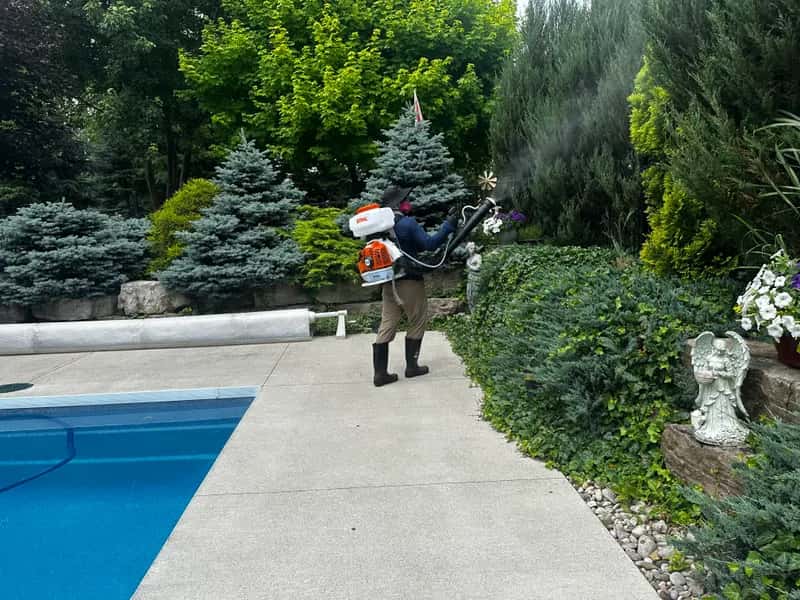
The most effective single intervention. A mid-May treatment lays down a residual on shrubs, fence lines, ornamental beds, and the underside of leaves — exactly the rest sites black flies use between feeding bouts. The flies that arrive in your yard land on treated surfaces and contact that residual, which lowers the pressure in your immediate yard environment. This is the only yard-level treatment that has a measurable effect on black flies, which is why our seasonal program bookings spike in early May from homeowners who learned this lesson the hard way last year.
Thermacell during peak hours
As an Amazon Associate I earn from qualifying purchases. BuzzSkito only points to products we would genuinely use or recommend, at no extra cost to you.
Thermacell units burn an allethrin pad and create a roughly 4-metre repellent cloud. They work on black flies and mosquitoes both. Run them on patios from 9:00 AM to 11:00 AM and from 4:00 PM to 7:00 PM during peak weeks. Effective. Not a substitute for barrier spray, but a useful supplement during outdoor entertaining. The rechargeable Thermacell E90 skips the butane cartridges entirely — a single charge covers a full evening on the patio. Check the Thermacell E90 on Amazon.ca →
Personal protection
Light-coloured clothing (beige, light grey, white). Long sleeves and pants during peak weeks. A hat with a brim — and a head net if you are gardening near the property edge or hiking the ravines. DEET (25-30% concentration) or picaridin (20%) on exposed skin; picaridin is odourless and won’t damage gear the way DEET can. Check picaridin repellents on Amazon.ca → For hands-free coverage during the worst weeks, a bug jacket with a built-in mesh hood beats reapplying spray — see our guide to bug-protective clothing. Check bug jackets on Amazon.ca → For longer outdoor sessions, wear factory permethrin-treated clothing — permethrin sprays are not registered in Canada for consumers to treat their own clothing, so buy the garments already treated. This is the single most effective personal protection layer for ravine walkers and gardeners.
As an Amazon Associate I earn from qualifying purchases. Price shown on Amazon.ca, at no extra cost to you.
🏆 Best Personal Protection
8.8/10· BuzzSkito ratingPermethrin clothing treatment spray (0.5%)
Because black flies cut rather than pierce, they shrug off skin repellents faster than mosquitoes do — so the gold standard is treating the clothing itself. One application binds to fabric, survives weeks of wear and several washes, and keeps working hands-free while you garden or walk the ravines during the worst three weeks. Treat clothing only, never skin.
Pros
- Gold standard for black fly protection
- One treatment lasts several weeks and washes
- Hands-free — no reapplying to skin
- Ideal for ravine walkers and gardeners
Cons
- For fabric only, never applied to skin
- Needs to dry fully before wearing
Pair it with a skin repellent on exposed hands and face for full coverage during peak weeks.
Yard habitat modification
Trim back overgrown shrubs and dense vegetation along property edges. Open up the leeward (downwind) side of tree canopies where black flies cluster. Eliminate cool, damp, sheltered rest pockets in fence corners. None of these prevent emergence — the flies are coming from kilometres away — but they reduce the rest habitat that holds them in your yard.
What does NOT work (and what to skip)
- Citronella candles. Almost zero measurable effect on black flies. The plume is too small and too dilute.
- Bug zappers. Black flies are weakly attracted to UV light. The kill rate is negligible relative to the population.
- Ultrasonic repellers. No scientific evidence of effectiveness for any biting insect, black flies included.
- Consumer hose-end yard sprays (Cutter, Repel, OFF! Yard). Active ingredient evaporates within hours; no residual; minimal effect on flying insects that arrive after application. These products are formulated more for marketing than for results.
- Bti mosquito dunks in standing water. Effective against mosquito larvae. Useless against black flies — black flies breed in flowing water, where the dunks wash away.
For a fuller picture of yard control economics, see our breakdown of mosquito control cost in Ontario.
When the wave ends
In most GTA years, black fly pressure crashes by the third week of June as stream water temperatures climb past the larval comfort zone. By Canada Day, the worst is over. Mosquitoes take over as the dominant biting insect through July and August — which is why our seasonal programs are designed to keep coverage active through the full transition. The GTA mosquito season timeline covers what comes next.
The 2026 wrap
This year is shaping up as a heavier-than-usual black fly season for the GTA, on the heels of a similarly elevated tick season. The pattern of warm springs producing aggressive early-insect waves is becoming more reliable across southern Ontario. The properties treated in mid-May have a residual in place before the worst three weeks of black fly pressure arrive. The properties that wait until July have missed the window entirely.
If your address is in any of the high-pressure zones described above — Credit River corridor in Mississauga, Don Valley in Toronto, 16 Mile Creek in Oakville, RBG-adjacent in Burlington, escarpment foot in Hamilton, Heart Lake in Brampton, Humber corridor in Vaughan — book your first treatment now. The free yard risk report gives you an address-specific pressure score in under 90 seconds.