
Reviewed by Alex Francisco
Published November 6, 2026 · Fact-checked against the sources listed below
Reading from Canada? Product rules and what is sold there differ. See the Canadian edition.
Our picks at a glance
BuzzSkito did not test these products. A long-reach jet spray labeled for wasp and hornet nests is this page's main recommendation, explained in the next section; the picks below name the longest reach and a foam among the cans read for this page, the dust and duster the extension guides use for ground nests, and the gear they say to wear. Every brand-name pesticide is named with its EPA registration number.
Wasp spray picks
As an Amazon Associate I earn from qualifying purchases.
- Check price on Amazon →
Longest reach on its label
Spectracide Wasp & Hornet Killer
A jet aerosol whose label claims a reach of up to 27 feet (EPA Reg. No. 9688-190-8845; prallethrin and lambda-cyhalothrin). Outdoor use only. The label says to spray at sunset from a safe distance, never directly underneath, and to wait 24 hours before removing the nest.
- Check price on Amazon →
Foam for nests within 20 feet
Spectracide Foaming Wasp & Hornet Killer
A blanketing foam with a label reach of up to 20 feet (EPA Reg. No. 9688-325-8845; prallethrin and cypermethrin). Outdoor use only. The label says to keep people and pets out of the area until the spray dries and never to use it in or on electrical equipment.
- Check price on Amazon →
For ground and wall nests
Deltamethrin 0.05 percent (EPA Reg. No. 432-772). Its label advises treating nests in the evening, says to dust the entrance and surrounding area of ground wasp nests, and says not to use it on overhead nests. Kentucky says dust blown into an opening penetrates farther than sprays.
- Check price on Amazon →
To apply the dust
Penn State and the University of Kentucky both name a handheld bulb or bellows duster for puffing dust into a nest entrance. Penn State suggests puffing until the wasps start to investigate, backing off while they settle, then returning to add more.
- Check price on Amazon →
Head-to-toe sting protection
UC IPM says to wear protective clothing that covers the whole body, including a veil and gloves, and Kentucky strongly recommends a full wasp suit and head veil sealed at the wrists, ankles and collar for anyone treating a hornet nest.
- Check price on Amazon →
For working after dark
Penn State says most stinging insects have difficulty seeing red, so a red light or filter helps keep them in the dark. Kentucky adds: do not shine the beam into the entrance; light it from one side and, if possible, set the light on the ground.
What is the best wasp spray?
An aerosol labeled for wasp and hornet nests that shoots a long, narrow stream is the best wasp spray for most nests, because distance is what keeps you from being stung. UC IPM's pest note on yellowjackets tells anyone treating a nest themselves to use an insecticide that shoots a long stream into the nest entrance and is labeled for yellowjacket nests. The University of Kentucky's guide to controlling wasps says an accessible paper wasp nest can be eliminated fairly easily with a wasp and hornet spray, one advantage being that it can be sprayed as far as 20 feet.
The cans read for this page print a reach claim, and it varies. Among them, the longest claim is on Spectracide Wasp & Hornet Killer (EPA Reg. No. 9688-190-8845), whose label claims a jet spray of up to 27 feet. Its EPA-accepted base label, Chemsico Wasp & Hornet Killer LE (EPA Reg. No. 9688-190), lists the same active ingredients: 0.025 percent prallethrin and 0.010 percent lambda-cyhalothrin. The EPA-accepted label for Raid Wasp & Hornet Killer 33 (EPA Reg. No. 4822-553) allows a claim of up to 22 feet. Penn State says most of these cans spray 15 to 20 feet, and UC IPM warns that stings are still likely even after dark with a stream that reaches 20 feet.
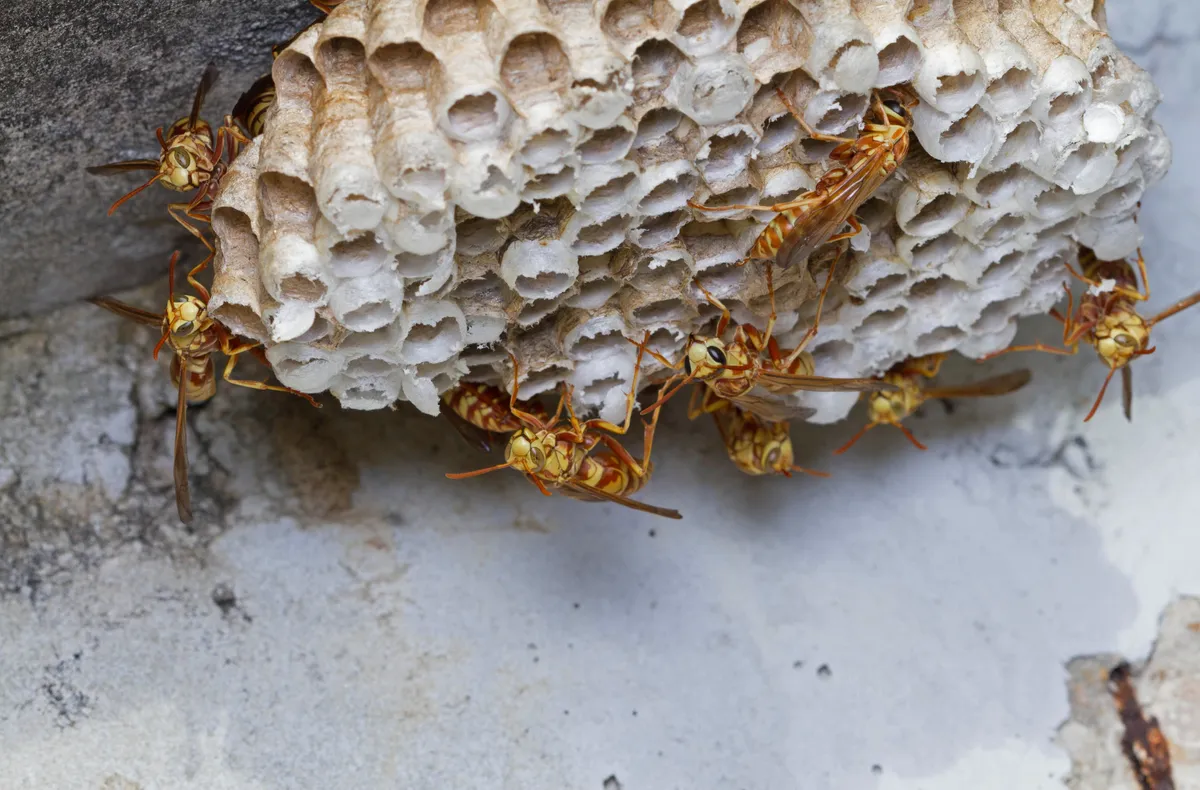
What the can does best is knock wasps down on contact. Penn State says ready-to-use wasp and hornet aerosols give immediate knockdown and usually lose their toxicity once they dry, and that they suit exposed, open-comb nests and small, exposed nests wrapped in a paper envelope but often penetrate larger or hidden nests poorly. Some labels claim more: Spectracide's says its spray will also kill insects that return to the nest over the next few days. How to identify the nest you have tells you which of those cases you are dealing with.
Jet or foam: which wasp spray should you buy?
Buy a jet for reach and a foam to coat a nest you can reach comfortably; both are aerosols, and both kinds of label tell you to soak the nest. The jets on this page claim 22 to 27 feet. Foam cans still project a stream before it foams: Spectracide's foaming spray (EPA Reg. No. 9688-325-8845) claims a jet of up to 20 feet that lays down a blanketing foam, and Ortho says its Home Defense Hornet & Wasp Killer7 uses an entrapping foam that reaches nests up to 20 feet above the ground and kills returning insects.
Read a foam's label before you aim it into a wall. The EPA-accepted label behind Spectracide's foam (EPA Reg. No. 9688-325) says the product is for outdoor use only and never to be used indoors. The foams Penn State describes for underground nests and voids are like liquid concentrates but come with or need a foaming agent, a different product from these ready-to-use cans, and Texas A&M describes professionals treating wall and underground voids with portable foam-generating machines. For a nest in the ground or a wall, a dust is the usual answer, covered below.
Freeze-type sprays are a third format. The EPA-accepted label for PT Wasp-Freeze II (EPA Reg. No. 499-550; 0.1 percent prallethrin) says it kills on contact from 15 feet away, gives 6 to 15 feet as an example of a safe distance to stand from the nest, and allows indoor use only in attics and crawl spaces. UC IPM cautions that even freeze-type products may not stop every wasp that comes flying out.
How the wasp sprays on this page compare
| Product (EPA Reg. No.) | Format and actives | Reach on the label | Where it may be used | Watch for |
|---|---|---|---|---|
| Spectracide Wasp & Hornet Killer (9688-190-8845) | Jet aerosol: prallethrin 0.025%, lambda-cyhalothrin 0.010% | Up to 27 ft | Outdoors only; never indoors | Not in or on electrical equipment; apply at sunset |
| Raid Wasp & Hornet Killer 33 (4822-553) | Jet aerosol: prallethrin 0.02%, cypermethrin 0.05% | Up to 22 ft | Outdoors only | Extremely flammable; keep people and pets out until sprays dry |
| Spectracide Foaming Wasp & Hornet Killer (9688-325-8845) | Foaming aerosol: prallethrin 0.02%, cypermethrin 0.04% | Up to 20 ft | Outdoors only; never indoors | Keep people and pets out until sprays dry; not in or on electrical equipment |
| Ortho Home Defense Hornet & Wasp Killer7 | Foaming aerosol: tetramethrin 0.20%, sumithrin 0.20% (Ortho) | Nests up to 20 ft above ground (Ortho) | Outdoors; indoors in attics and anywhere nests are built, with food and feed not exposed (Ortho) | Spray the nest opening first, then soak the rest (Ortho) |
| PT Wasp-Freeze II (499-550) | Aerosol: prallethrin 0.1% | Kills on contact from 15 ft; gives 6 to 15 ft as a safe distance | Outdoors; indoors only in attics and crawl spaces | Do not spray into electrical equipment |
| Delta Dust (432-772) | Dust: deltamethrin 0.05% | Applied with a hand or power duster | Ground nests and wall voids | Not for overhead nests |
From the EPA-accepted labels for EPA Reg. Nos. 9688-190, 4822-553, 9688-325, 499-550 and 432-772, Spectracide's own labels and Ortho's product page, all linked on this page.
How do you spray a wasp nest safely?
At dusk or after dark, from as far away as the can reaches, dressed against stings, with an escape route planned and everyone else kept out of the area. The labels and the extension guides agree on the steps:
- Find the nest by day, treat it at dusk. Penn State says to plan in daylight and do the work at night, when insects in the nest are less likely to fly and have trouble seeing. The labels agree in their own words: Spectracide's says to apply at sunset, Raid's says early morning or early evening, and Wasp-Freeze's says evening or early morning, when wasps gather on or in the nest.
- Cover up. UC IPM says to wear protective clothing that covers the entire body, including a veil and gloves, plus eye protection against the pesticide. Penn State's minimum is long sleeves, long pants, closed-toed shoes with socks and chemical-resistant gloves, with eye protection for any spray aimed above your shoulders.
- Light it from the side. Kentucky says not to shine a flashlight into the entrance, which can startle the wasps and draw them toward the light; aim the beam to one side or set the light on the ground. Penn State adds that a red light or red filter helps because most stinging insects have difficulty seeing red.
- Stand back, never underneath, wind behind you. Each spray label here says to stand away from the nest, and the Spectracide, Raid and Wasp-Freeze labels say not to stand directly under it. Kentucky explains why: sprayed wasps drop right away, so standing under a nest raises your risk of being stung. Spectracide's foam label also says to start up to 20 feet away and walk slowly toward the nest while spraying until it is soaked. The Spectracide, Raid and Wasp-Freeze labels say to keep the wind at your back, and the Raid label and Spectracide's EPA-accepted base label say not to spray when the wind is over 15 mph.
- Hit the entrance, then soak the nest. Penn State says to aim up into the entrance of an enveloped nest and soak it completely, and the Raid label says to spray directly into the nest opening until the whole nest is saturated.
- Walk away and stay away. Penn State says to plan an escape route and, if the insects get too defensive, to walk calmly, quietly and quickly away rather than panic or swat. UC IPM warns that partly poisoned, agitated wasps can turn up some distance from the nest even the next day.
- Leave the nest for at least a day. The Spectracide and Raid labels and Ortho's directions say to wait at least 24 hours before removing the nest, Kentucky says to wait at least 3 to 4 days with a hornet nest, and Penn State says to confirm the next day that the colony is dead before you knock the nest down and destroy it.
Where should you never use wasp spray?
On people or pets, indoors unless the label allows it, and anywhere it can reach water. Spectracide's label says to aim the spray away from yourself, and the Raid and Spectracide foam labels say not to apply the product in a way that will contact people or pets, directly or through drift, and to keep people and pets out of the area during application and until the spray has dried.
Do not keep a can for self-defense. An Iowa State University and eXtension article republished in Texas A&M's School Pest News points out that using a pesticide other than as its label directs violates federal law, that wasp spray has not been tested on people, and that there is no research suggesting it would stop an attacker.
Keep it outdoors unless the label says otherwise. The Spectracide jet and foam labels say never to use them indoors, and Raid's label is for outdoor use only; the Wasp-Freeze label allows indoor use only in attics and crawl spaces, and Ortho's directions list attics and anywhere nests are built. Water and bees matter too: the labels call these products toxic or extremely toxic to fish and say not to apply them to water or let them reach drains, and the Spectracide foam label says it is highly toxic to bees exposed to direct treatment on blooming crops or weeds.
NPIC's advice for pets is to keep them away from treated areas for the time the label lists or until the spray has dried completely, whichever is longer. If you use a product indoors where its label allows, NPIC also says to cover fish tanks.
How do you treat a wasp nest in the ground or a wall?
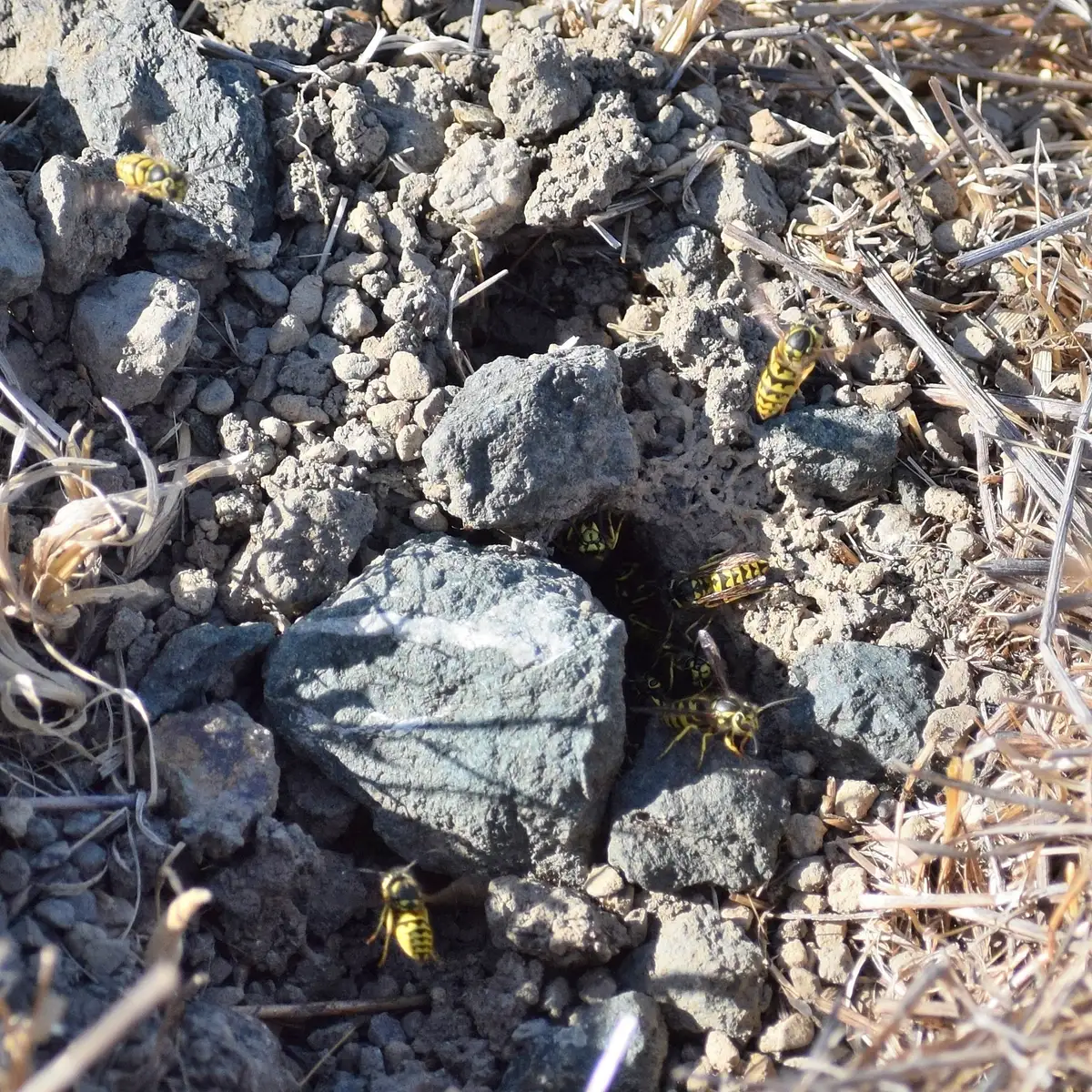
With an insecticide dust labeled for it, puffed into the entrance at night, and never by sealing the entrance while the colony is alive. Texas A&M AgriLife Extension says underground yellowjacket nests are best treated with an insecticide dust, which the wasps track deep into the nest as they come and go, and that aerosols may have a lower success rate unless enough is injected directly into the entrance. Kentucky says dust blown into the opening penetrates farther than sprays, especially when the nest sits some distance from the entrance, as in rock walls, behind siding or deep in old animal burrows.
A ground nest can be farther from the hole than it looks. UC IPM says an underground nest can be quite a distance from the visible entrance, so a spray may not reach the wasps, and Penn State says the entrance may be several feet from the nest. Penn State's method is hit and run: puff dust into the entrance until the yellowjackets start investigating, back off until they settle, and return to add more until their defense is too vigorous to go back.
Check the dust's label before you buy. The EPA-accepted label for Delta Dust (0.05 percent deltamethrin, EPA Reg. No. 432-772) advises treating wasp and bee nests in the evening and says to dust the entrance and surrounding area of ground wasp nests, to check one or two days later and remove the nest, and not to use the product on overhead nests. Texas A&M adds that any dust you use must have a label allowing its use on insect nests in the soil, and Penn State and Kentucky both apply dust with a handheld bulb or bellows duster. Before you treat a hole in the lawn, check that it is not ground bees, and see the full guide to ground wasps for the rest of the job.
Never seal a wall entrance while the colony is alive. Kentucky warns that sealing the spot where wasps enter siding may make them chew their way inward and emerge indoors, Texas A&M says wasps may force their way into the house looking for a new exit, and Penn State says to seal or treat any entry inside the house before the outside one so the colony is not pushed indoors. Penn State also prefers dust inside structures because foams and liquids can cause water damage to wood, drywall and electrical components, and UC IPM describes yellowjackets enlarging a cavity indoors until a wet patch becomes a hole in a wall or ceiling. A colony inside a wall is a nest to hand to a professional.
What about a hornet nest high in a tree?
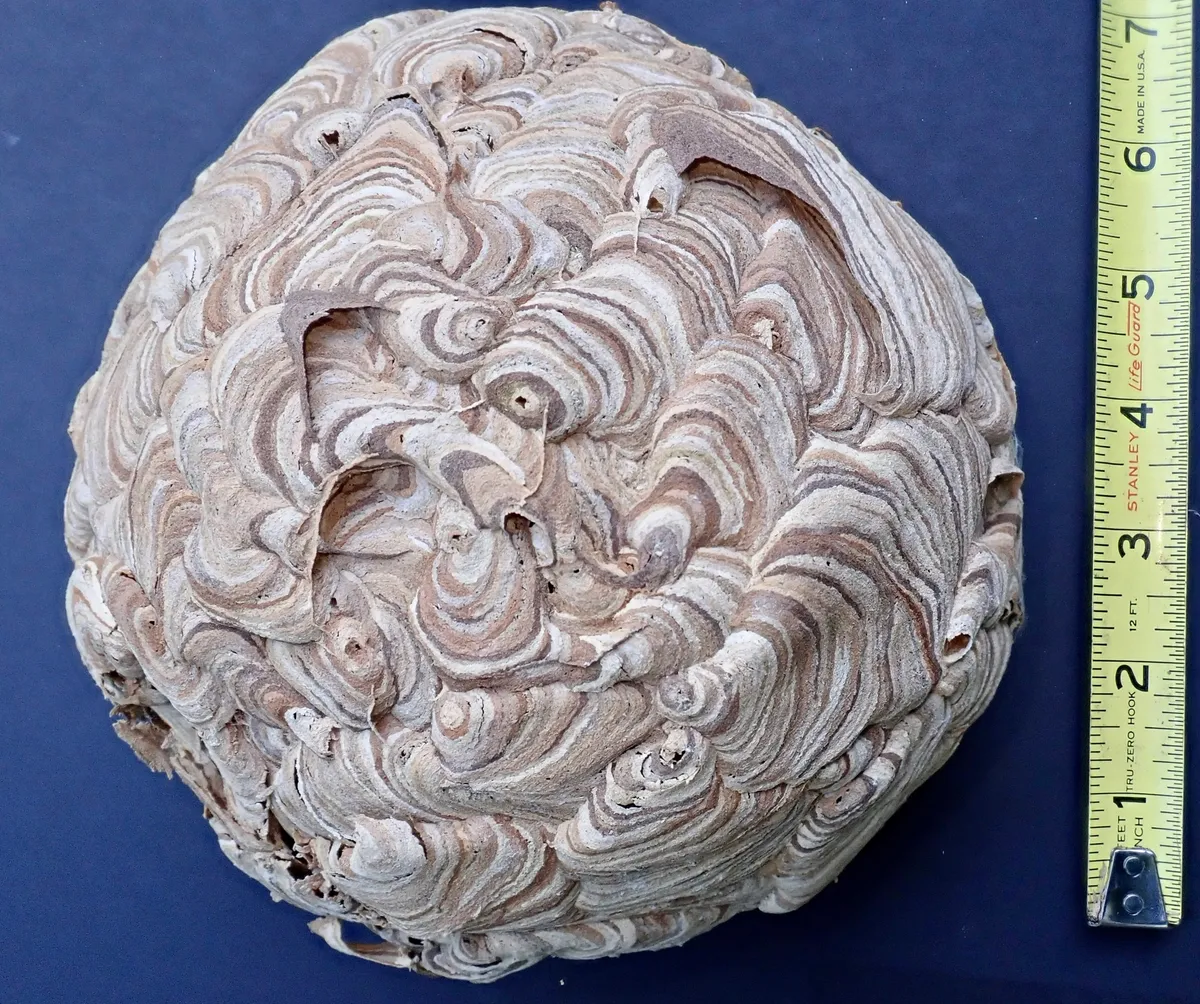
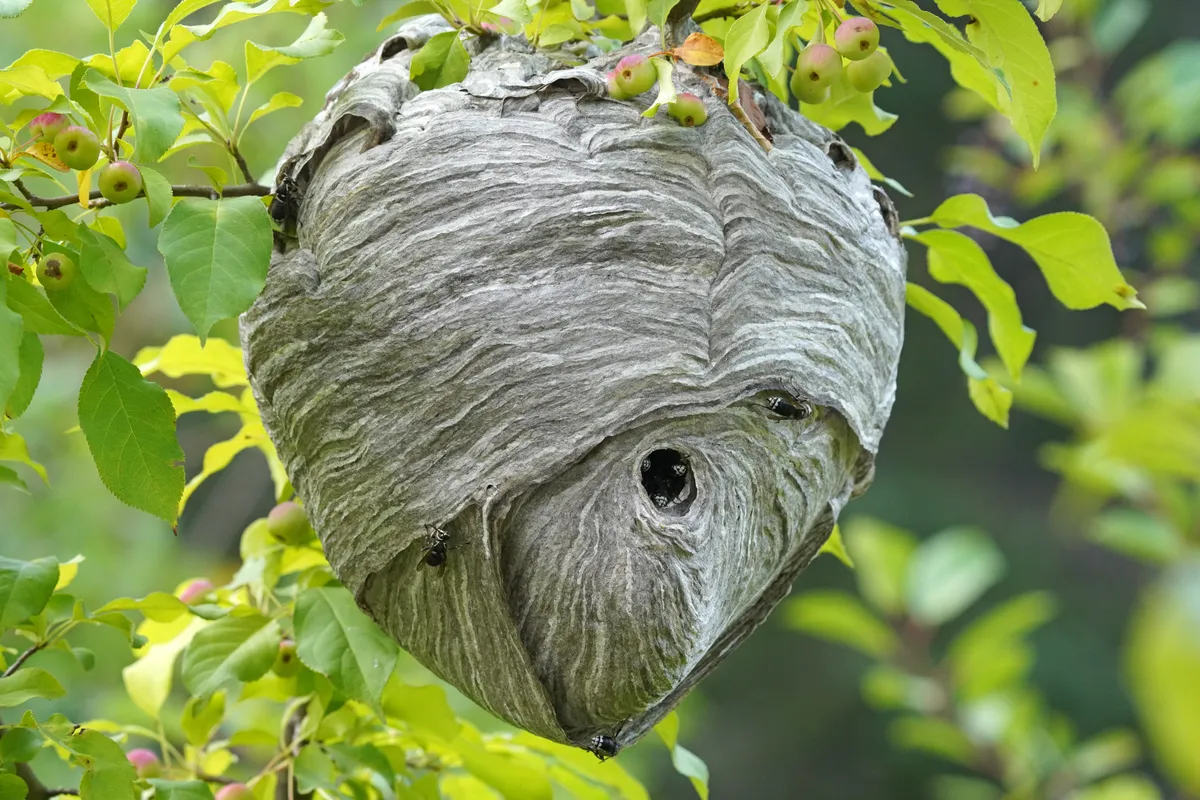
Leave it alone if you can, and call a professional if you cannot. Texas A&M says hornet nests high in trees or other remote places where they pose no threat should be left unharmed. Kentucky calls hornets far more difficult and dangerous to control than paper wasps: their nests can hold hundreds of wasps that are extremely aggressive when disturbed, and they are often out of reach without a ladder or other special equipment.
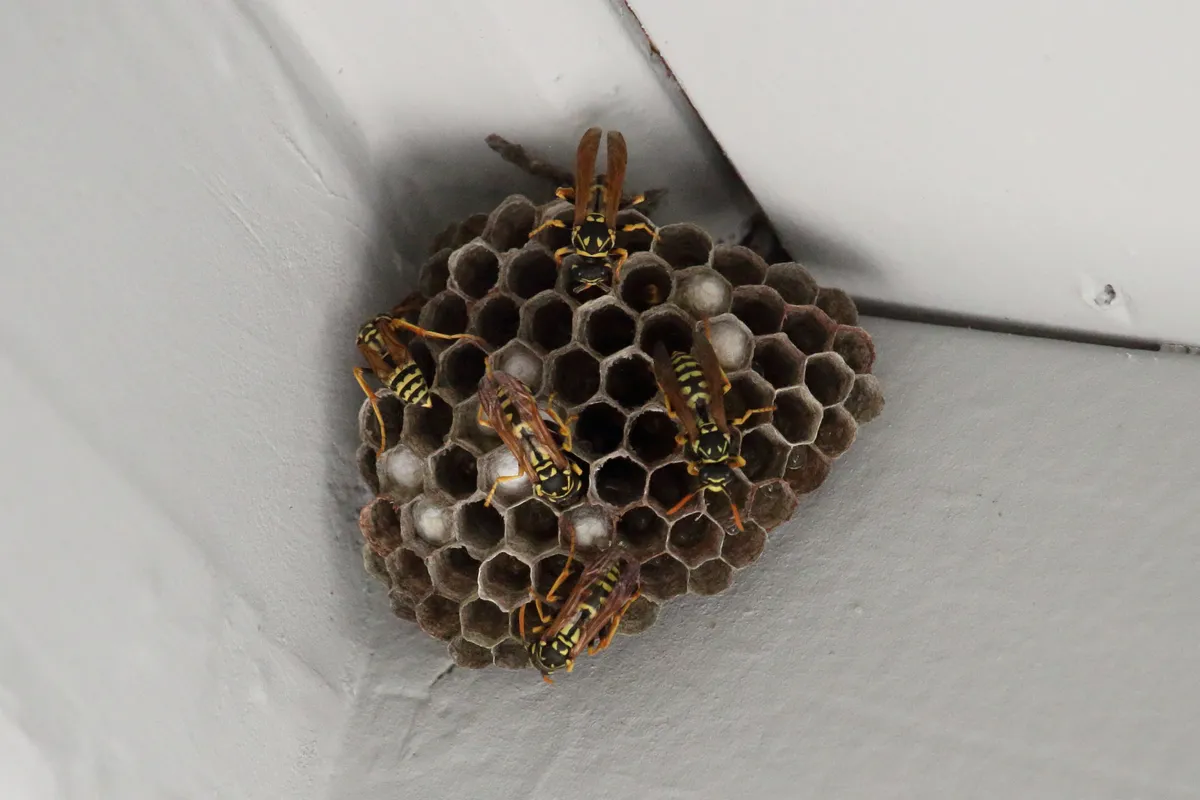
If you must treat one, Kentucky says to do it at night in a full wasp suit and head veil sealed at the wrists, ankles and collar, to apply spray or dust directly into the nest opening, usually a single one toward the bottom, without breaking the paper envelope, and to wait at least 3 to 4 days before removing the nest. If you use a dust, check its label first, since Delta Dust's says not to use it on overhead nests. Penn State notes that the thick, layered envelope of a large bald-faced hornet nest makes treatment difficult and that treatments may need repeating on successive nights. Bald-faced hornets and how to tell a wasp from a hornet cover identification.
What will wasp spray not do?
- Stop foragers from a nest you cannot find. Kentucky says late-season foragers may come from nests several hundred yards away, and UC IPM says lure traps can reduce local foragers but do not eliminate large populations. Traps are compared in a guide to wasp traps and a guide to yellow jacket traps.
- Reach deep into a big or hidden nest. Penn State says ready-to-use aerosols often penetrate larger or concealed nests poorly, which is why its guide turns to dusts, liquid concentrates and foaming concentrates for those nests.
- Prevent next year's nests. UC IPM says yellowjacket and paper wasp colonies normally live only one season and that queens start new nests in spring; Kentucky says colonies die off once the weather turns cold in states with cold winters, and Texas A&M says abandoned nests decompose and are not reused.
- Keep wasps away from your food. Kentucky says the best way to reduce foraging yellowjackets is to keep food and drinks covered and trash cans tightly lidded, and UC IPM says to cover soda cans, keep pet food indoors and pick up ripe fruit.
Do natural or homemade wasp killers work?
Plant-oil sprays kill the wasps they wet and little more. Texas A&M's tips for pest control professionals say exposed wasp nests can be treated with sprays of insecticidal soap, peppermint oil, eugenol and other natural insecticides, but that these mostly kill on contact, so re-treatment may be needed. Plant-oil wasp sprays can be sold as minimum-risk pesticides: peppermint oil and 2-phenylethyl propionate both appear on EPA's list of ingredients eligible for minimum-risk products, and EPA's minimum-risk page says such products are exempt from registration and that EPA does not review their labels.
Gasoline, fire and the garden hose do not belong on a nest. Penn State calls fire significantly more dangerous than the methods its guide describes and says fuels such as gasoline or kerosene are more toxic than most suitable insecticides, and Kentucky says dousing nests with gasoline or a garden hose seldom works and can bring multiple stings.
Who should not spray a wasp nest?
Anyone allergic to stings, and anyone who would have to climb a ladder or open a wall to reach the nest. Penn State says that if you know you are allergic to insect stings, you should not try to remove a colony yourself, and Texas A&M says wasp control should not be undertaken by anyone with a heart condition or known allergies to bee or wasp venom.
The risk is real. Kentucky cites about 225,000 emergency room visits and as many as 100 deaths a year in the U.S. from allergic reactions to wasp and hornet stings, and puts the number of Americans hypersensitive to the venom at about two million. The American Academy of Allergy, Asthma & Immunology calls anaphylaxis a medical emergency that may be fatal, says to get emergency treatment for symptoms after a sting and to see an allergist after a serious reaction, and says people who are severely allergic should carry epinephrine and still go to an emergency room after using it. CDC's NIOSH adds that workers with a history of severe reactions should carry an epinephrine auto-injector and wear medical identification.
For ordinary stings, Penn State says to wash the area with soap and water, which also removes the alarm signals that draw more wasps, and to seek medical attention immediately if symptoms spread well beyond the sting or cause trouble breathing or swallowing. Bee and wasp stings compared and the bug bite identifier go further.

When should you call a professional?
Call one for a nest in a wall, attic or other structure, a hornet nest you cannot reach from the ground, a large or very active colony, any nest close to someone who is allergic, and any nest on electrical equipment. Kentucky says it is often best to call a professional for a hornet nest and usually prudent for a yellowjacket nest, especially when a ladder is needed. UC IPM says calling for professional help is the easiest and safest way to eliminate a nest that has to go and that hiring a professional reduces risks to you and your family.
A professional takes the risk off you. Penn State notes that the technician takes on the risk of being stung and brings the knowledge, tools and labor, and that pest control companies carry liability insurance for any property damage during treatment.
Some nests need nothing. UC IPM says paper wasp nests should not need treatment unless they are near people, Texas A&M says yellowjacket nests away from human activity can be left alone and marked with a warning sign, and Penn State says nests found in the fall will soon die anyway. Waiting works best where winters are cold: UC IPM says some yellowjacket colonies survive for several years in very mild winters. If the insects are honey bees, Penn State suggests finding a beekeeper willing to remove the colony.
Identify before you buy. Yellow jacket identification covers the group UC IPM calls by far the most troublesome, especially the ground- and cavity-nesting species, paper wasps covers the open-comb nests under eaves, and the full plan for getting rid of wasps puts the steps on this page in order.
This guide is general educational information, not medical advice. If you have symptoms or concerns after a bite or exposure, contact a healthcare provider.
Use any pesticide exactly as its label directs. The label is the law, and what is registered and sold varies by state.
Frequently Asked Questions
What is the best wasp spray for nests?+
An aerosol labeled for wasp and hornet nests that shoots a long stream, used at dusk from the ground. UC IPM advises a spray that shoots a long stream into the nest entrance and is labeled for yellowjacket nests. Among the cans read for this page, Spectracide Wasp & Hornet Killer claims the longest reach, up to 27 feet, and Raid Wasp & Hornet Killer 33 claims up to 22 feet. For nests in the ground or a wall, extension guides prefer an insecticide dust.
Is foam or jet spray better for wasp nests?+
A jet reaches farther; a foam coats a nest you can reach. The jet cans on this page claim 22 to 27 feet, while Spectracide's foaming spray and Ortho's foam claim about 20 feet, and Ortho says its foam entraps wasps and kills returning insects. Spectracide's foam label says never to use it indoors, while Ortho's directions allow attics and anywhere nests are built. The foams Penn State describes for voids are like liquid concentrates with a foaming agent, not these cans.
How far away should you stand when spraying a wasp nest?+
As far as your can's label reach allows, and never directly underneath. Penn State says most wasp and hornet aerosols spray 15 to 20 feet and that working at night from 15 to 20 feet away, out of the wasps' flight path and away from your light, significantly lowers the risk of stings. The Wasp-Freeze label gives 6 to 15 feet as an example of a safe distance, and Spectracide's foam label says to start up to 20 feet away and walk slowly toward the nest while spraying. UC IPM warns that stings are still likely even after dark with a 20-foot stream, so wear protective clothing and plan your way out.
What time of day should you spray a wasp nest?+
At dusk, after dark or in early morning, when the wasps are in the nest and less active. Spectracide's labels say to apply at sunset, Raid's says early morning or early evening, and Wasp-Freeze's says evening or early morning because wasps gather on or in the nest then. Penn State says to scout during the day and do the work at night, when insects are less likely to fly and have trouble seeing.
How long after spraying can you remove a wasp nest?+
At least 24 hours, as the Spectracide and Raid labels and Ortho's directions say, and longer for a hornet nest. The University of Kentucky says to wait at least 3 to 4 days before removing a hornet nest. Texas A&M says not to remove a paper wasp nest until all the wasps are dead, which may take up to 2 days, and Penn State says to confirm the colony is dead the next day before knocking the nest down.
Can you use wasp spray indoors?+
Usually not; the label decides. The Spectracide jet and foam labels say never to use them indoors, and Raid Wasp & Hornet Killer 33 is labeled for outdoor use only. PT Wasp-Freeze II allows indoor use only in attics and crawl spaces, and Ortho's directions for its Home Defense Hornet & Wasp Killer7 list attics and anywhere nests are built. A colony living inside a wall or ceiling is a job for a professional.
Can you spray a wasp nest in the ground?+
You can spray into the opening, but a dust usually works better. The University of Kentucky says an aerosol sprayed into the opening often eliminates a yellowjacket ground nest, but that dust blown into the opening penetrates farther. Texas A&M says underground nests are best treated with a dust labeled for nests in the soil, and UC IPM warns that the nest can be some distance from the visible entrance, beyond the reach of a spray.
Is wasp spray safe around pets and children?+
Keep children and pets away from it, as the labels direct. The Raid and Spectracide foam labels say not to apply the product in a way that will contact people or pets, to keep them out of the area during application and to stay out until the spray has dried. NPIC advises keeping pets away for the time the label lists or until sprays are completely dry, whichever is longer. If a pet is exposed, call your veterinarian or the ASPCA Animal Poison Control Center at 888-426-4435, which may charge a fee.
Can wasp spray be used for self-defense?+
No. An Iowa State University and eXtension article republished by Texas A&M's school IPM program says that using a pesticide other than as its label directs violates federal law, that wasp spray has not been tested on people, and that no research suggests it would stop an attacker. Spectracide's label says to aim the spray away from yourself, and Raid's says not to use the product in a way that will contact any person.
Do natural wasp sprays work?+
They kill the wasps they wet, and little more. Texas A&M's tips for professionals say sprays of insecticidal soap, peppermint oil and eugenol mostly kill on contact, so re-treatment may be needed. Plant-oil sprays can be sold as minimum-risk pesticides, which EPA exempts from registration without reviewing their labels; peppermint oil and 2-phenylethyl propionate are on EPA's list of eligible ingredients. Never use gasoline or fire, which Penn State calls more dangerous than the usual methods.
Sources
- Pest Notes: Yellowjackets and Other Social Wasps (UC ANR Publication 7450; E. C. Mussen and M. K. Rust, updated March 2012) — University of California Statewide IPM Program
- Getting Rid of Paper Wasps, Yellowjackets, and Other Stinging Insects (J. Kopco, updated January 29, 2026) — Penn State Extension
- ENTFACT-620: Controlling Wasps, Hornets, and Yellowjackets (M. F. Potter, revised March 2026) — University of Kentucky Department of Entomology
- Paper Wasps, Yellowjackets and Solitary Wasps (E-239; G. C. Moore and M. E. Merchant, July 2003) — Texas A&M AgriLife Extension
- Chemsico Wasp & Hornet Killer LE label, EPA Reg. No. 9688-190 (notification, June 9, 2026) — US Environmental Protection Agency, Pesticide Product and Label System
- Spectracide Wasp & Hornet Killer3 label, EPA Reg. No. 9688-190-8845 (18.5 oz) — Spectrum Brands (United Industries Corporation)
- RWH 33 (Raid Wasp & Hornet Killer 33) label, EPA Reg. No. 4822-553 (February 13, 2026) — US Environmental Protection Agency, Pesticide Product and Label System
- Chemsico Wasp & Hornet Killer 4EC label, EPA Reg. No. 9688-325 (September 29, 2026) — US Environmental Protection Agency, Pesticide Product and Label System
- Spectracide Foaming Wasp & Hornet Killer label, EPA Reg. No. 9688-325-8845 (14 oz, 2024) — Spectrum Brands (United Industries Corporation)
- Ortho Home Defense Hornet & Wasp Killer7 (product page) — The Scotts Company (Ortho)
- TC-323 (PT Wasp-Freeze II) label, EPA Reg. No. 499-550 (February 26, 2026) — US Environmental Protection Agency, Pesticide Product and Label System
- K-Othrine Dust Insecticide (DeltaDust) label, EPA Reg. No. 432-772 (August 5, 2016) — US Environmental Protection Agency, Pesticide Product and Label System
- Minimum Risk Pesticide: Definition and Product Confirmation — US Environmental Protection Agency
- Active Ingredients Eligible for Minimum Risk Pesticide Products (updated December 2015) — US Environmental Protection Agency
- Stinging Insect Allergy — American Academy of Allergy, Asthma & Immunology
- Insects and Scorpions at Work (reviewed September 28, 2026) — Centers for Disease Control and Prevention, NIOSH
- Pets and Pesticide Use Fact Sheet — National Pesticide Information Center
- School Pest News, Volume 12, Issue 7 (October 2013): Don't use wasp spray as a substitute for pepper spray in a defensive situation (L. Spicer, Iowa State University and eXtension) — Texas A&M AgriLife Extension, School IPM
Read and approved by Alex Francisco. Found an error? Email support@buzzskito.ca.