BuzzSkito Mosquito & Tick Control Specialists · Published April 26, 2026
Quick Answer
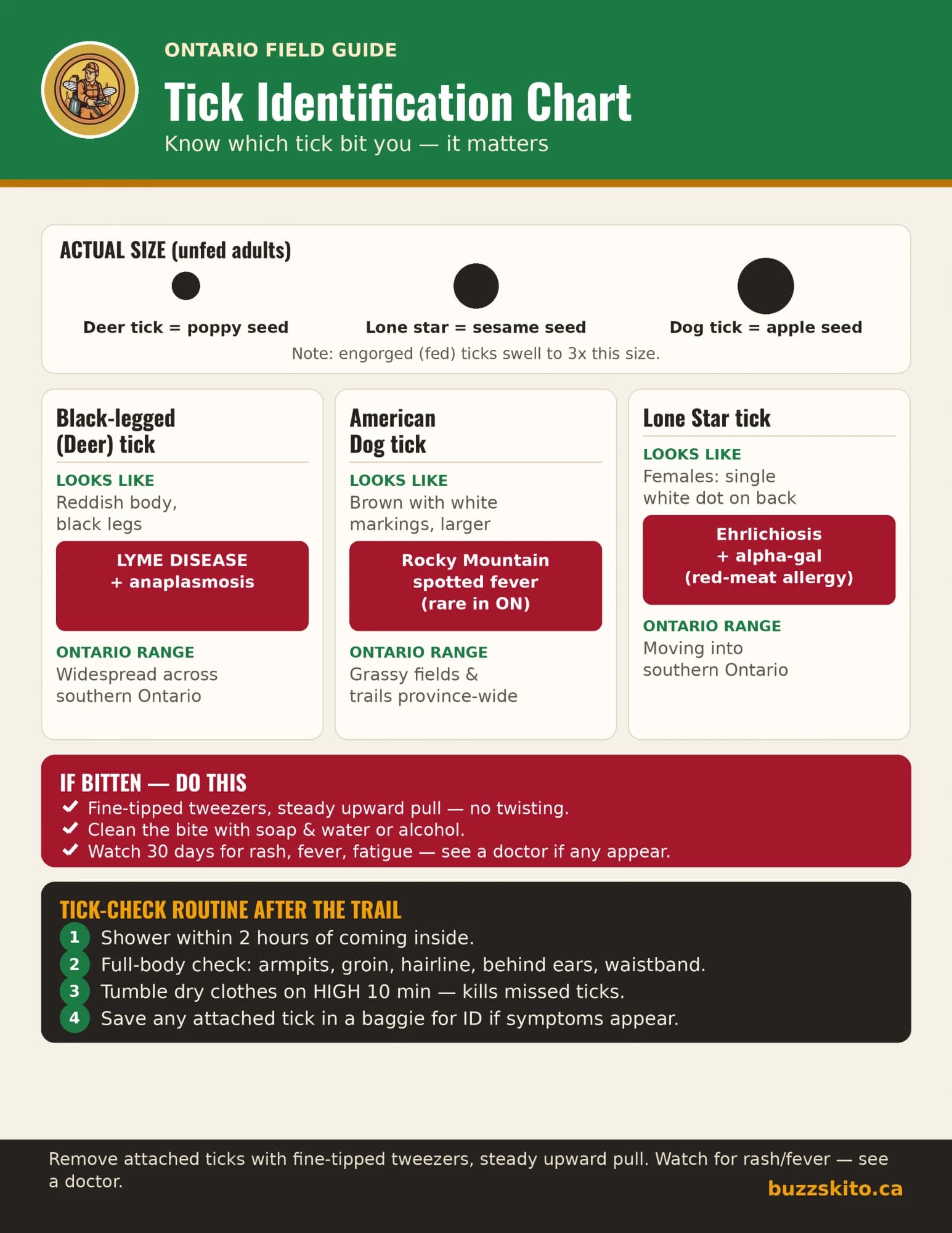
If you find a tick on your dog, stay calm and remove it right away with fine-tipped tweezers — grasp it at the head, pull straight up without twisting, and save it in a sealed bag. Most single tick bites do not cause illness when the tick is removed promptly.
- A blacklegged tick usually must stay attached 24+ hours before it can transmit Lyme disease, so fast removal sharply lowers the risk.
- An unfed tick is 1–3 mm (sesame-seed sized) and flat; a tick attached 36+ hours is engorged, grape-sized, and grey-blue.
- Lyme disease symptoms in dogs typically appear 2 to 5 months after the bite, not immediately.
- Only 10–30% of blacklegged ticks in Ontario actually carry the Lyme bacterium.
- A 4DX SNAP blood test takes about 8 minutes and screens for Lyme, ehrlichiosis, anaplasmosis, and heartworm.
- eTick.ca offers free tick identification in Ontario, run by Bishop’s University.
— BuzzSkito, GTA mosquito & tick control · 150+ five-star Google reviews
First — take a breath. You have time. Most blacklegged ticks need to be attached for 24 hours or more before they can transmit Lyme disease. Removing the tick correctly within the first day dramatically reduces any risk. Here’s exactly what to do, in order.
As an Amazon Associate I earn from qualifying purchases. BuzzSkito only points to products we would genuinely use or recommend, at no extra cost to you.
⏱️ Do This in the Next 5 Minutes
- Find fine-tipped tweezers (eyebrow tweezers work).
- Grasp the tick at the HEAD, as close to your dog’s skin as possible.
- Pull straight up — slow, steady pressure. No twisting.
- Clean the bite with rubbing alcohol or soap and water.
- Save the tick in a sealed plastic bag (label with date).
Step 1: Don’t Use Old Wives’ Tales
Before you do anything else, please do not try to suffocate the tick with petroleum jelly, kill it with rubbing alcohol while it’s still attached, or burn it off with a hot match. These methods don’t kill the tick fast enough — they cause it to regurgitate stomach contents into your dog, increasing the chance of disease transmission. Modern veterinary guidance is unanimous: mechanical removal with tweezers is the only correct method.
Step 2: Estimate How Long the Tick Has Been Attached
This is the most important detail for assessing risk. Look at the tick’s body:
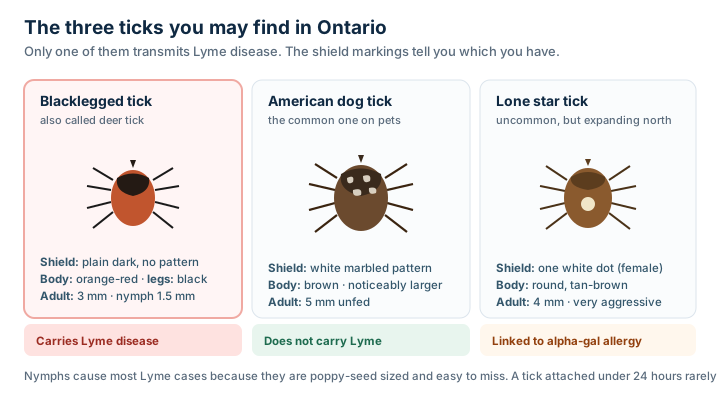
- Flat and small (1–3 mm), sesame-seed sized → Just attached or feeding less than 12 hours. Lyme risk is very low.
- Slightly rounded, pea-sized darker red → 12–24 hours. Risk still low but rising.
- Engorged, grape-shaped, grey-blue or olive coloured → 36+ hours. Lyme transmission window has passed.
If the tick is engorged, call your vet and mention it. If it’s flat and small, you almost certainly caught it in time.
Not certain the bump is even a tick? Our photo walkthrough of what a tick looks like on a dog shows unfed next to engorged, and how to tell a tick apart from a skin tag, a scab, or a flea.
Step 3: Remove the Tick
See our detailed step-by-step removal guide for the exact technique. The short version: tweezers at the head, pull straight up, save the tick in a bag, clean the bite, wash your hands.
Fine-tipped tweezers work in a pinch, but a dedicated tick-removal tool grips right at the head and lifts the tick out cleanly without squeezing its body — worth keeping in the drawer if you have a dog. Our tick removal tool guide compares the common options. Check price on Amazon.ca →
As an Amazon Associate I earn from qualifying purchases. Price shown on Amazon.ca, at no extra cost to you.
🏆 Our Top Pick
8.7/10· BuzzSkito ratingDedicated Tick-Removal Tool (hook or fine-tip set)
For the moment you find a tick, a purpose-built remover grips right at the head and levers the whole tick out without squeezing its body — the single most important thing for lowering disease-transmission risk. Cheap enough to keep one in every drawer and the car.
Pros
- Grips at the head, leaves nothing behind
- No body-squeezing that raises transmission risk
- Works on dogs, cats, and people
- Inexpensive and lasts for years
Cons
- A tool alone does not replace monthly vet preventatives
- Still need to save the tick for identification
Step 4: Note the Date and Location
Write down the date you found the tick and where on your dog’s body it was attached. If your dog develops symptoms in the next 5 months, your vet will want this information. Lyme disease symptoms in dogs typically appear 2 to 5 months after the bite — not immediately.
Step 5: Watch for Symptoms (For 5 Months)
Most tick bites are uneventful. But if Lyme disease was transmitted, you may see one or more of these symptoms in the months that follow:
- Lameness that shifts from one leg to another (the most common Lyme sign in dogs)
- Lethargy and reduced energy
- Loss of appetite
- Fever
- Swollen lymph nodes (under the jaw or behind the knee)
- Joint stiffness or reluctance to jump on furniture
If any of these appear, see your vet and mention the tick. A 4DX SNAP test takes 8 minutes and screens for Lyme, ehrlichiosis, anaplasmosis, and heartworm.
Worth knowing before that appointment: only a small share of infected dogs ever get sick, and a positive test in a dog with no symptoms is not automatically treated the same way as an ill one. Our guide on whether dogs get Lyme disease from ticks walks through the signs, the stages, and how vets decide.
For the bite site itself — what the lump should look like in the first days, what counts as normal irritation, and the point at which it stops being normal — see our guide to tick bite symptoms on a dog, which lays the whole watch period out as a timeline.
Should You Take the Tick to a Vet or Lab?
Two free options exist in Ontario:
- eTick.ca — submit a photo of the tick. Bishop’s University identifies the species and tells you if it’s a Lyme-carrier (blacklegged). Free, takes 1–3 days.
- Public Health Ontario — accepts physical tick submissions through public health units in some regions.
However: knowing the tick was a blacklegged species does NOT mean Lyme was transmitted. Only 10–30% of blacklegged ticks in Ontario actually carry the bacterium, and most attached ticks are removed before transmission. The most reliable approach is monitoring your dog and testing if anything unusual develops.
How to Stop Finding More Ticks on Your Dog
Finding one tick usually means there are more in your dog’s environment. The four-layer prevention strategy:
- Vet-prescribed monthly preventative (oral like Bravecto, Simparica, NexGard or topical like K9 Advantix). Your vet can advise which one suits your dog.
- Daily tick checks after walks. Ears, armpits, paws, tail base, neck.
- Yard maintenance: short grass, no leaf litter at lawn edges, 3-foot gravel barrier between lawn and woods.
- Professional yard tick spray: BuzzSkito’s 5-spray season program targets the leaf-litter and lawn-edge zones where ticks wait, repeated through the season. It lowers how often your dog meets a tick at home; it does not replace a vet preventative or daily checks.
Between vet visits, a topical or spray-on repellent adds a layer of protection for walks in tall grass — see our guide to tick repellent for dogs in Ontario for what to look for and what to avoid. Check price on Amazon.ca → Always confirm any new product with your vet before applying it to your dog.
Related Reading
- Detailed Tick Removal Step-by-Step
- Lyme Disease Prevention
- Tick Bite Symptoms
- Spring Tick Season in Ontario
- Ontario Lyme Risk Areas Map
Frequently Asked Questions
I found a tick on my dog — should I be worried?+
Don't panic, but act quickly. The risk of disease transmission depends on three things: how long the tick was attached (24+ hours raises Lyme risk significantly), what species it is (blacklegged ticks transmit Lyme disease, dog ticks generally do not), and whether your dog has up-to-date tick preventatives. Most single tick bites do not cause illness if removed properly. Remove the tick within minutes using fine-tipped tweezers, save it in a sealed bag, and watch your dog for symptoms over the next 2–5 months.
How do I know if a tick has been on my dog for too long?+
Look at the tick's body. An unfed tick is small, flat, and oval — about the size of a sesame seed (1–3 mm). A tick that has been feeding for 12–24 hours is partly engorged and looks rounder. A tick that has been attached for 36+ hours is grape- or pea-sized, grey-blue or olive coloured, and clearly bloated. The 24-hour mark is the key threshold for Lyme disease transmission risk in Ontario.
What should I do immediately after finding a tick on my dog?+
Step 1: Get fine-tipped tweezers or a tick-removal tool. Step 2: Grasp the tick at the head, as close to your dog's skin as possible. Step 3: Pull straight up with steady pressure — no twisting, no squeezing the body. Step 4: Clean the bite with rubbing alcohol or soap and water. Step 5: Save the tick in a sealed plastic bag with a damp paper towel for identification. Step 6: Note the date and watch for symptoms over the next 5 months. Step 7: Consider calling your vet if the tick was attached for 24+ hours.
Do I need to take my dog to the vet after finding a tick?+
Not always. Most single tick bites resolve without any veterinary intervention if the tick is removed promptly and your dog is on monthly tick preventatives. However, you should call your vet if: the tick was attached for 24+ hours, you find multiple ticks, you see a bullseye rash, your dog develops symptoms like fever, lameness, lethargy, or loss of appetite, the mouthparts broke off and the bite area is becoming infected, or you live in an Ontario tick hotspot and want a Lyme/4DX screening.
How long can a tick live on a dog?+
A feeding female tick will stay attached for 5–10 days, slowly engorging with blood, before dropping off to lay eggs. Male ticks may attach briefly to feed but typically don't engorge to the same size. The key point: every additional hour a tick remains attached increases disease transmission risk. Daily tick checks during tick season (April–November in Ontario) are the most effective prevention against missed attachments.
Can ticks jump from my dog to me?+
Ticks do not jump or fly. However, an unattached tick that crawled onto your dog from grass or vegetation can crawl from your dog onto you while you're petting them or while they're on the couch. After removing a tick from your dog, wash your hands thoroughly. Adult blacklegged ticks bite humans and transmit Lyme disease just as they do to dogs. Always check yourself for ticks after handling a dog that's been in tick habitat.
Should I have the tick tested for Lyme disease?+
You can submit ticks for testing in Ontario through the eTick.ca program (free, run by Bishop's University) or through some private labs. The tick is photographed and identified, and you're told if it's a species that can carry Lyme. eTick is fast and free. However, knowing a tick was a blacklegged species doesn't mean it transmitted Lyme — only 10–30% of blacklegged ticks in Ontario actually carry Borrelia bacteria. The more reliable approach is monitoring your dog for symptoms over the next 5 months and getting a 4DX blood test from your vet if anything unusual develops.
How do I prevent finding ticks on my dog again?+
A combined approach works best: (1) Monthly vet-prescribed tick preventative for your dog. (2) Keep your lawn mowed short and clear leaf litter from edges. (3) Avoid tall grass and brushy areas during walks. (4) Daily tick checks after every outdoor walk in tick season. (5) Professional tick barrier spray for your yard — BuzzSkito's 5-spray season program puts a registered residual acaricide, applied according to label directions, on the leaf litter, lawn edges and fence lines where ticks wait, repeated through the season. It reduces the odds of an encounter at home; it does not clear a property, so keep doing steps 1 and 4.