BuzzSkito Mosquito & Tick Control Specialists · Published May 28, 2026
Quick Answer
On a typical GTA lot, professional barrier spray beats a DIY toolkit: a diligent DIY stack costs about $500–$725 a summer in materials alone and is built from short-range, short-lived tools you have to keep re-running, while a professional barrier-spray season treats the resting vegetation across the whole lot and renews a residual there on a schedule, with no labour on your part. The best strategy is professional spray as the foundation with targeted DIY as the supplement.
- A full DIY mosquito toolkit costs roughly $500–$725 per GTA summer plus 30–40 hours of labour.
- DIY tactics are short-range and short-lived; professional barrier spray covers the whole lot and leaves a residual that is renewed on a schedule.
- A professional single treatment starts at $99; a 5-spray basic season is $549 and a 10-spray standard season is $994.
- Professional barrier spray leaves a residual on treated vegetation and is re-applied on a schedule (monthly, every 2 weeks, or weekly).
- BTi dunks give 95%+ larval kill for 30 days but do nothing for adult mosquitoes already biting.
- University research found only 0.22% of insects killed by bug zappers were biting mosquitoes.
— BuzzSkito, GTA mosquito & tick control · 150+ five-star Google reviews
Why this comparison matters in the GTA specifically
The GTA mosquito season runs from late May through late September, with peak pressure from late June through August. The combination of humid Lake Ontario summers, dense ravine green space, abundant standing water (gutters, ponds, retention basins), and rising species diversity (Asian tiger mosquito establishment is now confirmed in southern Ontario) means a typical suburban GTA backyard faces meaningful mosquito pressure for 12-14 weeks per year.
That length-of-season matters for the DIY-vs-professional comparison. A one-week vacation in Muskoka, you can manage with a head net, DEET, and a citronella candle. A 14-week season in your own backyard — where you want to garden, host barbecues, let kids play in the grass at dusk, sit on the patio with a drink at 8pm — requires sustained protection. The DIY toolkit and the professional service are competing for the same job: keep your yard usable through the worst weeks. Here is what each actually delivers.
The full DIY mosquito control toolkit
As an Amazon Associate I earn from qualifying purchases. BuzzSkito only points to products we would genuinely use or recommend, at no extra cost to you.
BTi mosquito dunks and granules (Bacillus thuringiensis israelensis)
The single most effective DIY product. BTi is a naturally-occurring bacterium that produces toxins specific to mosquito, black fly, and fungus gnat larvae. It is not a broad-spectrum insecticide. Dunks ($1-$2 each) drop into standing water — birdbaths, rain barrels, plant saucers, ponds, French drains, retention basins — and the product label rates them to kill mosquito larvae within 24 hours. One dunk is labelled to treat 100 square feet of water for 30 days. Granules ($25 for a 32-oz container) work the same way for shallow water.
Verdict: Genuinely effective for what they do. If you have any standing water on the property, BTi is the highest-leverage DIY investment you can make. It does nothing for adult mosquitoes already biting in your yard.
As an Amazon Associate I earn from qualifying purchases. Price shown on Amazon.ca, at no extra cost to you.
🏆 Best DIY Product
8.7/10· BuzzSkito ratingThe single most effective DIY product in this guide. Drop one into any standing water — birdbaths, rain barrels, plant saucers, ponds, French drains — and the label rates it to kill larvae within 24 hours and keep working for 30 days, breaking the breeding cycle. Its toxin targets mosquito, black fly, and fungus gnat larvae rather than acting as a broad-spectrum insecticide. It won't touch adult mosquitoes already biting, so pair it with yard treatment for full coverage.
Pros
- 95%+ larval kill in treated water
- One dunk lasts ~30 days per 100 sq ft
- Larvae-specific, not broad-spectrum
Cons
- Only works on standing water you can find
- Does nothing for adult biters already in the yard
Thermacell
Thermacell units burn an allethrin pad over a butane heater and create a 4-metre cloud of mosquito-repellent vapour. Independent research (including studies funded by the US Centers for Disease Control) shows 75-95% bite reduction within the protected zone while the unit is operating. Cost: $40 for the unit, $10 per refill pack (good for ~12 hours), $200-$300 for a season of regular patio use.
Verdict: Excellent for stationary outdoor activity (patio dining, deck reading). Useless for moving around the yard or for protecting children playing in the grass. Best used as a supplement, not a standalone solution. For the current rechargeable lineup, see our full Thermacell E90 Canada review.
Citronella candles, torches, and incense
Citronella oil is a registered mosquito repellent. The effect is real but narrow: a typical citronella candle creates a 1-2 metre repellent zone in low wind, much smaller in any breeze. Cost: $35-$60 for a season of regular use.
Verdict: Marginal effectiveness. Pleasant ambience. Do not rely on citronella as a primary defence for a meaningful outdoor area. The Mayo Clinic and the US Environmental Protection Agency both place citronella substantially below DEET and picaridin for personal protection.
Hose-end and tank lawn perimeter sprays (Cutter Backyard Bug Control, OFF! Yard, Repel)
These products advertise "up to 12 weeks of protection" — the claim is misleading. The active ingredients are pyrethroid family chemistries (lambda-cyhalothrin, bifenthrin, gamma-cyhalothrin) similar to what professional services use, but the consumer-product formulations evaporate within 4-24 hours rather than binding to surfaces with the residual professional applications achieve. Independent testing (Consumer Reports, university extension services) consistently shows 20-40% mosquito reduction in the first 48 hours, declining to background levels by day 5-7.
Verdict: Modest short-term effect, often misapplied (wrong concentration, wrong timing, sprayed on flowering plants harming pollinators). Bottle cost runs $15-$25 per application; biweekly application across the season runs $60-$120. Pay attention to the label — most prohibit application within 30m of water, on edibles, or on flowering ornamentals where bees are active. The combination of mediocre effectiveness, frequent reapplication, and inconsistent application makes these poor value compared to professional service at comparable seasonal cost.
Mosquito Magnet, Dynatrap, Skeetervac, CO2 traps
These units bait mosquitoes with carbon dioxide (mimicking human breath) plus octenol or other attractants, then capture them in a net or vacuum. Unit cost ranges from $200 (Dynatrap basic) to $700 (Mosquito Magnet Patriot). Operating cost runs $250-$400 per season (propane, attractant cartridges, replacement parts). University research shows 30-60% population reduction in a treated area after 6+ weeks of continuous operation — but the reduction is species-specific (most effective against Culex, weaker against Aedes), the unit must run continuously, and the placement matters enormously (10m from any area where humans will be, downwind).
Verdict: Genuine effect on populations over time. Significant equipment investment, ongoing operating costs, slow ramp-up (population reduction is not immediate), and species-specific. For a single backyard, the cost-effectiveness ratio is below professional barrier spray. Better suited to larger acreage where running multiple units across the property makes sense.
Bug zappers (UV light traps)
The University of Delaware ran the definitive study: of 13,789 insects killed by residential bug zappers over a study period, only 31 were biting mosquitoes — 0.22%. The rest were beneficial insects (moths, lacewings, parasitic wasps). Bug zappers are an ecological disaster and contribute essentially nothing to mosquito control.
Verdict: Do not buy. The marketing is decades old. The science is unambiguous. If you are still tempted, read our Flowtron BK-40D review first — it walks through exactly what the best-selling zapper does and does not kill.
Permethrin-treated clothing
This is the single most effective personal protection layer available — and one of the least known. Permethrin (a pyrethroid) is bonded to the fabric of factory pre-treated garments, which is the format permitted for Canadian consumers — a spray-on treatment you apply to clothing yourself is not approved here (our permethrin Canada guide explains why). Mosquitoes, ticks, and black flies that contact treated fabric are knocked down within seconds. Cost: roughly $40-$120 per garment. Permethrin-treated pants, socks, and long sleeves are the gold standard for outdoor work, hiking, gardening near tick habitat, and outdoor evening activity.
Verdict: Highly effective for personal protection. Does not protect the yard. Best used in combination with yard treatment, especially for ravine walkers and outdoor workers.
DEET, picaridin, and oil of lemon eucalyptus personal repellents
DEET (25-30%) and picaridin (20%) are the two repellents with the most research and the strongest field performance. Both deliver 5-8 hours of personal protection. Oil of lemon eucalyptus (OLE) at 30% delivers 2-4 hours of protection — useful for shorter outings. Cost: $10-$15 per bottle, $40-$60 for a family across the season.
Verdict: Essential layer for any outdoor activity. Does not affect the yard mosquito population.
Professional barrier spray — what you actually get
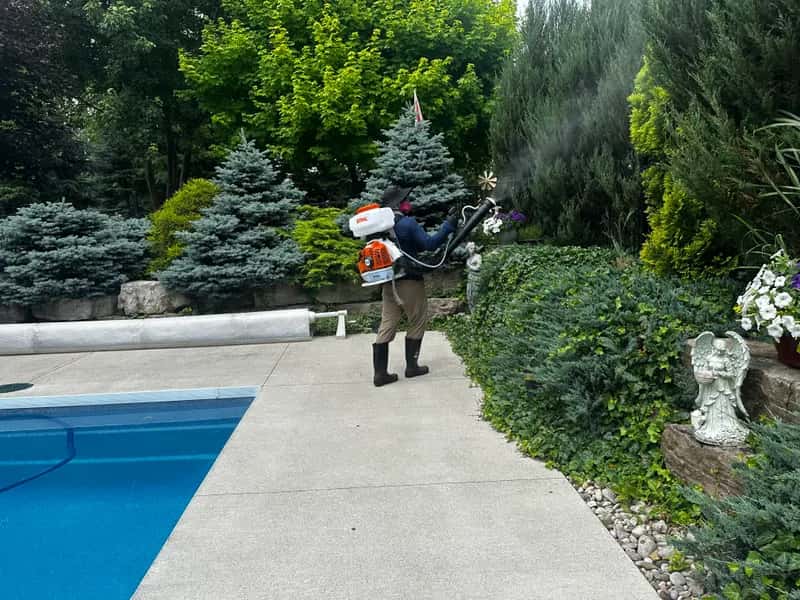
A professional yard treatment uses a PCP-registered residual pyrethroid (typically deltamethrin, lambda-cyhalothrin, or bifenthrin) applied at a label-specified concentration through a precision backpack sprayer. The applicator targets the surfaces where mosquitoes rest between feeding bouts: shrub interiors, the underside of leaves, fence lines, dense ornamental beds, the lawn-to-bed transition, woodpiles, and shaded fence corners. The formulation dries on plant surfaces and leaves a residual that knocks down mosquitoes on contact with treated foliage, which is why it is re-applied on a schedule.
We are not going to put a percentage on our own service without a study behind it. The structural advantage over DIY is coverage and persistence: a licensed applicator treats every shaded resting site across the lot — leaf undersides, shrub interiors, fence-line vegetation, under decks — with a residual product, renewed at each scheduled visit. No consumer-grade tactic covers that much surface area. What none of them do, ours included, is clear a yard: mosquitoes disperse in from neighbouring properties continuously.
What a season of professional service costs in the GTA
- Single treatment: $99 standard lot under 10,000 sq ft. Useful for events.
- Basic season (5 sprays, monthly May-September): $549. Coverage every 4-5 weeks. Best fit for properties with moderate pressure or budget constraints.
- Standard season (10 sprays, bi-weekly May-September): $994. Most popular. A treatment every 2 weeks through the mosquito-active window. Best fit for most GTA suburban properties.
- Exclusive season (20+ sprays, weekly May-September): $2,049. Weekly treatment for high-pressure properties. Best fit for large lots, ravine-adjacent properties, frequent outdoor entertaining.
Lot size scaling applies for properties above 10,000 sq ft. For a full cost breakdown including the underlying economics, see our mosquito control cost page and the related Ontario cost guide.
The cost math — head-to-head
A diligent DIY mosquito program for a GTA backyard, including everything a serious homeowner would use:
- Thermacell unit + 5 refill packs: $90
- BTi mosquito dunks for standing water: $25
- 5 bottles of hose-end perimeter spray applied biweekly: $90
- Citronella candles for season-long patio use: $40
- Family DEET/picaridin supply: $50
- Permethrin-treated socks for 2 family members: $50
- Dynatrap basic unit + replacement attractants: $230
- Replacement Thermacell mat refills, additional candles, additional repellent through season: $80
DIY total: roughly $655 in materials, plus 30-40 hours of personal time across the May-September season.
Professional standard season program: $549 for 5 sprays (basic) or $994 for 10 sprays (standard). The basic season is below the DIY material total. The standard season is moderately above it. Either eliminates the labour entirely.
The cost math is closer than most homeowners assume. The coverage gap is where the real difference lives — and on time-cost, the professional service is overwhelmingly more efficient.
Effectiveness comparison — head-to-head
Headline numbers, drawn from independent university extension research, manufacturer-funded studies (read with caveats), and independent consumer testing where available:
- Bug zappers: ~0% mosquito reduction
- Citronella candles: 5-15% reduction within 1-2m
- Consumer hose-end sprays at peak day: 20-40% reduction; declines to background within 5-7 days
- BTi dunks in treated standing water: 95%+ larval kill for 30 days (does nothing for adults already on property)
- Thermacell within 4m protected zone while running: 75-95% bite reduction
- Mosquito Magnet / Dynatrap after 6 weeks continuous operation: 30-60% population reduction
- Permethrin-treated clothing: 90%+ personal protection
- DEET/picaridin on exposed skin: 90%+ personal protection
- Professional barrier spray on yard: residual on treated resting vegetation, renewed at each scheduled visit
The pattern is clear: the personal protection tactics (DEET, permethrin clothing) are highly effective on the body but do not protect the yard. The yard-protective DIY tactics are limited by range and by how fast their actives break down. Professional barrier spray is the only intervention here that treats the resting vegetation across an entire lot and renews a residual on it at each scheduled visit — though it too has a limit, since mosquitoes disperse in continuously from neighbouring properties.
Safety comparison — the honest answer
Two very different concerns: human/pet safety, and pollinator/beneficial-insect safety.
Human and pet safety
The real difference between professional and consumer-applied products is how they are applied. Three reasons. First, professional applicators are licensed by the Ontario Ministry of the Environment under the Ontario Pesticide Operator Licence — meaning they have passed training on application protocols, label compliance, and handling practices. Second, products are applied at the label rate with calibrated equipment; consumer products are routinely over-concentrated by homeowners. Third, the label’s re-entry direction is followed and explained: stay off treated areas until the spray has dried. For more on pet and child safety specifically, see is mosquito spray safe for kids and pets.
Pollinator safety
This is the legitimate concern. Pyrethroid-based barrier sprays — both professional and consumer — are toxic to bees, butterflies, and beneficial insects on direct contact. Three protocols matter for responsible professional application: do not spray flowering plants or active pollinator zones; follow the label’s timing and weather directions; target shrub interiors, fence lines, and the underside of leaves rather than blossoms.
The widespread consumer misuse of hose-end sprays — applied at peak pollinator activity, sprayed directly on flowering ornamentals, mixed at higher-than-label concentrations — drives substantially more pollinator harm than disciplined professional application. The honest position is that any insecticide use has environmental cost; the goal is to minimize the cost per unit of mosquito reduction, and professional application has the better ratio.
The climate context — why DIY struggles in the 2026 GTA
A humid GTA summer in 2026 generates aggressive mosquito pressure. The conditions that drive mosquito reproduction — warm nights, frequent rain, abundant standing water in gutters, plant saucers, retention basins, and ravine drainage — exceed what casual DIY effort can keep up with. A homeowner who diligently empties standing water every three days, applies Thermacell every patio session, and reapplies hose-end spray biweekly will reduce pressure meaningfully. But they will still face nights when the patio is unusable and dusk-to-dawn windows when the kids cannot play outside.
Professional barrier spray applied every two weeks across May-September renews the residual on schedule through the entire pressure window, so results do not hinge on any single application. This is the structural reason professional treatment suits a GTA suburban lot specifically — the climate generates pressure faster than weekend application can suppress.
When DIY makes sense (the honest case)
Not every property needs professional service. DIY is the right choice if:
- Your lot is small (under 3,000 sq ft) and urban
- You are not within 1km of major water (Credit River, Don Valley, 16 Mile Creek, Bronte Creek, RBG, Cootes Paradise, Lake Ontario)
- Your yard is dry — no standing water, no irrigation ponds, no leaf-clogged gutters
- You use the yard occasionally rather than daily
- You have no young children playing outside daily, and no one with severe bite reactions
- You are comfortable with short-range, short-lived tools you re-run yourself rather than a residual maintained across the whole lot
For these properties, a focused DIY stack — Thermacell on the patio, BTi anywhere standing water exists, permethrin-treated clothing for ravine walks, DEET for evenings — covers the realistic use case at minimum cost.
When professional makes sense (the structural case)
Professional barrier spray is the better economic decision when:
- Your property is within 1km of major water (most of the GTA suburbs)
- Your lot exceeds 5,000 sq ft
- You have young children playing outside daily
- You entertain or host outdoor gatherings more than 2-3 times per month
- You have a pet (especially dogs) using the yard daily
- Your time is worth more than $20/hour and you would rather not spend 30-40 hours per summer on mosquito management
- You want treatment on a predictable schedule rather than ad-hoc effort
For most GTA suburban properties — Mississauga, Oakville, Burlington, Hamilton, Brampton, Vaughan, Markham, Etobicoke, Scarborough, North York — this list applies. The BuzzSkito mosquito control service is built around exactly this profile.
The hybrid stack (what actually works best)
For most homeowners, the optimal strategy is not professional-only or DIY-only. It is professional barrier spray as the spine, with targeted DIY as the supplement.
- Professional barrier spray every 2-3 weeks (May-September) — the foundation. It puts a residual on the shaded resting vegetation across the whole lot and the rolling re-treatments keep it there, but mosquitoes disperse back in continuously from neighbouring properties, which is why it is repeated rather than one-and-done.
- BTi dunks in any standing water — treats breeding sources on your property at trivial cost.
- Thermacell on the patio during peak hours — puts a repellent vapour cloud over the seating area itself, roughly 4 metres across. It does nothing outside that radius and nothing once the unit is switched off.
- Permethrin-treated pants and socks for outdoor work, gardening near edges, ravine walks — personal protection layer.
- DEET or picaridin for outings beyond the treated yard — covers exposure off-property.
This stack costs roughly $700-$1,200 across a GTA summer ($549-$994 professional + $150-$200 DIY supplements). It is the recommendation we make to most clients — DIY does not go away, it gets focused on the gaps the professional treatment cannot address: the seating area while you are sitting in it, the standing water breeding on your own lot, and your body once you leave the treated yard. No combination of these eliminates mosquitoes, because adults keep dispersing in from off-property.
Mosquitoes are not the whole story — the tick add-on
The DIY-vs-professional analysis above applies to mosquitoes. For ticks, the calculus shifts further toward professional treatment because DIY tick options are even more limited (permethrin on clothing, lawn perimeter sprays, habitat modification — that is essentially the full toolkit) and the disease risk (Lyme, anaplasmosis) is higher than mosquito-borne disease risk in the GTA. If your property faces both pressures — which is most properties — the tick add-on bundle with mosquito service is $497 for the tick portion (5 sprays per season, saving $100 versus the $597 standalone). Treating for both on the same visit is the most efficient way to cover the two pests.
The honest recommendation
Most GTA suburban backyards are too pressured for DIY-only mosquito control to deliver acceptable outcomes. Professional barrier spray is the one intervention here that treats the whole lot, and the cost is closer to a serious DIY program than most homeowners realize. The right strategy for most properties is professional barrier spray as the foundation, supplemented by Thermacell on the patio, BTi anywhere standing water exists, permethrin-treated clothing for outdoor work, and personal repellent for off-property outings.
For Mississauga properties near the Credit River, Oakville and Burlington properties along 16 Mile Creek and the escarpment foot, Toronto properties in the Don Valley or Humber corridor, Hamilton properties bordering Cootes Paradise or the escarpment, Brampton properties near Heart Lake, Vaughan properties along the Humber, Markham properties near Rouge Park — the professional case is overwhelming. For dense urban downtown Toronto properties on small lots far from water, the DIY case is more competitive.
The fastest way to decide for your specific address is the free yard risk report. It calculates an address-specific 1-100 score in under 90 seconds using your neighbourhood pressure data, water and forest proximity, lot characteristics, and family-situation factors. Properties scoring 70+ are in the band where professional yard treatment is strongly recommended; properties below 40 can probably manage with DIY.