BuzzSkito Mosquito & Tick Control Specialists · Published August 22, 2026
Jump to current Canadian availability — the complete system, and the battery that decides how long it runs:
Why This Is a Real Purchase in Ontario
A sump pump is the only appliance in a Canadian house whose failure is measured in drywall. And the reason a battery backup exists is not that primary pumps are unreliable — a decent submersible runs for years. It is that the two failures are correlated. The hours a GTA basement is most likely to flood are the hours the grid is most likely to be down: freezing rain loading the lines in March, and the fast-moving convective cells that knock out power across Mississauga, Brampton and Etobicoke in June and July, arriving with 30–50 mm of rain in under an hour.
That correlation is why the Insurance Bureau of Canada puts a battery-operated backup pump and a basement water alarm on the same homeowner checklist as backwater valves and downspout extensions. It is also why this search is worth taking seriously rather than skimming: the person reading it usually has a wet spot on a finished floor, or a neighbour who just did.
Weeping tile makes it worse in older Ontario housing stock. On a lot where the foundation drains discharge into the pit rather than to a storm connection, the pit does not stop filling when the power goes out. It fills faster, because the ground around the footings is saturated. A primary pump with no electricity is not a slow leak — it is a rising pit with nowhere to go.
The Specification That Actually Matters (It Is Not GPH)
Every backup pump on the shelf leads with a gallons-per-hour figure. Treat that number as marketing until you know two things: what lift it was measured at, and what your battery can actually supply.
Head height eats the headline. A pump rated at, say, 1,000 GPH is usually quoted at zero or minimal lift. A real Ontario basement pumps 8 to 10 feet vertically out of the pit, then runs horizontally to a discharge point well clear of the foundation. Every foot of vertical lift and every elbow costs flow. Look for the manufacturer’s flow figure at 10 feet, not the number on the front of the box, and compare pumps at the same head.
The real spec is gallons per amp-hour. A backup pump is a battery-powered device, so the only figure that predicts how it behaves in a two-day outage is how much water it moves per amp-hour consumed at your head height. Two pumps with identical GPH ratings can differ substantially here, and the more efficient one buys you hours of extra protection off the same battery. Good manufacturers publish it. When a listing does not, that silence tells you something.
Battery capacity is the other half. A group 27 deep-cycle AGM lands somewhere around 75–100 amp-hours; a group 31 goes higher. Multiply that by the pump’s gallons per amp-hour and you have your genuine reserve, expressed in gallons. Compare it against what your pit does on a bad night. If you have ever watched your primary cycle every ninety seconds for an hour, you already know that number is bigger than you would like.
The Mistake Most Canadian Buyers Make
Three of them, actually, and all three are installation rather than product choice.
One discharge pipe, one check valve. The most common error is teeing the backup into the primary’s discharge line without giving each pump its own check valve. When the backup fires, part of what it pushes goes straight back down through the dead primary and into the pit. The pump runs, the battery drains, and the water level barely moves. Each pump needs a check valve on its own leg above the tee. This is a $25 part and it is the difference between a system that works and a system that looks like it works.
The battery in the garage. Lead-acid capacity is temperature-dependent, and the relationship is unkind: a battery sitting near freezing can deliver well under half its rated reserve. An attached Ontario garage in March is exactly that environment. Put the battery in the conditioned basement, off the floor, in a vented box — and remember a battery box beside a pit is something children and pets will investigate.
Never testing it. A dead battery is visually identical to a live one. Twice a year — late March, and again in June — unplug the charger, lift the backup float by hand, and confirm the pump moves water and the alarm sounds. That five-minute test is the entire maintenance programme, and it is the step almost everybody skips.
When the Cheaper Option Is the Right Call
We are not going to pretend everyone needs a $600 system. Three situations where the honest recommendation is to spend less:
- Your pit has never cycled. Some GTA lots — higher ground, sandier soil, a pit installed because code asked for one rather than because water arrives — genuinely do not need a backup. Buy a water alarm, keep a spare primary pump in the box on a shelf, and revisit the decision the first spring the pump actually runs.
- Your failures have been mechanical, not electrical. If what has actually failed is a jammed float or a burnt-out motor while the lights stayed on, a second AC pump on a higher float and a separate circuit solves your real problem for less money and with no battery to replace. Add a generator inlet later if outages become the issue.
- You are on municipal water with strong pressure and the house sits empty for weeks. A water-powered backup has no runtime limit and no battery to die unnoticed. Confirm your municipality permits it and what backflow protection it requires, and accept that it consumes treated water while it runs — but for a house nobody checks, unlimited runtime beats a bigger battery.
The one thing we would not skip at any budget is the alarm. It is the cheapest item on this page and the only one that changes the outcome when everything else has already failed.
Winter, Freeze-Ups, and the Discharge Line
Southern Ontario’s freeze-thaw cycle creates a failure specific to this climate: the discharge line freezes solid during a cold snap, then a January or February thaw fills the pit against a blocked pipe. The pump runs, moves nothing, and burns out or trips.
Two defences. First, slope the exterior discharge so it drains completely between cycles and never terminates in a low spot where meltwater ponds and refreezes. Second, fit a freeze-relief tee near the exit — a deliberate opening that lets the pump dump water at grade rather than deadheading against an ice plug. It is not elegant, and a plumber will point out that it partly defeats the purpose of routing water away, which is true. It is still better than a seized pump in February.
While you are out there in spring: extend the discharge well clear of the foundation, and make sure it is not quietly refilling the same weeping tile that feeds the pit. That closed loop is more common in older GTA neighbourhoods than anyone would like.
The Part Nobody Mentions: A Sump Discharge Is a Mosquito Nursery
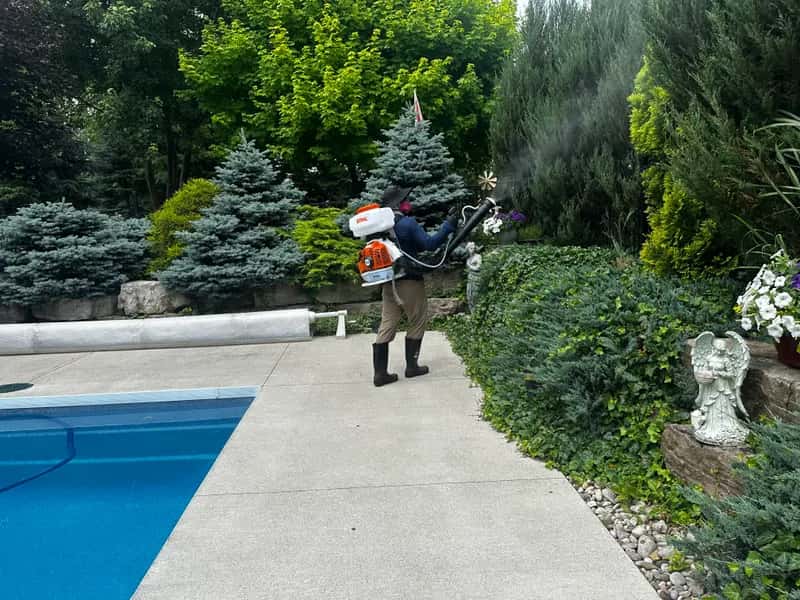
This is our actual field, so allow us the tangent. A sump discharge ending in a splash block, a low corner of the lawn, or a plastic bin someone set there to stop the erosion is standing water refreshed on a schedule — which is close to ideal habitat. Culex mosquitoes need only a few days and a container of water to complete a generation, and a chronically wet discharge zone will out-produce anything else on a suburban lot.
If you are already down there fixing the plumbing, walk the run: standing water is the single strongest predictor of mosquito pressure on a property, and a sump outfall is one of the breeding spots homeowners consistently miss. Getting the water to daylight and away from the house fixes two problems with one trench.
The Other Half of a Wet Basement
A backup pump handles the event. It does nothing about the ambient condition a pit-served basement usually has, which is elevated relative humidity for most of the Ontario summer. Above roughly 60% RH you are running an environment that favours mould, dust mites, silverfish and centipedes — the classic damp-basement lineup.
If the pump runs often, pair it with dehumidification sized to the space: our dehumidifier sizing guide covers the pint-per-day maths, the basement picks cover the units themselves, and if the moisture is arriving through a dirt crawl space rather than the pit, vapour barrier versus dehumidifier is the decision to read first. If the crawlers have already moved in, centipede control starts with drying the space, not with spray.
Where to Buy in Canada
Home Depot Canada and Rona carry the mainstream complete backup systems and stock replacement batteries for them. Canadian Tire is reliable for deep-cycle batteries, battery boxes and alarms. Home Hardware tends to be the best bet outside the GTA for the fittings — check valves, unions, freeze-relief tees — that turn parts into an installation. Plumbing wholesalers such as Wolseley and Bartle & Gibson sell to homeowners in many locations and carry the heavier contractor-grade DC pumps big-box stores do not.
Amazon.ca is the one channel carrying the whole chain year-round: system, spare battery, monitor, alarm, and the small fittings. That matters because this category is bought in a hurry. Nobody researches backup sump pumps in a dry February; they research them on the Sunday after the basement got wet, which is exactly when local stock is thin.
A Sensible Install Checklist
- DC backup pump mounted with its float set above the primary’s, so the primary always runs first.
- A check valve on each pump’s own leg, above the tee into the shared discharge.
- Deep-cycle AGM battery, group 27 or 31, in a vented box, off the floor, in conditioned space.
- Controller plugged into a circuit you can identify — and labelled at the panel.
- An audible alarm at minimum; a Wi-Fi monitor if the house is ever empty for more than a day.
- A sealed pit lid, which also cuts humidity and radon entry from the pit.
- Exterior discharge sloped, extended clear of the foundation, and not draining back into the weeping tile.
- Twice-yearly manual test: unplug the charger, lift the float, confirm water moves and the alarm sounds.
The Bottom Line
Buy the system, not the pump. A DC backup pump on a matched controller, with a group 27 or 31 deep-cycle AGM battery, its own check valve, and an alarm you will actually hear, is what protects an Ontario basement through a March ice storm or a July line-down. Size it by gallons per amp-hour at 10 feet of head, keep the battery warm, and test it twice a year. And if your pit genuinely never runs, buy the alarm and a spare primary and put the difference somewhere it earns more — that is the honest answer, and it is the one most guides will not give you.
Frequently Asked Questions
Do I really need a battery backup sump pump in Ontario?
If your sump pump runs during spring melt or after summer storms, yes. The reason is not that primary pumps fail often — it is that the two failures arrive together. Ontario’s worst basement-flooding hours are the same hours the grid is under strain: wet snow and freezing rain in March, and the fast-moving thunderstorm cells that take down lines across the GTA in June and July. A primary pump with no power is a decoration. The Insurance Bureau of Canada puts a battery-operated backup pump and a water alarm on the same homeowner checklist as backwater valves and downspout extensions for exactly this reason. If your pit is dry all year and your pump has never cycled, a water alarm on its own is a defensible cheaper choice.
How long will a battery backup sump pump run on one charge?
The honest answer is measured in gallons moved, not hours, because a backup pump only runs when the float rises. A group 27 deep-cycle AGM battery in good condition typically carries a DC backup pump through roughly 1,500 to 3,000 gallons of total pumping at a normal Ontario basement lift of 8 to 10 feet, depending on how efficient the pump is. Continuous running — a genuinely flooding pit — drains that in a few hours. Intermittent cycling during a two-day outage can stretch the same battery across the whole event. Manufacturers quote a best-case continuous figure; assume you will get meaningfully less at real head height with a battery that is a couple of years old.
What size battery does a backup sump pump need?
A group 27 or group 31 deep-cycle battery is the standard pairing, in the range of roughly 75 to 110 amp-hours. Deep-cycle matters more than the group number: it is built to be drained down and recharged repeatedly. Match the battery to the controller — a charger designed for a 75 Ah battery will undercharge a 110 Ah one and shorten its life. If your pit runs hard every spring, two batteries wired in parallel roughly doubles your reserve and is a common upgrade on properties with a high water table.
Can I use a car battery for a sump pump backup?
You can physically wire one in, and it will work once. A car starting battery is engineered to deliver a very large current for a few seconds and then be recharged immediately by the alternator, so its plates are thin to maximize surface area. Draining one deeply, which is exactly what a backup sump pump does, damages it. Expect a handful of real outages before it will not hold a useful charge, and expect to discover that on the night it matters. Buy a deep-cycle AGM instead. It is the one component in this system you should not economize on.
Battery backup or water-powered backup sump pump — which is better in Canada?
A water-powered backup uses municipal water pressure to drive an ejector, so it has no battery to maintain and no runtime limit. That is a genuine advantage for a cottage or a house nobody checks for weeks. The catch is specifically Canadian: you must be on municipal water — it does nothing on a well, and a well pump is dead in an outage anyway — you need adequate static pressure, and many Ontario municipalities require a backflow preventer or restrict the installation outright. It also consumes treated water at a meaningful rate while running, which you pay for. On municipal supply with good pressure and a plumber who knows the local bylaw, it is a strong option. Otherwise, battery.
Where should the backup battery be installed?
On a shelf or in a vented battery box beside the pit, in the conditioned part of the basement — not in an attached garage and not in a cold room. Lead-acid capacity falls off sharply as temperature drops, and a battery sitting near freezing can deliver well under half its rated reserve, which is a cruel failure mode in a March thaw. Keep it up off a floor that may flood, keep the terminals clean, and give a flooded (non-sealed) battery the ventilation its manual specifies. AGM batteries are sealed and are the easier choice in a finished basement.
How often do backup sump pump batteries need replacing?
Plan on three to five years for a deep-cycle AGM in a residential backup system, shorter if it has been deeply discharged several times or has spent seasons in a cold corner. The failure is silent, which is the whole problem — a dead battery looks exactly like a live one. Test in March before melt and again in June: unplug the charger, lift the backup float by hand, and confirm the pump actually moves water. A controller with a low-battery alarm, or a Wi-Fi monitor, turns that annual chore into something you find out about the day it happens instead of the day you need it.
Does home insurance in Canada require a sump pump backup?
Requirements vary by insurer and by postal code, so ask your broker rather than assuming. What is broadly true across Canada: sewer backup and overland water are usually optional endorsements rather than base coverage, some insurers will not write those endorsements at all in repeatedly flooded neighbourhoods, and several offer a credit or a lower deductible when a backwater valve and a backup pump are installed. Toronto and a number of other GTA municipalities also run basement flooding protection subsidy programs that can offset part of the plumbing work — terms and amounts change, so check your municipality’s current program page before you book the plumber.