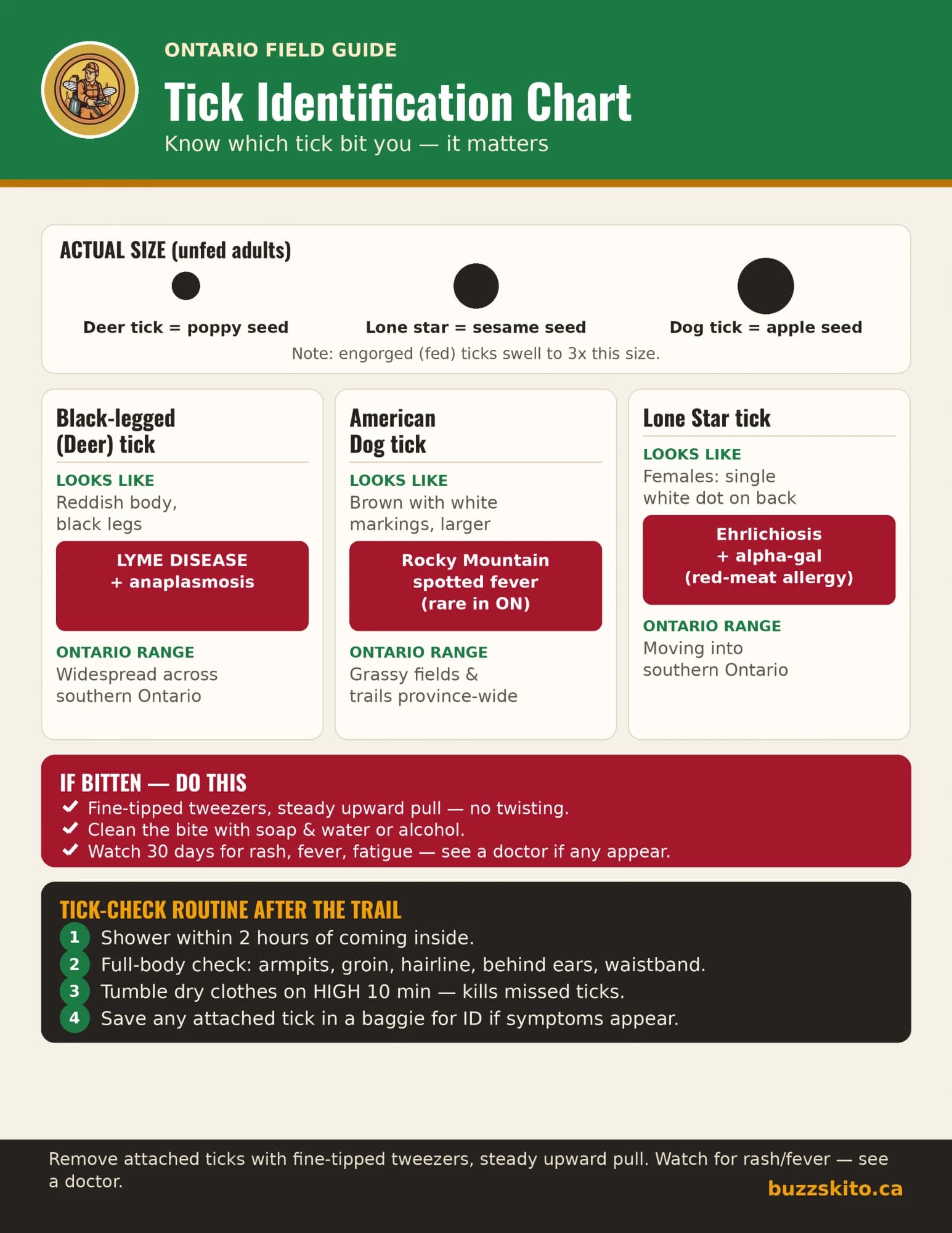
Quick Answer
A tick bite itself is rarely dangerous to a healthy dog — the risk is what the tick may have transmitted, and Lyme disease symptoms can take 2 to 5 months to appear. Remove the tick, note the date, and watch your dog for months, not days.
- A fresh bite is usually a small red bump that heals in 1–2 weeks; about 10% of dogs react more visibly.
- Canine Lyme disease symptoms typically appear 2–5 months after the bite.
- Anaplasmosis shows in 1–2 weeks and ehrlichiosis in 1–3 weeks post-bite.
- Shifting-leg lameness is the most common sign of Lyme in dogs; the bull’s-eye rash is rarely visible under fur.
- Canine Lyme responds well to doxycycline, typically a 28-day course.
- Most yard ticks are picked up at home — professional yard spray targets the leaf litter and lawn edges where they wait.
— BuzzSkito, GTA mosquito & tick control · 150+ five-star Google reviews
BuzzSkito Mosquito & Tick Control Specialists · Published April 26, 2026
A tick bite by itself is rarely dangerous to a healthy dog. The danger is in what the tick may have transmitted — and the tricky part is that disease symptoms can take 2 to 5 months to appear. This guide walks you through what to expect at each stage.
As an Amazon Associate I earn from qualifying purchases. BuzzSkito only points to products we would genuinely use or recommend, at no extra cost to you.
As an Amazon Associate I earn from qualifying purchases. Price shown on Amazon.ca, at no extra cost to you.
🏆 What to keep on hand
8.7/10· BuzzSkito ratingThe single most useful thing to own after a tick bite is a proper removal tool. A fine-tipped tool or pointed tweezers grips close to the skin so you can pull straight out without squeezing the tick's body or leaving mouthparts behind — the exact technique that lowers disease-transmission risk.
Pros
- Grips close to the skin for a clean pull
- Reduces the chance of leaving mouthparts behind
- Cheap, reusable, and worth keeping in every kit
Cons
- Still requires correct straight-out technique
- Not a substitute for vet-prescribed preventatives
What a Tick Bite Looks Like on a Dog
The bite itself is small — usually a slightly raised, reddish bump where the tick was attached. After removal, you may see:
- Day 0–2: Small red lump where the tick was; mild swelling of 1–2 mm.
- Day 2–7: Redness fades; small scab forms; mild crusting normal.
- Day 7–14: Bite area heals fully and disappears.
About 10% of dogs develop a more visible reaction — a larger lump (1–2 cm), localized swelling, or mild itching. This is usually a mild histamine response, not infection. It typically resolves on its own in 1–2 weeks.
Note: The famous “bullseye rash” (erythema migrans) that humans get with early Lyme disease is rarely visible on dogs because of the fur. Don’t look for it.
The Critical Timeline — When to Watch What
Day 1–14 (acute bite)
Watch the local bite area for:
- Spreading redness more than 1 cm (could indicate secondary bacterial infection)
- Warmth, swelling, or pus (infection)
- Excessive licking or biting at the spot (may need an Elizabethan collar)
- Bleeding or open wound that won’t close
If any appear and persist 24+ hours, call your vet.
Day 7–21 (anaplasmosis / ehrlichiosis window)
Two tick-borne infections reported in Ontario — anaplasmosis and ehrlichiosis — show symptoms in this window:
- Lethargy and reduced energy
- Fever (above 39.5°C / 103°F)
- Loss of appetite
- Stiffness or reluctance to move
- Bruising or unusual bleeding (rare but serious)
Month 2–5 (Lyme disease window)
This is the most important window because Lyme is the most common tick-borne disease in Ontario, and the delay makes it easy to miss the link to a tick bite from months prior.
Classic Lyme disease symptoms in dogs:
- Shifting-leg lameness — your dog limps on one leg for a few days, then suddenly limps on a different leg. This is the #1 sign.
- Lethargy and reduced energy
- Loss of appetite
- Fever
- Swollen lymph nodes (under the jaw, behind the knee)
- Joint stiffness, reluctance to jump on furniture or climb stairs
- Up to 95% of dogs with Lyme are asymptomatic — annual 4DX screening recommended in Ontario tick zones
Because those signs surface months after the bite, it pays to know the whole arc before you are in it — how canine Lyme progresses through its three stages, and what treatment and recovery realistically look like.
Long-term (rare but serious)
A small percentage of dogs with untreated Lyme develop Lyme nephritis — a kidney inflammation that is frequently fatal. Watch for: increased thirst and urination, vomiting, weight loss, and weakness. These signs warrant immediate veterinary attention.
What To Do At Each Stage
Day 0: Remove the tick correctly (step-by-step guide). A fine-tipped tick removal tool or pointed tweezers lets you grip close to the skin and pull straight out without leaving mouthparts behind — check price on Amazon.ca →. Clean the bite. Save the tick. Note the date.
Day 1–14: Watch the bite for local infection signs. Most bites heal without intervention.
Week 2–3: Watch for systemic symptoms (fever, lethargy, joint stiffness). If anything appears, call the vet.
Month 2–5: Watch for shifting-leg lameness — the calling card of canine Lyme. If your dog limps on one leg, then a different leg days later, see the vet immediately. A 4DX SNAP test takes 8 minutes.
Annual: If you live in an Ontario tick hotspot (Oak Ridges Moraine, Rouge Park, Bronte Creek, Niagara, cottage country), discuss a 4DX screen with your vet at every annual checkup.
Treatment — If Lyme is Confirmed
Canine Lyme disease responds well to doxycycline, an antibiotic given for 28 days. Most dogs feel significantly better within a week. Treated early, recovery is excellent. Untreated, Lyme can become chronic and lead to Lyme nephritis. Your vet will determine whether your dog needs treatment based on symptoms, antibody levels (4DX), and quantitative C6 testing.
Prevention — The Three-Layer Strategy
- Vet-prescribed monthly preventative (Bravecto, NexGard, Simparica, or K9 Advantix II). These kill ticks before disease transmission. For walks and hikes between doses, a topical or collar-style dog tick repellent (check price on Amazon.ca →) adds a layer of protection — see our guide to tick repellents for dogs in Ontario.
- Daily tick checks after walks. Know what ticks look like. Common spots: ears, armpits, paws, tail base, neck.
- Yard tick control. Most ticks your dog encounters are in your own yard. BuzzSkito’s 5-spray season program treats the leaf litter, lawn edges and fence lines where ticks wait for a host — the places your dog actually brushes past. It lowers the odds of a pickup at home, but it is not a substitute for a vet-prescribed preventative.
Related Reading
- How to Remove a Tick from a Dog
- I Found a Tick on My Dog — What Now?
- Lyme Disease Prevention in Ontario
- Complete List of Ontario Tick-Borne Diseases
- BuzzSkito Tick Control Service
Frequently Asked Questions
What does a tick bite look like on a dog?+
A fresh tick bite typically appears as a small red bump or raised area on the skin where the tick was attached. Once the tick falls off or is removed, you may see a small scab and slight inflammation that resolves over 1–2 weeks. About 10% of dogs develop a more pronounced reaction — a larger red lump, some swelling, or mild itching. The bullseye rash that appears on humans with Lyme disease is rarely visible on dogs because of the fur. The bite itself is rarely dangerous; the disease risk comes from what the tick may have transmitted.
How long after a tick bite will my dog show symptoms?+
Lyme disease symptoms in dogs typically appear 2 to 5 months after a tick bite — not days. This long incubation is why it's easy to miss the connection. By the time symptoms appear, most owners have forgotten about the tick. Other tick-borne diseases have different timelines: anaplasmosis appears 1–2 weeks post-bite, ehrlichiosis 1–3 weeks. Always note the date you found a tick and watch your dog for 5+ months.
What are the early signs of Lyme disease in dogs?+
The classic Lyme disease signs in dogs are: shifting-leg lameness (the most common — your dog limps on one leg, then a different leg days later), lethargy, fever, swollen lymph nodes (under the jaw or behind the knee), loss of appetite, and joint stiffness or reluctance to climb stairs or jump on furniture. Dogs do NOT typically develop the bullseye rash that humans get. If you notice any of these signs after a known or suspected tick bite, see your vet for a 4DX SNAP test.
Can a tick bite kill my dog?+
Tick bites are not directly lethal — but the diseases ticks can transmit can be fatal if untreated. Severe Lyme disease in dogs can progress to Lyme nephritis, a kidney inflammation that is often fatal even with aggressive treatment. Anaplasmosis and ehrlichiosis can cause severe blood disorders. The good news: caught early, all three diseases respond well to doxycycline antibiotic treatment. The key is awareness — note tick bites, watch for symptoms over 5 months, and get prompt veterinary attention if anything seems off.
How do I treat a tick bite on my dog at home?+
After removing the tick correctly with tweezers, clean the bite area with rubbing alcohol or chlorhexidine solution. A small amount of triple antibiotic ointment is fine if there is irritation. Most bites heal within 1–2 weeks without intervention. Don't pick at the area or try to extract anything that's already worked its way into the skin. Watch for: spreading redness (more than 1 cm), warmth, pus or discharge, persistent itching, or your dog excessively licking the spot — these can indicate secondary bacterial infection requiring veterinary attention.
When should I take my dog to the vet for a tick bite?+
See your vet if: the bite area is becoming more red, warm, or swollen 24+ hours later; you suspect the tick was attached for 24+ hours; your dog develops any systemic symptoms (lameness, fever, lethargy, loss of appetite, swollen lymph nodes); you found multiple ticks on your dog; you live in an Ontario tick hotspot and want preventive 4DX testing; the tick's mouthparts broke off and the area is not healing. Routine bites without symptoms generally do not require a vet visit beyond your dog's regular preventative care.
Are some dogs more sensitive to tick bites?+
Yes. Dogs with thin coats, light skin, or known allergies tend to react more visibly to tick bites. Some breeds — particularly Golden Retrievers, Labradors, and Bernese Mountain Dogs — have higher rates of severe Lyme disease complications including Lyme nephritis. Senior dogs and dogs with compromised immune systems are at higher overall risk for tick-borne disease. If your dog falls into these higher-risk categories, prevention (monthly preventative + yard treatment) is especially important.
Can I prevent tick bites on my dog without medication?+
You can reduce — but not eliminate — tick bite risk through behaviour and environment alone. Keep grass mowed short, avoid tall grass on walks, do daily tick checks, create a 3-foot wood chip barrier between lawn and woods. However, vet-prescribed monthly tick preventatives (Bravecto, NexGard, Simparica, K9 Advantix II) are the gold standard. Alongside those, professional yard tick spray targets ticks in your dog's primary environment — your own backyard, where dogs spend the majority of their outdoor time.