BuzzSkito Mosquito & Tick Control Specialists · Published May 1, 2026 · Updated July 12, 2026
Short version: electric zappers don’t reduce mosquito bites. If you want a plug-in device that actually targets mosquitoes, a CO₂/UV trap like DynaTrap is the honest pick:
Why Bug Zappers Don’t Work for Mosquitoes
The biology is simple. UV light attracts insects with strong phototactic responses — moths, beetles, mayflies, and other species that use moonlight and starlight for navigation. Female mosquitoes (the only ones that bite) are not strongly UV-responsive — they hunt for blood meals using CO₂ exhalation, body heat, lactic acid in sweat, and other skin compounds.
This means a bug zapper sitting in your backyard at night attracts hundreds or thousands of moths and beetles — but the female mosquito buzzing at your ear is heading TO YOU specifically because she’s detecting your CO₂ plume. She’ll fly past the bug zapper without noticing it.
The University of Delaware study (Frick & Tallamy, 1996) is the most-cited research. It examined 13,789 insects killed by residential bug zappers over a season. Mosquitoes were 0.22% of total catches. The other 99.78% were beneficial or harmless insects.
The Pollinator Problem
Outdoor bug zappers contribute to nighttime pollinator decline. Moths are the unsung pollinators of the night: a global meta-analysis of 139 plant species found no significant difference in pollination success between day and night for about 90% of them, with nocturnal visitors — overwhelmingly moths — producing significantly greater seed set. Lacewings (commonly zapped) eat aphids and improve garden health. Beetles play roles in nutrient cycling.
The Xerces Society for Invertebrate Conservation recommends against residential outdoor UV bug zappers because of the disproportionate impact on beneficial insects relative to the negligible mosquito reduction, calling them “ludicrously bad at killing pest insects, instead killing scores of benign and beneficial insects.” Xerces also sets out the arithmetic behind the AMCA’s billions figure: roughly 4 million zappers running an average of forty nights a year.
Best Bug Zappers in Canada 2026 (For the Flies & Moths They DO Kill)
Let’s be honest about what a bug zapper is actually good for: nuisance flying insects — moths, gnats, midges, June beetles, the odd wasp — that swarm a patio light on a summer evening. If that’s your goal (a deck that feels less buggy, not fewer mosquito bites), these are the units most often cross-shopped in Canada in 2026, ranked by the job each one does best. We don’t list prices — they change weekly and we don’t track them.
| # | Bug Zapper | Best For | Coverage | Where it turns up in Canada |
|---|---|---|---|---|
| 1 | Flowtron BK-40D Electronic Insect Killer | Best large outdoor (moths & beetles) | Manufacturer-rated up to 1 acre | Home Depot Canada, Amazon.ca |
| 2 | Stinger Cordless Rechargeable Zapper | Best portable / no outlet | Manufacturer-rated ½ acre | Canadian Tire, Amazon.ca |
| 3 | Black+Decker Outdoor Bug Zapper | Best small patio | Manufacturer-rated ¼ – ½ acre | Mostly online listings |
| 4 | Aspectek 20W Bug Zapper | Best value / covered porch | Manufacturer-rated ½ acre | Mostly online listings |
| 5 | Black Flag Executioner Racket | Best indoor swatter | Handheld | Widely carried, incl. Dollarama-tier rackets |
Shopping for a patio zapper to knock down moths and gnats? The Flowtron line is the Canadian default:
Reality check: none of these will noticeably reduce the mosquitoes biting you — that isn’t what they’re built for. If mosquitoes are the actual problem, a Thermacell patio zone, a same-day knockdown from a mosquito fogger, or licensed barrier spray will do more in one evening than a season of zapping moths. Across the GTA that spray is the treatment we run ourselves, from mosquito control in Oakville to the rest of our Mississauga-based service area.
What a Bug Zapper Actually Kills: A Verdict by Insect
“Do bug zappers work?” has no single answer, because the device is not aimed at an insect — it is aimed at a behaviour. Anything that navigates by light at night flies into it. Anything that hunts by smell, by carbon dioxide, or by sight in daylight does not, no matter how many volts the grid carries. That one distinction predicts every row of the table below, and it is the reason the honest verdict flips from “yes, genuinely” to “no, not at all” depending on which bug is bothering you.
| Insect | Does a zapper work? | Why | What to use instead (or as well) |
|---|---|---|---|
| House flies & blow flies | Yes | Strongly phototactic and big enough to bridge the grid. Ultraviolet insect light traps were designed around this insect, not around mosquitoes. | Near food, a glue-board commercial fly light trap instead of a grid, because nothing is scattered when the fly is caught on an adhesive sheet. |
| Cluster flies | Yes, indoors in autumn | Overwintering cluster flies gather at warm, lit windows, so an indoor unit intercepts a real share of them. | Sealing the entry points is the permanent fix — our cluster fly guide for Canadian homes covers the soffit and window-frame gaps they use. |
| Moths (outdoor) | Yes — and that is the problem | The single largest category in almost every published catch count. Moths navigate by moonlight, which is exactly what a UV-A tube imitates. | Nothing. This is the ecological cost of owning a zapper, not a feature — the Xerces Society objects on precisely this basis. |
| Pantry moths | No | They live in the cupboard and mate there. A yard unit never encounters them, and an indoor unit is in the wrong room. | Pheromone pantry moth traps, which target the male moth by scent and break the breeding cycle rather than waiting for a flight to a light. |
| June beetles, mayflies, caddisflies | Yes | Classic light-driven night fliers, heavy-bodied enough to bridge the wires. A lakefront unit fills its tray with these in a single warm week. | Turning off or shielding the porch light that is drawing them in the first place does most of the same work for nothing. |
| Non-biting midges (chironomids) | Yes, in volume | They emerge from lakes and ponds in enormous synchronised broods and swarm any bright light. This is why a waterfront zapper sounds busy all evening. | Nothing needed; the swarm is seasonal and harmless. The catch here is what makes people believe the device is working on mosquitoes. |
| No-see-ums / biting midges (Culicoides) | No | At roughly 1–3 mm they can pass between the grid wires without completing the circuit, and the biting females are host-seeking on carbon dioxide and skin odour rather than light. | Fine no-see-um mesh (a tighter weave than standard window screen) plus a repellent zone. Our no-see-ums and biting midges in Ontario guide covers where and when they bite here. |
| Fungus gnats | Partial | Adults are weakly attracted to light and some end up in an indoor unit, but the population lives as larvae in the top centimetres of houseplant soil. | Dry the soil surface, yellow sticky cards at pot level, BTI drench — the sequence in our fungus gnats in houseplants guide, which attacks the larvae rather than the flight. |
| Fruit flies | No | They orient to fermentation volatiles from ripening fruit, not to ultraviolet. A zapper in the same kitchen will sit there catching nothing. | A cider-vinegar trap outperforms any zapper here — see how to get rid of fruit flies and the ranked fruit fly traps sold in Canada. |
| Drain flies | No | They breed in the organic biofilm inside a drain and barely fly. Killing the occasional adult does not touch the source. | Mechanical cleaning of the drain itself, as in our drain fly guide — the only fix that removes the breeding film. |
| Wasps & yellowjackets | Barely | Day-active, and they navigate by sight and by protein and sugar odours rather than by UV. You will find the odd one in the tray; the nest keeps producing regardless. | A baited trap — protein bait early season, sweet bait late summer — from our yellow jacket trap roundup, or nest removal as set out in how to get rid of wasps in Canada. |
| Black flies | No | Day-biting, drawn to carbon dioxide and dark moving shapes, and breeding in running water well away from the yard. | Timing and cover; the spring window is short and predictable, which our black fly season guide for Ontario sets out week by week. |
| Deer flies & horse flies | No | Strongly visual daytime hunters that chase large dark moving objects. Ultraviolet at night is irrelevant to them. | A sticky dark-ball trap exploits the visual cue instead — see deer flies and horse flies in Ontario. |
| Mosquitoes | No | Host-seeking females follow carbon dioxide, body heat and skin chemistry. Published catch counts put mosquitoes at 0.13% to 6.4% of everything a residential zapper kills, and an outdoor unit sold in Canada without registration must state on its own label that it does not control mosquitoes or other biting flies (Pest Control Products Regulations, Schedule 2, item 6). | Larval control, a CO₂-baited trap, a repellent zone, or licensed residual barrier spray, which treats the leaf surfaces mosquitoes rest on rather than advertising to the sky. |
| Ticks and fleas | No | Neither flies. A tick waits on vegetation for a host to brush past; a flea lives on the animal and in the carpet. | Perimeter tick treatment on the yard edge and vet-prescribed products on the pet. Our tick programme runs five sprays per season. |
Read the table as a purchase test. If the insect ruining your evening appears in a green row, a bug zapper is a reasonable buy and you can stop reading the rest of this page. If it appears in a red row, no zapper at any price and any wattage will change your situation, and the money is better spent on the tool in the last column. The most common mistake we see in the GTA is a homeowner buying an acre-rated unit for mosquitoes, getting a tray full of midges and June beetles, and concluding the device is working because the tray is full.
The flies row deserves a note of its own, because it is where the marketing and the entomology finally agree. Commercial kitchens, food-processing plants and restaurant patios have used ultraviolet insect light traps for decades and they work — but the food-safe version is a glue-board unit rather than an electrocuting grid, because Kansas State University research (Urban & Broce) documented that electrocuting an insect scatters fragments and can aerosolize bacteria several feet around the device. If you want a zapper for flies specifically, and it will sit anywhere near food, buy the sticky-board format instead: our commercial fly light trap guide explains which certifications to look for. For a garage or a three-season room with no food in it, a plain grid unit is fine, and the indoor fly and mosquito trap roundup covers the small quiet ones.
Solar & Outdoor Bug Zappers: Do They Work?
Solar bug zappers have taken off because they need no outlet — you stake one anywhere in the yard and a small panel charges a battery by day to run the UV light and electric grid after dark. For cordless placement (a far corner of the lot, a dock, a campsite) they’re genuinely handy. Two honest caveats for Canadian yards: (1) the UV output on budget solar units is weak, so the kill radius is a few metres, not a whole yard; and (2) after a cloudy GTA day the battery may only run a couple of hours before it dies. Like every zapper, they catch mostly moths and gnats — not the female mosquitoes that actually bite.
Want a stake-anywhere solar zapper for a spot with no power nearby?
We’ve tested the solar category in depth — coverage radius, battery life after cloudy days, and which units survive a Canadian season — in our best solar bug zappers in Canada guide.
Where to Buy Bug Zappers in Canada (Costco vs Canadian Tire vs Amazon)
All the big Canadian retailers stock zappers from spring through late summer, but they’re good at different things. Here is the honest comparison — who actually has stock in July, and where to go for a specific model. Prices are deliberately left out: they move week to week and a printed figure is wrong within a month.
| Retailer | Selection | Honest verdict |
|---|---|---|
| Costco Canada | Large units only, seasonal (spring) | Aggressive pricing on big zappers when in stock — but sells out by mid-summer and carries no replacement bulbs |
| Canadian Tire | Widest confirmed walk-in range: Stinger units, store-brand corded zappers, handheld rackets | The reliable default — year-round stock, easy returns, and the likeliest place to find a replacement UV tube |
| Home Depot Canada | Flowtron outdoor units, the Ryobi 18V ONE+ cordless zapper, spring/summer | The Canadian home of the Flowtron line; some models are online-order only |
| Amazon.ca | Largest model range — incl. solar, rechargeable rackets, and specific Flowtron models | Best for finding a specific model (like the BK-40D) or buying off-season when stores have cleared shelves |
If you’ve settled on the big Flowtron (the unit most Canadians end up buying), read our dedicated Flowtron bug zapper Canada review first — it covers the BK-15D vs BK-40D vs BK-80D sizing and the octenol-cartridge question. For cordless spots, the solar zapper roundup ranks what’s actually worth buying.
Check today’s Amazon.ca pricing before you drive to a store:
Other Bug Zapper Models Canadians Run Into
Five models are ranked above because they are the ones Canadians buy most. But Google’s Canadian shopping results and our own search data throw up a longer list of names, and buyers reasonably want to know what those are before deciding. Here is the honest read on each — what the model is, where you actually encounter it here, and the one thing to check before you spend money. We do not test products, so this is a summary of the format and the manufacturer’s own published claims, not a bench result.
| Model / brand | Format | Where you see it in Canada | What to check first |
|---|---|---|---|
| Ryobi 18V ONE+ cordless zapper | Battery lantern-style grid unit | Home Depot Canada, alongside the rest of the ONE+ tool line | You need a charged ONE+ battery. This is a placement product for a dock, campsite or far fence corner with no outlet — not a coverage upgrade. |
| Black Flag BZ-20 Octenol | Corded outdoor grid with an octenol cartridge | Canadian shopping carousels and online listings | The octenol lure is the only thing here aimed at biting insects, and it is a consumable. In Canada an octenol lure is a registered pest control product in its own right: Health Canada’s re-evaluation decision RVD2024-07 lists eight registered octenol products, including Flowtron’s (PCP 28456) and Stinger’s (PCP 29062). No Black Flag cartridge appears on that list, so confirm a Canadian-registered replacement lure exists before committing to the model. |
| Bell & Howell Monster Zapper | Corded outdoor grid, as-seen-on-TV branding | Online listings and seasonal retail | Marketing-led coverage claims. Compare the stated wattage against the Flowtron ladder further down this page rather than the advertised acreage. |
| PIC and Greenstrike | Mixed range — grids, stakes and lure-based devices | Garden centres, hardware chains and online | These brand names cover several different device types. Read the product page carefully: a lure-based larval device and a UV grid are not the same purchase. |
| Zap T6 Pro, Coremaster, Yissvic, BoostX, Elektra 969 | Imported corded and rechargeable grid units | Almost entirely online marketplace listings | Canadian certification and whether replacement tubes exist. This is law, not just good practice: Schedule 2 of the Pest Control Products Regulations lets an electric insect killer be sold in Canada unregistered only if it is CSA-certified to CAN/CSA-C22.2 No. 189-M89, High-Voltage Insect Killers, and carries the required label statements. Unbranded imports frequently fail both the certification and the spare-tube test, which makes a cheap unit disposable. |
| Aspectek 20 W and similar covered-porch units | Compact corded indoor/covered grid | Widely listed online; occasionally in-store | That it is rated for the site. A unit sold as indoor-only still meets humidity and blowing rain under a porch roof. |
Two patterns are worth naming. First, brand does not predict catch composition — every unit in that table is the same UV tube and wire grid, so a premium badge buys build quality and a warranty rather than mosquitoes. Second, the marketplace imports are where Canadian buyers get burned: no CSA or cUL certification mark, no replacement tube available, and a housing that does not survive one freeze-thaw cycle in a garage. If the listing cannot tell you which tube it takes, assume there isn’t one.
“Bug Zapper Near Me” — the Canadian Stores People Forget
The four retailers in the table above are the obvious ones. The stores that actually still have stock in August, or that carry the part you need in the middle of a season, are usually the ones nobody thinks to check:
- Home Hardware and its Building Centre stores — small-to-mid outdoor units, and one of the more reliable places in the country to walk in and buy a replacement UV tube.
- Princess Auto — handheld electric rackets and the occasional corded unit, bought as seasonal lots rather than a permanent line. Stock is unpredictable, prices are low.
- Peavey Mart and rural farm-supply co-ops — the Canadian equivalent of the American acreage channel. The best bet for a 1-acre-plus unit, a barn or stable model, or bulk tubes.
- Dollarama — the cheap handheld racket, which is the one format we recommend without caveats. It will not last five seasons at that price, but it will kill the mosquito in your bedroom tonight.
- Costco Canada — the best pricing on large units during the spring sale, cleared by mid-summer, and no replacement bulbs at all. Buy the unit there and the tube somewhere else.
Replacement UV bulbs, by Canadian retailer
The tube is the part that actually decides whether the device still works, and it is the part most retailers do not stock. A fluorescent UV-A tube loses a substantial share of its ultraviolet output long before it stops visibly glowing, so a unit with a two-year-old tube looks fine and attracts almost nothing. Replace annually, expect $15–$25, and bring the old tube or the model number — the Flowtron BK-15D, BK-40D and BK-80D all take different tubes.
| Retailer | Carries replacement UV tubes? |
|---|---|
| Canadian Tire | Yes — the most reliable year-round walk-in source, and the widest fit range |
| Home Hardware | Yes — usually in stock, and staff will match a tube to a model number |
| Home Depot Canada | Yes, for the models it sells; thinner selection outside those |
| Rona | Inconsistent — call ahead rather than driving over |
| Walmart Canada | Rarely — assume no, and buy the tube elsewhere |
| Costco Canada | No — units only, and only in season |
What ACTUALLY Works for Canadian Mosquitoes
If your goal is fewer mosquito bites in your Canadian backyard, the effective tools are:
- Eliminate breeding water — drain anything you can, treat permanent water with BTI dunks ($15/season)
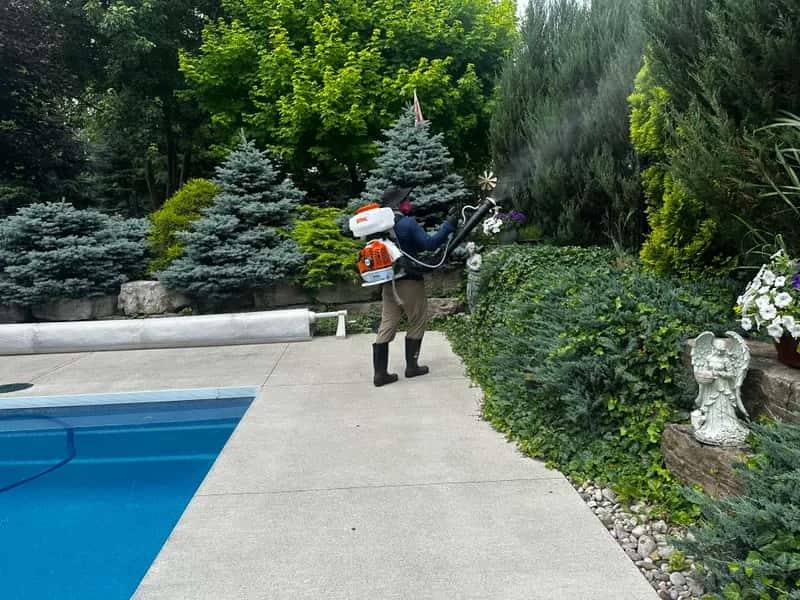
- Whole-yard barrier spray — BuzzSkito’s licensed application treats vegetation with Health Canada-approved residual formula. Mosquitoes resting on leaves die on contact for 21–30 days per treatment. Also kills ticks. ~$99 per treatment, $549–$994 for full-season programs — GTA homeowners can book the same treatment locally, including mosquito control in Vaughan.
- Patio repellent zone — Thermacell creates a repellent zone the manufacturer rates at about 15 ft (4.5 m) across around your seating
- Personal repellent — picaridin or DEET on exposed skin for active outdoor use
- Cottage/rural CO₂ trap — Mosquito Magnet for properties with chronic high populations
Grid vs Fan: Why One Device Catches Mosquitoes and the Other Cannot
Every recommendation on this page to buy “a real trap instead” rests on a mechanical difference that is rarely spelled out, so here it is properly. It comes down to two things: how the device physically captures an insect, and what it offers her as a reason to approach.
Capture. A zapper is a passive obstacle. The insect must fly at the light, reach the grid, and be physically large enough to bridge two wires and complete the circuit. Anything smaller than the wire spacing — a 1–3 mm Culicoides biting midge, for instance — can pass straight through an energised grid untouched. A fan trap does not ask the insect to do anything. A fan pulls a column of air into a mesh basket, and an insect that enters that column is carried in and dehydrates. Mosquitoes are weak, slow fliers, and once inside a counterflow of moving air they cannot fly back out. Size is irrelevant; flight strength is what matters.
Attraction. This is the larger half. A UV tube offers a host-seeking female nothing she is looking for — she is following a carbon dioxide plume, warmth, and the skin chemistry of a mammal. Fan traps bait the airflow with exactly those cues: carbon dioxide from a propane burner or a cylinder, octenol (1-octen-3-ol, a compound in mammal breath and sweat), lactic acid, or a proprietary skin-scent lure such as the one Biogents uses. Add a lure and the catch composition changes completely, because the device is finally speaking the language the mosquito is listening for. Add nothing and no amount of extra wattage helps: a brighter light is a louder message in a language she does not read.
That is the whole argument in one sentence — a zapper competes with the moon, and a baited fan trap competes with you. It also explains the middle ground honestly. Hybrid units like DynaTrap pair a UV tube with a fan and a titanium-dioxide surface that releases a small amount of CO₂, which is why they catch more mosquitoes than a bare grid and still far fewer than a propane unit. If you want the full comparison of what each format costs to run over a season, our mosquito trap running cost breakdown puts propane, lures and electricity side by side, and the Mosquito Magnet vs DynaTrap comparison covers the two units people actually cross-shop. For a rural or lakefront lot, acreage-rated traps are a different sizing problem again.
What Consumer Reports and Mosquito Entomologists Say
Consumer Reports has covered bug zappers and advises against relying on one for mosquitoes. What makes its coverage useful is that it does not lean on product testing — it quotes the people who count mosquitoes for a living. Three names recur, and they are worth knowing because they are the actual authorities behind almost every “experts say” sentence written about this device:
- Daniel Markowski, PhD — technical advisor to the American Mosquito Control Association, the body whose 71 billion to 350 billion beneficial-insect estimate is cited throughout this page.
- Eva Buckner, PhD — of the University of Florida’s Florida Medical Entomology Laboratory, the research station behind much of the North American field data on trap efficacy.
- Kristen Healy, PhD — Louisiana State University, and a past president of the American Mosquito Control Association (she served as AMCA president in 2022).
Their position is consistent with the catch data rather than an opinion layered on top of it: electrocuting devices kill large volumes of non-target insects and do not reduce the mosquitoes biting a person in a yard. It is worth stating plainly what this means for anyone searching for a “Consumer Reports best bug zapper” verdict. No consumer-testing organisation has identified a bug zapper that solves a mosquito problem, and none will, because the limitation is entomological rather than a matter of build quality or price. A better-made zapper is a better-made moth trap.
We are a licensed mosquito and tick control company in Mississauga, so we have a commercial interest in this conclusion, and readers should weigh that. The counterweight is that the finding is not ours: it is the University of Delaware in 1996, the University of Notre Dame yard trials, the AMCA, the Xerces Society, the Audubon Society and the researchers named above, all reaching the same result independently over four decades.
The Traps That Actually Catch Mosquitoes: AGO, BG-GAT and In2Care
If the answer to “what should I buy instead” stops at Mosquito Magnet and DynaTrap, it is incomplete. The devices with the strongest published field records are not the ones on the garden-centre shelf — they come out of public health entomology, and they work by targeting the female after she has fed, when she is looking for water to lay eggs in rather than for a host. That is a much easier cue to fake than a human being.
- Autocidal Gravid Ovitrap (AGO) — developed by the US Centers for Disease Control and Prevention. A bucket of hay-infusion water offers an egg-laying female the smell of an ideal nursery; she enters and is caught on an adhesive surface before she can lay. It uses no power, no CO₂ and no pesticide. Deployed in numbers across a neighbourhood it has produced large sustained reductions in Aedes aegypti in CDC field programmes.
- Catchmaster Ovi-Catch AGO — the commercial version of that CDC design, and the one a homeowner or a pest control operator can actually order.
- Biogents BG-GAT (Gravid Aedes Trap) — the same gravid-female logic in a passive, unpowered container from the German manufacturer whose BG-Mosquitaire fan trap is the research-standard host-seeking trap. Nothing to plug in and nothing to refill but water.
- In2Care Mosquito Trap — goes a step further and uses the mosquito as the delivery vehicle: a visiting female picks up a larvicide (pyriproxyfen) and a fungal agent, then carries the larvicide to every other container she visits. It is distributed through professional pest control channels. Canadian readers should confirm PMRA registration and Canadian availability before assuming it can be bought here; pesticide registration does not cross the border automatically.
The honest Ontario caveat. All four are built around container-breeding Aedes — the species that lay in a saucer under a flowerpot, and the reason these traps dominate public health programmes in the American South and the Caribbean. In a GTA backyard the biting pressure is mostly Culex pipiens and floodwater Aedes vexans, which breed in catch basins, ditches and ground pools rather than in tidy containers, so a gravid trap catches a smaller share of the local population than the Puerto Rico figures would suggest. For an Ontario yard the practical stack remains: eliminate standing water, treat what you cannot drain with BTI, add a CO₂-baited fan trap if the property backs onto water, and treat resting vegetation with a licensed residual. It is a longer list than “buy a zapper,” and every item on it does something a zapper does not.
Bug Zappers vs Real Solutions — Cost-Effectiveness
| Solution | Approximate first-year cost | Mosquito reduction | Pollinator impact |
|---|---|---|---|
| Outdoor bug zapper | $80–$200 | Mosquitoes are a low single-digit share of the catch | High (negative) |
| DynaTrap | $290–$380 | Catches some mosquitoes; far fewer than a CO₂-baited trap | Moderate (negative) |
| Thermacell | $80–$150 | Manufacturer-rated zone about 15 ft (4.5 m) across | Low |
| Professional barrier spray | $549–$994/season | Whole yard 21–30 days | Low (targeted) |
Barrier spray is the only row in that table that treats the whole property rather than one device radius, which is also why it is the only one priced by lot size rather than by unit — the full breakdown of what mosquito control costs in Ontario shows how a season program scales from a standard lot upward.
The Indoor Racket Zapper Exception
One bug-zapper format does work: handheld electric racket zappers (Black Flag Executioner, Stinger Indoor Racket, etc.). These look like badminton rackets with electrified mesh. When a mosquito gets inside your house, you can swat it manually — the electrified mesh kills on contact. Costs $15–$30, available at Canadian Tire, Home Depot, Walmart, Dollarama. Lasts years. Genuinely useful for the occasional indoor mosquito. We’ve ranked the models worth buying in our electric fly swatter Canada guide.
The one zapper we actually keep in the house — a rechargeable electric racket for the odd mosquito that sneaks in:
But for OUTDOOR yard mosquito control, racket zappers obviously don’t scale. You can’t swat a yard’s worth of mosquitoes one at a time. The closest thing to an automated version is a laser mosquito killer, which detects and shoots individual mosquitoes instead of waiting for them to fly into a grid — clever engineering, but short-range and far pricier than a $20 racket.
Do bug zappers actually work?
They work — just not on the insect you bought one for. Published catch counts put mosquitoes at 0.13% to 6.4% of everything a residential zapper kills. The American Mosquito Control Association reports no significant difference in mosquito numbers between yards with a zapper and yards without one. They are genuinely effective on moths, midges and beetles.
The distinction matters because “does it work” hides two different questions. Does the device kill insects? Yes, thousands per season. Does it reduce the number of mosquitoes biting you? No. The American Mosquito Control Association’s summary of the University of Notre Dame yard trials is the cleanest statement of it: mosquitoes made up roughly 4.1% and 6.4% of the daily catch, and comparing yards with and without a zapper produced no significant difference in the mosquitoes actually present.
That is the same finding the University of Delaware reached in 1996 (Frick & Tallamy), the University of Florida’s extension work has repeated, and Wirecutter reached independently. Four decades of counting, one answer.
Why did people stop using bug zappers?
Three things turned opinion. The 1996 University of Delaware count found 0.22% of 13,789 zapped insects were mosquitoes. The American Mosquito Control Association estimates electrocuting devices kill 71 billion to 350 billion beneficial insects a year in the United States. And better targeted tools arrived — CO₂ traps, repellent zones and residual barrier spray.
The peak of the backyard bug zapper was roughly 1975 to 2000, before the entomology caught up with the marketing. What broke the habit, in order:
- The catch data went public. Once homeowners learned the zapper was killing moths and lacewings at a ratio of several hundred to one biting mosquito, the value proposition collapsed.
- The ecological cost got quantified. The Xerces Society for Invertebrate Conservation recommends against residential outdoor UV zappers. The AMCA’s 71–350 billion beneficial-insect estimate is a United States figure — the scale is national, not per-yard.
- Substitutes got better. CO₂-baited traps target the actual host cue. Repellent zone devices protect a seating area. Licensed barrier spray treats the vegetation mosquitoes rest on. All three attack the mosquito instead of attracting whatever flies at a light.
- The noise and the mess. A grid firing every few seconds all night is not a small thing next to a bedroom window, and the debris tray is unpleasant.
What did not change is retail availability. Zappers still fill shelves every spring at The Home Depot, Lowe’s, Ace Hardware, Walmart, Canadian Tire and Rona, because they sell on the promise, not the result.
What is the most effective bug zapper?
For mosquitoes, none of them — that is the honest answer. For nuisance moths, midges and beetles, effectiveness tracks UV wattage and coverage area, so the largest unit you can safely site wins. Indoors, the most effective format is a handheld electric racket, because you aim it at the insect you can actually see.
If “most effective” means “kills the most insects per night,” the answer is simply the highest-wattage outdoor unit with the widest rated coverage — in practice the 80 W class rated for about 1.5 acres. If it means “solves my mosquito problem,” the effective devices are not zappers at all: a CO₂-baited trap, a repellent zone, or a residual barrier application. The ranked table earlier on this page sorts the zapper field by the job each unit does best; the cost-effectiveness table below it shows why none of those jobs is mosquito reduction.
What is the best bug zapper for a screened-in porch?
A low-wattage indoor-rated unit — 15 to 20 watts — hung 6 to 8 feet up and at least 15 feet from where anyone sits or eats. The screen already excludes most flying insects, so the zapper only has to handle the gnats and midges that slip through. Never hang an outdoor-only unit under a porch roof.
Screened porches are a standard feature across the American South and Midwest and much rarer in the Greater Toronto Area, so the sizing advice is genuinely different from the open-deck case:
- Size down, hard. An acre-rated outdoor unit under an 8-foot ceiling is drawing insects from the yard toward the porch. On an enclosed porch, the goal is to kill what is already inside, not to advertise.
- Check the rating, not the shape. A screened porch is still exposed to blowing rain and humidity. An indoor-only unit gets a damp night it was not built for; look for a unit the manufacturer rates for covered outdoor use.
- Keep it away from the table. Work at Kansas State University (Urban & Broce) documented that electrocuting an insect scatters fragments and can aerosolize bacteria and viral particles the insect was carrying, for several feet around the grid. That is the reason not to hang one over a dining table or a food-prep surface, indoors or on a porch.
- Fix the screen first. A single torn corner or a gap at the door sweep lets in more mosquitoes than any zapper removes. Screen repair is the highest-return hour you will spend on a porch.
- For a porch you actually sit on, a repellent zone device does far more for biting pressure than any zapper, because it works on the mosquito’s chemistry rather than her eyesight.
What to Consider Before Buying a Bug Zapper
Every specification on a bug zapper box maps to one of six decisions. Here is what each number actually controls, with the US-market units the listings use.
| Criterion | What listings show | What it actually controls |
|---|---|---|
| Power source | Corded 120 V (US) / 120 V (Canada), solar panel + battery, or USB-rechargeable handheld | Where you can put it. Corded units run all night at full output; solar units are placement-free but dim, and a cloudy day can cut runtime to a couple of hours. |
| Indoor vs outdoor rating | IPX4 / IPX5 weather rating on outdoor listings; "indoor use only" on plug-in units | Whether rain ruins it. An indoor-only unit under a porch roof still meets humidity and blowing rain. Match the rating to the site, not the shape of the housing. |
| Coverage area | 800 sq ft, 2,100 sq ft, 6,000 sq ft, ½ acre, 1 acre, 1.5 acres | How far the UV is visible to insects. Treat it as an attraction radius claim from the manufacturer, not a verified kill zone — no US agency reviews these figures before sale. |
| Grid voltage | Roughly 2,000 V – 5,600 V on US retail listings | Almost nothing you care about. Above roughly 2,000 V the grid kills anything that bridges it; a higher number is a marketing figure, not more mosquitoes. |
| Bulb type and wattage | 15 W / 20 W / 40 W / 80 W fluorescent UV-A tube, or newer UV LED | Attraction range and running cost. Fluorescent tubes dim measurably over a season and are the annual replacement part; LED units hold output longer and draw less power. |
| Bait / attractant | Octenol cartridge sold separately, sometimes "mosquito lure" | Whether the device is even aimed at mosquitoes. Octenol mimics a mammal breath cue. Adding it changes the product's regulatory status on both sides of the border: in the US the entire product becomes a pesticide requiring FIFRA registration, and in Canada the octenol lure is itself a registered pest control product (Health Canada, RVD2024-07) — see the EPA section below. |
Two things are missing from that list on purpose. There is no “kills mosquitoes” specification, because no manufacturer has to substantiate one before sale. And there is no filter for pollinator impact, because every UV zapper has the same one.
Bug Zapper Coverage and Voltage by Size (Square Feet, Acres and Watts)
The single question most buyers are actually asking is “which size do I need,” and it is the question the manufacturer sizing ladders answer fastest. Here is the standard Flowtron ladder — the reference most other brands size against — with both the acreage figures used in Canada and the square footage US listings lead with. The anchor conversion: 1 acre = 43,560 sq ft.
| Model class | UV wattage | Rated coverage | In square feet | Suits |
|---|---|---|---|---|
| Compact indoor / porch unit | 15 – 20 W | Under ¼ acre | ≈ 800 – 6,000 sq ft | Screened porch, garage, covered patio, three-season room |
| Flowtron BK-15D class | 15 W | ½ acre | ≈ 21,780 sq ft | Small suburban lot, deck perimeter, townhouse yard |
| Flowtron BK-40D class | 40 W | 1 acre | 43,560 sq ft | Standard detached lot with mature trees; the volume seller in both countries |
| Flowtron BK-80D class | 80 W | 1.5 acres | ≈ 65,340 sq ft | Acreage, rural property, lakefront, large open lawn |
| Commercial-grade unit | 80 W+ | 1.5 acres+ | 65,340 sq ft+ | Restaurant patio, campground, barn or stable aisle |
| Handheld electric racket | n/a (battery grid) | Arm’s reach | Whatever you can swing at | The one format that reliably kills a mosquito you can see |
On voltage: US listings advertise grid voltages from roughly 2,000 V to 5,600 V, and the number is close to meaningless as a buying signal. The grid runs at high voltage and very low current; once it is high enough to arc across an insect bridging the wires, more volts do not produce more kills. Wattage and coverage are the specifications that change the result. Treat a 4,500 V badge the way you would treat a horsepower sticker on a lawnmower box.
Metric-to-US conversions used elsewhere on this page, for readers working in feet: a 4.5 m repellent zone is about 15 ft across; the 3 m minimum standoff distance from a running zapper is about 10 ft; ½ acre is about 21,780 sq ft and 1 acre is 43,560 sq ft. Model-by-model detail on the BK-15D, BK-40D and BK-80D, including the octenol-cartridge question, is in our dedicated Flowtron bug zapper review.
The Four Specs Reviews Score and the Box Buries
Coverage, wattage and voltage are on the front of every carton. The four specifications that decide whether you still like the device in August are not, and they are the ones review sites weigh most heavily. These are manufacturer-published figures and format characteristics, not our own measurements — we run a mosquito control company, not a test bench.
| Spec | Typical range | Why it decides whether you keep using it |
|---|---|---|
| Weight and portability | Handheld racket well under 0.5 kg; compact porch units around 1–2 kg; acre-rated outdoor units roughly 3–5 kg | Weight sets where you can hang it. A 4 kg unit needs a rated hook or a branch, not a shepherd’s stake, and it is the reason people leave a big zapper in one bad location all season instead of moving it to the yard edge where it belongs. |
| Weather rating | IPX4 or IPX5 on outdoor listings; "indoor use only" on plug-in units; solar stakes vary widely | The single most common cause of a dead unit in year two. An indoor-rated unit under a porch roof still meets humidity and blowing rain. Match the rating to the site rather than to the shape of the housing. |
| Noise | A continuous low hum from the transformer, plus a sharp crack at every kill | It is not the average noise that matters, it is the unpredictability. A grid firing every few seconds is genuinely disruptive within earshot of a bedroom window or a conversation, which is why the placement advice on this page keeps pushing the unit to the far edge of the property. |
| Ease of cleaning | Removable debris tray and a supplied nylon brush on better units; sealed housings on cheap ones | A grid caked with debris arcs, smells and catches less, and it is the practical fire risk. If the tray does not slide out and the grid cannot be brushed, the unit has a short service life no matter what it cost. |
| Bulb availability | Named replacement tube part number on established brands; nothing at all on marketplace imports | The quiet one. A unit whose tube you cannot buy is a one-or-two-season purchase, because output falls off well before the tube fails. Check that a replacement exists before you buy the unit, not after. |
Where to Buy Bug Zappers in the United States
US readers arriving on this page will not find Canadian Tire or Rona nearby, so here is the American shelf equivalent. Two notes before the table: the biggest difference between the two markets is that the US has a genuine rural-hardware channel (Tractor Supply, Ace) carrying acreage-sized units that Canadian big-box stores mostly skip, and that handheld racket swatters — the one format worth owning — are cheapest at discount-tool retailers rather than garden centres.
| US retailer | What they stock | Honest verdict |
|---|---|---|
| The Home Depot | Full outdoor line plus replacement UV bulbs, spring through late summer | The default walk-in option in most US metros, and one of the few that reliably carries replacement tubes |
| Lowe’s | Flowtron and Stinger outdoor units, rackets, seasonal endcaps | Comparable to Home Depot; stock thins fast after the Fourth of July. US only — Lowe’s left the Canadian retail market and its stores became RONA+ in 2024 |
| Walmart | Budget through mid-range outdoor units, solar stakes, rackets | Cheapest entry point, thinnest on parts — assume no replacement bulbs |
| Ace Hardware (incl. Westlake Ace) | Neighbourhood-hardware selection, strong on bulbs and accessories | Smaller range but staff who can find you the right replacement tube; the local-pack answer for "bug zapper near me" |
| Harbor Freight | Handheld electric racket swatters, budget corded units | Where to look for a cheap handheld racket — the one zapper format that actually works |
| Tractor Supply | Acreage-rated outdoor units, barn and stable models, bulk bulbs | The rural-US equivalent of the Canadian Tire slot; best for 1-acre-plus properties and outbuildings |
| Amazon | Widest model range, including specific Flowtron models, solar stakes and rechargeable rackets | Best for a specific model or an off-season purchase when store shelves have been cleared |
Stock and pricing change constantly and we do not track them — confirm before you drive, especially for a replacement tube. Canadian retailers are covered in the tables above. US devices are regulated differently from Canadian ones: see the EPA vs Health Canada section below.
Comparing models before you go to a store?
Owning a Bug Zapper: Placement, Cleaning, Rain, Electricity and Fire Safety
If you already own one — or you are buying one for moths and gnats with your eyes open — these are the ownership questions that decide whether it works well and lasts. They are also the questions almost nobody answers properly.
Where to place and how high to hang it
Hang it 6 to 8 feet off the ground, at the edge of the area you use rather than in the middle of it, and at least 15 to 25 feet from where people sit or eat. The device is an attractant: putting it beside the patio table draws insects toward you and then kills a fraction of them in your airspace. Keep it away from doorways for the same reason, away from bedroom windows because of the noise, and out of direct competition with a bright porch light, which will simply out-compete it. Plug outdoor units into a GFCI-protected exterior outlet using an outdoor-rated cord.
How to clean a bug zapper
Unplug it and wait a few minutes before touching anything — the internal capacitor can hold a charge after the power is off. Empty the debris tray, then brush the grid with the nylon brush that shipped with the unit (never a metal tool, never your finger, never a hose). Wipe the UV tube with a dry cloth, because a film of insect residue measurably cuts light output. Let everything dry fully before plugging it back in. Do this every two to four weeks in season; a grid caked with debris arcs, smells, and kills less.
Rain, weather and whether to turn it off
Outdoor-rated units are built to stay out in rain — many US listings quote an IPX4 or IPX5 rating — so you do not need to run out and unplug one in a shower. What you must not do is take an indoor-rated unit outside, pressure-wash any unit, or plug an outdoor unit into a non-GFCI outlet. In a severe storm or standing water, unplug it. Bring the unit indoors at the end of the season rather than leaving it on the hook through winter; freeze-thaw cycles are what kill housings and sockets in both Ontario and the northern US.
How much electricity does a bug zapper use
Less than most people assume. A 40 W unit run 8 hours a night draws about 0.32 kWh nightly, so roughly 38 kWh across a four-month season. An 80 W unit run 12 hours a night on a longer southern season lands nearer 140 kWh. At typical 2026 residential rates that is a few dollars at the low end and roughly $20 to $40 at the high end — which is the range quoted in the research table above, and it assumes a large unit run long hours. The replacement UV tube, at $15 to $25 annually, often costs more than the power.
Can a bug zapper start a fire, and what happens if you touch one
Both risks are low but neither is zero, and both come down to maintenance. Accumulated insect debris on the grid is the fire concern: it can carbonize and sustain an arc, which is the practical reason for the cleaning schedule above and for not hanging a unit tight against dry eaves, siding or stored materials. As for touching one: the grid carries thousands of volts at very low current, and outdoor units have an outer guard cage specifically to keep fingers and paws away from it. Treat it as live equipment regardless — unplug before servicing, never poke anything metal through the guard, and keep it out of reach of children. If anyone receives a shock and feels unwell afterwards, seek medical care rather than waiting it out.
Bulbs, blacklight and daylight
The tube in a conventional zapper is a UV-A “blacklight” in roughly the 350–370 nm band, which is what phototactic night-flying insects steer by; a plain white bulb attracts far fewer of them. Newer units substitute UV LEDs, which hold output longer and draw less power — the same fluorescent-to-LED shift that has happened across lighting generally. None of this changes the mosquito result, because host-seeking females are following CO₂ and skin chemistry rather than light. It also explains why zappers do very little in daylight: the grid still works, but ambient sunlight erases the contrast that made the tube visible in the first place.
Mosquitoes in the United States vs Canada — and Why Zappers Fail Even Harder in the South
This is general information, not medical advice. If you are concerned about a bite reaction, a fever after mosquito exposure, or any symptom that worries you, contact a healthcare provider. In an emergency, call your local emergency number.
This page was written from a Canadian yard, where the mosquito that bothers you is a night-and-dusk biter and the season runs May to September. That framing transfers cleanly to the Northeast and Upper Midwest and badly everywhere else, so here is the American picture alongside it.
The American Mosquito Control Association recognises 174 mosquito species in the United States, unevenly distributed — Texas has the most at 85 species, Hawaii the fewest at 6 — and at least 43 US species have been found infected with West Nile virus. The four that matter most for a homeowner deciding whether a UV device is worth buying:
- Culex quinquefasciatus (southern house mosquito) — the primary West Nile vector across the American South. Mississippi State University Extension identifies it as the main WNV carrier in the region. Night-active, breeds in nutrient-rich standing water, and unbothered by UV light.
- Culex pipiens (northern house mosquito) — the equivalent WNV vector across the northern US and into southern Canada. Also night-active.
- Aedes aegypti (yellow fever mosquito) — established across the Southeast and Gulf, a vector of dengue, Zika and chikungunya, and an aggressive daytime biter that breeds in containers within a few yards of the house.
- Aedes albopictus (Asian tiger mosquito) — the same container-breeding, day-biting profile, spreading steadily north through the mid-Atlantic and lower Midwest.
This is the US-specific reason a bug zapper is an even worse purchase in Houston, Miami or Atlanta than in Mississauga. A UV zapper is a night-time device. The mosquitoes doing most of the biting in the American South and increasingly the mid-Atlantic are Aedes species that bite in daylight, breed in a saucer under a flowerpot, and never see the tube. A device that only advertises at night against an insect that bites at noon is not underperforming — it is aimed at the wrong half of the day.
The health context is not hypothetical. The US Centers for Disease Control and Prevention reported the 2026 West Nile season off to its earliest and heaviest start since 2004: 48 human cases by June 30, 38 of them neuroinvasive, with activity in 23 states — the most states reporting at that point in the year in a decade. Dengue is a separate and growing pressure: CDC records thousands of US dengue cases a year, the large majority of them travel-associated, with a small number of locally acquired cases in Florida and other Gulf-state jurisdictions — see CDC’s dengue surveillance pages for the current count, which we do not attempt to track here. CDC’s prevention guidance is EPA-registered repellent, covering up, avoiding exposure between dusk and dawn, and screening the house, while its Integrated Mosquito Management framework adds eliminating standing water and treating larval and resting habitat — lists on which UV electrocution appears nowhere.
For US readers who want a local, non-commercial source rather than a company blog, the land-grant extension services are the American equivalent of provincial public health here: the University of Florida’s UF/IFAS Extension and Mississippi State University Extension both publish plain-language mosquito guidance for their regions, and the National Pesticide Information Center (Oregon State University, 1-800-858-7378) answers device and pesticide questions directly by phone. The Kansas State University work by Urban and Broce is the source for the aerosolization caution about siting a zapper near food.
When Is Mosquito Season Where You Live? US Regions vs Canada
“Mosquito season” on this page means the Ontario season. It is not the American one. If you are sizing a season’s worth of running hours, bulb life or control spending, use your own row:
| Region | Typical mosquito season | What that means for a zapper |
|---|---|---|
| Gulf Coast, Florida, South Texas, southern California and Arizona | Effectively year-round | No off-season, so bulbs dim and debris accumulates continuously. Container-breeding Aedes aegypti and the night-active Culex quinquefasciatus peak at different times of year in south Florida — two separate problems, neither answered by UV. |
| Southeast and mid-Atlantic | Roughly March – November | Long season, heavy Aedes albopictus daytime biting pressure. A night-only device misses most of the problem. |
| Midwest | Roughly April – October | Culex-dominated and night-active, so the zapper at least overlaps the biting window — it still does not reduce it. |
| Northeast and Upper Midwest | Roughly May – September | The one US band where the Canadian framing on this page transfers unchanged. |
| Southern Ontario and the GTA (Canada) | May – September, peak June – July | The season this page was written for; our own service window runs May through September. |
The practical consequence: a homeowner in Minnesota can buy one UV tube a year and store the unit for seven months. A homeowner in south Florida is running the same device continuously, replacing tubes more often, and still contending with a daytime biter it cannot see.
How Bug Zappers Are Regulated: US EPA vs Health Canada
Neither country tests whether a bug zapper works before it goes on sale, but they get there by different routes, and Canada’s route ends somewhere most buyers would never guess: a mandatory label statement saying the device does not control mosquitoes.
In the United States, the Environmental Protection Agency treats a bug zapper as a pesticide device under FIFRA rather than as a pesticide product. A device “is not required to be registered under FIFRA section 3,” in the EPA’s own words, and its efficacy is not reviewed before sale; what the EPA does require is that it be produced in a registered pesticide-producing establishment whose establishment number appears on the label, and that the labelling bear no statements that are false or misleading. That is why the coverage figures on the shelf are attraction claims rather than verified kill zones — nobody checked them. Crucially, the moment a manufacturer adds an octenol attractant cartridge the product stops being a bare device: EPA’s rule is that if a product “incorporates a substance or mixture of substances intended to prevent, destroy, repel, or mitigate any pest, the entire product is considered to be a pesticide and is subject to registration under FIFRA section 3.”
In Canada, a bug zapper is not outside the pesticide law at all, which is a common misconception. Under the Pest Control Products Act, a “device” is a pest control product, and Schedule 1 of the Pest Control Products Regulations names, at item 2, “devices that are manufactured, represented or sold as a means to attract or destroy flying insects, or to attract and destroy them.” That is a bug zapper, exactly. Such a device may be sold here without registration only if it meets the conditions in Schedule 2, and those conditions are specific:
- Outdoor units (Schedule 2, item 6) must be certified by the Canadian Standards Association to CAN/CSA-C22.2 No. 189-M89, High-Voltage Insect Killers, and the label must carry both “For Outdoor Use Only” and the sentence “This device does not control blackflies, mosquitoes or other biting flies.”
- Indoor units (Schedule 2, item 5) need the same CSA certification, plus the statements “This device should not be installed directly on or over surfaces where food is exposed, processed or prepared” and a note to use it alongside sanitary practices.
- Both exemptions apply only to devices that work “by means other than the use of an active ingredient that is a chemical.” Bolt an octenol lure onto the unit and you have added a chemical attractant — and octenol is itself a registered pest control product in Canada, confirmed in Health Canada’s re-evaluation decision RVD2024-07 (June 2024) as “registered as a mosquito attractant for outdoor use only in devices which trap and kill mosquitos.”
So the Canadian regulator has not measured whether your zapper works, but it has decided what the box is allowed to say — and what it requires the outdoor box to say is that the thing does not control mosquitoes. Separately, when you read “Health Canada-approved” in our service section, that refers to something different again: the residual insecticide used in a licensed barrier application is a registered pest control product reviewed under the Act and applied by a licensed technician, which is a far higher bar than a device exemption.
The practical takeaway on both sides of the border: no regulator has told a bug zapper manufacturer to prove it reduces mosquitoes. In the United States that is because efficacy is simply not reviewed for devices; in Canada it is because the label has to disclaim the mosquito claim outright. Read the box carefully and you will find it promises to attract and kill flying insects — which is precisely, and only, what it does.
Other Names for Bug Zappers — and How the Technology Changed
Searching for these devices is harder than it should be because they carry at least five names. The formal engineering term is an electrical discharge insect control system. Trade and regulatory documents use electric insect killer and insect electrocutor trap. Consumers say bug zapper, and in commercial food-service contexts you will see fly killer unit or insect light trap — though the last of those usually means a glue-board unit, which catches insects on an adhesive sheet instead of electrocuting them, and is the format health inspectors prefer near food precisely because nothing gets scattered.
The hardware itself has changed once in fifty years. The original design paired a fluorescent UV-A blacklight tube with a high-voltage wire grid, and that combination still dominates the outdoor category. The shift underway now is to UV LEDs, which run cooler, draw less power, hold their output across a season instead of dimming, and remove the annual tube replacement. What has not changed, through both generations, is the underlying premise: the device attracts insects that navigate by light. Female mosquitoes do not. Better light-emitting technology solves the wrong half of the problem, and it will keep solving the wrong half no matter how good the LEDs get.
Who Invented the Bug Zapper? A Ninety-Year Arc
The device is older than almost anyone assumes, and its history explains why it is still on every hardware shelf despite the data. Popular Mechanics published a design for an electrical insect killer in 1911. The patent usually credited with setting the modern template — a fluorescent ultraviolet tube mounted in front of an electrified wire grid — was granted in 1934 to William F. Folmer and Harrison L. Chapin (US patent 1,962,439), on an application filed in 1931. For its first four decades the format was overwhelmingly commercial: dairy barns, food plants, restaurant kitchens, places with a genuine fly problem and no food-safety objection at the time.
What put it on suburban lawns was manufacturing, not entomology. Cheap moulded plastic housings and mass-produced transformers made the backyard unit a seasonal impulse buy through the 1970s, 1980s and 1990s, sold on a promise the original commercial design never made — that it would deal with mosquitoes. That is the gap the research eventually closed. The University of Delaware count (Frick & Tallamy, 1996) found 0.22% of 13,789 zapped insects were mosquitoes; the American Mosquito Control Association’s estimate that electrocuting devices kill 71 billion to 350 billion beneficial insects a year in the United States followed; and the Xerces Society and Audubon Society positions against residential outdoor UV zappers came after that.
So the answer to the question people actually type — why did people stop using bug zappers? — has a date attached to it. The device did not get worse. It was never designed for the job the 1980s box put on the front, and between 1996 and roughly 2010 enough homeowners found that out. What has changed since is only the light source: fluorescent tubes are giving way to UV LEDs that run cooler, draw less power and hold their output across a season. Ninety years in, the premise is untouched. The device attracts insects that navigate by light, and the mosquito biting you is not one of them.
The Bug Zapper Evidence, in One Place
Every figure this page relies on, with its source, so you can check any of them without reading nine sections:
- 0.22% of 13,789 insects. University of Delaware residential bug zapper catch count — Frick & Tallamy, 1996. The single most-cited number in the field.
- 4.1% and 6.4% of daily catch. University of Notre Dame yard trials, as summarised by the American Mosquito Control Association, which reports no significant difference in mosquito numbers between yards with a zapper and yards without one.
- 0.13% to 6.4%. The full range across the published residential catch figures cited above — 0.13% female mosquitoes in one backyard study, 0.22% biting flies in the Delaware count, and 4.1% and 6.4% of daily catch in the two Notre Dame yard trials. Most counts sit at the bottom of that range.
- 71 billion to 350 billion beneficial insects a year. American Mosquito Control Association estimate of the annual toll of electrocuting devices in the United States. A national figure, not a per-yard one.
- Fragments and aerosolized bacteria for several feet. Kansas State University, Urban & Broce — the source of the standing advice never to site a zapper near food.
- Recommends against residential outdoor UV zappers. The Xerces Society for Invertebrate Conservation, which calls them “ludicrously bad at killing pest insects, instead killing scores of benign and beneficial insects.”
- Regulated as a pesticide device under FIFRA, efficacy not reviewed before sale. US Environmental Protection Agency. Coverage figures on the box are unverified manufacturer attraction claims.
- Registered pest control products reviewed under the Pest Control Products Act. Health Canada — which applies to the residual insecticide a licensed applicator sprays.
- “This device does not control blackflies, mosquitoes or other biting flies.” The label statement Canadian law requires on an outdoor electric insect killer sold without registration, together with CSA certification to CAN/CSA-C22.2 No. 189-M89 — Pest Control Products Regulations, Schedule 1 item 2 and Schedule 2 item 6. The indoor equivalent must state that it should not be installed over exposed food.
- Registered as a mosquito attractant for outdoor use only in devices which trap and kill mosquitoes. Health Canada’s octenol re-evaluation decision RVD2024-07 (28 June 2024), which lists eight registered octenol products in Canada, including the Flowtron Mosquito Attractant (PCP 28456) and the Stinger octenol lure (PCP 29062).
- Advises against relying on a zapper for mosquitoes. Consumer Reports, quoting Daniel Markowski PhD (AMCA), Eva Buckner PhD (University of Florida FMEL) and Kristen Healy PhD (Louisiana State University).
- 1 acre = 43,560 sq ft. The conversion behind every coverage claim on this page.
Related Reading
- Mosquito Magnet Canada — Where to Buy + Do They Work
- DynaTrap Canada Honest Review
- Thermacell Canada Guide
- Mosquito Dunks Canada Guide
- Flowtron Bug Zapper Canada — BK-15D vs BK-40D vs BK-80D
- Best Solar Bug Zappers in Canada
- Electric Fly Swatters in Canada — Ranked
- BuzzSkito Professional Mosquito Control Service
- Commercial Fly Light Traps in Canada — the food-safe glue-board format, for anyone buying a zapper specifically for flies
- Yellow Jacket & Wasp Traps in Canada — because a UV grid barely touches day-active wasps
- No-See-Ums & Biting Midges in Ontario — the biting insect small enough to pass through a zapper grid
- How to Get Rid of Fruit Flies — a cider-vinegar trap beats any zapper on this one
- Fungus Gnats in Houseplants — killing flying adults does nothing to the larvae in the soil
- Biogents BG-Mosquitaire in Canada — the lure-and-fan mechanism a UV grid cannot replicate
- What Mosquito Traps Actually Cost to Run — propane, lures and electricity compared over a season