BuzzSkito Mosquito & Tick Control Specialists · Published May 1, 2026
As an Amazon Associate, BuzzSkito earns from qualifying purchases. BuzzSkito only points to products we would genuinely use or recommend, at no extra cost to you.
Popular Health-Canada-approved options for each (Natrapel/OFF! picaridin, Watkins/OFF! DEET):
Best Picaridin Repellents in Canada
All three of these are 20% picaridin (often labelled “icaridin 20%” on Canadian packaging), Health-Canada-approved, and safe for kids 6 months and older. Any one of them gives you the full 5–8 hours of mosquito protection and up to 8 hours against ticks — pick the format you like best.
Natrapel 20% Picaridin
Outdoor-store favourite — pump or continuous spray, travel-friendly, stocked at MEC and Atmosphere.
Check price on Amazon.ca →OFF! Defense Picaridin
Most-stocked pharmacy pick — lotion or spray, budget-friendly, easy to find at Shoppers and Canadian Tire.
Check price on Amazon.ca →Sawyer Picaridin
Long-lasting lotion loved by hikers and travellers — one application covers a full day outdoors.
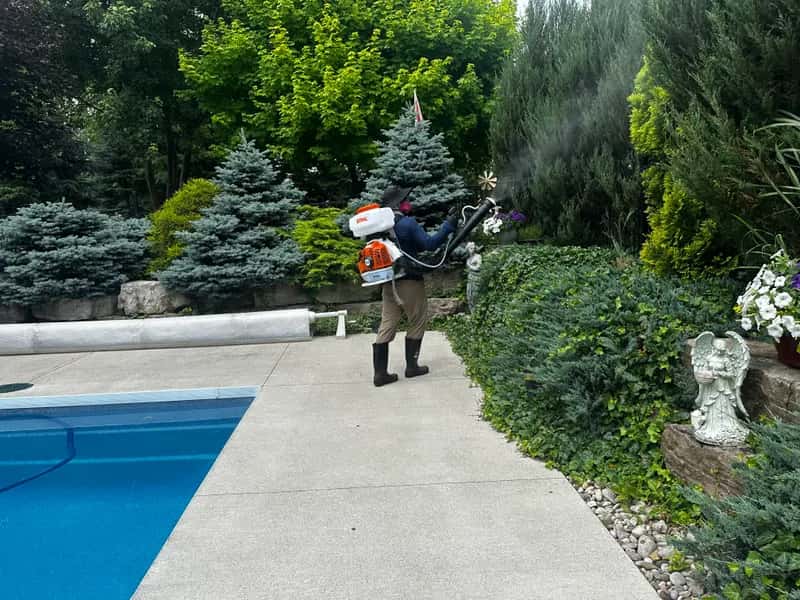
Check price on Amazon.ca →Skin repellent keeps bites off you for a few hours — it won’t clear your yard. For hands-off, whole-property coverage, layer in professional barrier spray with 21–30 day residual.
What Each Compound Actually Does
DEET (N,N-Diethyl-meta-toluamide) was developed by the US military in 1946 and registered for civilian use in 1957. It works by interfering with mosquitoes’ olfactory receptors — they essentially can’t smell you when DEET is on your skin. Eight decades of human use have produced extensive safety data; rare side effects include skin irritation in sensitive individuals.
The questions readers ask next are almost always about safety — Health Canada’s 30% adult and 10% child concentration caps, the cancer claims that circulate online, and whether it is acceptable in pregnancy. We work through each of those in our DEET safety explainer.
Picaridin (also called icaridin) was developed in the 1980s and approved by Health Canada in 2010. It works similarly to DEET — disrupting the mosquito’s ability to detect human scent compounds (lactic acid, CO₂, octenol). Modern formulations are odourless, non-sticky, and safe on plastics and synthetic fabrics. The World Health Organization recommends picaridin for travel to disease-endemic regions.
The Plastic-Damage Problem with DEET
If you’ve ever applied DEET spray and accidentally got it on your sunglasses, watch, or hiking gear, you may have noticed coatings clouding or plastics turning sticky. DEET is a known plasticizer — it actively breaks down many synthetic materials. Specifically affected:
- Polycarbonate sunglasses (anti-reflective coatings dissolve)
- Nylon hiking pants and shirts
- Spandex/Lycra athletic wear
- Plastic watch straps and silicone bands
- Phone cases (especially TPU)
- Vinyl and PVC (camping gear, raincoats)
- Some painted surfaces (kayaks, gear)
Picaridin doesn’t damage any of these materials. For Ontario hikers with $200 sunglasses or a $400 rain jacket, that alone is reason enough to choose picaridin.
The Smart Layered Strategy for Canadian Outdoor Activity
Skin repellent alone is rarely the complete answer. The best protection layers multiple tools that each address a different vector:
- Skin: Picaridin 20% or DEET 30% — apply to exposed skin before going outdoors
- Clothing: Sawyer Permethrin — pre-treat hiking pants, socks, hat (kills ticks on contact)
- Patio: Thermacell — 4.5m repellent zone around your seating area
- Yard vegetation: Professional barrier spray — kills mosquitoes and ticks resting on leaves, 21–30 day residual
- Standing water: BTI dunks — kills larvae before they become biting adults
For Children and Pets — Safety Reminders
Children 6 months+: Both picaridin 20% and DEET 30% are approved by Health Canada and the Canadian Paediatric Society. Apply to your hands first, then rub onto the child’s exposed skin (not face — apply to your hands, rub on the back of their neck and ears). Avoid hands and around eyes/mouth.
Children under 6 months: No chemical repellents. Use mosquito netting on strollers and physical barriers (long sleeves, lightweight pants).
Dogs: Don’t apply human repellents directly. Use vet-prescribed oral or topical tick/flea prevention. Picaridin is safer than DEET if accidentally licked, but neither is ideal.
Cats: Keep away from freshly-applied repellent on humans until it dries (30 minutes). NEVER apply permethrin near cats — it’s fatal to them.