BuzzSkito Mosquito & Tick Control Specialists · Published July 13, 2026
As an Amazon Associate I earn from qualifying purchases. BuzzSkito only points to products we would genuinely use or recommend, at no extra cost to you.
The One Feature That Settles It: Count the Legs
If you want a single rule that works almost every time, it is this: count the legs. An insect has six; an arachnid has eight. Line a tick up next to a fly, a beetle, or a mosquito and the tick has an extra pair. That eight-legged body plan is the defining trait of the class Arachnida, the group that contains spiders, scorpions, harvestmen, mites, and ticks. So the moment you confirm eight legs, you have your answer — a tick is an arachnid, full stop.
The comparison goes deeper than leg count. An insect body is built in three obvious sections — head, thorax, and abdomen — and typically carries a pair of antennae and one or two pairs of wings. A tick has none of that. Its body is a single fused oval with no separate head, no antennae probing the air, and no wings folded on its back. What looks like a “head” on a tick is actually just its mouthparts (the capitulum), used to anchor and feed. Take away the wings, the antennae, and the segmented body, add two more legs, and you are unmistakably looking at an arachnid.
Counting legs on a nymph the size of a poppy seed is a job for a magnifier, not the naked eye — a pocket 10x loupe settles arachnid-or-insect in seconds and doubles as a tick-check tool. Check price on Amazon.ca →
Ticks Are Really Just Big Mites (Subclass Acari)
Here is the part that surprises most people: a tick’s closest relatives are not spiders but mites. Ticks and mites together make up the subclass Acari within the arachnids. Ticks are simply the largest, blood-specialised members of that group — think of a tick as a mite that evolved to feed on the blood of mammals, birds, and reptiles. That is why a swollen, engorged tick looks nothing like a spider: it is behaving like the parasitic mite it fundamentally is.
Spiders (order Araneae) are cousins one branch over on the same arachnid family tree. They share the eight legs and the wingless, antenna-free body, but spiders spin silk, have a two-part body, and hunt or trap prey. Ticks do none of that. So the accurate way to say it: ticks are arachnids, ticks are acarines (mites and ticks), and ticks are related to spiders — but they are not spiders themselves.
What About Seed Ticks With Six Legs?
There is exactly one honest exception to the “eight legs” rule, and it is worth knowing because it trips people up. When a tick first hatches from the egg, it is a larva — often called a seed tick — and at that stage it has only six legs. After its first blood meal it moults into a nymph and grows a fourth pair, reaching the full eight legs it keeps for the rest of its life as a nymph and adult.
So a six-legged seed tick is not evidence that ticks are insects — it is just an immature arachnid that has not finished developing. Because seed ticks are barely the size of a poppy seed and cluster in large numbers, they are easy to mistake for tiny insects or specks of dirt. If you want to tell them apart from actual insects and other look-alikes, our guide to bugs that look like ticks walks through the differences with the features to check.
Why the Arachnid vs Insect Distinction Actually Matters
This is not a pedantic taxonomy debate. Whether ticks are arachnids or insects changes how you get rid of them:
- Insect gadgets do not work on ticks. Bug zappers, CO₂ mosquito traps, and porch fans are built around insect biology — flight and attraction to light or carbon dioxide. Ticks fly nowhere and are not lured to those devices, so they sail right past this whole category of “insect” solutions.
- They live where mites live. Like other acarines, ticks depend on humidity and hide in leaf litter, tall grass, and the shaded lawn-to-woods edge — not out in the open where insect controls are often aimed.
- Repellents still apply. The active ingredients proven against ticks overlap with mosquito repellents — DEET, picaridin, and clothing-applied permethrin all work on ticks — but you have to choose ones specifically tested against ticks, not just “insects.”
- Yard control targets arachnid habitat. Effective treatment knocks down the damp edges and brush lines where ticks quest, which is a different playbook than fogging for adult flying insects.
On point three, the Canadian test is the label: look for a PCP registration number and wording that names ticks, not just insects. See tick repellents on Amazon.ca →
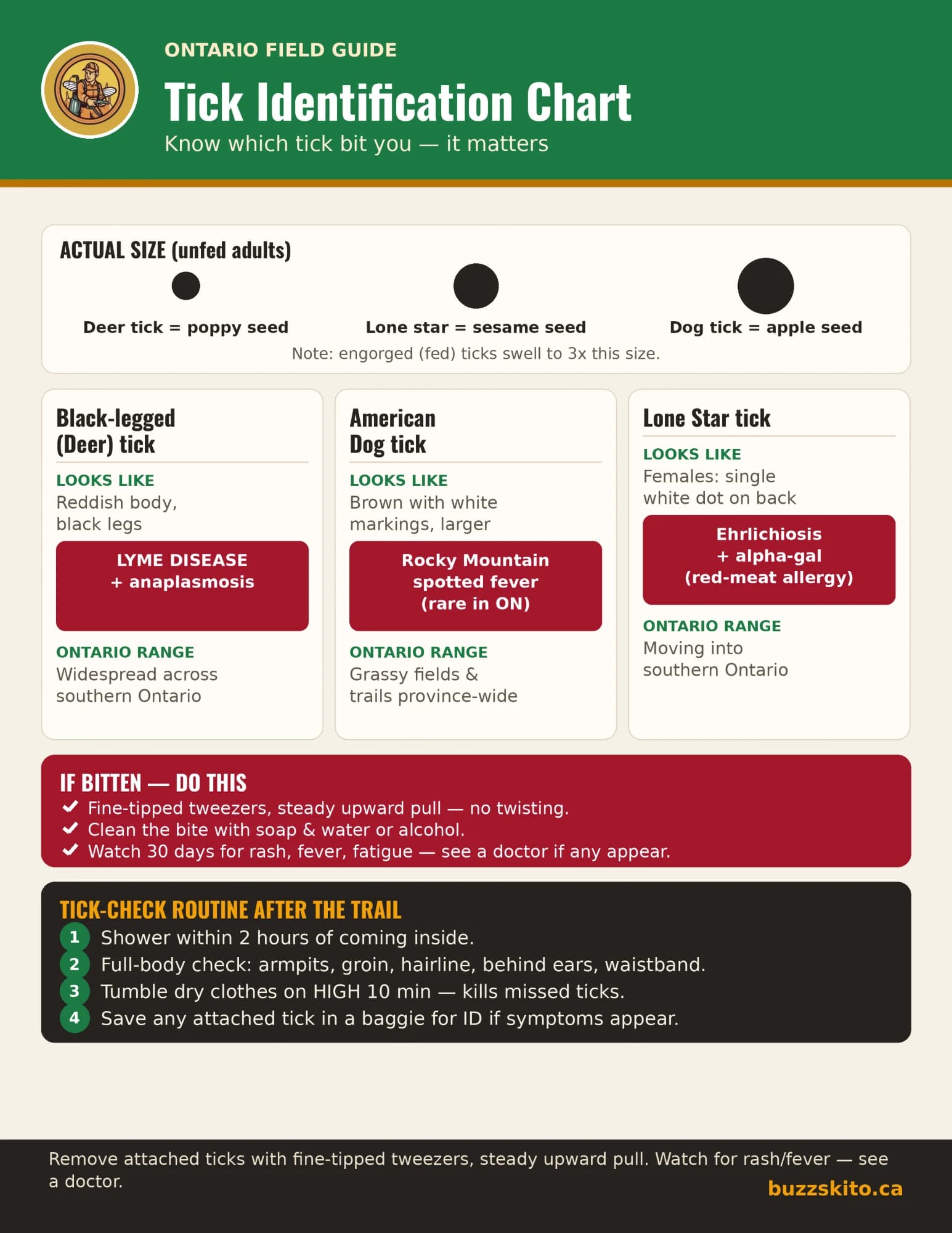
If you want to confirm what you are actually dealing with before you treat, compare it against our photo-based rundowns of what ticks look like and the deer tick vs dog tick comparison. And if a tick is already attached, keep a fine-tipped removal tool on hand so you can grip it close to the skin and pull straight out. Check tick-removal tools on Amazon →
As an Amazon Associate I earn from qualifying purchases. Price shown on Amazon.ca, at no extra cost to you.
🏆 Handy to Keep Nearby
8.5/10· BuzzSkito ratingBecause ticks anchor with their mouthparts, a fine-tipped tool lets you grip an attached tick close to the skin and pull straight out without squeezing its body — the removal method health authorities recommend.
Pros
- Grips close to the skin for a clean straight pull
- Compact enough for a bag, car, or first-aid kit
- Works on tiny nymph ticks that fingers miss
Cons
- Not a substitute for treating tick habitat in the yard
- Easy to misplace when you need it most
Quick Recap
- Ticks are arachnids, class Arachnida — not insects (class Insecta).
- Nymph and adult ticks have eight legs; insects have six.
- Ticks sit in the subclass Acari, making them the largest blood-feeding mites.
- They are related to spiders (also arachnids) but are not spiders.
- Ticks have no wings and no antennae, and cannot fly or jump.
- The lone six-legged exception is the newly hatched larval seed tick.
Related Reading
- Bugs That Look Like Ticks (Photo Guide)
- What Ticks Look Like — Size & ID Guide
- Deer Tick vs Dog Tick — How to Tell Them Apart
- Do Ticks Fly or Jump? How They Reach You
- BuzzSkito Tick Control Service
Frequently Asked Questions
Are ticks arachnids or insects?+
Ticks are arachnids, not insects. Adult and nymph ticks have eight legs — the defining feature of the class Arachnida, which also includes spiders, scorpions, and mites. Insects have six legs. Ticks belong to the subclass Acari (the mites and ticks), so their closest relatives are actually mites, not the six-legged bugs most people picture.
Why are ticks not insects?+
Ticks fail every test for being an insect. Insects have six legs, three body segments (head, thorax, abdomen), one pair of antennae, and usually wings. Ticks have eight legs, a fused single body region with no distinct head or thorax, no antennae, and no wings at any life stage. Those differences place ticks firmly in the class Arachnida alongside spiders and mites rather than in the class Insecta.
How many legs does a tick have?+
An adult or nymph tick has eight legs, like a spider. The one exception is the newly hatched larval stage — a "seed tick" — which has only six legs until its first moult, then grows a fourth pair. Because the vast majority of ticks people encounter are nymphs or adults, the practical answer is eight legs, which is exactly why ticks are arachnids and not insects.
Are ticks bugs?+
In everyday speech people call almost any small crawling creature a "bug," so calling a tick a bug is understandable. Scientifically it is wrong on two counts: true bugs are a specific order of insects (Hemiptera), and ticks are not insects at all — they are arachnids. So a tick is not a bug, not an insect, and not related to beetles or flies. It is an eight-legged arachnid in the same broad group as spiders and mites.
Are ticks related to spiders?+
Yes. Ticks and spiders are both arachnids, so they share a class (Arachnida) and the eight-legged, wingless, antenna-free body plan. They are cousins rather than the same thing: spiders are in the order Araneae, while ticks sit in the subclass Acari with mites. That shared arachnid ancestry is why a tick looks more like a tiny flat spider than like a fly or a beetle.
Are ticks a type of mite?+
Effectively, yes — ticks are large, blood-feeding mites. Both ticks and mites belong to the subclass Acari within the arachnids. Ticks are simply the biggest members of that group and are specialised as parasites that feed on the blood of mammals, birds, and reptiles. A tick is closer to a dust mite or chigger than it is to any insect.
Do ticks have wings or antennae?+
No. Ticks have no wings and no antennae at any point in their life. This is a key reason ticks cannot fly or jump the way many insects can — they reach a host only by climbing vegetation and grabbing on as it brushes past (a behaviour called questing). The absence of wings and antennae, plus eight legs, is a quick way to confirm you are looking at an arachnid and not an insect.
Does it matter whether a tick is an arachnid or an insect?+
It matters for control. Because ticks are arachnids and not insects, many products labelled only for flying or crawling insects are not designed to control them, and ticks do not respond to CO2 traps or bug zappers built for mosquitoes. Effective tick control targets arachnid behaviour instead: knock down the humid, shaded, leaf-littered yard edges where ticks quest, and use repellents like DEET, picaridin, or permethrin proven against ticks.