BuzzSkito Mosquito & Tick Control Specialists · Published April 21, 2026
If your GTA property backs onto a river, sits near a ravine, looks out over a pond, or is anywhere near the Lake Ontario waterfront, you already know that mosquito season hits harder for you than for your friends on flat suburban blocks. This guide explains why — and what actually makes a difference. See our GTA mosquito control service page to get started.
Why Water-Adjacent Properties Are Different
Mosquitoes breed in standing or slow-moving water — all mosquito species require an aquatic larval stage. Properties near water face two compounding challenges that flat suburban lots don’t:
- A proximate, ongoing breeding source. The river, pond, or marsh is constantly producing new adults through the season. Even aggressive treatment of your property doesn’t eliminate the source — it only reduces adult populations on your vegetation.
- Harbouring habitat. River valleys and ravines are typically wooded and shaded, providing the cool, humid daytime cover that adult mosquitoes require. They rest in this vegetation during the day, then disperse into surrounding yards at dusk.
The result is that water-adjacent properties need more frequent treatment and should start earlier in the season than their neighbours on flat blocks.
The GTA’s Major Mosquito Source Waterways
Not all water bodies create equal mosquito pressure. Here’s how the GTA’s major waterways rank by mosquito impact:
- Credit River (Mississauga, Brampton, Georgetown, Caledon): One of the GTA’s most significant mosquito corridors. The river runs through the western GTA from Caledon to Port Credit with extensive floodplain and valley habitat all along its length. Mosquito activity along the Credit peaks in June and remains elevated through August. Properties in Mississauga’s Credit Valley, Meadowvale, and Port Credit neighbourhoods and in Brampton’s Creditview area are most affected.
- Humber River (Vaughan, Woodbridge, Etobicoke, Toronto): The Humber runs from Bolton through Vaughan, Woodbridge, and Etobicoke to Humber Bay. Boyd Conservation Area, the Humber floodplain, and the lower valley all sustain large mosquito populations. See our Vaughan and Etobicoke mosquito control pages for city-specific details.
- Don River (Toronto, North York, Markham): The East and West Don and their tributaries run through the centre of Toronto, creating ravine corridors that affect properties from North York through Toronto’s midtown and east-end neighbourhoods.
- Rouge River and Highland Creek (Scarborough, Markham): These eastern GTA waterways border Rouge National Urban Park and run through Scarborough. See our Scarborough mosquito control and Markham mosquito control pages.
- Sixteen Mile Creek (Milton, Oakville): Running through Oakville to Burlington and south Milton, this watershed generates significant activity especially in late May and June. Glen Abbey and Bronte Creek area properties in Oakville and Bronte Meadows in Milton are the most affected.
These same corridors run a second, earlier problem before mosquito season properly begins: black flies, which breed in the clean flowing sections of the very same rivers. If your spring is worse than your July, read our GTA black fly guide for Mississauga and Toronto — the emergence peaks weeks before the first mosquito wave.
Backyard Ponds: A Double-Edged Feature
A well-maintained backyard pond with good water circulation, goldfish, or regular treatment can actually be mosquito-neutral. The problems arise with:
- Shallow, warm ponds with no circulation: Still, warm, shallow water is ideal mosquito breeding habitat. A 12-inch-deep ornamental pond with no pump can produce hundreds of larvae per week in July.
- Ponds surrounded by dense vegetation: Overhanging plants, dense marginal planting, and shaded pond edges give adult mosquitoes resting cover immediately adjacent to the breeding source.
- Seasonal ponds and drainage swales: Low areas in your yard that hold water for 5–7 days after rain can be completing larval cycles without being identified as ponds.
As an Amazon Associate I earn from qualifying purchases. BuzzSkito only points to products we would genuinely use or recommend, at no extra cost to you.
For ornamental ponds, Bti (Bacillus thuringiensis israelensis) mosquito dunks are an effective larval control option — one floating dunk slowly releases Bti for about 30 days. Check Mosquito Dunks on Amazon.ca → For the shallow low spots and drainage swales that pool for 5–7 days after rain, granular Mosquito Bits release Bti immediately for a faster larval knockdown. Check Mosquito Bits on Amazon.ca → For stormwater management ponds and drainage features you don’t control, the strategy shifts entirely to adult control through barrier spray on your property.
As an Amazon Associate I earn from qualifying purchases. Price shown on Amazon.ca, at no extra cost to you.
🏆 Best for Standing Water You Control
8.7/10· BuzzSkito ratingSummit Mosquito Dunks (Bti larvicide)
For an ornamental pond, rain barrel, or bird bath, floating Bti dunks are the single most effective DIY move — a naturally occurring soil bacterium that kills mosquito larvae before they hatch and acts on those larvae rather than on fish, frogs, birds, or pets (use it where the label directs). One dunk treats about 100 sq ft of surface water for roughly 30 days.
Pros
- Targets larvae — stops mosquitoes before they fly
- Ornamental ponds are a labelled use site
- One dunk lasts about 30 days
Cons
- Only works on standing water you can reach
- No effect on adult mosquitoes already in the yard
Stormwater Management Ponds: The New Suburban Reality
Virtually every GTA subdivision built since 1990 includes retention or detention ponds as part of the stormwater management system. These ponds — common in new areas of Brampton, Vaughan, Milton, and Markham — are designed for water quality and flood management, not mosquito prevention. Their shallow margins, emergent vegetation, and minimal circulation make them excellent mosquito breeding sites.
The municipality is responsible for managing these ponds, but management focus is water quality, not mosquito larvae. As a homeowner adjacent to one of these ponds, you cannot control the source — you can only create a barrier on your own property between the pond and your outdoor living space.
The Treatment Strategy for Water-Adjacent Properties
The approach differs from standard suburban treatment in two ways:
- Earlier start: Begin treatment in the first week of May, before populations emerge from adjacent water sources. On a property adjacent to the Credit River, waiting until mosquitoes are annoying (usually mid-June) means you’ve already lost the easiest month.
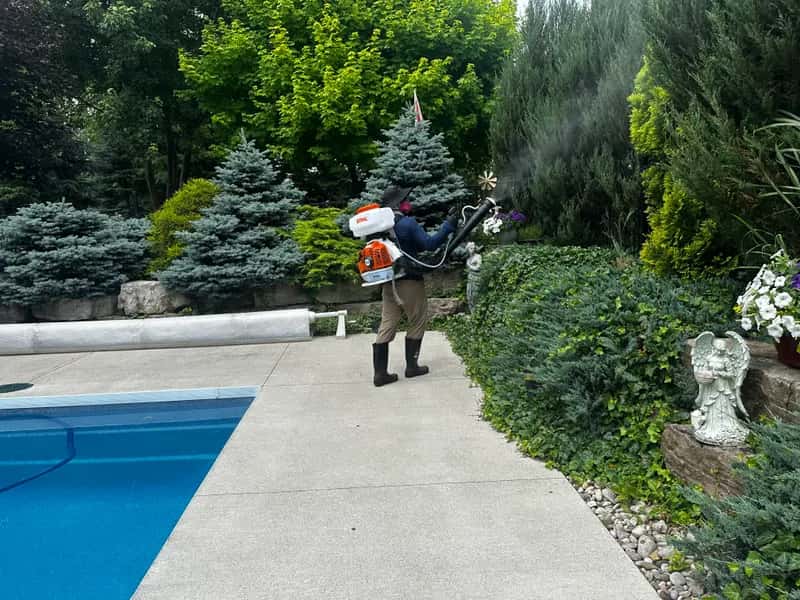
- More frequent schedule: a treatment every 2 weeks (10 from May through September) rather than the monthly 5 most suburban yards get, at least through peak season. The continuous re-colonization from adjacent water sources shortens the effective window of each treatment.
Related Guides and Services
- All GTA Mosquito Control Services
- BuzzSkito Service Areas
- The Ultimate Backyard Mosquito Control Guide (GTA Edition)
- Mosquito Control in Vaughan & York Region
- Mosquito Season in Scarborough & East Toronto
- When to Book Your First Treatment of the Season
Frequently Asked Questions
Can I treat standing water on my property myself?
You can use Bacillus thuringiensis israelensis (Bti) mosquito dunks in standing water you control — backyard ponds, bird baths, or rain barrels. Bti is a naturally occurring soil bacterium that specifically targets mosquito larvae; use it only where the product label directs. For standing water you don't control (retention ponds, drainage ditches, creek margins), you need to focus on barrier spray targeting adult mosquitoes on your property rather than source elimination.
I live near Lake Ontario in Mississauga. Is the lake itself a breeding source?
Open Lake Ontario water is not a significant mosquito breeding source — mosquitoes need shallow, still water, and the lake itself is too deep and wave-affected. The risk areas are the sheltered inlet creeks, marina embayments, and marshes where calm, shallow water pools. Rattray Marsh in Mississauga and the Humber Bay wetlands in Toronto are the most significant lakefront mosquito sources. Properties within 500m of these marshes rather than the open lakeshore typically see the most elevated activity.
My neighbours have a backyard pond that looks like it breeds mosquitoes. What can I do?
You can be a good neighbour and mention Bti dunks — available at most garden centres — which target mosquito larvae in the water they are placed in (following the label). Beyond that, the most effective thing you can do is treat your own property: barrier spray on your vegetation will reduce adult mosquitoes from all sources, whether they're breeding in your neighbour's pond, the creek down the street, or the drainage swale behind your fence.
Do I need more treatments per season if I live near the Humber or Credit River?
Often, yes. Properties adjacent to active waterways are continuously re-colonized by mosquitoes migrating from the source. A monthly schedule (5 treatments, May through September) covers most suburban yards. Properties immediately adjacent to the Humber River, Credit River, Don River, or major conservation areas are re-colonized all season, so many of them move up to a treatment every 2 weeks (10 per season), at least through peak season.