BuzzSkito Mosquito & Tick Control Specialists · Published April 29, 2026
As an Amazon Associate, BuzzSkito earns from qualifying purchases. BuzzSkito only points to products we would genuinely use or recommend, at no extra cost to you.
How to Keep Mosquitoes Away (Fast)
If you just want to know how to keep mosquitoes away and repel them today, here's the ranked quick-list — highest-impact action first. The top three do the heavy lifting; the rest keep them away between treatments.
- Dump every source of standing water. No water, no breeding — this is the single fastest way to keep mosquitoes away because it stops the next generation before it hatches.
- Drop a BTI mosquito dunk in water you can't drain. Rain barrels, pond features, and pooling drains stay mosquito-free for 30 days per dunk.
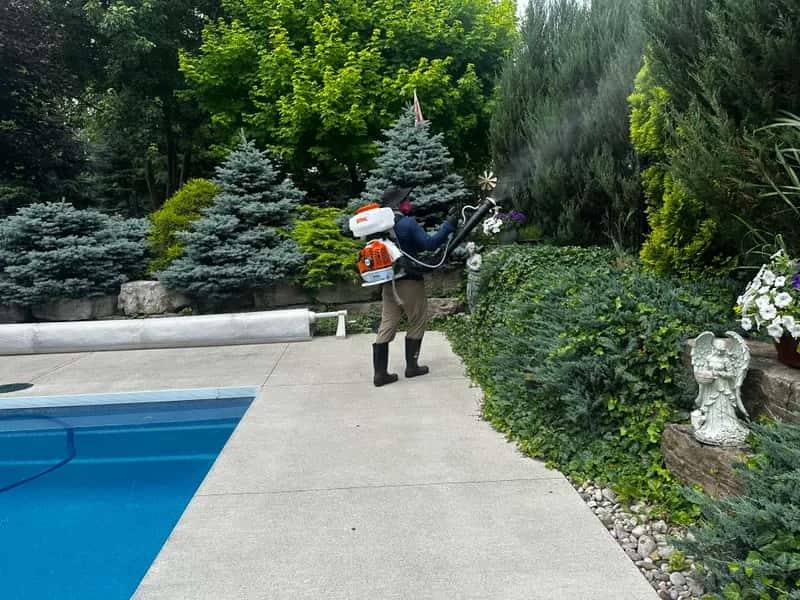
- Apply a professional barrier spray. A residual treatment on shrubs, fence lines, and resting sites keeps adult mosquitoes away for up to 30 days — the strongest repellent effect you can get for a whole yard.
- Run a fan where you sit. Mosquitoes are weak fliers; steady airflow keeps them away from a deck or patio instantly.
- Wear DEET or picaridin. The most reliable way to repel mosquitoes off your skin during outdoor activities — see our Ontario mosquito repellent guide for what actually works.
- Cut grass short and prune dense shrubs. Removing shaded daytime resting spots keeps mosquitoes from settling in your yard.
1. Eliminate Every Standing Water Source on Your Property
Mosquitoes need standing water to breed — they cannot reproduce without it. The fastest single action you can take is a yard sweep eliminating every container holding water for 48+ hours: birdbaths (change weekly), plant saucers (drill drainage holes), kiddie pools (drain after use), wheelbarrows, buckets, recycling bin lids, garbage can lids, kids' toys, tarps with creases, and old tires. One uncovered birdbath can produce thousands of mosquitoes per week.
2. Clean Your Gutters Twice Per Season
Clogged gutters accumulate organic debris and standing water at the roofline — a hidden breeding site most homeowners never check. Clean once in early May and again in mid-July, plus after major storms. Consider gutter guards if your property has heavy tree cover.
3. Treat Rain Barrels with BTI Mosquito Dunks
Rain barrels are productive mosquito breeding sites unless treated. BTI (Bacillus thuringiensis israelensis) mosquito dunks are the gold-standard solution — the widely sold Summit Mosquito Dunks are the reference product. Their label rates them to kill mosquito larvae within 24 hours, and they are completely safe for fish, pets, beneficial insects, and humans (Health Canada registers BTI as a low-risk larvicide). One dunk treats up to 100 sq ft of water surface for 30 days.
Check Summit Mosquito Dunks prices on Amazon.ca → For dosing, brand comparisons, and safety notes, see our complete guide to mosquito dunks in Canada.
As an Amazon Associate, BuzzSkito earns from qualifying purchases. Price shown on Amazon.ca, at no extra cost to you.
🏆 Our Top Pick for Water You Can't Drain
9.0/10· BuzzSkito ratingFor rain barrels, pond features, and pooling drains you can't empty, floating BTI dunks are the gold-standard larvicide — they kill mosquito larvae within a day and keep working for weeks, while staying safe around fish, pets, and pollinators. The single most useful buyable product in this whole guide.
Pros
- Kills larvae within 24 hours
- One dunk protects a water source for about a month
- Health Canada low-risk — safe around fish, pets, and pollinators
Cons
- Treats larvae only — does nothing for adult mosquitoes
- Needs replacing each month through the season
4. Treat Your Pool Cover Weekly
Active chlorinated pools cannot support mosquito breeding — chlorine kills larvae. But pool COVERS that collect rainwater are major breeding sites. Drain the cover weekly during peak season, or treat with BTI dunks until you can drain it.
5. Level Low-Lying Lawn Areas
Areas of lawn that hold water 48+ hours after rain are persistent breeding sites. Top-dress low spots with topsoil, or improve drainage through aeration and overseeding. Properties with clay soil should focus on aeration in early May.
6. Apply Professional Barrier Spray
Professional barrier spray (Health Canada-approved residual insecticide applied to vegetation, shrub interiors, leaf undersides, fence lines, and resting sites) is the single most effective adult-mosquito control measure available to homeowners. It kills on contact and provides up to 30 days of residual protection. Single treatments start at $99.
7. Use Fans on Outdoor Living Areas
Mosquitoes are weak fliers. Wind speeds above ~1.5 m/s exceed their flight capability. A moderately powerful outdoor fan creates a localized "mosquito-free zone" around a deck or patio. Fans complement professional barrier spray — they don't replace it.
The same physics works indoors, which is why a box or ceiling fan aimed across a bed is the best no-chemical fix for the one mosquito that made it inside. If the problem has moved through your door, the indoor version of this playbook covers hunting it down and closing the gap it came in through.
8. Plant Mosquito-Repelling Plants Strategically
Lavender, basil, catnip, lemon balm, and citronella grass contain volatile oils mosquitoes find unpleasant. They reduce ambient mosquito pressure within 1–3 metres of the plant. Plant strategically near patios, doorways, and seating areas — not as a yard-wide solution. Combine with barrier spray for best results.
9. Keep Grass Cut Short and Shrubs Pruned
Mosquitoes rest in tall grass, shaded shrub interiors, and leaf-dense vegetation during the day. Keeping grass at 2–3 inches and pruning interior shrub growth reduces resting habitat. This won't eliminate mosquitoes, but it makes barrier spray treatments more effective.
10. Use Personal DEET or Picaridin Repellent for Outdoor Activities
DEET (20–30% concentration) and picaridin (also called icaridin, 20%) are the most effective personal mosquito repellents in Canada. Both are registered by Health Canada. DEET is the longest-studied active; picaridin is odourless, non-greasy, and won't damage plastics or gear. Apply when spending extended time outdoors, especially at dusk/dawn. Personal repellent doesn't reduce yard mosquito population — but it prevents bites during outdoor activities.
Check picaridin repellent prices on Amazon.ca → Not sure which active to pick? Our picaridin vs DEET comparison for Canada breaks down protection time, safety, and cost.
11. Check Tree Holes and Catch Basins on Your Lot
Old tree holes that collect rainwater are productive breeding sites — fill with sand or expanding foam. Driveway catch basins and yard drains can hold water for weeks; treat with BTI dunks if water persists.
12. Maintain Through the Full Season — Don't Stop in July
Mosquito populations rebuild within 2–3 weeks if treatments stop. A common mistake Ontario homeowners make is stopping mosquito control in late July when activity dips, then having a misery-spike in August. Continue barrier spray treatments through mid-September for full-season protection.
Bottom Line
A layered approach — source elimination, BTI for what you can't drain, professional barrier spray for adult control, and personal protection for outdoor activities — each cover a gap the others leave open. The compounding is the point: source elimination removes local breeding, BTI handles water you cannot drain, barrier spray treats the resting vegetation for mosquitoes arriving from off-property, and personal protection catches what still gets through. No layer clears a yard on its own.
Related Guides
- The Ultimate Backyard Mosquito Control Guide (GTA Edition)
- The Ultimate Tick Control Guide for Ontario Homeowners
- Hidden Mosquito Breeding Spots in Your GTA Backyard
- Best Mosquito Repellents for Ontario (2026 Guide)
- Lyme Disease Prevention in Ontario
- View Our Mosquito Control Services
- View Our Tick Control Services
Frequently Asked Questions
Eliminate Every Standing Water Source on Your Property+
Mosquitoes need standing water to breed — they cannot reproduce without it. The fastest single action you can take is a yard sweep eliminating every container holding water for 48+ hours: birdbaths (change weekly), plant saucers (drill drainage holes), kiddie pools (drain after use), wheelbarrows, buckets, recycling bin lids, garbage can lids, kids' toys, tarps with creases, and old tires. One uncovered birdbath can produce thousands of mosquitoes per week.
Clean Your Gutters Twice Per Season+
Clogged gutters accumulate organic debris and standing water at the roofline — a hidden breeding site most homeowners never check. Clean once in early May and again in mid-July, plus after major storms. Consider gutter guards if your property has heavy tree cover.
Treat Rain Barrels with BTI Mosquito Dunks+
Rain barrels are productive mosquito breeding sites unless treated. BTI (Bacillus thuringiensis israelensis) mosquito dunks are the gold-standard solution — they kill mosquito larvae within 24 hours and are completely safe for fish, pets, beneficial insects, and humans (Health Canada approves BTI even for drinking water reservoirs). One dunk treats up to 100 sq ft of water surface for 30 days.
Treat Your Pool Cover Weekly+
Active chlorinated pools cannot support mosquito breeding — chlorine kills larvae. But pool COVERS that collect rainwater are major breeding sites. Drain the cover weekly during peak season, or treat with BTI dunks until you can drain it.
Level Low-Lying Lawn Areas+
Areas of lawn that hold water 48+ hours after rain are persistent breeding sites. Top-dress low spots with topsoil, or improve drainage through aeration and overseeding. Properties with clay soil should focus on aeration in early May.
Apply Professional Barrier Spray+
Professional barrier spray (Health Canada-approved residual insecticide applied to vegetation, shrub interiors, leaf undersides, fence lines, and resting sites) is the single most effective adult-mosquito control measure available to homeowners. It kills on contact and provides up to 30 days of residual protection. Single treatments start at $99.
How do I keep mosquitoes away from my yard?+
To keep mosquitoes away long-term, remove the standing water they breed in, treat any water you can't drain with BTI mosquito dunks, and put down a professional barrier spray on shrubs and fence-line resting sites for up to 30 days of protection. Between treatments, run a fan where you sit, keep grass short, and re-check for refilled containers after every rain. The two layers cover different failure modes: source elimination removes the mosquitoes bred on your lot, and barrier spray treats the vegetation the ones flying in from elsewhere land on. Neither clears a yard on its own, and neither is permanent.
What is the fastest way to repel mosquitoes outdoors?+
The fastest way to repel mosquitoes off your body is a Health Canada-registered DEET (20–30%) or picaridin (20%) repellent applied before you head outside. To repel them from a specific spot like a deck or patio, aim a fan at your seating area — mosquitoes are weak fliers and steady airflow keeps them away instantly. Repellents and fans reduce bites but don't lower your yard's mosquito population, so pair them with source elimination and barrier spray for lasting results.