BuzzSkito Mosquito & Tick Control Specialists · Published July 12, 2026
Jump to the net you actually need — live Canadian price checks:
The one spec that matters: mesh fineness
Every mosquito net is a physical filter, and the only thing standing between you and a bite is the size of the holes. The global standard for bed nets is a mesh of at least 156 holes per square inch (openings around 1.2 mm or smaller). That stops mosquitoes reliably. If your problem is no-see-ums (biting midges) or black flies — the scourge of Canadian cottage country in May and June — you need a much finer “no-see-um” or marine-grade mesh, roughly 500+ holes per square inch. A coarse net that looks fine against a mosquito will let a cloud of no-see-ums straight through, which is why cheap dollar-store nets so often disappoint north of the GTA.
The second thing to check is material. Polyester nets are the most durable and hold their shape; polyethylene nets are softer, lighter, and pack down small for travel. Both work — the mesh count matters far more than the fibre.
Bed canopy vs pop-up bed net
For a permanent bedroom, a rectangular four-corner canopy net is the best sleep experience: it hangs from four points (or a ceiling hook plus a frame) and gives you vertical walls, so the mesh stays well off your face and body. Avoid the pretty single-point cone canopies for anything bigger than a single bed — a cone tapers inward and leaves the corners of a queen or king exposed, and wherever your shoulder or knee touches the mesh, a mosquito can bite through it. A good rectangular canopy runs $30–$70 in Canada. If the mosquitoes are getting in through a door rather than reaching the bed from indoors, the cheaper fix is upstream — a magnetic screen door stops them entering in the first place.
If you rent, travel, or sleep at a cottage where you cannot drill a ceiling hook, buy a free-standing pop-up bed net instead. It has its own spring frame, sets up in seconds, seals underneath so nothing crawls in, and folds flat into a disc for storage. Expect $35–$80. It is also the friendliest option for a child’s bed — no hardware, no drape to pull down. For a crib, skip both and buy a fitted dome crib net ($20–$45) sized to the crib so there are no loose edges a baby can pull in.
A net is the guaranteed answer for the mosquito that has already found your bedroom, but it is not the only one — a fan aimed across the bed works on the same weak-flier physics for a fraction of the setup, and the insect still got in through a torn screen or hatched from water sitting somewhere in the house. Our walkthrough of how to hunt down a mosquito in a bedroom covers finding it, killing it, and closing the route it used.
Head nets and net hats: the best $12 you can spend
A head net — a fine-mesh hood worn over a wide-brim hat — is the single most cost-effective piece of insect protection in existence. For $8–$20 it keeps mosquitoes, black flies, and no-see-ums off your face and neck completely, which is exactly where bugs are most maddening. Buy one with a built-in brim ring or pair it with a stiff-brim hat so the mesh is held away from your skin; a net that sags onto your cheek lets bugs bite through it. For black-fly season in the Canadian Shield, choose no-see-um mesh and a model that cinches below the shoulders so nothing sneaks up from your collar. Every camper, angler, gardener, and cottage-dweller in Ontario should own one.
Hammock nets and stroller nets
A hammock net has to run the full length of the hammock and seal or zip underneath. Short “cap” nets that only cover your upper body are a waste of money — mosquitoes simply come at your feet and your back where the fabric presses against you. The best designs use a ridge line to suspend the mesh well off your body so nothing can bite through. Budget $30–$90 depending on length and mesh grade.
A stroller net is a small universal mesh cover with an elastic edge that stretches over the whole bassinet or seat. It is the safest way to protect a baby too young for repellent — no chemicals, just a physical barrier. At $10–$25 it is cheap insurance for stroller walks at dawn and dusk. Make sure it fully encloses the opening with no gap at the handle end, and never leave a sleeping infant unattended under any cover.
Patio and deck: pop-up screen rooms
If you want to protect a group — a picnic table, a hot tub, a deck dinner — a net for one person will not cut it. A pop-up screen house or mesh gazebo room ($60–$200 at Canadian Tire, Home Depot Canada, and Costco) gives you a bug-free enclosed space for the evening. It is bulky and takes a few minutes to set up, but for entertaining it beats spraying everyone with repellent. The trade-off is obvious: you are protecting one tent-sized footprint, not the yard. For the full range of patio enclosure options — screen houses, screened gazebos, magnetic doors, and clip-on curtains — see our patio mosquito screens guide.
Where a pop-up room gets packed away after every dinner, a proper screened gazebo stays anchored on the deck for the whole season with zip-around netting walls — the step up worth making if you eat outside most evenings rather than a few times a summer.
Permethrin-treated nets: worth it?
Insecticide-treated nets are the reason bed nets are credited with preventing hundreds of millions of malaria cases worldwide — the permethrin kills mosquitoes that land on the mesh, so even a net with a small hole still protects you. For adults and older kids, treated nets and bug shirts are considered safe (permethrin bonds to the fabric and is not readily absorbed through skin) and are registered for sale in Canada. Two hard rules: permethrin is highly toxic to cats and fish until it dries, so keep cats away from freshly treated gear and never apply it near an aquarium or pond. For a crib or a stroller, most Canadian parents just use an untreated fine-mesh net — the barrier alone is enough. If you are outfitting for hiking or cottage country, our bug-protective clothing guide covers permethrin-treated shirts, pants, and full bug suits available in Canada.
Where a mosquito net stops helping
A net is a barrier around a bounded space, and that is exactly its limit. Here is what a net cannot do:
- It does not clear your yard. The moment you step out from under it, you are unprotected. For same-day, whole-yard usability you need barrier spray on the vegetation.
- It does nothing for ticks. Ticks crawl up from grass and leaf litter onto your legs — they do not fly into a net. Tick protection comes from treated clothing, a yard perimeter treatment, and tucking pants into socks.
- It fails if it is not sealed. An untucked bed net, a stroller net with a gap, or a hammock net with an open zip is an open door.
- Skin against mesh gets bitten. Keep the mesh taut and off your body — a mosquito will happily probe through fabric pressed to your arm.
Net vs repellent vs barrier spray
| Tool | Protects | Cost | Tick coverage |
|---|---|---|---|
| Mosquito net | One bounded space (bed, hammock, head) | $8–$200 | None |
| DEET / icaridin repellent | Your exposed skin, a few hours | $8–$20 | Partial (on skin) |
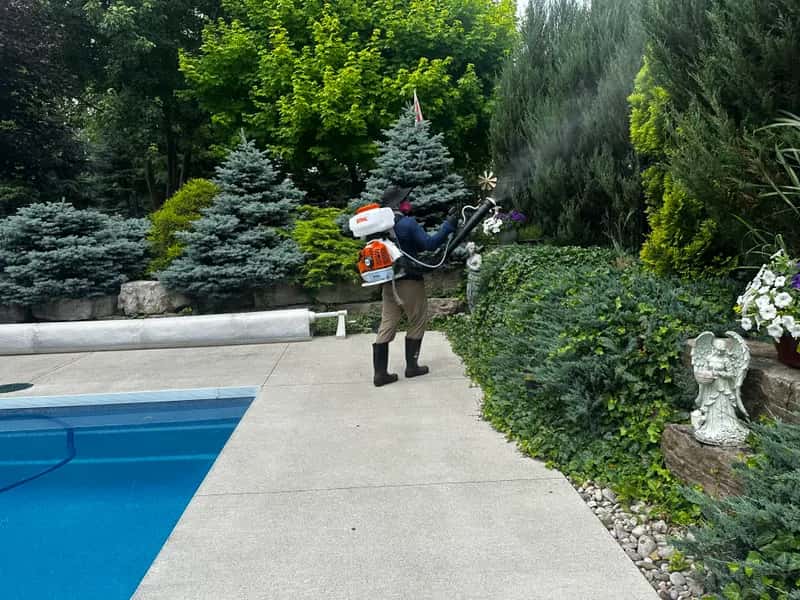
| Professional barrier spray | Your whole yard, 21–30 days | From $99 / treatment | Yes — full coverage |
They are not competitors — they are a stack. A head net and repellent for the trail, a bed or stroller net for sleeping, and barrier spray to actually reclaim the backyard at home. If you are trying to decide what to put on your skin, our Ontario mosquito repellent guide breaks down DEET vs icaridin vs the natural options. Still weighing netting against a professional treatment for the yard itself? Our netting vs barrier spray comparison runs the full cost-and-coverage math.
Related Reading
- Mosquito Screens for Your Patio (Canada) — Buyer’s Guide
- Mosquito Netting vs Barrier Spray — Which Is Better?
- Bug-Protective Clothing in Canada — Treated Shirts, Pants & Suits
- Best Mosquito Repellent in Ontario 2026 — DEET vs Icaridin
- BuzzSkito Professional Mosquito Control Service
- Book a Free Yard Assessment
- More BuzzSkito mosquito & tick guides