BuzzSkito Mosquito & Tick Control Specialists · Published April 10, 2026
Prevention reduces breeding. Treatment reduces the adults resting in your yard. Together, they give you the most mosquito-free yard possible. This guide covers both. Part of our Ultimate Mosquito Control Guide.
As an Amazon Associate I earn from qualifying purchases. BuzzSkito only points to products we would genuinely use or recommend, at no extra cost to you.
The Two-Part Strategy: Prevention + Treatment
Mosquito prevention and mosquito treatment are not competing approaches — they're complementary. Eliminating breeding sites (prevention) reduces how many mosquitoes can be produced on your property. Professional barrier spray (treatment) reduces the adult mosquitoes resting in your yard, including those that arrive from neighbouring areas. Together, they deliver dramatically better results than either alone.
Knowing what not to do matters just as much. Spraying the open lawn instead of the shaded leaf undersides where mosquitoes actually rest, or cancelling treatments after one cold week in August, quietly undoes good prevention work — we round those up in 12 mosquito mistakes Ontario homeowners make every summer.
12 Ways to Prevent Mosquitoes in Your Ontario Backyard
1. Change Birdbath Water Weekly
Birdbaths are among the most common backyard mosquito breeding sites. Mosquito larvae can complete development in as few as 7 days in warm weather. Change the water completely every 5–7 days, or add a fountain/agitator that keeps water moving (mosquitoes prefer still water).
2. Clean Your Gutters
Clogged gutters accumulate organic debris and standing water — ideal mosquito habitat right at the roofline. Clean gutters at least twice per season and after major storms. Consider gutter guards to prevent future blockage.
3. Remove or Drain Containers After Rain
Do a sweep of your yard after every significant rain: buckets, watering cans, children's toys, wheelbarrows, tarps, and any other containers that have collected water. Even small containers can produce hundreds of mosquitoes.
4. Drill Drainage Holes in Plant Saucers
Decorative plant saucers beneath outdoor pots can hold standing water for weeks. Drill a small drainage hole in the bottom of saucers that you don't actively use for watering, or empty them manually after rain.
5. Level Low-Lying Areas in Your Lawn
Areas of the lawn that collect and hold water after rain are persistent breeding sites. Top-dress low spots with soil, or improve drainage through aeration and overseeding to allow faster water infiltration.
6. Keep Pools and Hot Tubs Covered and Properly Treated
A properly chlorinated, circulating pool won't breed mosquitoes. But a pool with a stagnant, uncovered cover can. Ensure pool covers drain quickly after rain, and maintain proper chlorination and filtration throughout the season.
7. Maintain Your Lawn and Trim Vegetation
Adult mosquitoes rest in tall grass, dense shrubs, and shaded ground cover during the heat of the day. Keeping grass mowed and shrubs trimmed reduces the available resting habitat — and also improves the effectiveness of barrier spray treatments, which need to reach those resting surfaces.
8. Clear Leaf Litter and Debris
Decomposing leaves create moist, shaded microhabitats that mosquitoes use as resting sites and that trap the moisture that enables larval development in small depressions. Rake leaf litter from garden beds and lawn edges regularly throughout the season.
9. Use Mosquito Dunks in Ornamental Ponds
If you have a pond, rain barrel, or other permanent water feature you can't drain or empty, use Bacillus thuringiensis israelensis (Bti) mosquito dunks. These biological control products kill mosquito larvae without harming fish, frogs, or other wildlife. One floating dunk treats up to 100 sq ft of surface water for about 30 days — see our full mosquito dunks buyer's guide for Canada for dosing and where to buy.
As an Amazon Associate I earn from qualifying purchases. Price shown on Amazon.ca, at no extra cost to you.
🏆 Our Top Pick for Untreatable Standing Water
8.8/10· BuzzSkito ratingThe single most useful product on this list. For a pond, rain barrel, or low spot you can't drain, these floating BTI dunks kill mosquito larvae before they ever reach biting age — biological control that's safe around fish, frogs, pets, and kids. Slow-dissolving, so one dunk keeps working for weeks.
Pros
- Kills larvae in water you can't drain
- Safe for fish, pets, and wildlife
- One dunk lasts about a month
Cons
- Only treats standing water — not adults
- Won't protect a seating area on its own
Check Mosquito Dunks price on Amazon.ca →
10. Install or Repair Window and Door Screens
This won't reduce outdoor mosquito populations, but intact screens prevent mosquitoes from entering your home. Check for tears or gaps — especially in sliding door screens, which are commonly damaged — before the season starts.
11. Use Patio Fans (and a Repeller for Still Evenings)
Mosquitoes are weak fliers — they struggle in winds above 1 m/s. A strong oscillating fan aimed across your seating area creates a wind barrier that keeps mosquitoes away from the immediate area. On calm, windless evenings when a fan isn't enough, a Thermacell-style patio repeller creates a roughly 20 ft protection zone around a deck or dining table — compare the popular units in our best mosquito repellent device guide for Canada. Best used as a complement to barrier spray for sitting areas.
Check Thermacell price on Amazon.ca →
12. Schedule Professional Barrier Spray
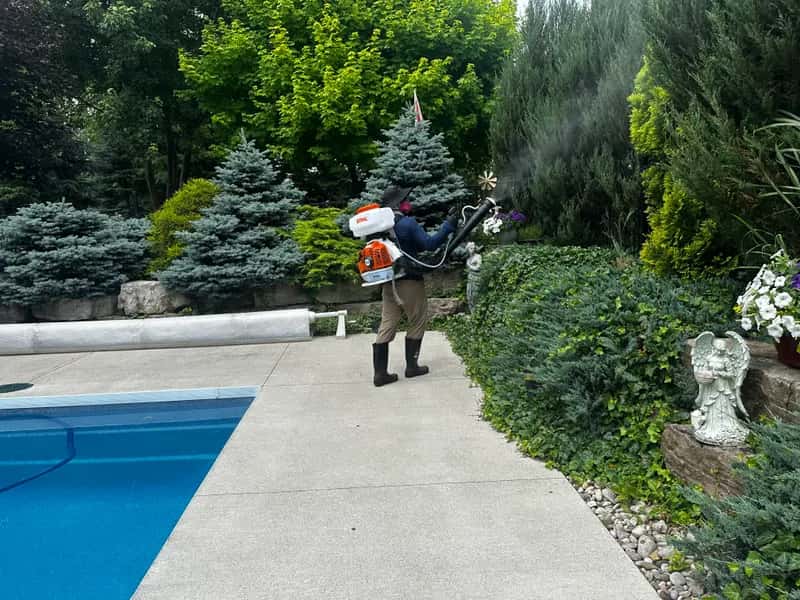
The most impactful single step: professional barrier spray by BuzzSkito reduces the adult mosquitoes resting in your yard. The residual it leaves on that foliage is renewed on your plan's schedule (every 2 weeks on Standard, monthly on Basic), and every plan comes with a rain-back guarantee. Combine with the prevention steps above for the most effective mosquito-free backyard possible.
Frequently Asked Questions
What is the single most effective thing I can do to reduce mosquitoes in my backyard?
Eliminate all standing water on your property. Mosquitoes breed in even tiny amounts of standing water, and removing breeding sites dramatically reduces how many mosquitoes can establish on your property. Combine this with professional barrier spray for maximum results.
Do mosquito-repelling plants actually work?
Plants like citronella grass, lavender, lemon balm, and basil contain aromatic compounds that mosquitoes find unpleasant — but only when the plant's leaves are crushed or disturbed. Unbruised plants in a garden bed provide minimal repellency. They're a nice supplement but not a meaningful mosquito control strategy on their own.
Does a backyard fan help with mosquitoes?
Yes — mosquitoes are weak fliers. A strong fan on a patio or deck creates wind that makes it difficult for mosquitoes to land. This works well in the immediate vicinity of the fan but provides no protection for the rest of the yard.